
Laser sequence and build orientation govern interface quality in multi-material laser powder bed fusion

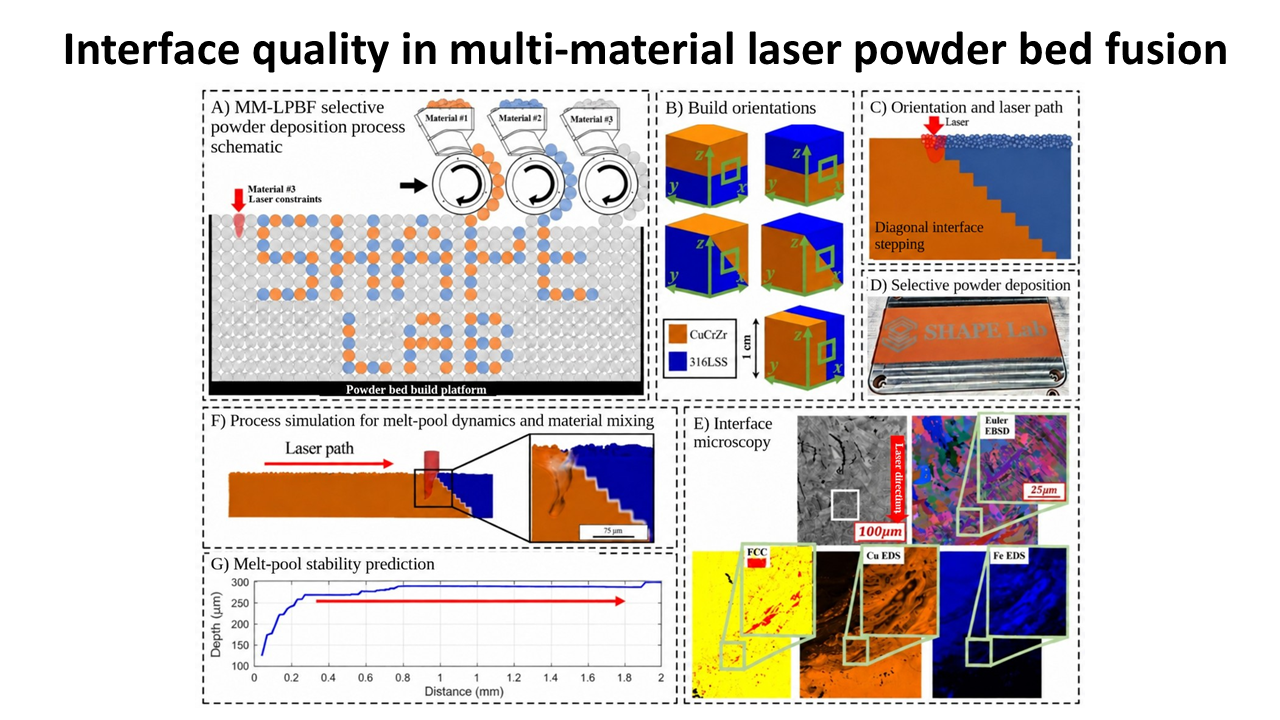
Multi-material laser powder bed fusion (MM-LPBF) offers the ability to locally tailor functional properties by combining dissimilar metals within a single component. However, achieving robust bonding at highly mismatched interfaces remains a critical challenge. This work investigates the interfacial evolution in CuCrZr–316LSS transitions, a material pair with extreme differences in thermal conductivity and a 75% difference in optimal volumetric energy density. This study investigates the interfacial formation mechanisms in CuCrZr–316LSS using five distinct interface configurations: (i) 316L deposited over CuCrZr across a horizontal interface, (ii) CuCrZr deposited over 316L across a horizontal interface, (iii) 316L deposited over CuCrZr along a diagonal interface, (iv) CuCrZr deposited over 316L along a diagonal interface, and (v) the two materials printed with a vertical interface via intralayer deposition. The results demonstrate that deposition order, i.e., laser scanning sequence, and interface geometry critically dictate the quality of interfaces in MM-LPBF systems. Microstructural characterization via optical microscopy, scanning electron microscopy, energy-dispersive X-ray spectroscopy, electron backscatter diffraction, and transmission electron microscopy revealed that exposure sequence strongly governs interfacial morphology, phase development, and the presence of interfacial defects. To further contextualize these results, meso-scale computational fluid dynamics simulations were employed to capture melt-pool dynamics, convection patterns, and material mixing behavior. Overall, this work clarifies the fundamental role of build orientation and laser scanning sequence in governing process stability and interface quality in MM-LPBF systems (copper- and iron-based in this study) and lays the foundation to achieve reliable interface quality in multi-material components manufactured through MM-LPBF.
- Griffis J, Masker A, Schreiber J, Manogharan G. Site-Specific Property Informed Interface Design of Multi-Material Laser Powder Bed Fusion. In: Volume 1: Additive Manufacturing; Advanced Materials Manufacturing; Biomanufacturing; Life Cycle Engineering. American Society of Mechanical Engineers; 2024. doi: 10.1115/msec2024-125138
- Griffis JC, Shahed K, Meinert K, Yilmaz B, Lear M, Manogharan G. Multi-material laser powder bed fusion: effects of build orientation on defects, material structure and mechanical properties. npj Adv Manuf. 2025;2(1):5. doi: 10.1038/s44334-025-00020-5
- Griffis JC, Shahed KS, Okwudire CE, Manogharan GP. Process Modeling of Multi-Material Laser Powder Bed Fusion. In: Solid Freeform Fabrication. 2023. doi: 10.26153/tsw/50998
- Griffis J, Wang J, Hartman K, et al. Advancing multi-material laser powder bed fusion through topology optimized design. Addit Manuf. 2026;125:105247. doi: 10.1016/j.addma.2026.105247
- Shaikh A, Griffis J, Stebbins R, et al. Towards gradient design of TPMS lattices and laser powder bed fusion processing– Role of laser strategies and lattice thickness. Manuf Lett. 2024;41:1046-1054. doi: 10.1016/j.mfglet.2024.09.129
- Shaikh A, Saxena A, Griffis J, Shahed K, Manogharan G. Functionally graded TPMS gyroid structures for additive manufacturing of non-pneumatic tires. Mater Sci Addit Manuf. 2024;3(4):5022. doi: 10.36922/msam.5022
- Hartman K, Nguyen-Van S, Griffis J, et al. Additive manufacturing of functionally graded thickness in TPMS lattice structures with optimised mechanical strength. Virtual Phys Prototyp. 2026;21(1):e2686063. doi: 10.1080/17452759.2026.2686063
- Reichardt A, Shapiro AA, Otis R, et al. Advances in additive manufacturing of metal-based functionally graded materials. Int Mater Rev. 2021;66(1):1-29. doi: 10.1080/09506608.2019.1709354
- Carroll BE, Otis RA, Borgonia JP, et al. Functionally graded material of 304L stainless steel and inconel 625 fabricated by directed energy deposition: Characterization and thermodynamic modeling. Acta Mater. 2016;108:46-54. doi: 10.1016/j.actamat.2016.02.019
- Dev Singh D, Arjula S, Raji Reddy A. Functionally Graded Materials Manufactured by Direct Energy Deposition: A review. Mater Today Proc. 2021;47:2450-2456. doi: 10.1016/j.matpr.2021.04.536
- Ghanavati R, Mosallanejad MH, Behjat A, et al. Multi-material processing of metallic components by direct additive manufacturing methods: technologies, scientific insights, and industrial applications. Int J Extreme Manuf. 2026;8(4):042004. doi: 10.1088/2631-7990/ae5295
- Demir AG, Kim J, Caltanissetta F, et al. Enabling multi-material gradient structure in laser powder bed fusion. J Mater Process Technol. 2022;301:117439. doi: 10.1016/j.jmatprotec.2021.117439
- Kulkarni A, Peddiraju VC, Chatterjee S, Srinivasan D. Effect of Build Geometry and Porosity in Additively Manufactured CuCrZr. J Eng Mater Technol. 2024;146(3). doi: 10.1115/1.4064003
- Yu X, Griffis J, Manogharan G, Panesar A. Multi-material additive manufacturing: a computational design perspective. Virtual Phys Prototyp. 2025;20(1):e2546671. doi: 10.1080/17452759.2025.2546671
- Dongfang K, Fan H, Sui S, et al. Effect of Laser Powder Bed Fusion Process Parameters on the Microstructures, Mechanical Properties, and Conductivity of CuCrZr Alloy. J Materi Eng Perform. 2024;34(13):13304-13317. doi: 10.1007/s11665-024-10026-3
- Morshed-Behbahani K, Aliyu A, Bishop DP, Nasiri A. Additive manufacturing of copper-based alloys for high-temperature aerospace applications: A review. Mater Today Commun. 2024;38:108395. doi: 10.1016/j.mtcomm.2024.108395
- Cortis D, Pilone D, Grazzi F, et al. Functionally graded material via L-PBF: characterisation of multi-material junction between steels (AISI 316L/16MnCr5), copper (CuCrZr) and aluminium alloys (Al-Sc/AlSi10Mg). Prog Addit Manuf. 2025;10(4):2455-2472. doi: 10.1007/s40964-024-00761-3
- Chueh YH, Hsieh BY, Shih AJ. Interfacial characteristics in multi-material laser powder bed fusion of CuZr/316L stainless steel. CIRP Ann. 2024;73(1):145-148. doi: 10.1016/j.cirp.2024.03.001
- Mao S, Ren Z, Liu G, Zhang DZ. The effect of processing parameters on the molten pool dynamics during laser powder bed fusion of CuCrZr/316L multi-material. J Mater Res Technol. 2024;31:1769-1785. doi: 10.1016/j.jmrt.2024.06.115
- Zhai W, Li G, Zhou W. Evaluation of Laser Powder Bed Fusion-Fabricated 316L/CuCrZr Bimetal Joint. Materials. 2025;18(7):1434. doi: 10.3390/ma18071434
- Jin X, Hoo ZS, Jin C, Xiao Z, Yao L. Microhardness and Tensile Strength Analysis of SS316L/CuCrZr Interface by Laser Powder Bed Fusion. Materials. 2024;17(12):2836. doi: 10.3390/ma17122836
- Mao S, Yang B, Liu G, Liu G, Zhang Z. Temperature distribution and residual stress evolution at the interface of CuCrZr/316 L multi-material by laser powder bed fusion. Opt Laser Technol. 2023;163:109355. doi: 10.1016/j.optlastec.2023.109355
- Martendal CP, Esteves PDB, Deillon L, et al. Effects of beam shaping on copper-steel interfaces in multi-material laser beam powder bed fusion. J Mater Process Technol. 2024;327:118344. doi: 10.1016/j.jmatprotec.2024.118344
- Li Z, Kuai Z, Liu B, et al. Selective laser melting of 316L–CuCrZr bimetallic structure via In718 transition layer. J Mater Res Technol. 2023;25:3819-3834. doi: 10.1016/j.jmrt.2023.06.196
- Kuai Z, Li Z, Liu B, Chen Y, Li H, Bai P. Microstructure and mechanical properties of CuCrZr/316L hybrid components manufactured using selective laser melting. J Alloys Compd. 2023;955:170103. doi: 10.1016/j.jallcom.2023.170103
- Deillon L, Abando Beldarrain N, Li X, Bambach M. Coupling hot isostatic pressing and laser powder bed fusion: A new strategy to manufacture defect-free CuCrZr-316L steel multi-material structures. Mater Des. 2024;241:112914. doi: 10.1016/j.matdes.2024.112914
- Meyer I, Oel M, Ehlers T, Lachmayer R. Additive manufacturing of multi-material parts – Design guidelines for manufacturing of 316L/CuCrZr in laser powder bed fusion. Heliyon. 2023;9(8):e18301. doi: 10.1016/j.heliyon.2023.e18301
- Wang Y, Liu B, Tang Q, Huo W, Li Z, Bai Y. Interface microstructure and mechanical properties of selective laser melting-formed CuCrZr alloy for 316 L stainless steel. Mater Werkst. 2025;56(1):88-94. doi: 10.1002/mawe.202400101
- De Leon E, Riensche A, Bevans BD, Billings C, Siddique Z, Liu Y. A Review of Modeling, Simulation, and Process Qualification of Additively Manufactured Metal Components via the Laser Powder Bed Fusion Method. J Manuf Mater Process. 2025;9(1):22. doi: 10.3390/jmmp9010022
- Sun Z, Chueh YH, Li L. Multiphase mesoscopic simulation of multiple and functionally gradient materials laser powder bed fusion additive manufacturing processes. Addit Manuf. 2020;35:101448. doi: 10.1016/j.addma.2020.101448
- Samad SN, Griffis J, Manogharan G, Kouraytem N. Multi-material additive manufacturing of metals: A review of structures and mechanical characteristics. Eng Sci Addit Manuf. 2025;1(2):025180010. doi: 10.36922/ESAM025180010
- Chen N, Khan HA, Wan Z, et al. Microstructural characteristics and crack formation in additively manufactured bimetal material of 316L stainless steel and Inconel 625. Addit Manuf. 2020;32:101037. doi: 10.1016/j.addma.2020.101037
- Gu H, Wei C, Li L, et al. Multi-physics modelling of molten pool development and track formation in multi-track, multi-layer and multi-material selective laser melting. Int J Heat Mass Transf. 2020;151:119458. doi: 10.1016/j.ijheatmasstransfer.2020.119458
- Stainless Steel 316L - 1.4404 Data Sheet - thyssenkrupp Materials (UK). Materials UK. Accessed September 27, 2024. https://www.thyssenkrupp-materials.co.uk/stainless-steel-316l-14404.html
- Eckart TLS Powder Alloys. Eckart NAFTA. Accessed April 21, 2024. https://www.eckart.net/us/en/am/tls
- Oliver WC, Pharr GM. An improved technique for determining hardness and elastic modulus using load and displacement sensing indentation experiments. J Mater Res. 1992;7(6):1564-1583. doi: 10.1557/jmr.1992.1564
- Scherrer P. Estimation of the Size and Internal Structure of Colloidal Particles by Means of Röntgen. Nachrichten Von Ges Wiss Zu Gött. 1918;2:96-100.
- Abdel-Rahman AS, Sabry YA. An approach to the micro-strain distribution inside nanoparticle structure. Int J Non-Linear Mech. 2024;161:104670. doi: 10.1016/j.ijnonlinmec.2024.104670
- Maniammal K, Madhu G, Biju V. X-ray diffraction line profile analysis of nanostructured nickel oxide: Shape factor and convolution of crystallite size and microstrain contributions. Phys E Low-Dimens Syst Nanostructures. 2017;85:214-222. doi: 10.1016/j.physe.2016.08.035
- Bayat M, Thanki A, Mohanty S, et al. Keyhole-induced porosities in Laser-based Powder Bed Fusion (L-PBF) of Ti6Al4V: High-fidelity modelling and experimental validation. Addit Manuf. 2019;30:100835. doi: 10.1016/j.addma.2019.100835
- Bayat M, Mohanty S, Hattel JH. Multiphysics modelling of lack-of-fusion voids formation and evolution in In718 made by multi-track/multi-layer L-PBF. Int J Heat Mass Transf. 2019;139:95-114. doi: 10.1016/j.ijheatmasstransfer.2019.05.003
- Trapp J, Rubenchik AM, Guss G, Matthews MJ. In situ absorptivity measurements of metallic powders during laser powder-bed fusion additive manufacturing. Appl Mater Today. 2017;9:341-349. doi: 10.1016/j.apmt.2017.08.006
- Bonesso M, Lago M, Favero G, et al. Analysis and development of CuCrZr alloy fabrication in LPBF: Impact of process parameters and heat treatments on thermo-mechanical properties. Mater Today Commun. 2026;50:114618. doi: 10.1016/j.mtcomm.2026.114618
- Lopes P, Zafar F, Costa C, et al. A comprehensive study of LPBF parameter influence in 316L stainless steel mechanical properties, macrostructure, and printability. Proc Inst Mech Eng Part J Mater Des Appl. 2025;239(4):828-847. doi: 10.1177/14644207241286674
- Xu L, Zhang Y, Zhao L, Ren W, Han Y. Performance Improvement for the CuCrZr Alloy Produced by Laser Powder Bed Fusion Using the Remelting Process. Materials. 2024;17(3):624. doi: 10.3390/ma17030624
- Azizi N, Jabari E, Hasanabadi M, Toyserkani E. High-power laser powder bed fusion of Cu–Cr–Zr alloy: A comprehensive study on statistical process optimization, microstructure, and mechanical properties. J Manuf Process. 2025;149:931-954. doi: 10.1016/j.jmapro.2025.06.007
- Tang X, Chen X, Sun F, et al. A study on the mechanical and electrical properties of high-strength CuCrZr alloy fabricated using laser powder bed fusion. J Alloys Compd. 2022;924:166627. doi: 10.1016/j.jallcom.2022.166627
- Xie H, Tang X, Chen X, et al. The effect of build orientations on mechanical and thermal properties on CuCrZr alloys fabricated by laser powder bed fusion. J Mater Res Technol. 2023;23:3322-3336. doi: 10.1016/j.jmrt.2023.01.218
- Kurdi A, Tabbakh T, Basak AK. Microstructural and Nanoindentation Investigation on the Laser Powder Bed Fusion Stainless Steel 316L. Materials. 2023;16(17):5933. doi: 10.3390/ma16175933
- Uddin MJ, Ramirez-Cedillo E, Mirshams RA, Siller HR. Nanoindentation and electron backscatter diffraction mapping in laser powder bed fusion of stainless steel 316L. Mater Charact. 2021;174:111047. doi: 10.1016/j.matchar.2021.111047
- Zafari A, Xia K. Laser powder bed fusion of ultrahigh strength Fe-Cu alloys using elemental powders. Addit Manuf. 2021;47:102270. doi: 10.1016/j.addma.2021.102270
- Mahmoudiniya M, Hermans MJM, Kestens LAI. Grain boundary susceptibility to liquid metal embrittlement during wire arc additive manufacturing of a bronze/stainless steel bimetallic structure. Mater Charact. 2025;224:115058. doi: 10.1016/j.matchar.2025.115058
- Nippes EF, Ball DJ. Copper-Contamination Cracking: Cracking Mechanism and Crack Inhibitors. Weld J. 1982;61(3).
- Gan Z, Liu H, Li S, He X, Yu G. Modeling of thermal behavior and mass transport in multi-layer laser additive manufacturing of Ni-based alloy on cast iron. Int J Heat Mass Transf. 2017;111:709-722. doi: 10.1016/j.ijheatmasstransfer.2017.04.055
- Curiotto S, Greco R, Pryds NH, Johnson E, Battezzati L. The liquid metastable miscibility gap in Cu-based systems. Fluid Phase Equilibria. 2007;256(1-2):132-136. doi: 10.1016/j.fluid.2006.10.003
- Wilde G, Willnecker R, Singh RN, Sommer F. The Metastable Miscibility Gap in the System Fe–Cu. Int J Mater Res. 1997;88(10):804-809. doi: 10.3139/ijmr-1997-0151
- Wen Y, Wu X, Huang A, et al. Laser powder bed fusion of immiscible steel and bronze: A compositional gradient approach for optimum constituent combination. Acta Mater. 2024;264:119572. doi: 10.1016/j.actamat.2023.119572
- Hyer H, Zhou L, Park S, et al. Understanding the Laser Powder Bed Fusion of AlSi10Mg Alloy. Metallogr Microstruct Anal. 2020;9(4):484-502. doi: 10.1007/s13632-020-00659-w
- Wang D, Lv J, Liu Z, et al. Interface Optimization, Microstructural Characterization, and Mechanical Performance of CuCrZr/GH4169 Multi-Material Structures Manufactured via LPBF-LDED Integrated Additive Manufacturing. Materials. 2025;18(10):2206. doi: 10.3390/ma18102206
- Mao S, Zhang DZ, Ren Z, Fu G, Ma X. Effects of process parameters on interfacial characterization and mechanical properties of 316L/CuCrZr functionally graded material by selective laser melting. J Alloys Compd. 2022;899:163256. doi: 10.1016/j.jallcom.2021.163256
- Tan C, Chew Y, Bi G, et al. Additive manufacturing of steel–copper functionally graded material with ultrahigh bonding strength. J Mater Sci Technol. 2021;72:217-222. doi: 10.1016/j.jmst.2020.07.044
- Livne Z, Munitz A. Characterization of explosively bonded iron and copper plates. J Mater Sci. 1987;22(4):1495-1500. doi: 10.1007/BF01233153
- Zhang Z, Mativenga P, Huang SQ. Manufacturing, Microstructure, and Mechanics of 316L SS Biomaterials by Laser Powder Bed Fusion. J Funct Biomater. 2025;16(8):280. doi: 10.3390/jfb16080280
- Zhang S, Wu X, Wang Z, et al. Microstructural and Mechanical Property Variations in 316L Stainless Steel Fabricated by Laser Powder Bed Fusion Under High-Density Processing Conditions. Materials. 2025;18(16):3899. doi: 10.3390/ma18163899
- An SU, Larionov V, Monastryrski V, et al. The Thermal Analysis of the Mushy Zone and Grain Structure Changes during Directional Solidification of Superalloys. In: Superalloys 2000 (Ninth International Symposium). TMS; 2000:247-254. doi: 10.7449/2000/Superalloys_2000_247_254
- Drezet JM, Ayrault D, Wisniewski J, et al. Étude de la sensibilité à la fissuration à chaud d’un alliage CuCrZr au cours du soudage par faisceau d’électrons. Matér Tech. 2010;98(4):287-296. doi: 10.1051/mattech/2010108
- Ren N, Li J, Zhang R, et al. Solute trapping and non-equilibrium microstructure during rapid solidification of additive manufacturing. Nat Commun. 2023;14(1):7990. doi: 10.1038/s41467-023-43563-x
- Haghdadi N, Breen AJ, Chen H, et al. New insights into the character of austenite-ferrite boundaries in an additively manufactured duplex stainless steel. Scr Mater. 2024;245:116049. doi: 10.1016/j.scriptamat.2024.116049
- Ma J, Song Y, Jiang H, Rong L. Effect of Cu on the Microstructure and Mechanical Properties of a Low-Carbon Martensitic Stainless Steel. Materials. 2022;15(24):8849. doi: 10.3390/ma15248849
- Banas J, Mazurkiewicz A. The effect of copper on passivity and corrosion behaviour of ferritic and ferritic–austenitic stainless steels. Mater Sci Eng A. 2000;277(1-2):183-191. doi: 10.1016/S0921-5093(99)00530-4
- Kapoor I, Davis C, Li Z. Effects of residual elements during the casting process of steel production: a critical review. Ironmak Steelmak. 2021;48(6):712-727. doi: 10.1080/03019233.2021.1898869
- Krawczyk R, Słania J, Golański G, Pfeifer T. Mechanical Properties and Microstructure of Austenite—Ferrite Duplex Stainless Steel Hybrid (Laser + GMAW) and SAW Welded Joint. Materials. 2023;16(7):2909. doi: 10.3390/ma16072909
- Tao P, Gong J-M, Wang Y-F, Jiang Y, Li Y, Cen W-W. Characterization on stress-strain behavior of ferrite and austenite in a 2205 duplex stainless steel based on nanoindentation and finite element method. Results Phys. 2018;11:377-384. doi: 10.1016/j.rinp.2018.06.023
- Li X, Gao F, Jiao J, Cao G, Wang Y, Liu Z. Influences of cooling rates on delta ferrite of nuclear power 316H austenitic stainless steel. Mater Charact. 2021;174:111029. doi: 10.1016/j.matchar.2021.111029
- Gao L, Chen Y, Zhang X, Agnew SR, Chuang AC, Sun T. Evolution of dislocations during the rapid solidification in additive manufacturing. Nat Commun. 2025;16(1):4696. doi: 10.1038/s41467-025-59988-5
- Liu W, Shen S, Meng J, et al. Mechanical field assisted additive manufacturing of ultrahigh strength aluminum alloy. Int J Extreme Manuf. 2025;7(4):045008. doi: 10.1088/2631-7990/adbb95
- Abbaschian R, Reed-Hill RE. Physical Metallurgy Principles. Cengage Learning; 2008. https://books.google.com/books/about/Physical_Metallurgy_Principles.html?id=iYUGAAAAQBAJ
- Dieter GE. Mechanical Metallurgy. McGraw-Hill Book Company; 1961. https://books.google.com/books/about/MECHANICAL_METALLURGY.html?id=aztpTSdVSAQC
- Sprouster DJ, Streit Cunningham W, Halada GP, et al. Dislocation microstructure and its influence on corrosion behavior in laser additively manufactured 316L stainless steel. Addit Manuf. 2021;47:102263. doi: 10.1016/j.addma.2021.102263
- Navarre C, Van Petegem S, Schlenger L, et al. Monitoring of laser-induced fast recrystallization in SS-316L through synchrotron X-ray diffraction. Mater Des. 2024;238:112628. doi: 10.1016/j.matdes.2023.112628
- Hall EO. The Deformation and Ageing of Mild Steel: III Discussion of Results. Proc Phys Soc Sect B. 1951;64(9):747-753. doi: 10.1088/0370-1301/64/9/303
- Zhang X, Fang T, Saniie J, Bakhtiari S, Heifetz A. Unsupervised learning-enabled pulsed infrared thermographic microscopy of subsurface defects in stainless steel. Sci Rep. 2024;14(1):14865. doi: 10.1038/s41598-024-64214-1
- Aurubis. Material Datasheet for CuCrZr. https://www.aurubis.com/dam/jcr:d6d50d64-69d6-4742-821d-8fb8b48c9044/cucrzr-c18160-pna-372_en.pdf
- Griffis J, Shaikh A, Gong B, Jacob A, Schreiber J, Manogharan G. Mechanical interlocking as a design-driven approach to strengthen multi-material laser powder bed fusion interface. Mater Des. 2026;271:117097. doi: 10.1016/j.matdes.2026.117097