
Regulation mechanism of heat input on in situ tempering and precipitation behavior of wire arc additively manufactured 1,600 MPa low-alloy ultra-high-strength steel

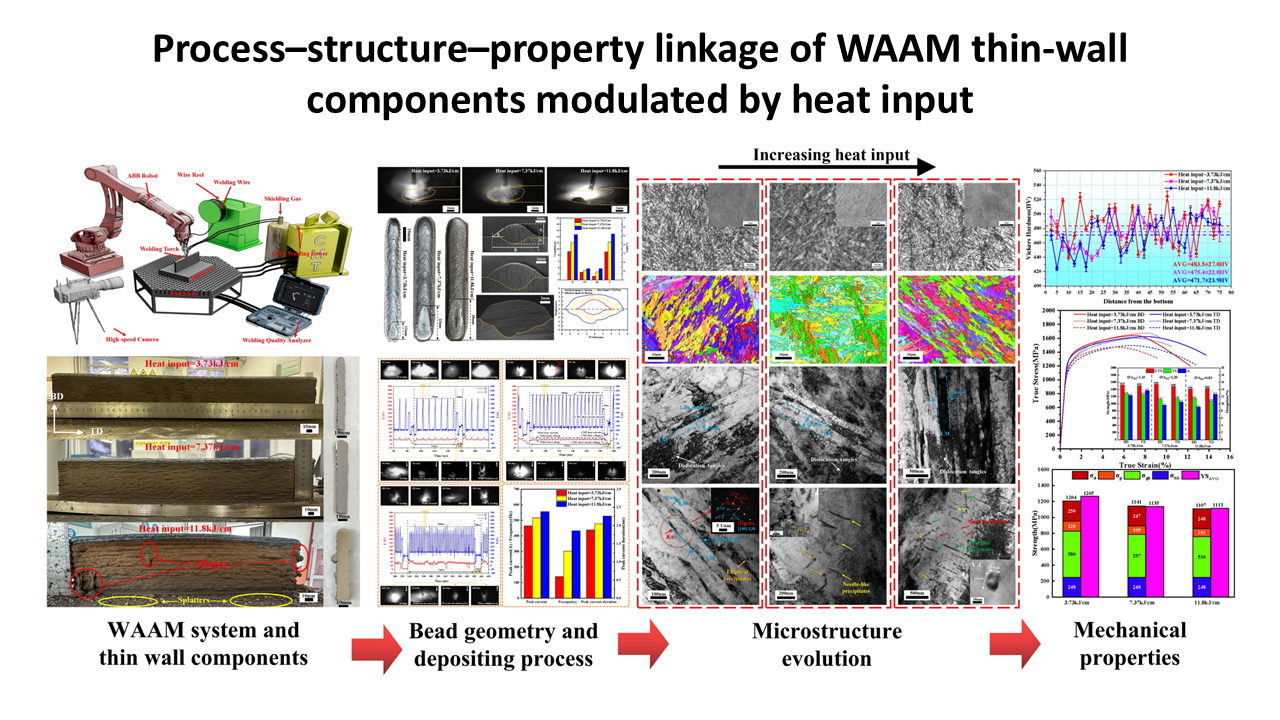
With surging demand for lightweight, high-strength metal components in high-end equipment and large-scale engineering structures, additive manufacturing of low-alloy ultra-high-strength steel (LUHSS) has become a hot research topic. Wire arc additive manufacturing (WAAM) shows remarkable potential for fabricating large LUHSS components; however, repetitive thermal cycles can trigger in situ tempering, significantly affecting carbide evolution and mechanical properties. To address this, this study employed a cold metal transfer plus pulse (CMT+P)-based WAAM process to fabricate thin-walled LUHSS specimens under gradient heat input conditions (3.73, 7.37, and 11.8 kJ/cm) and systematically characterized their mechanical properties and microstructure. The results indicate that increasing heat input enlarges the melt pool and weld bead dimensions, while excessive heat input exacerbates oxide inclusion precipitation and compromises forming quality; the deposited microstructure consists primarily of lamellar martensite, retained austenite, and dispersed carbides. Heat input can precisely control the in situ tempering effect, driving the gradual transformation of carbides from pure Cr23C6 to a coexistence of Cr23C6 and Cr3C, ultimately forming Cr7C3. Grain coarsening and dislocation recovery weaken the material’s strengthening effect. At a heat input of 3.73 kJ/cm, the specimen exhibited excellent strength–ductility synergy and near-isotropic characteristics, with tensile strength, yield strength, and elongation of 1,529 MPa, 1,272 MPa, and 12.3%, respectively. This study shows how heat input-induced in situ tempering regulates precipitation behavior and the mechanical properties of WAAM-formed LUHSS.
- Li K, Yang T, Gong N, et al. Additive manufacturing of ultra-high strength steels: A review. J Alloys Compd. 2023;965:171390. doi: 10.1016/j.jallcom.2023.171390
- Tümer M, Schneider-Bröskamp C, Enzinger N. Fusion welding of ultra-high strength structural steels – A review. J Manuf Processes. 2022;82:203-229. doi: 10.1016/j.jmapro.2022.07.049
- Duan Y, Zhu W, Liu W, Ma Y, Cai Q, Cai Y. A novel strategy for preparing high-performance powder metallurgical low alloy ultrahigh strength steel. Mater Sci Eng A. 2023;864:144585. doi: 10.1016/j.msea.2023.144585
- Choudhary SK, Ganguly S, Sengupta A, Sharma V. Solidification morphology and segregation in continuously cast steel slab. J Mater Process Technol. 2017;243:312-321. doi: 10.1016/j.jmatprotec.2016.12.030
- Li K, Liao R, Zheng Q, et al. Design exploration of staggered hybrid minimal surface magnesium alloy bone scaffolds. Int J Mech Sci. 2024;281:109566. doi: 10.1016/j.ijmecsci.2024.109566
- Zhan J, Li Y, Guo Z, et al. A 4D-printed NiTi alloy with encoded microstructures evades the cooling capacity–energy efficiency trade-off in elastocaloric refrigeration. Mater Sci Eng R Rep. 2026;169:101191. doi: 10.1016/j.mser.2026.101191
- Treutler K, Wesling V. The Current State of Research of Wire Arc Additive Manufacturing (WAAM): A Review. Appl Sci. 2021;11(18):8619. doi: 10.3390/app11188619
- Jafari D, Vaneker THJ, Gibson I. Wire and arc additive manufacturing: Opportunities and challenges to control the quality and accuracy of manufactured parts. Mater Des. 2021;202:109471. doi: 10.1016/j.matdes.2021.109471
- Jing C, Chen Z, Liu B, et al. Improving mechanical strength and isotropy for wire-arc additive manufactured 304L stainless steels via controlling arc heat input. Mater Sci Eng A. 2022;845:143223. doi: 10.1016/j.msea.2022.143223
- Le VT, Bui MC, Nguyen TD, Nguyen VA, Nguyen VC. On the connection of the heat input to the forming quality in wire-and-arc additive manufacturing of stainless steels. Vacuum. 2023;209:111807. doi: 10.1016/j.vacuum.2023.111807
- Panagiotopoulos V, Hadjipantelis N, Gantes CJ. Influence of process parameters on weld quality and nominal geometry of wire arc additively manufactured steel elements. Structures. 2025;80:110044. doi: 10.1016/j.istruc.2025.110044
- Gupta DK, Mulik RS. Selection of Process Parameters and its Effect on Bead Geometry, Mechanical Properties, and Microstructure of Inconel 825 Fabricated Using Wire Arc Additive Manufacturing. Met Mater Int. 2025;31(12):3744-3760. doi: 10.1007/s12540-025-01967-y
- Zhang J, Fan J, Xu J, Yang D, Peng Y, Wang K. The effect of heat input on the microstructure and mechanical properties of 18Ni 300 maraging steel fabricated by arc directed energy deposition. Mater Sci Eng A. 2023;884:145545. doi: 10.1016/j.msea.2023.145545
- Deng F, Yang G, Wu B, Qin L, Zheng J, Zhou S. Microstructure and Mechanical Properties of Hybrid-Manufactured Maraging Steel Component Using 4% Nitrogen Shielding Gas Fabricated by Wrought-Wire Arc Additive Manufacturing. Coatings. 2022;12(3):356. doi: 10.3390/coatings12030356
- Kachomba T, Mutua J, Obiko J, Ngoret J. Multi-response optimisation of wire-arc additive manufacturing process parameters for AISI 4130 steel during remanufacturing process. Mater Res Express. 2024;11(5):056503. doi: 10.1088/2053-1591/ad425a
- Zhao J, Quan G-z, Zhang Y-q, et al. Influence of deposition path strategy on residual stress and deformation in weaving wire-arc additive manufacturing of disc parts. J Mater Res Technol. 2024;30:2242-2256. doi: 10.1016/j.jmrt.2024.03.226
- Knezović N, Garašić I, Jurić I. Influence of the Interlayer Temperature on Structure and Properties of Wire and Arc Additive Manufactured Duplex Stainless Steel Product. Materials. 2020;13(24):5795. doi: 10.3390/ma13245795
- Turgut B, Gürol U, Onler R. Effect of interlayer dwell time on output quality in wire arc additive manufacturing of low carbon low alloy steel components. Int J Adv Manuf Tech. 2023;126(11-12):5277-5288. doi: 10.1007/s00170-023-11481-3
- Sun L, Jiang F, Huang R, Yuan D, Guo C, Wang J. Anisotropic mechanical properties and deformation behavior of low-carbon high-strength steel component fabricated by wire and arc additive manufacturing. Mater Sci Eng A. 2020;787:139514. doi: 10.1016/j.msea.2020.139514
- Rafieazad M, Nemani AV, Ghaffari M, Nasiri A. On Microstructure and Mechanical Properties of a Low-Carbon Low-Alloy Steel Block Fabricated by Wire Arc Additive Manufacturing. J Mater Eng Perform. 2021;30(7):4937-4945. doi: 10.1007/s11665-021-05568-9
- Farias FWC, da Cruz Payão Filho J, Moraes e Oliveira VHP. Prediction of the interpass temperature of a wire arc additive manufactured wall: FEM simulations and artificial neural network. Addit Manuf. 2021;48:102387. doi: 10.1016/j.addma.2021.102387
- Zeng J, Nie W, Li X. The Influence of Heat Input on the Surface Quality of Wire and Arc Additive Manufacturing. Appl Sci. 2021;11(21):10201. doi: 10.3390/app112110201
- Rosli NA, Alkahari MR, Abdollah MFb, Maidin S, Ramli FR, Herawan SG. Review on effect of heat input for wire arc additive manufacturing process. J Mater Res Technol. 2021;11:2127-2145. doi: 10.1016/j.jmrt.2021.02.002
- Yildiz AS, Davut K, Koc B, Yilmaz O. Wire arc additive manufacturing of high-strength low alloy steels: study of process parameters and their influence on the bead geometry and mechanical characteristics. Int J Adv Manuf Tech. 2020;108(11-12):3391-3404. doi: 10.1007/s00170-020-05482-9
- Fang Q, Zhao L, Chen C, Zhu Y, Peng Y, Yin F. Effect of heat input on microstructural and mechanical properties of high strength low alloy steel block parts fabricated by wire arc additive manufacturing. Mater Today Commun. 2023;34:105146. doi: 10.1016/j.mtcomm.2022.105146
- Rodrigues TA, Duarte V, Avila JA, Santos TG, Miranda RM, Oliveira JP. Wire and arc additive manufacturing of HSLA steel: Effect of thermal cycles on microstructure and mechanical properties. Addit Manuf. 2019;27:440-450. doi: 10.1016/j.addma.2019.03.029
- Duarte VR, Rodrigues TA, Schell N, Santos TG, Oliveira JP, Miranda RM. Wire and Arc Additive Manufacturing of High-Strength Low-Alloy Steel: Microstructure and Mechanical Properties. Adv Eng Mater. 2021;23(11):2001036. doi: 10.1002/adem.202001036
- Rashid MS. High-Strength, Low-Alloy Steels. Science. 1980;208(4446):862-869. doi: 10.1126/science.208.4446.862
- Li J, Zhan D, Jiang Z, Zhang H, Yang Y, Zhang Y. Progress on improving strength-toughness of ultra-high strength martensitic steels for aerospace applications: a review. J Mater Res Technol. 2023;23:172-190. doi: 10.1016/j.jmrt.2022.12.177
- Xu Y, Mishra B, Narra SP. Experimental investigation of in-situ microstructural transformations in wire arc additively manufactured maraging 250-grade steel. Mater Charact. 2022;190:112065. doi: 10.1016/j.matchar.2022.112065
- Hearn W, Lindgren K, Persson J, Hryha E. In situ tempering of martensite during laser powder bed fusion of Fe-0.45C steel. Materialia. 2022;23:101459. doi: 10.1016/j.mtla.2022.101459
- Gou Q, Zhang Z, Xu L, Wu D, Zhang T, Liu H. Heat and mass transfer behavior in CMT plus pulse arc manufacturing. Int J Mech Sci. 2024;281:109638. doi: 10.1016/j.ijmecsci.2024.109638
- Pang J, Hu S, Shen J, Wang P, Liang Y. Arc characteristics and metal transfer behavior of CMT+P welding process. J Mater Process Technol. 2016;238:212-217. doi: 10.1016/j.jmatprotec.2016.07.033
- Luo Y, Li J, Xu J, Zhu L, Han J, Zhang C. Influence of pulsed arc on the metal droplet deposited by projected transfer mode in wire-arc additive manufacturing. J Mater Process Technol. 2018;259:353-360. doi: 10.1016/j.jmatprotec.2018.04.047
- Han Q, Gao J, Han C, Zhang G, Li Y. Experimental investigation on improving the deposition rate of gas metal arc-based additive manufacturing by auxiliary wire feeding method. Weld World. 2021;65(1):35-45. doi: 10.1007/s40194-020-00994-0
- Ding D, Pan Z, Cuiuri D, Li H. Wire-feed additive manufacturing of metal components: technologies, developments and future interests. Int J Adv Manuf Tech. 2015;81(1-4):465-481. doi: 10.1007/s00170-015-7077-3
- Ahsan MRU, Seo G-J, Fan X, et al. Effects of process parameters on bead shape, microstructure, and mechanical properties in wire + arc additive manufacturing of Al0.1CoCrFeNi high-entropy alloy. J Manuf Processes. 2021;68:1314-1327. doi: 10.1016/j.jmapro.2021.06.047
- Zhang X, Zhao Q, Liu C, et al. On the formation of oxide inclusions in the high nitrogen chromium-manganese steel produced by the Wire and Arc Additive Manufacturing. J Mater Res Technol. 2024;33:3852-3863. doi: 10.1016/j.jmrt.2024.10.103
- Zhan J, Li K, Ma R, et al. Achieving fine tailoring of elastocaloric properties of laser powder bed-fused NiTi alloy via laser beam manipulation. Int J Mach Tools Manuf. 2024;202:104210. doi: 10.1016/j.ijmachtools.2024.104210
- Guo L, Lina Z, Joel A, and Ojo O. Solidification structures and phases in wire arc additive manufactured C250 maraging steel. Mater Sci Technol. 2023;39(5):582-590. doi: 10.1080/02670836.2022.2128577
- Kan C, Zhao L, Cao Y, Ma C, Peng Y, Tian Z. Microstructure evolution and strengthening behavior of maraging steel fabricated by wire arc additive manufacturing at different heat treatment processes. Mater Sci Eng A. 2024;909:146804. doi: 10.1016/j.msea.2024.146804
- Ali Y, Henckell P, Hildebrand J, Reimann J, Bergmann JP, Barnikol-Oettler S. Wire arc additive manufacturing of hot work tool steel with CMT process. J Mater Process Technol. 2019;269:109-116. doi: 10.1016/j.jmatprotec.2019.01.034
- Lyu Z, Sato YS, Tokita S, Zhao Y, Jia J, Wu A. Microstructural evolution in a thin wall of 2Cr13 martensitic stainless steel during wire arc additive manufacturing. Mater Charact. 2021;182:111520. doi: 10.1016/j.matchar.2021.111520
- Li K, Zhan J, Yang T, et al. Homogenization timing effect on microstructure and precipitation strengthening of 17–4PH stainless steel fabricated by laser powder bed fusion. Addit Manuf. 2022;52:102672. doi: 10.1016/j.addma.2022.102672
- Tasalloti H, Kah P, Martikainen J. Effect of heat input on dissimilar welds of ultra high strength steel and duplex stainless steel: Microstructural and compositional analysis. Mater Charact. 2017;123:29-41. doi: 10.1016/j.matchar.2016.11.014
- Zheng Y, Liu F, Gao J, et al. Effect of different heat input on the microstructure and mechanical properties of laser cladding repaired 300M steel. J Mater Res Technol. 2023;22:556-568. doi: 10.1016/j.jmrt.2022.11.153
- Rust B, Schmidt J, Stroetmann R. Influence of the cooling time t8/5 on weld metals. Weld World. 2025;69(10):2961-2974. doi: 10.1007/s40194-025-01942-6
- Ge J, Lin J, Fu H, Lei Y, Xiao R. Tailoring microstructural features of wire arc additive manufacturing 2Cr13 part via varying inter-layer dwelling time. Mater Lett. 2018;232:11-13. doi: 10.1016/j.matlet.2018.08.037
- Deng M, Sui S, Yao B, Ma L, Lin X, Chen J. Microstructure and room-temperature tensile property of Ti-5.7Al-4.0Sn-3.5Zr-0.4Mo-0.4Si-0.4Nb-1.0Ta-0.05C with near equiaxed β grain fabricated by laser directed energy deposition technique. J Mater Sci Technol. 2022;101:308-320. doi: 10.1016/j.jmst.2021.03.012
- Kishida K, Ito M, Inui H, Heilmaier M, Eggeler G. On the inherent strength of Cr23C6 with the complex face-centered cubic D84 structure. Acta Mater. 2024;263:119518. doi: 10.1016/j.actamat.2023.119518
- Shen Y, Wo J. M3C2 (Cr3C2 Type) carbides formed in steel. Mater Today Commun. 2023;35:106280. doi: 10.1016/j.mtcomm.2023.106280
- Zheng L, Hu X, Kang X, Li D. Precipitation of M23C6 and its effect on tensile properties of 0.3C–20Cr–11Mn–1Mo–0.35N steel. Mater Des. 2015;78:42-50. doi: 10.1016/j.matdes.2015.04.016
- Qiu J, He X, Liu Z, Tang Z, Wang X, He J. Effect of W and Mo contents on the microstructural evolution and properties in the 9% Cr martensitic rotor steel during long-term aging at 630 °C. J Mater Res Technol. 2024;32:152-164. doi: 10.1016/j.jmrt.2024.07.069
- Dong J, Zhou X, Liu Y, Li C, Liu C, Guo Q. Carbide precipitation in Nb-V-Ti microalloyed ultra-high strength steel during tempering. Mater Sci Eng A. 2017;683:215-226. doi: 10.1016/j.msea.2016.12.019
- Janovec J, Vyrostkova A, Svoboda M. Influence of tempering temperature on stability of carbide phases in 2.6cr-0.7mo-0.3v steel with various carbon content. Article. Metall Mater Trans A. 1994;25(2):267-275. doi: 10.1007/BF02647972
- Zhou Z, Shan Q, Jiang Y, Li Z, Zhang Z. Effect of nanoscale V2C precipitates on the three-body abrasive wear behavior of high-Mn austenitic steel. Wear. 2019;436-437:203009. doi: 10.1016/j.wear.2019.203009
- Galindo-Nava EI, Rivera-Díaz-del-Castillo PEJ. A model for the microstructure behaviour and strength evolution in lath martensite. Acta Mater. 2015;98:81-93. doi: 10.1016/j.actamat.2015.07.018
- Yao Z, Huang Z, Lyu S, Tang F, Zhao B, Ma X. Characterization and strengthening mechanism of high-strength medium carbon spring steels. J Mater Res Technol. 2023;27:1395-1405. doi: 10.1016/j.jmrt.2023.09.314
- Petch NJ. The cleavage strength of polycrystals. J Iron Steel Inst. 1953;174:25-28.
- Guo W, An T, Zheng S, Zuo Y, Cao Z, Ma C. Influence mechanism of PWHT on strength and toughness of deposited metal with 1500 MPa grade ultra-high strength steel welding wire. Mater Sci Eng A. 2025;925:147846. doi: 10.1016/j.msea.2025.147846
- Kang J, Zhao L, An T, Cao Z, Zuo Y, Ma C. Effect of carbon content on strength and toughness of deposited metal for 1000 MPa-grade high-strength welding wire. Mater Today Commun. 2024;39:108930. doi: 10.1016/j.mtcomm.2024.108930