
Machine learning-driven additive manufacturing of biomedical metals: A review of forward prediction, inverse optimization, and quality control

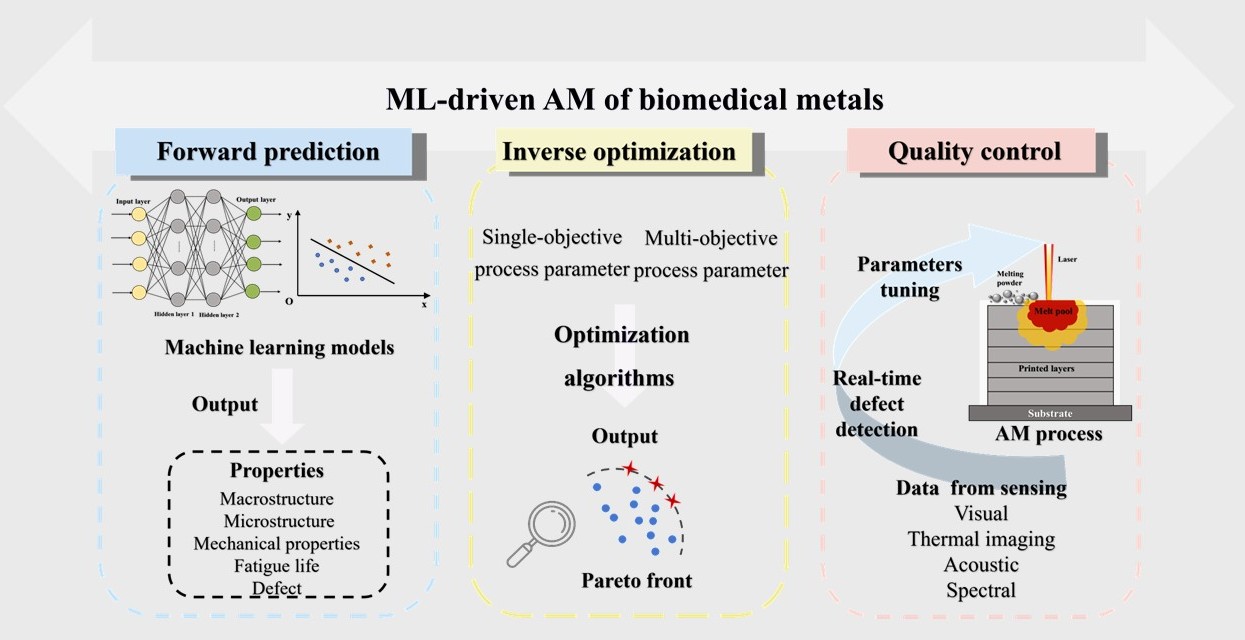
Additive manufacturing (AM) for biomedical metals presents revolutionary opportunities for producing personalized, complex structured biomedical components. However, the high nonlinearity and complexity of the manufacturing process pose significant challenges to the performance consistency of biomedical metals. Traditional trial-and-error approaches and experience-based optimization methods are increasingly inadequate for meeting the demands of high-reliability medical applications. In recent years, machine learning (ML) has emerged as a powerful data-driven tool, deeply integrating into every stage of AM for biomedical metals and providing a driving force for its intelligent transformation and upgrading. This review outlines three key applications of ML in biomedical metal AM: at the property prediction stage, ML enables forward prediction of performance characteristics by establishing precise mapping relationships between process parameters and macrostructure quality, microstructure, and mechanical/functional properties; at the process optimization level, ML-driven inverse optimization algorithms efficiently navigate high-dimensional parameter spaces to achieve both single-objective perfection and multi-objective balancing; at the quality monitoring and control level, ML enables real-time diagnosis of manufacturing defects and even closed-loop adaptive control by integrating multiple in situ sensor data. This review explores how ML can facilitate the biomedical metals during the AM process and outlines its future development toward fully integrated intelligent design and manufacturing processes.
- Cui Y, Wang L, Zhang L. Towards load-bearing biomedical titanium-based alloys: From essential requirements to future developments. Prog Mater Sci. 2024;144:101277. doi: 10.1016/j.pmatsci.2024.101277
- Isik M, Avila JD, Bandyopadhyay A. Alumina and tricalcium phosphate added CoCr alloy for load-bearing implants. Addit Manuf. 2020;36:101553. doi: 10.1016/j.addma.2020.101553
- Dong J, Lin T, Shao H, et al. Advances in degradation behavior of biomedical magnesium alloys: A review. J Alloys Compd. 2022;908:164600. doi: 10.1016/j.jallcom.2022.164600
- Perumal G, Ayyagari A, Chakrabarti A, et al. Friction stir processing of stainless steel for ascertaining its superlative performance in bioimplant applications. ACS Appl Mater Interfaces. 2017;9(42):36615-36631. doi: 10.1021/acsami.7b11064
- Sarraf M, Rezvani Ghomi E, Alipour S, Ramakrishna S, Liana Sukiman N. A state-of-the-art review of the fabrication and characteristics of titanium and its alloys for biomedical applications. Bio Des Manuf. 2022;5(2):371-395. doi: 10.1007/s42242-021-00170-3
- Hao YL, Li SJ, Yang R. Biomedical titanium alloys and their additive manufacturing. Rare Metals. 2016;35(9):661-671. doi: 10.1007/s12598-016-0793-5
- Bandyopadhyay A, Mitra I, Avila JD, Upadhyayula M, Bose S. Porous metal implants: Processing, properties, and challenges. Int J Extreme Manuf. 2023;5(3):032014. doi: 10.1088/2631-7990/acdd35
- Yang Y, Jiang R, Han C, et al. Frontiers in laser additive manufacturing technology. Addit Manuf Front. 2024;3(4):200160. doi: 10.1016/j.amf.2024.200160
- Zhang LC, Wang J. Stabilizing 3D-printed metal alloys. Science. 2024;383(6683):586-587. doi: 10.1126/science.adn6566
- Wong KC, Scheinemann P. Additive manufactured metallic implants for orthopaedic applications. Sci China Mater. 2018;61(4):440-454. doi: 10.1007/s40843-017-9243-9
- Luna V, Trujillo L, Gamon A, et al. Comprehensive and comparative heat treatment of additively manufactured inconel 625 alloy and corresponding microstructures and mechanical properties. J Manuf Mater Process. 2022;6(5):107. doi: 10.3390/jmmp6050107
- Alghamdi A, Downing D, Tino R, et al. Buckling phenomena in AM lattice strut elements: A design tool applied to Ti-6Al-4V LB-PBF. Mater Des. 2021;208:109892. doi: 10.1016/j.matdes.2021.109892
- Babuska TF, Krick BA, Susan DF, Kustas AB. Comparison of powder bed fusion and directed energy deposition for tailoring mechanical properties of traditionally brittle alloys. Manuf Lett. 2021;28:30-34. doi: 10.1016/j.mfglet.2021.02.003
- Gotterbarm MR, Seifi M, Melzer D, et al. Small scale testing of IN718 single crystals manufactured by EB-PBF. Addit Manuf. 2020;36:101449. doi: 10.1016/j.addma.2020.101449
- Qian M, Xu W, Brandt M, Tang HP. Additive manufacturing and postprocessing of Ti-6Al-4V for superior mechanical properties. MRS Bull. 2016;41(10):775-784. doi: 10.1557/mrs.2016.215
- Behjat A, Sanaei S, Mosallanejad MH, et al. A novel titanium alloy for load-bearing biomedical implants: Evaluating the antibacterial and biocompatibility of Ti536 produced via electron beam powder bed fusion additive manufacturing process. Biomater Adv. 2024;163:213928. doi: 10.1016/j.bioadv.2024.213928
- Ma HY, Wang JC, Qin P, et al. Advances in additively manufactured titanium alloys by powder bed fusion and directed energy deposition: Microstructure, defects, and mechanical behavior. J Mater Sci Technol. 2024;183:32-62. doi: 10.1016/j.jmst.2023.11.003
- Attar H, Calin M, Zhang LC, Scudino S, Eckert J. Manufacture by selective laser melting and mechanical behavior of commercially pure titanium. Mater Sci Eng A. 2014;593:170-177. doi: 10.1016/j.msea.2013.11.038
- Zhao B, Wang H, Qiao N, Wang C, Hu M. Corrosion resistance characteristics of a Ti-6Al-4V alloy scaffold that is fabricated by electron beam melting and selective laser melting for implantation in vivo. Mater Sci Eng C. 2017;70:832-841. doi: 10.1016/j.msec.2016.07.045
- Bai Y, Gai X, Li S, et al. Improved corrosion behaviour of electron beam melted Ti-6Al–4V alloy in phosphate buffered saline. Corros Sci. 2017;123:289-296. doi: 10.1016/j.corsci.2017.05.003
- Cui YW, Chen LY, Qin P, et al. Metastable pitting corrosion behavior of laser powder bed fusion produced Ti-6Al-4V in Hank’s solution. Corros Sci. 2022;203:110333. doi: 10.1016/j.corsci.2022.110333
- Shao L, Du Y, Dai K, et al. β-Ti alloys for orthopedic and dental applications: A review of progress on improvement of properties through surface modification. Coatings. 2021;11(12):1446. doi: 10.3390/coatings11121446
- Wang B, Luo M, Shi Z, et al. Porous titanium alloys for medical application: Progress in preparation process and surface modification research. Mater Sci Addit Manuf. 2024;3(1):2753. doi: 10.36922/msam.2753
- Kumar P, Sawant MS, Jain NK, Gupta S. Study of mechanical characteristics of additively manufactured Co-Cr-Mo- 2/4/6Ti alloys for knee implant material. CIRP J Manuf Sci Technol. 2022;39:261-275. doi: 10.1016/j.cirpj.2022.08.015
- Wang Z, Yan Y, Wang Y, Su Y, Qiao L. Lifecycle of cobalt-based alloy for artificial joints: From bulk material to nanoparticles and ions due to bio-tribocorrosion. J Mater Sci Technol. 2020;46:98-106. doi: 10.1016/j.jmst.2019.12.010
- Kong D, Dong C, Wei S, et al. About metastable cellular structure in additively manufactured austenitic stainless steels. Addit Manuf. 2021;38:101804. doi: 10.1016/j.addma.2020.101804
- Abd-Elaziem W, Elkatatny S, Sebaey TA, Darwish MA, Abd El-Baky MA, Hamada A. Machine learning for advancing laser powder bed fusion of stainless steel. J Mater Res Technol. 2024;30:4986-5016. doi: 10.1016/j.jmrt.2024.04.130
- Guo Y, Sun M, Zhang W, Wang L. Machine learning in enhancing corrosion resistance of magnesium alloys: A comprehensive review. Metals. 2023;13(10):1790. doi: 10.3390/met13101790
- Li K, Ji C, Bai S, Jiang B, Pan F. Selective laser melting of magnesium alloys: Necessity, formability, performance, optimization and applications. J Mater Sci Technol. 2023;154:65-93. doi: 10.1016/j.jmst.2022.12.053
- Singh YP, Moses JC, Bhardwaj N, Mandal BB. Overcoming the dependence on animal models for osteoarthritis therapeutics - the promises and prospects of in vitro models. Adv Healthc Mater. 2021;10(20):e2100961. doi: 10.1002/adhm.202100961
- Li HF, Shi ZZ, Wang LN. Opportunities and challenges of biodegradable Zn-based alloys. J Mater Sci Technol. 2020;46:136-138. doi: 10.1016/j.jmst.2019.12.014
- Heiden M. Magnesium, iron and zinc alloys, the trifecta of bioresorbable orthopaedic and vascular implantation - a review. J Biotechnol Biomater. 2015;5:2. doi: 10.4172/2155-952X.1000178
- Wen P, Qin Y, Chen Y, et al. Laser additive manufacturing of Zn porous scaffolds: Shielding gas flow, surface quality and densification. J Mater Sci Technol. 2019;35(2):368-376. doi: 10.1016/j.jmst.2018.09.065
- Qin Y, Wen P, Guo H, et al. Additive manufacturing of biodegradable metals: Current research status and future perspectives. Acta Biomater. 2019;98:3-22. doi: 10.1016/j.actbio.2019.04.046
- Davoodi E, Montazerian H, Mirhakimi AS, et al. Additively manufactured metallic biomaterials. Bioact Mater. 2022;15:214-249. doi: 10.1016/j.bioactmat.2021.12.027
- Tang Z, Peng X, Li K, Metaxas DN. Towards efficient U-nets: A coupled and quantized approach. IEEE Trans Pattern Anal Mach Intell. 2020;42(8):2038-2050. doi: 10.1109/TPAMI.2019.2907634
- Janiesch C, Zschech P, Heinrich K. Machine learning and deep learning. Electron Mark. 2021;31(3):685-695. doi: 10.1007/s12525-021-00475-2
- Louridas P, Ebert C. Machine learning. IEEE Softw. 2016;33(5):110-115. doi: 10.1109/MS.2016.114
- Liu J, Ye J, Izquierdo DS, Vinel A, Shamsaei N, Shao S. A review of machine learning techniques for process and performance optimization in laser beam powder bed fusion additive manufacturing. J Intell Manuf. 2022;34:1-27. doi: 10.1007/s10845-022-02012-0
- Rui Z, Liu J, Shi Y, Wang D. Additive manufacturing method of lattice structure based on material manufacturing performance driven: Using machine learning to optimize manufacturing process. Addit Manuf Front. 2025:200258. doi: 10.1016/j.amf.2025.200258
- Calderon CE, Plata JJ, Toher C, et al. The AFLOW standard for high-throughput materials science calculations. Computat Mater Sci. 2015;108:233-238. doi: 10.1016/j.commatsci.2015.07.019
- Kirklin S, Saal JE, Meredig B, et al. The open quantum materials database (OQMD): Assessing the accuracy of DFT formation energies. NPJ Computat Mater. 2015;1(1):15010. doi: 10.1038/npjcompumats.2015.10
- Dai D, Xu T, Wei X, et al. Using machine learning and feature engineering to characterize limited material datasets of high-entropy alloys. Computational Materials Science. 2020;175:109618. doi: 10.1016/j.commatsci.2020.109618
- Zeng P, Tang S, Wang H, et al. Design and properties of ultra-hard high-entropy alloys based on machine learning and statistical feature selection. Journal of Alloys and Compounds. 2025;1044:184356. doi: 10.1016/j.jallcom.2025.184356
- Xu M, Guo LZ. Learning from group supervision: The impact of supervision deficiency on multi-label learning. Sci China Inform Sci. 2021;64(3):130101. doi: 10.1007/s11432-020-3132-4
- Sarkar JP, Saha I, Chakraborty S, Maulik U. Machine learning integrated credibilistic semi supervised clustering for categorical data. Appl Soft Comput. 2020;86:105871. doi: 10.1016/j.asoc.2019.105871
- Bhat N, Birbilis N, Barnard AS. Unsupervised learning and pattern recognition in alloy design. Digital Discovery. 2024;3(12):2396-2416. doi: 10.1039/d4dd00282b
- Nurhalizah RS, Ardianto R, Purwono P. Analisis supervised dan unsupervised learning pada machine learning: Systematic literature review. J Ilmu Komput Inform. 2024;4(1):61-72. doi: 10.54082/jiki.168
- Abd-Elaziem W, Darwish MA, Hamada A, Daoush WM. Titanium-Based alloys and composites for orthopedic implants Applications: A comprehensive review. Mater Des. 2024;241:112850. doi: 10.1016/j.matdes.2024.112850
- Zhang X, Saniie J, Bakhtiari S, Heifetz A. Compression of Pulsed Infrared Thermography Data With Unsupervised Learning for Nondestructive Evaluation of Additively Manufactured Metals. IEEE Access. 2022;10:9094-9107. doi: 10.1109/access.2022.3141654
- Emmert-Streib F, Dehmer M. Evaluation of regression models: Model assessment, model selection and generalization error. Mach Learn Knowl Extract. 2019;1(1):521-551. doi: 10.3390/make1010032
- Saxena A, Prasad M, Gupta A, et al. A review of clustering techniques and developments. Neurocomputing. 2017;267:664-681. doi: 10.1016/j.neucom.2017.06.053
- Bahl S, Suwas S, Chatterjee K. Comprehensive review on alloy design, processing, and performance of β Titanium alloys as biomedical materials. Int Mater Rev. 2021;66(2):114-139. doi: 10.1080/09506608.2020.1735829
- Li H, Yang X. Effect of surface morphologies on the in vitro and in vivo properties of biomedical metallic materials. ACS Biomater Sci Eng. 2024;10(10):6017-6028. doi: 10.1021/acsbiomaterials.4c00942
- Wang J, Dou J, Wang Z, Hu C, Yu H, Chen C. Research progress of biodegradable magnesium-based biomedical materials: A review. J Alloys Compd. 2022;923:166377. doi: 10.1016/j.jallcom.2022.166377
- Guo AXY, Cheng L, Zhan S, et al. Biomedical applications of the powder‐based 3D printed titanium alloys: A review. J Mater Sci Technol. 2022;125:252-264. doi: 10.1016/j.jmst.2021.11.084
- Li Y, Tan J, Qian C, Liu X, Nie R. Review of machine learning-assisted multi-property design of high-entropy alloys: Phase structure, mechanical, tribological, corrosion, and hydrogen storage properties. J Mater Res Technol. 2025;37:3350-3377. doi: 10.1016/j.jmrt.2025.07.005
- Hu M, Tan Q, Knibbe R, et al. Recent applications of machine learning in alloy design: A review. Mater Sci Eng R Rep. 2023;155:100746. doi: 10.1016/j.mser.2023.100746
- Jin L, Zhai X, Wang K, et al. Big data, machine learning, and digital twin assisted additive manufacturing: A review. Mater Des. 2024;244:113086. doi: 10.1016/j.matdes.2024.113086
- Zhu K, Fuh JYH, Lin X. Metal-based additive manufacturing condition monitoring: A review on machine learning based approaches. IEEE/ASME Trans Mechatronics. 2022;27(5):2495-2510. doi: 10.1109/TMECH.2021.3110818
- Chen K, Zhang P, Yan H, et al. A review of machine learning in additive manufacturing: design and process. Int J Adv Manuf Technol. 2024;135(3):1051-1087. doi: 10.1007/s00170-024-14543-2
- Inayathullah S, Buddala R. Review of machine learning applications in additive manufacturing. Results Eng. 2025;25:103676. doi: 10.1016/j.rineng.2024.103676
- Kim H, Kim KH, Jeong J, Jeon H, Jung ID. Advancing intelligent additive manufacturing: Machine learning approaches for process optimization and quality control. Int J AI Mater Des. 2025;2(2):27-55. doi: 10.36922/ijamd025130010
- Li Z, Qiu J, Xu H, et al. Characteristics of β-type Ti-41Nb alloy produced by laser powder bed fusion: Microstructure, mechanical properties and in vitro biocompatibility. J Mater Sci Technol. 2022;124:260-272. doi: 10.1016/j.jmst.2022.02.026
- Bartolomeu F, Faria S, Carvalho O, et al. Predictive models for physical and mechanical properties of Ti6Al4V produced by Selective Laser Melting. Mater Sci Eng A. 2016;663:181-192. doi: 10.1016/j.msea.2016.03.113
- Maitra V, Shi J, Lu C. Robust prediction and validation of as-built density of Ti-6Al-4V parts manufactured via selective laser melting using a machine learning approach. J Manuf Process. 2022;78:183-201. doi: 10.1016/j.jmapro.2022.04.020
- Jiang D, Luo M, Liu C, et al. 3D Printing parameter optimisation combined with heat treatment for achievinghigh density and enhanced performance in refractory high-entropy alloys. Virtual Phys Prototyp. 2025;20(1):e2524524. doi: 10.1080/17452759.2025.2524524
- Gor M, Dobriyal A, Wankhede V, et al. Density prediction in powder bed fusion additive manufacturing: Machine learning-based techniques. Appl Sci. 2022;12(14):7271. doi: 10.3390/app12147271
- Chan KS, Koike M, Mason RL, Okabe T. Fatigue life of titanium alloys fabricated by additive layer manufacturing techniques for dental implants. Metallurgical Mater Trans A. 2013;44(2):1010-1022. doi: 10.1007/s11661-012-1470-4
- Dawood HI, Mohammed KS, Rahmat A, Uday MB. The influence of the surface roughness on the microstructures and mechanical properties of 6061 aluminium alloy using friction stir welding. Surf Coat Technol. 2015;270:272-283. doi: 10.1016/j.surfcoat.2015.02.045
- Jiang X, Lu J, Zhao N, Chen Z, Zhao Z. A review of wear in additive manufacturing: Wear mechanism, materials, and process. Lubricants. 2024;12(9):321. doi: 10.3390/lubricants12090321
- Pegues J, Roach M, Scott Williamson R, Shamsaei N. Surface roughness effects on the fatigue strength of additively manufactured Ti-6Al-4V. Int J Fatigue. 2018;116:543-552. doi: 10.1016/j.ijfatigue.2018.07.013
- Koo J, Park E, Baek AMC, Kim N. The Research of Surface Roughness Prediction with Machine Learning According to Process Parameters in Laser Powder Bed Fusion. Berlin: Springer Singapore; 2022. p. 62-65.
- Xia C, Pan Z, Polden J, Li H, Xu Y, Chen S. Modelling and prediction of surface roughness in wire arc additive manufacturing using machine learning. J Intell Manuf. 2022;33(5):1467-1482. doi: 10.1007/s10845-020-01725-4
- So MS, Seo GJ, Kim DB, Shin JH. Prediction of metal additively manufactured surface roughness using deep neural network. Sensors. 2022;22(20):7955. doi: 10.3390/s22207955
- Mukherjee T, Elmer JW, Wei HL, et al. Control of grain structure, phases, and defects in additive manufacturing of high-performance metallic components. Prog Mater Sci. 2023;138:101153. doi: 10.1016/j.pmatsci.2023.101153
- Yan F, Xiong W, Faierson E. Grain structure control of additively manufactured metallic materials. Materials. 2017;10(11):1260. doi: 10.3390/ma10111260
- Zhang F, Huang K, Zhao K, et al. Directed energy deposition combining high-throughput technology and machine learning to investigate the composition-microstructure-mechanical property relationships in titanium alloys. J Mater Process Technol. 2023;311:117800. doi: 10.1016/j.jmatprotec.2022.117800
- Calvat M, Bean C, Anjaria D, et al. Learning metal microstructural heterogeneity through spatial mapping of diffraction latent space features. NPJ Computat Mater. 2025;11(1):284. doi: 10.1038/s41524-025-01770-8
- Chi J, Huang X, He D, et al. Obtaining strength and ductility synergy for directed energy deposited Ti17 alloys by machine learning. Mater Lett. 2024;356:135537. doi: 10.1016/j.matlet.2023.135537
- Wang H, Li B, Zhang W, Xuan F. Microstructural feature-driven machine learning for predicting mechanical tensile strength of laser powder bed fusion (L-PBF) additively manufactured Ti6Al4V alloy. Eng Fract Mech. 2024;295:109788. doi: 10.1016/j.engfracmech.2023.109788
- Liu S, Stebner AP, Kappes BB, Zhang X. Machine learning for knowledge transfer across multiple metals additive manufacturing printers. Addit Manuf. 2021;39:101877. doi: 10.1016/j.addma.2021.101877
- Fang L, Cheng L, Glerum JA, Bennett J, Cao J, Wagner GJ. Data-driven analysis of process, structure, and properties of additively manufactured Inconel 718 thin walls. NPJ Computat Mater. 2022;8(1):126. doi: 10.1038/s41524-022-00808-5
- Liu YT, Chua C, Soh V, Sun Z, Chua CK, Sing SL. Revealing the underlying mechanism in controlling Young’s modulus of additively manufactured Ti-6Al-4V using fuzzified machine learning. Virtual Phys Prototyp. 2025;20(1):e2443103. doi: 10.1080/17452759.2024.2443103
- Dong S, Wang Y, Li J, Li Y, Wang L, Zhang J. Machine learning aided prediction and design for the mechanical properties of magnesium alloys. Metals Mater Int. 2024;30(3):593-606. doi: 10.1007/s12540-023-01531-6
- Akbari P, Zamani M, Mostafaei A. Machine learning prediction of mechanical properties in metal additive manufacturing. Addit Manuf. 2024;91:104320. doi: 10.1016/j.addma.2024.104320
- Lian Z, Li M, Lu W. Fatigue life prediction of aluminum alloy via knowledge-based machine learning. Int J Fatigue. 2022;157:106716. doi: 10.1016/j.ijfatigue.2021.106716
- Johnsen AR, Petersen JE, Pedersen MM, Yıldırım HC. Factors affecting the fatigue strength of additively manufacturedTi-6Al-4V parts. Weld World. 2023;68(2):361-409. doi: 10.1007/s40194-023-01604-5
- Zhan Z, Hu W, Meng Q. Data-driven fatigue life prediction in additive manufactured titanium alloy: A damage mechanics based machine learning framework. Eng Fract Mechan. 2021;252:107850. doi: 10.1016/j.engfracmech.2021.107850
- Zhang M, Sun CN, Zhang X, et al. High cycle fatigue life prediction of laser additive manufactured stainless steel: A machine learning approach. Int J Fatigue. 2019;128:105194. doi: 10.1016/j.ijfatigue.2019.105194
- Shen T, Zhang W, Li B. Machine learning-enabled predictions of as-built relative density and high-cycle fatigue life of Ti6Al4V alloy additively manufactured by laser powder bed fusion. Mater Today Commun. 2023;37:107286. doi: 10.1016/j.mtcomm.2023.107286
- Tang YT, Panwisawas C, Ghoussoub JN, et al. Alloys-by-design: Application to new superalloys for additive manufacturing. Acta Mater. 2021;202:417-436. doi: 10.1016/j.actamat.2020.09.023
- Wang L, Zhang Y, Chia HY, Yan W. Mechanism of keyhole pore formation in metal additive manufacturing. NPJ Computat Mater. 2022;8(1):22. doi: 10.1038/s41524-022-00699-6
- Lee JA, Sagong MJ, Jung J, Kim ES, Kim HS. Explainable machine learning for understanding and predicting geometry and defect types in Fe-Ni alloys fabricated by laser metal deposition additive manufacturing. J Mater Res Technol. 2023;22:413-423. doi: 10.1016/j.jmrt.2022.11.137
- Gui Y, Aoyagi K, Bian H, Chiba A. Detection, classification and prediction of internal defects from surface morphology data of metal parts fabricated by powder bed fusion type additive manufacturing using an electron beam. Addit Manuf. 2022;54:102736. doi: 10.1016/j.addma.2022.102736
- Du Y, Mukherjee T, DebRoy T. Physics-informed machine learning and mechanistic modeling of additive manufacturing to reduce defects. Appl Mater Today. 2021;24:101123. doi: 10.1016/j.apmt.2021.101123
- Dharmadhikari S, Menon N, Basak A. A reinforcement learning approach for process parameter optimization in additive manufacturing. Addit Manuf. 2023;71:103556. doi: 10.1016/j.addma.2023.103556
- Zhou HR, Yang H, Li HQ, et al. Advancements in machine learning for material design and process optimization in the field of additive manufacturing. China Foundry. 2024;21(2):101-115. doi: 10.1007/s41230-024-3145-3
- Liu D, Wang Y. Metal additive manufacturing process design based on physics constrained neural networks and multi-objective Bayesian optimization. Manuf Lett. 2022;33:817-827. doi: 10.1016/j.mfglet.2022.07.101
- Ma J, Cao B, Dong S, et al. MLMD: A programming-free AI platform to predict and design materials. NPJ Computat Mater. 2024;10(1):59. doi: 10.1038/s41524-024-01243-4
- Hou Yi C, Jianzhao W, Xinzhi W, Wentao Y. Process parameter optimization of metal additive manufacturing: A review and outlook. J Mater Inform. 2022;2(4):16. doi: 10.20517/jmi.2022.18
- Grbcic L, Müller J, de Jong WA. Efficient inverse design optimization through multi-fidelity simulations, machine learning, and boundary refinement strategies. Eng Comput. 2024;40(6):4081-4108. doi: 10.1007/s00366-024-02053-4
- Hua Y, Jin Y, Hao K, Cao Y. Generating multiple reference vectors for a class of many-objective optimization problems with degenerate Pareto fronts. Complex Intell Syst. 2020;6(2):275-285. doi: 10.1007/s40747-020-00136-5
- Deb K, Pratap A, Agarwal S, Meyarivan T. A fast and elitist multiobjective genetic algorithm: NSGA-II. IEEE Transactions on Evolutionary Computation. 2002;6(2):182- 197. doi:10.1109/4235.996017
- Wang J, Feng L, Xu J, et al. Optimal process parameter combinations search for desired deposited layer geometry in laser-arc hybrid additive manufacturing based on multi-pass overlapping deposited layer contour prediction model and improved NSGA-II algorithm. Optics Laser Technol. 2025;187:112700. doi: 10.1016/j.optlastec.2025.112700
- Padhye N, Deb K. Multi‐objective optimisation and multi‐criteria decision making in SLS using evolutionary approaches. Rapid Prototyp J. 2011;17(6):458-478. doi: 10.1108/13552541111184198
- Aboutaleb AM, Mahtabi MJ, Tschopp MA, Bian L. Multi-objective accelerated process optimization of mechanical properties in laser-based additive manufacturing: Case study on Selective Laser Melting (SLM) Ti-6Al-4V. J Manuf Process. 2019;38:432-444. doi: 10.1016/j.jmapro.2018.12.040
- Startt J, McCarthy MJ, Wood MA, Donegan S, Dingreville R. Bayesian blacksmithing: Discovering thermomechanical properties and deformation mechanisms in high-entropyrefractory alloys. NPJ Computat Mater. 2024;10(1):164. doi: 10.1038/s41524-024-01353-z
- Wang ZL, Ogawa T, Adachi Y. Influence of algorithm parameters of Bayesian optimization, genetic algorithm, and particle swarm optimization on their optimization performance. Adv Theory Simul. 2019;2(10):1900110. doi: 10.1002/adts.201900110
- Palm N, Landerer M, Palm H. Gaussian process regression based multi-objective Bayesian optimization for power system design. Sustainability. 2022;14(19):12777. doi: 10.3390/su141912777
- Moradi A, Tajalli S, Mosallanejad MH, Saboori A. Intelligent laser-based metal additive manufacturing: A review on machine learning for process optimization and property prediction. Int J Adv Manuf Technol. 2024;136(2):527-560. doi: 10.1007/s00170-024-14858-0
- Narayana PL, Kim JH, Lee J, et al. Optimization of process parameters for direct energy deposited Ti-6Al-4V alloy using neural networks. Int J Adv Manuf Technol. 2021;114(11):3269-3283. doi: 10.1007/s00170-021-07115-1
- Nguyen DS, Park HS, Lee CM. Optimization of selective laser melting process parameters for Ti-6Al-4V alloy manufacturing using deep learning. J Manuf Process. 2020;55:230-235. doi: 10.1016/j.jmapro.2020.04.014
- Gan Z, Li H, Wolff SJ, et al. Data-driven microstructure and microhardness design in additive manufacturing using a self-organizing map. Engineering. 2019;5(4):730-735. doi: 10.1016/j.eng.2019.03.014
- Tapia G, Khairallah S, Matthews M, King WE, Elwany A. Gaussian process-based surrogate modeling framework for process planning in laser powder-bed fusion additive manufacturing of 316L stainless steel. Int J Adv Manuf Technol. 2018;94(9):3591-3603. doi: 10.1007/s00170-017-1045-z
- Heddar MIE, Mehdi B, Matougui N, Tahan SA, Jahazi M. Adaptable multi-objective optimization framework: application to metal additive manufacturing. Int J Adv Manuf Technol. 2024;132(3-4):1897-1914. doi: 10.1007/s00170-024-13489-9
- Wang S, Shi Y, Cheng W, Fan K, Wang Q, Li Y, et al. Multi-objective optimization of additive manufacturing process parameters of nitinol alloys for elastocaloric cooling. Engineering Applications of Artificial Intelligence. 2025;154:111012. doi: 10.1016/j.engappai.2025.111012
- Meng L, Zhao J, Lan X, Yang H, Wang Z. Multi-objective optimisation of bio-inspired lightweight sandwich structures based on selective laser melting. Virtual Phys Prototyp. 2020;15(1):106-119. doi: 10.1080/17452759.2019.1692673
- Cai Y, Wang Y, Chen H, Xiong J. Searching optimal process parameters for desired layer geometry in wire-laser directed energy deposition based on machine learning. Virtual Phys Prototyp. 2024;19(1):e2352066. doi: 10.1080/17452759.2024.2352066
- Heiss A, Thatikonda VS, Klotz UE. Multi-objective optimization of LPBF manufacturing with Zn-4Al-1Cu alloy for technical applications. J Manuf Process. 2025;134:193-206. doi: 10.1016/j.jmapro.2024.12.049
- Peng S, Li T, Zhao J, et al. Towards energy and material efficient laser cladding process: Modeling and optimization using a hybrid TS-GEP algorithm and the NSGA-II. J Clean Prod. 2019;227:58-69. doi: 10.1016/j.jclepro.2019.04.187
- Hu Z, Huang C, Xie L, Hua L, Yuan Y, Zhang LC. Machine learning assisted quality control in metal additive manufacturing: A review. Adv Powder Mater. 2025;4(6):100342. doi: 10.1016/j.apmate.2025.100342
- Gerdes S, Gaikwad A, Ramesh S, Rivero IV, Tamayol A, Rao P. Monitoring and control of biological additive manufacturing using machine learning. J Intell Manuf. 2024;35(3):1055-1077. doi: 10.1007/s10845-023-02092-6
- Pereira AG, Barbosa GF, Filho MG, Shiki SB, Silva AL. Quality control in extrusion-based additive manufacturing: A review of machine learning approaches. IEEE Trans Cybern. 2025;55(6):2522-2534. doi: 10.1109/tcyb.2025.3558515
- Khanzadeh M, Chowdhury S, Tschopp MA, Doude HR, Marufuzzaman M, Bian L. In-situ monitoring of melt pool images for porosity prediction in directed energy deposition processes. IISE Trans. 2019;51(5):437-455. doi: 10.1080/24725854.2017.1417656
- Yang T, Mazumder S, Jin Y, et al. A review of diagnostics methodologies for metal additive manufacturing processes and products. Materials (Basel). 2021;14(17):4929. doi: 10.3390/ma14174929
- Zheng L, Zhang Q, Cao H, et al. Melt pool boundary extraction and its width prediction from infrared images in selective laser melting. Mater Des. 2019;183:108110. doi: 10.1016/j.matdes.2019.108110
- Mohr G, Altenburg SJ, Ulbricht A, et al. In-situ defect detection in laser powder bed fusion by using thermography and optical tomography-comparison to computedtomography. Metals. 2020;10(1):103. doi: 10.3390/met10010103
- Liu L, Ju F, Kim S. Online thermal profile prediction for large format additive manufacturing: A hybrid CNN-LSTM based approach. Addit Manuf. 2025;109:104882. doi: 10.1016/j.addma.2025.104882
- Lopez A, Bacelar R, Pires I, Santos TG, Sousa JP, Quintino L. Non-destructive testing application of radiography and ultrasound for wire and arc additive manufacturing. Addit Manuf. 2018;21:298-306. doi: 10.1016/j.addma.2018.03.020
- Wang J, Zhang X, Lu Y. Machine learning in image-based metal additive manufacturing process monitoring and control: A review. Eng Sci Addit Manuf. 2025;1(1):8548. doi: 10.36922/esam.8548
- Ansari MA, Crampton A, Garrard R, Cai B, Attallah M. A convolutional neural network (CNN) classification to identify the presence of pores in powder bed fusion images. Int J Adv Manuf Technol. 2022;120(7):5133-5150. doi: 10.1007/s00170-022-08995-7
- Lee H, Heogh W, Yang J, et al. Deep learning for in-situ powder stream fault detection in directed energy deposition process. J Manuf Syst. 2022;62:575-587. doi: 10.1016/j.jmsy.2022.01.013
- Yang Z, Zhu L, Dun Y, et al. In-situ monitoring of the melt pool dynamics in ultrasound-assisted metal 3D printing using machine learning. Virtual Phys Prototyp. 2023;18(1):e2251453. doi: 10.1080/17452759.2023.2251453
- Mi J, Zhang Y, Li H, et al. In-situ monitoring laser based directed energy deposition process with deep convolutional neural network. J Intell Manuf. 2023;34(2):683-693. doi: 10.1007/s10845-021-01820-0
- Prem PR, Sanker AP, Sebastian S, Kaliyavaradhan SK. A review on application of acoustic emission testing during additive manufacturing. J Nondestr Eval. 2023;42(4):96. doi: 10.1007/s10921-023-01005-0
- Chakrobarty A, Sultan T, Cetinkaya C. Machine learning-driven ultrasonic monitoring for quality assurance in additive manufacturing employing 2D phononic coupons. Journal of Manufacturing Processes. 2025;141:416-430. doi: 10.1016/j.jmapro.2025.02.083
- Luo S, Ma X, Xu J, Li M, Cao L. Deep learning based monitoring of spatter behavior by the acoustic signal in selective laser melting. Sensors (Basel). 2021;21(21):7179. doi: 10.3390/s21217179
- Rahman MA, Jamal S, Cruz MV, Silwal B, Taheri H. In situ process monitoring of multi-layer deposition in wire arc additive manufacturing (WAAM) process with acoustic data analysis and machine learning. Int J Adv Manuf Technol. 2024;132(9):5087-5101. doi: 10.1007/s00170-024-13641-5
- Montazeri M, Nassar AR, Dunbar AJ, Rao P. In-process monitoring of porosity in additive manufacturing using optical emission spectroscopy. IISE Trans. 2020;52(5):500-515. doi: 10.1080/24725854.2019.1659525
- Chen X, Fu Y, Kong F, et al. An in-process multi-feature data fusion nondestructive testing approach for wire arc additive manufacturing. Rapid Prototyp J. 2021;28(3):573-584. doi: 10.1108/rpj-02-2021-0034
- Gaikwad A, Giera B, Guss GM, Forien JB, Matthews MJ, Rao P. Heterogeneous sensing and scientific machine learning for quality assurance in laser powder bed fusion - A single-track study. Addit Manuf. 2020;36:101659. doi: 10.1016/j.addma.2020.101659
- Knaak C, Masseling L, Duong E, Abels P, Gillner A. Improving build quality in laser powder bed fusion using high dynamic range imaging and model-based reinforcement learning. IEEE Access. 2021;9:55214-55231. doi: 10.1109/ACCESS.2021.3067302
- Scime L, Beuth J. A multi-scale convolutional neural network for autonomous anomaly detection and classification in a laser powder bed fusion additive manufacturing process. Addit Manuf. 2018;24:273-286. doi: 10.1016/j.addma.2018.09.034
- Chen L, Bi G, Yao X, et al. Multisensor fusion-based digital twin for localized quality prediction in robotic laser-directed energy deposition. Robot Comput Integr Manuf. 2023;84:102581. doi: 10.1016/j.rcim.2023.102581
- Rescsanski S, Hebert R, Haghighi A, Tang J, Imani F. Towards intelligent cooperative robotics in additive manufacturing: Past, present, and future. Robot Comput Integr Manuf. 2025;93:102925. doi: 10.1016/j.rcim.2024.102925
- Abranovic B, Sarkar S, Chang-Davidson E, Beuth J. Melt pool level flaw detection in laser hot wire directed energy deposition using a convolutional long short-term memory autoencoder. Addit Manuf. 2024;79:103843. doi: 10.1016/j.addma.2023.103843
- Reutzel EW, Nassar AR. A survey of sensing and control systems for machine and process monitoring of directed-energy, metal-based additive manufacturing. Rapid Prototyp J. 2015;21(2):159-167. doi: 10.1108/rpj-12-2014-0177
- Wang Q, Michaleris P, Nassar AR, Irwin JE, Ren Y, Stutzman CB. Model-based feedforward control of laser powder bed fusion additive manufacturing. Addit Manuf. 2020;31:100985. doi: 10.1016/j.addma.2019.100985
- Meng L, McWilliams B, Jarosinski W, et al. Machine learning in additive manufacturing: A review. JOM. 2020;72(6):2363-2377. doi: 10.1007/s11837-020-04155-y
- Ye D, Hong GS, Zhang Y, Zhu K, Fuh JYH. Defect detection in selective laser melting technology by acoustic signals with deep belief networks. Int J Adv Manuf Technol. 2018;96(5):2791-2801. doi: 10.1007/s00170-018-1728-0
- Armstrong AA, Pfeil A, Alleyne AG, Wagoner Johnson AJ. Process monitoring and control strategies in extrusion-based bioprinting to fabricate spatially graded structures. Bioprinting. 2021;21:e00126. doi: 10.1016/j.bprint.2020.e00126
- Liu Y, Wang L, Brandt M. Model predictive control of laser metal deposition. Int J Adv Manuf Technol. 2019;105(1):1055-1067. doi: 10.1007/s00170-019-04279-9
- Cao X, Ayalew B. Robust multivariable predictive control for laser-aided powder deposition processes. J Franklin Instit. 2019;356(5):2505-2529. doi: 10.1016/j.jfranklin.2018.12.015
- Chen YP, Karkaria V, Tsai YK, et al. Real-time decision-making for Digital Twin in additive manufacturing with Model Predictive Control using time-series deep neural networks. J Manuf Syst. 2025;80:412-424. doi: 10.1016/j.jmsy.2025.03.009
- Li Z, Birbilis N. NSGAN: A non-dominant sorting optimisation-based generative adversarial design framework for alloy discovery. NPJ Computat Mater. 2024;10(1):112. doi: 10.1038/s41524-024-01294-7
- Griebler JJ, Tappan AS, Rogers SA, Grillet AM, Kopatz JW. Printability criterion and filler characteristics model for material extrusion additive manufacturing. Addit Manuf. 2025;99:104651. doi: 10.1016/j.addma.2025.104651
- Ren W, Zhang YF, Wang WL, Ding SJ, Li N. Prediction and design of high hardness high entropy alloy through machine learning. Mater Des. 2023;235:112454. doi: 10.1016/j.matdes.2023.112454
- Trovato M, Belluomo L, Bici M, Prist M, Campana F, Cicconi P. Machine learning in design for additive manufacturing: A state-of-the-art discussion for a support tool in product design lifecycle. Int J Adv Manuf Technol. 2025;137:2157-2180. doi: 10.1007/s00170-025-15273-9
- Gunasegaram DR, Barnard AS, Matthews MJ, et al. Machine learning-assisted in-situ adaptive strategies for the control of defects and anomalies in metal additive manufacturing. Addit Manuf. 2024;81:104013. doi: 10.1016/j.addma.2024.104013