
TwinPrint: A dual-arm robotic 3D bioprinting solution for multi-material biofabrication of soft matter constructs

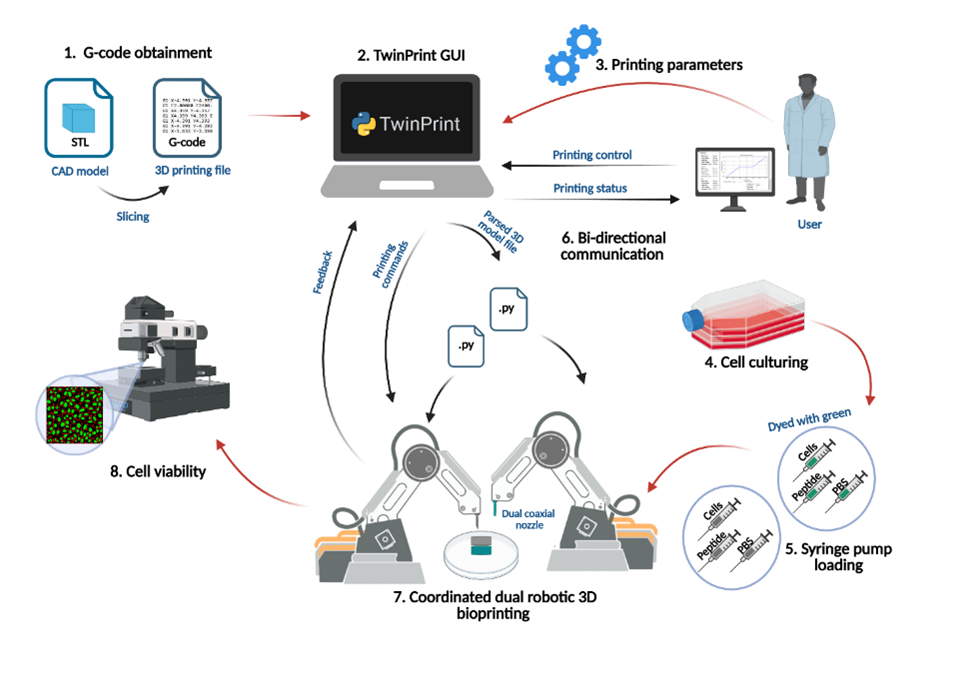
As the field of three-dimensional (3D) bioprinting gains increased momentum, complex 3D bioprinters are being developed to keep up with the needs of biofabrication and tissue engineering. Cartesian-based linear 3D bioprinters have facilitated the fabrication of 3D biological constructs and scaffolds. However, to achieve meaningful advancement in biofabrication, 3D bioprinters need increased freedom of motion, seamless multi-material printing, full automation, and ease of use. In this paper, we propose TwinPrint, a dual-arm robotic 3D bioprinting system, designed to be compatible with soft bioinks to build multi-material constructs, crucial for creating functional tissue. The uniquely integrated robotic 3D bioprinter—comprising an in-house fabricated coaxial nozzle, two 4-axis robotic arms, six microfluidic pumps, and a software interface—work harmoniously as a single unit. We showcase the development of the Python-based software and Graphical User Interface, integrating all components into a single easy-to-use interface. Due to their human-like and instantaneous gelation properties, peptide-based bioinks were used as printing material to test the system. Developed in our laboratory as an alternative to gelatin- and alginate-based bioinks, they avoided chemical and ultraviolet-crosslinking by solidifying instantaneously under physiological conditions. For system performance testing, acellular and cellular constructs were observed for structural fidelity, multi-material layering, printing accuracy, cell viability, and proliferation. Overall, our proposed system showcases an innovative integration of robotics for biofabrication to expedite the printing process and enable multi-task print protocols. By saving time, increasing degrees of freedom, and expanding printing complexity, we believe TwinPrint is a promising next step for biofabrication.
- Pavek A, Nartker C, Saleh M, et al. Tissue engineering through 3D bioprinting to recreate and study bone disease. Biomedicines. 2021;9(5):551. doi: 10.3390/biomedicines9050551
- Gao T, Gillispie GJ, Copus JS, et al. Optimization of gelatin-alginate composite bioink printability using rheological parameters: A systematic approach. Biofabrication. 2018;10(3):034106. doi: 10.1088/1758-5090/aacdc7
- Xiongfa J, Hao Z, Liming Z, Jun X. Recent advances in 3D bioprinting for the regeneration of functional cartilage. Regen Med. 2018;13(1):73-87. doi: 10.2217/rme-2017-0106
- Cubo N, Garcia M, Del Cañizo JF, Velasco D, Jorcano JL. 3D bioprinting of functional human skin: Production and in vivo analysis. Biofabrication. 2016;9(1):015006. doi: 10.1088/1758-5090/9/1/015006
- Vijayavenkataraman S, Lu WF, Fuh JYH. 3D bioprinting of skin: A state-of-the-art review on modelling, materials, and processes. Biofabrication. 2016;8(3):032001. doi: 10.1088/1758-5090/8/3/032001
- Izadifar M, Chapman D, Babyn P, Chen X, Kelly ME. UV-assisted 3D bioprinting of nanoreinforced hybrid cardiac patch for myocardial tissue engineering. Tissue Eng Part C Methods. 2018;24(2):74-88. doi: 10.1089/ten.tec.2017.0346
- Hoch E, Tovar GEM, Borchers K. Bioprinting of artificial blood vessels: Current approaches towards a demanding goal. Eur J Cardiothorac Surg. 2014;46(5):767-778. doi: 10.1093/ejcts/ezu242
- Wang X, Ao Q, Tian X, et al. 3D bioprinting technologies for hard tissue and organ engineering. Materials (Basel). 2016;9(10):802. doi: 10.3390/ma9100802
- Richard C, Neild A, Cadarso VJ. The emerging role of microfluidics in multi-material 3D bioprinting. Lab Chip. 2020;20(12):2044-2056. doi: 10.1039/c9lc01184f
- AlZaid S, Hammad N, Albalawi HI, Khan ZN, Othman E, Hauser CAE. Advanced software development of 2D and 3D model visualization for twinprint, a dual-arm 3D bioprinting system for multi-material printing. Mater Sci Add Manuf. 2022;1(3):19. doi: 10.18063/msam.v1i3.19
- Sodupe-Ortega E, Sanz-Garcia A, Pernia-Espinoza A, Escobedo-Lucea C. Accurate calibration in multi-material 3D bioprinting for tissue engineering. Materials (Basel). 2018;11(8):1402. doi: 10.3390/ma11081402
- Maresca JA, DeMel DC, Wagner GA, Haase C, Geibel JP. Three-dimensional bioprinting applications for bone tissue engineering. Cells. 2023;12(9):1230. doi: 10.3390/cells12091230
- Cameron T, Naseri E, MacCallum B, Ahmadi A. Development of a disposable single-nozzle printhead for 3D bioprinting of continuous multi-material constructs. Micromachines (Basel). 2020;11(5):459. doi: 10.3390/mi11050459
- Liu W, Zhang YS, Heinrich MA, et al. Rapid continuous multimaterial extrusion bioprinting. Adv Mater. 2017;29(3):1604630. doi: 10.1002/adma.201604630
- Miri AK, Nieto D, Iglesias L, et al. Bioprinting: Microfluidics-enabled multimaterial maskless stereolithographic bioprinting (Adv. Mater. 27/2018). Adv Mater. 2018;30(27):1870201. doi: 10.1002/adma.201870201
- Pagan E, Stefanek E, Seyfoori A, et al. A handheld bioprinter for multi-material printing of complex constructs. Biofabrication. 2023;15(3):035012. doi: 10.1088/1758-5090/acc42c
- Hauser CAE, Deng R, Mishra A, et al. Natural tri- to hexapeptides self-assemble in water to amyloid beta-type fiber aggregates by unexpected alpha -helical intermediate structures. Proc Natl Acad Sci U S A. 2011;108(4):1361-1366. doi: 10.1073/pnas.1014796108
- Mishra A, Loo Y, Deng R, et al. Ultrasmall natural peptides self-assemble to strong temperature-resistant helical fibers in scaffolds suitable for tissue engineering. Nano Today. 2011;6(3):232-239. doi: 10.1016/j.nantod.2011.05.001
- Rauf S, Susapto HH, Kahin K, et al. Self-assembling tetrameric peptides allow in situ 3D bioprinting under physiological conditions. J Mater Chem B. 2021;9(4):1069-1081. doi: 10.1039/d0tb02424d
- Susapto HH, Alhattab D, Abdelrahman S, et al. Ultrashort peptide bioinks support automated printing of large-scale constructs assuring long-term survival of printed tissue constructs. Nano Lett. 2021;21(7):2719-2729. doi: 10.1021/acs.nanolett.0c04426
- Ravanbakhsh H, Karamzadeh V, Bao G, Mongeau L, Juncker D, Zhang YS. Emerging technologies in multi-material bioprinting. Adv Mater. 2021;33(49):2104730. doi: 10.1002/adma.202104730
- Loo Y, Lakshmanan A, Ni M, Toh LL, Wang S, Hauser CAE. Peptide bioink: Self-assembling nanofibrous scaffolds for three-dimensional organotypic cultures. Nano Lett. 2015;15(10):6919-6925. doi: 10.1021/acs.nanolett.5b02859
- Kahin K, Khan Z, Albagami M, et al. Development of a robotic 3D bioprinting and microfluidic pumping system for tissue and organ engineering. In: Gray BL, Becker H, editors. Microfluidics, BioMEMS, and Medical Microsystems XVII. Washington, DC: SPIE; 2019. p. 25. doi: 10.1117/12.2507237
- Khan Z, Kahin K, Rauf S, et al. Optimization of a 3D bioprinting process using ultrashort peptide bioinks. Int J Bioprint. 2018;5(1):173. doi: 10.18063/ijb.v5i1.173
- Khan Z, Kahin K, Hauser C. Time-dependent pulsing of microfluidic pumps to enhance 3D bioprinting of peptide bioinks. In: Gray BL, Becker H, editors. Microfluidics, BioMEMS, and Medical Microsystems XIX. Washington, DC: SPIE; 2021. p. 5. doi: 10.1117/12.2578830
- Li K, Huang W, Guo H, et al. Advancements in robotic arm-based 3D bioprinting for biomedical applications. Life Med. 2023;2(6):lnad046. doi: 10.1093/lifemedi/lnad046
- Xie N, Shi G, Shen Y, et al. Research progress of robot technology in in situ 3D bioprinting. Int J Bioprint. 2022;8(4):614. doi: 10.18063/ijb.v8i4.614
- Prendergast ME, Burdick JA. Recent advances in enabling technologies in 3D printing for precision medicine. Adv Mater. 2020;32(13):1902516. doi: 10.1002/adma.201902516
- Dong H, Hu B, Zhang W, et al. Robotic-assisted automated in situ bioprinting. Int J Bioprint. 2022;9(1):629. doi: 10.18063/ijb.v9i1.629
- Albert BJ, Wang C, Williams C, Butcher JT. Non-planar embedded 3D printing for complex hydrogel manufacturing. Bioprinting. 2022;28:e00242. doi: 10.1016/j.bprint.2022.e00242
- Wulle F, Gorke O, Schmidt S, et al. Multi-axis 3D printing of gelatin methacryloyl hydrogels on a non-planar surface obtained from magnetic resonance imaging. Addit Manuf. 2022;50:102566. doi: 10.1016/j.addma.2021.102566
- Fortunato GM, Batoni E, Bonatti AF, Vozzi G, De Maria C. Surface reconstruction and tissue recognition for robotic-based in situ bioprinting. Bioprinting. 2022;26:e00195. doi: 10.1016/j.bprint.2022.e00195
- Ozbolat IT, Moncal KK, Gudapati H. Evaluation of bioprinter technologies. Addit Manuf. 2017;13:179-200. doi: 10.1016/j.addma.2016.10.003
- Ozbolat IT, Hospodiuk M. Current advances and future perspectives in extrusion-based bioprinting. Biomaterials. 2016;76:321-343. doi: 10.1016/j.biomaterials.2015.10.076
- Wong KV, Hernandez A. A review of additive manufacturing. ISRN Mech Eng. 2012;2012:208760. doi: 10.5402/2012/208760
- Montalti A, Ferretti P, Santi GM. From CAD to G-code: Strategies to minimizing errors in 3D printing process. CIRP J Manuf Sci Technol. 2024;55:62-70. doi: 10.1016/j.cirpj.2024.09.005
- Bikas H, Stavropoulos P, Chryssolouris G. Additive manufacturing methods and modelling approaches: A critical review. Int J Adv Manuf Technol. 2016;83(1-4):389-405. doi: 10.1007/s00170-015-7576-2
- Hammad NS, Khan ZN, Valle-Pérez AU, Hauser C. A predictive machine learning model to optimize flow rates on an integrated microfluidic pumping system for peptide-based 3D bioprinting. In: Gray BL, Rapp BE, editors. Microfluidics, BioMEMS, and Medical Microsystems XXI. Washington, DC: SPIE; 2023. p. 3. doi: 10.1117/12.2650440
- Lv D, Hu Z, Lu L, Lu H, Xu X. Three-dimensional cell culture: A powerful tool in tumor research and drug discovery. Oncol Lett. 2017;14(6):6999-7010. doi: 10.3892/ol.2017.7134
- Heinrich MA, Bansal R, Lammers T, Zhang YS, Michel Schiffelers R, Prakash J. 3D‐bioprinted mini-brain: A glioblastoma model to study cellular interactions and therapeutics. Adv Mater. 2019;31(14):e1806590. doi: 10.1002/adma.201806590
- Kokkaliaris KD, Scadden DT. Cell interactions in the bone marrow microenvironment affecting myeloid malignancies. Blood Adv. 2020;4(15):3795-3803. doi: 10.1182/bloodadvances.2020002127
- Ladikou EE, Sivaloganathan H, Pepper A, Chevassut T. Acute myeloid leukaemia in its niche: The bone marrow microenvironment in acute myeloid leukaemia. Curr Oncol Rep. 2020;22(3):27. doi: 10.1007/s11912-020-0885-0