
3D bioprinting technologies: Current applications and emerging trends

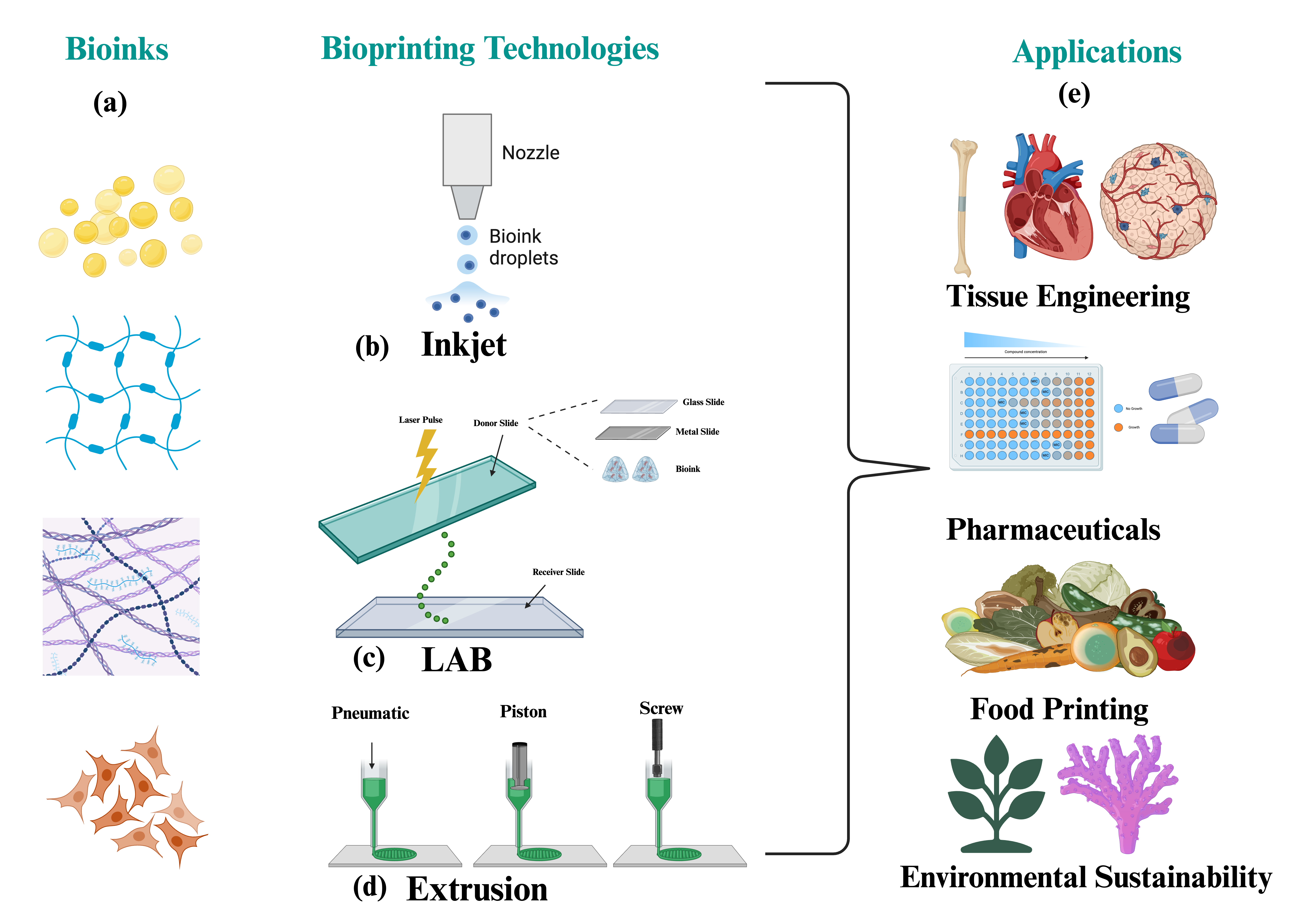
Three-dimensional bioprinting has rapidly advanced as a key technology in tissue engineering and regenerative medicine. While many reviews provide broad overviews of bioprinting techniques and materials, this work offers a focused analysis of the interface between bioprinting technologies and bioink chemistry. It examines how deposition mechanisms—inkjet, laser-assisted, vat-polymerization, and extrusion-based systems—impose constraints on bioink viscosity, cross-linking strategies, and mechanical properties, ultimately influencing printing resolution, construct scale, and cell viability. This review is organized around three fundamental trade-offs: resolution versus construct size, printability versus biological functionality, and scalability versus cell viability. Natural, synthetic, and hybrid bioinks are evaluated not only by composition but also by their physicochemical properties and their role in directing cell fate in neural, vascular, and musculoskeletal applications. Key translational challenges are highlighted, including immunogenicity, foreign body responses, batch-to-batch variability, and the lack of reproducible, Good Manufacturing Practice–compliant manufacturing workflows. Finally, the review identifies priorities for advancing the field, including stimuli-responsive bioinks, real-time monitoring integration, artificial intelligence–assisted design, and multi-material bioprinting. These directions are essential for bridging the gap between laboratory-scale innovation and clinically viable tissue constructs.
- Bell E, Ehrlich HP, Buttle DJ, Nakatsuji T. Living tissue formed in vitro and accepted as skin-equivalent tissue of full thickness. Science. 1981;211(4486):1052-1054. doi: 10.1126/science.7008197
- Hull CW. Apparatus for production of three-dimensional objects by stereolithography. United States Patent Application 638905. Filed 1984.
- Klebe RJ. Cytoscribing: a method for micropositioning cells and the construction of two-and three-dimensional synthetic tissues. Exp Cell Res. 1988;179(2):362-373. doi: 10.1016/0014-4827(88)90275-3
- Khademhosseini A, Langer R. Drug delivery and tissue engineering. Chem Eng Prog. 2006;102(2):38-42.
- Atala A, Bauer SB, Soker S, Yoo JJ, Retik AB. Tissue-engineered autologous bladders for patients needing cystoplasty. Lancet. 2006;367(9518):1241-1246. doi: 10.1016/S0140-6736(06)68438-9
- S.5002-117th Congress (2021-2022): FDA Modernization Act 2.0. September 29, 2022. https://www.congress.gov/bill/117th-congress/senate-bill/5002
- McGonigle P, Ruggeri B. Animal models of human disease: challenges in enabling translation. Biochem Pharmacol. 2014;87(1):162-171. doi: 10.1016/j.bcp.2013.08.006
- Parihar A, Parihar DS, Gaur K, Arya N, Choubey VK, Khan R. 3D Bioprinting for Drug Development and Screening: Recent Trends Towards Personalized Medicine. Hybrid Adv. 2024;7:100320. doi: 10.1016/j.hybadv.2024.100320
- Shukla AK, Gao G, Kim BS. Applications of 3D bioprinting technology in induced pluripotent stem cells-based tissue engineering. Micromachines. 2022;13(2):155. doi: 10.3390/mi13020155
- Freedman LP, Cockburn IM, Simcoe TS. The economics of reproducibility in preclinical research. PLoS Biol. 2015;13(6):e1002165. doi: 10.1371/journal.pbio.1002165
- Lee SJ, Jeong W, Atala A. 3D bioprinting for engineered tissue constructs and patient-specific models: current progress and prospects in clinical applications. Adv Mater. 2024;36(49):2408032. doi: 10.1002/adma.202408032
- Agarwal T, Onesto V, Banerjee D, et al. 3D bioprinting in tissue engineering: current state-of-the-art and challenges towards system standardization and clinical translation. Biofabrication. 2025;17(4):042003. doi: 10.1088/1758-5090/ade47a
- Beg S, Almalki WH, Malik A, et al. 3D printing for drug delivery and biomedical applications. Drug Discov Today. 2020;25(9):1668-1681. doi: 10.1016/j.drudis.2020.07.007
- Lam EHY, Yu F, Zhu S, Wang Z. 3D bioprinting for next-generation personalized medicine. Int J Mol Sci. 2023;24(7):6357. doi: 10.3390/ijms24076357
- Kumari M, Singla M, Sobti RC. Animal models and their substitutes in biomedical research. In: Sobti RC, ed. Advances in Animal Experimentation and Modeling. Elsevier; 2022:87-101. doi: 10.1016/B978-0-323-90583-1.00014-3
- Compaan AM, Christensen K, Huang Y. Inkjet bioprinting of 3D silk fibroin cellular constructs using sacrificial alginate. ACS Biomater Sci Eng. 2017;3(8):1519-1526. doi: 10.1021/acsbiomaterials.6b00432
- Pasierb A, Jezierska M, Karpuk A, Czuwara J, Rudnicka L. 3D skin bioprinting: future potential for skin regeneration. Adv Dermatol Allergol. 2022;39(5):845-851. doi: 10.5114/ada.2021.109692
- Pourchet LJ, Thepot A, Albouy M, et al. Human skin 3D bioprinting using scaffold-free approach. Adv Healthc Mater. 2017;6(4):1601101. doi: 10.1002/adhm.201601101
- He P, Zhao J, Zhang J, et al. Bioprinting of skin constructs for wound healing. Burns Trauma. 2018;6. doi: 10.1186/s41038-017-0104-x
- Abdollahiyan P, Oroojalian F, Mokhtarzadeh A, de la Guardia M. Hydrogel-based 3D bioprinting for bone and cartilage tissue engineering. Biotechnol J. 2020;15(12):2000095. doi: 10.1002/biot.202000095
- Chimene D, Miller L, Cross LM, Jaiswal MK, Singh I, Gaharwar AK. Nanoengineered osteoinductive bioink for 3D bioprinting bone tissue. ACS Appl Mater Interfaces. 2020;12(14):15976-15988. doi: 10.1021/acsami.9b19037
- Genova T, Roato I, Carossa M, Motta C, Cavagnetto D, Mussano F. Advances on bone substitutes through 3D bioprinting. Int J Mol Sci. 2020;21(19):7012. doi: 10.3390/ijms21197012
- Daly AC, Freeman FE, Gonzalez-Fernandez T, Critchley SE, Nulty J, Kelly DJ. 3D bioprinting for cartilage and osteochondral tissue engineering. Adv Healthc Mater. 2017;6(22):1700298. doi: 10.1002/adhm.201700298
- Di Bella C, Fosang A, Donati DM, Wallace GG, Choong PF. 3D bioprinting of cartilage for orthopedic surgeons: reading between the lines. Front Surg. 2015;2:39. doi: 10.3389/fsurg.2015.00039
- Huang Y, Li X, Poudel AJ, Zhang W, Xiao L. Hydrogel-based bioinks for 3D bioprinting articular cartilage: a comprehensive review with focus on mechanical reinforcement. Appl Mater Today. 2022;29:101668. doi: 10.1016/j.apmt.2022.101668
- Datta P, Ayan B, Ozbolat IT. Bioprinting for vascular and vascularized tissue biofabrication. Acta Biomater. 2017;51:1-20. doi: 10.1016/j.actbio.2017.01.035
- Richards D, Jia J, Yost M, Markwald R, Mei Y. 3D bioprinting for vascularized tissue fabrication. Ann Biomed Eng. 2017;45:132-147. doi: 10.1007/s10439-016-1653-z
- Kim JJ, Cho D-W. Advanced strategies in 3D bioprinting for vascular tissue engineering and disease modelling using smart bioinks. Virtual Phys Prototyp. 2024;19(1):e2395470. doi: 10.1080/17452759.2024.2395470
- Murphy SV, Atala A. 3D bioprinting of tissues and organs. Nat Biotechnol. 2014;32(8):773-785. doi: 10.1038/nbt.2958
- Kačarević ŽP, Rider PM, Alkildani S, et al. An introduction to 3D bioprinting: possibilities, challenges and future aspects. Materials. 2018;11(11):2199. doi: 10.3390/ma11112199
- Levato R, Dudaryeva O, Garciamendez-Mijares CE, et al. Light-based vat-polymerization bioprinting. Nat Rev Methods Primers. 2023;3(1):47. doi: 10.1038/s43586-023-00231-0
- Ng WL, Huang X, Shkolnikov V, Suntornnond R, Yeong WY. Polyvinylpyrrolidone-based bioink: influence of bioink properties on printing performance and cell proliferation during inkjet-based bioprinting. Bio-Des Manuf. 2023;6(6):676-690. doi: 10.1007/s42242-023-00245-3
- Binder KW, Allen AJ, Yoo JJ, Atala A. Drop-on-demand inkjet bioprinting: a primer. Gene Ther Regul. 2011;6(1):33-49. doi: 10.1142/S1568558611000258
- Mattimore JP, Groff RE, Burg T, Pepper ME. A general purpose driver board for the HP26 ink-jet cartridge with applications to bioprinting. In: Proceedings of the IEEE SoutheastCon 2010 (SoutheastCon). IEEE; 2010:510-513. doi: 10.1109/secon.2010.5453819
- Arai K, Iwanaga S, Toda H, Genci C, Nishiyama Y, Nakamura M. Three-dimensional inkjet biofabrication based on designed images. Biofabrication. 2011;3(3):034113. doi: 10.1088/1758-5082/3/3/034113
- Uzun S, Schelling M, Hantanasirisakul K, et al. Additive-free aqueous MXene inks for thermal inkjet printing on textiles. Small. 2021;17(1):2006376. doi: 10.1002/smll.202006376
- Suntornnond R, Ng WL, Huang X, Yeow CHE, Yeong WY. Improving printability of hydrogel-based bio-inks for thermal inkjet bioprinting applications via saponification and heat treatment processes. J Mater Chem B. 2022;10(31):5989-6000. doi: 10.1039/D2TB00442A
- Wang Q, Liao Y, Ho Y, et al. A study on cell viability based on thermal inkjet three-dimensional bioprinting. Phys Fluids. 2023;35(8). doi: 10.1063/5.0159135
- Morales PA, Rodriguez B, Furth ME, et al. Thermal inkjet bioprinting drastically alters cell phenotype. Biofabrication. 2023;15(3):031001. doi: 10.1088/1758-5090/acd3b3
- Huang Z, Feng X, Zhang T, Liu Z, Zhu B, Xie Y. Highly stretchable hydrogels for sensitive pressure sensor and programmable surface patterning by thermal bubble inkjet technology. J Appl Polym Sci. 2020;137(38):49146. doi: 10.1002/app.49146
- Jentsch S, Nasehi R, Kuckelkorn C, Gundert B, Aveic S, Fischer H. Multiscale 3D bioprinting by nozzle-free acoustic droplet ejection. Small Methods. 2021;5(6):2000971. doi: 10.1002/smtd.202000971
- Kuznetsova I, Smirnov A, Anisimkin V, et al. Inkjet printing of plate acoustic wave devices. Sensors. 2020;20(12):3349. doi: 10.3390/s20123349
- Liu C, Pandit PP, Parsons C, Khan F, Hu Y. Acoustic field-assisted inkjet-based additive manufacturing of carbon fiber-reinforced polydimethylsiloxane composites. J Manuf Process. 2022;80:87-94. doi: 10.1016/j.jmapro.2022.05.059
- Chen K, Jiang E, Wei X, et al. The acoustic droplet printing of functional tumor microenvironments. Lab Chip. 2021;21(8):1604-1612. doi: 10.1039/d1lc00003a
- Barui S, Saunders RE, Naskar S, Basu B, Derby B. Acoustic poration and dynamic healing of mammalian cell membranes during inkjet printing. ACS Biomater Sci Eng. 2020;6(1):749-757. doi: 10.1021/acsbiomaterials.9b01635
- Skardal A, Mack D, Kapetanovic E, et al. Bioprinted amniotic fluid-derived stem cells accelerate healing of large skin wounds. Stem Cells Transl Med. 2012;1(11):792-802. doi: 10.5966/sctm.2012-0088
- Cui X, Breitenkamp K, Finn M, Lotz M, D’Lima DD. Direct human cartilage repair using three-dimensional bioprinting technology. Tissue Eng Part A. 2012;18(11-12):1304-1312. doi: 10.1089/ten.tea.2011.0543
- Gao G, Schilling AF, Yonezawa T, Wang J, Dai G, Cui X. Bioactive nanoparticles stimulate bone tissue formation in bioprinted three-dimensional scaffold and human mesenchymal stem cells. Biotechnol J. 2014;9(10):1304-1311. doi: 10.1002/biot.201400305
- Tse C, Whiteley R, Yu T, et al. Inkjet printing Schwann cells and neuronal analogue NG108-15 cells. Biofabrication. 2016;8(1):015017. doi: 10.1088/1758-5090/8/1/015017
- Xu T, Baicu C, Aho M, Zile M, Boland T. Fabrication and characterization of bio-engineered cardiac pseudo tissues. Biofabrication. 2009;1(3):035001. doi: 10.1088/1758-5082/1/3/035001
- Wittmann CN. Production and Functionality of Melanocytes for Use in 3D-Printed Pigment-Capable Skin Tissue [master’s thesis]. University of Texas at El Paso; 2017.
- Hospodiuk M, Dey M, Sosnoski D, Ozbolat IT. The bioink: A comprehensive review on bioprintable materials. Biotechnol Adv. 2017;35(2):217-239. doi: 10.1016/j.biotechadv.2016.12.006
- Li X, Liu B, Pei B, et al. Inkjet bioprinting of biomaterials. Chem Rev. 2020;120(19):10793-10833. doi: 10.1021/acs.chemrev.0c00008
- Bishop ES, Mostafa S, Pakvasa M, et al. 3-D bioprinting technologies in tissue engineering and regenerative medicine: Current and future trends. Genes Dis. 2017;4(4):185-195. doi: 10.1016/j.gendis.2017.10.002
- Odde DJ, Renn MJ. Laser-guided direct writing of living cells. Biotechnol Bioeng. 2000;67(3):312-318. doi: 10.1002/(sici)1097-0290(20000205)67:3<312::aid-bit7>3.0.co;2-f
- Mandrycky C, Wang Z, Kim K, Kim D-H. 3D bioprinting for engineering complex tissues. Biotechnol Adv. 2016;34(4):422-434. doi: 10.1016/j.biotechadv.2015.12.011
- Keriquel V, Oliveira H, Rémy M, et al. In situ printing of mesenchymal stromal cells, by laser-assisted bioprinting, for in vivo bone regeneration applications. Sci Rep. 2017;7(1):1778. doi: 10.1038/s41598-017-01914-x
- Kawecki F, Clafshenkel W, Auger F, Bourget J-M, Fradette J, Devillard R. Self-assembled human osseous cell sheets as living biopapers for the laser-assisted bioprinting of human endothelial cells. Biofabrication. 2018;10(3):035006. doi: 10.1088/1758-5090/aabd5b
- Dou C, Perez V, Qu J, Tsin A, Xu B, Li J. A state-of-the-art review of laser-assisted bioprinting and its future research trends. ChemBioEng Rev. 2021;8(5):517-534. doi: 10.1002/cben.202000037
- Saksena J, Sklare S, Phamduy TB, Huang Y, Chrisey DB. The Power of CAD/CAM Laser Bioprinting at the Single-Cell Level: Evolution of Printing. In: Zhang LG, Fisher JP, Leong KW, eds. 3D Bioprinting and Nanotechnology in Tissue Engineering and Regenerative Medicine. Elsevier; 2022:93-121. doi: 10.1016/B978-0-12-824552-1.00004-9
- Michael S, Sorg H, Peck C-T, et al. Tissue engineered skin substitutes created by laser-assisted bioprinting form skin-like structures in the dorsal skin fold chamber in mice. PLoS One. 2013;8(3):e57741. doi: 10.1371/journal.pone.0057741
- Yan Y, Jiang J, Zhang M, et al. Effect of iPSCs-derived keratinocytes on healing of full-thickness skin wounds in mice. Exp Cell Res. 2019;385(1):111627. doi: 10.1016/j.yexcr.2019.111627
- Chang P, Li S, Sun Q, et al. Large full-thickness wounded skin regeneration using 3D-printed elastic scaffold with minimal functional unit of skin. J Tissue Eng. 2022;13:20417314211063022. doi: 10.1177/20417314211063022
- Tan SH, Ngo ZH, Leavesley D, Liang K. Recent advances in the design of three-dimensional and bioprinted scaffolds for full-thickness wound healing. Tissue Eng Part B Rev. 2022;28(1):160-181. doi: 10.1089/ten.teb.2020.0339
- Albanna M, Binder KW, Murphy SV, et al. In situ bioprinting of autologous skin cells accelerates wound healing of extensive excisional full-thickness wounds. Sci Rep. 2019;9(1):1856. doi: 10.1038/s41598-018-38366-w
- Liu Y, Liu X, Guo H, et al. 3D bioprinting bioglass to construct vascularized full-thickness skin substitutes for wound healing. Mater Today Bio. 2024;24:100899. doi: 10.1016/j.mtbio.2023.100899
- Kérourédan O, Hakobyan D, Rémy M, et al. In situ prevascularization designed by laser-assisted bioprinting: effect on bone regeneration. Biofabrication. 2019;11(4):045002. doi: 10.1088/1758-5090/ab2620
- Izatt MT, Thorpe PL, Thompson RG, et al. The use of physical biomodelling in complex spinal surgery. Eur Spine J. 2007;16(9):1507-1518. doi: 10.1007/s00586-006-0289-3
- Chu T-MG, Orton DG, Hollister SJ, Feinberg SE, Halloran JW. Mechanical and in vivo performance of hydroxyapatite implants with controlled architectures. Biomaterials. 2002;23(5):1283-1293. doi: 10.1016/s0142-9612(01)00243-5
- Lee S-J, Kang H-W, Park JK, Rhie J-W, Hahn SK, Cho D-W. Application of microstereolithography in the development of three-dimensional cartilage regeneration scaffolds. Biomed Microdevices. 2008;10(2):233-241. doi: 10.1007/s10544-007-9129-4
- Zhu W, Qu X, Zhu J, et al. Direct 3D bioprinting of prevascularized tissue constructs with complex microarchitecture. Biomaterials. 2017;124:106-115. doi: 10.1016/j.biomaterials.2017.01.042
- Ma X, Qu X, Zhu W, et al. Deterministically patterned biomimetic human iPSC-derived hepatic model via rapid 3D bioprinting. Proc Natl Acad Sci USA. 2016;113(8):2206-2211. doi: 10.1073/pnas.1524510113
- Zhou X, Zhu W, Nowicki M, et al. 3D bioprinting a cell-laden bone matrix for breast cancer metastasis study. ACS Appl Mater Interfaces. 2016;8(44):30017-30026. doi: 10.1021/acsami.6b10673
- Lee S-J, Nowicki M, Harris B, Zhang LG. Fabrication of a highly aligned neural scaffold via a table top stereolithography 3D printing and electrospinning. Tissue Eng Part A. 2017;23(11-12):491-502. doi: 10.1089/ten.tea.2016.0353
- Lee J-S, Hong JM, Jung JW, Shim J-H, Oh J-H, Cho D-W. 3D printing of composite tissue with complex shape applied to ear regeneration. Biofabrication. 2014;6(2):024103. doi: 10.1088/1758-5082/6/2/024103
- Kundu J, Shim JH, Jang J, Kim SW, Cho DW. An additive manufacturing-based PCL–alginate–chondrocyte bioprinted scaffold for cartilage tissue engineering. J Tissue Eng Regen Med. 2015;9(11):1286-1297. doi: 10.1002/term.1682
- Pati F, Jang J, Ha D-H, et al. Printing three-dimensional tissue analogues with decellularized extracellular matrix bioink. Nat Commun. 2014;5(1):3935. doi: 10.1038/ncomms4935
- Panwar A, Tan LP. Current status of bioinks for micro-extrusion-based 3D bioprinting. Molecules. 2016;21(6):685. doi: 10.3390/molecules21060685
- Ouyang L. Study on Microextrusion-Based 3D Bioprinting and Bioink Crosslinking Mechanisms. Springer; 2019. doi: 10.1007/978-981-13-9455-3
- Rahman J, Quodbach J. Versatility on demand–The case for semi-solid micro-extrusion in pharmaceutics. Adv Drug Deliv Rev. 2021;172:104-126. doi: 10.1016/j.addr.2021.02.013
- Seyedmahmoud R, Messler M, Loboa E. 3D bioprinting technologies for tissue engineering: a mini review. J Stem Cells Res Dev Ther. 2020;6(4):46. doi: 10.24966/SRDT-2060/100046
- Duan B, Hockaday LA, Kang KH, Butcher JT. 3D bioprinting of heterogeneous aortic valve conduits with alginate/gelatin hydrogels. J Biomed Mater Res A. 2013;101(5):1255-1264. doi: 10.1002/jbm.a.34420
- Chang R, Nam J, Sun W. Direct cell writing of 3D microorgan for in vitro pharmacokinetic model. Tissue Eng Part C Methods. 2008;14(2):157-166. doi: 10.1089/ten.tec.2007.0392
- Xu F, Celli J, Rizvi I, Moon S, Hasan T, Demirci U. A three-dimensional in vitro ovarian cancer coculture model using a high-throughput cell patterning platform. Biotechnol J. 2011;6(2):204-212. doi: 10.1002/biot.201000340
- Ng WL, Lee JM, Zhou M, et al. Vat polymerization-based bioprinting—process, materials, applications and regulatory challenges. Biofabrication. 2020;12(2):022001. doi: 10.1088/1758-5090/ab6034
- Li Y, Zhang X, Zhang X, Zhang Y, Hou D. Recent progress of the vat photopolymerization technique in tissue engineering: A brief review of mechanisms, methods, materials, and applications. Polymers. 2023;15(19):3940. doi: 10.3390/polym15193940
- Chartrain NA, Williams CB, Whittington AR. A review on fabricating tissue scaffolds using vat photopolymerization. Acta Biomater. 2018;74:90-111. doi: 10.1016/j.actbio.2018.05.010
- Zhang F, Zhu L, Li Z, et al. The recent development of vat photopolymerization: A review. Addit Manuf. 2021;48:102423. doi: 10.1016/j.addma.2021.102423
- Yu C, Ma X, Zhu W, et al. Scanningless and continuous 3D bioprinting of human tissues with decellularized extracellular matrix. Biomaterials. 2019;194:1-13. doi: 10.1016/j.biomaterials.2018.12.009
- Grigoryan B, Paulsen SJ, Corbett DC, et al. Multivascular networks and functional intravascular topologies within biocompatible hydrogels. Science. 2019;364(6439):458-464. doi: 10.1126/science.aav9750
- Shiwarski DJ, Hudson AR, Tashman JW, Feinberg AW. Emergence of FRESH 3D printing as a platform for advanced tissue biofabrication. APL Bioeng. 2021;5(1). doi: 10.1063/5.0032777
- Hinton TJ, Jallerat Q, Palchesko RN, et al. Three-dimensional printing of complex biological structures by freeform reversible embedding of suspended hydrogels. Sci Adv. 2015;1(9):e1500758. doi: 10.1126/sciadv.1500758
- Kreimendahl F, Kniebs C, Tavares Sobreiro AM, Schmitz-Rode T, Jockenhoevel S, Thiebes AL. FRESH bioprinting technology for tissue engineering–the influence of printing process and bioink composition on cell behavior and vascularization. J Appl Biomater Funct Mater. 2021;19. doi: 10.1177/22808000211028808
- Mirdamadi E, Tashman JW, Shiwarski DJ, Palchesko RN, Feinberg AW. FRESH 3D bioprinting a full-size model of the human heart. ACS Biomater Sci Eng. 2020;6(11):6453-6459. doi: 10.1021/acsbiomaterials.0c01133
- Lee A, Hudson A, Shiwarski D, et al. 3D bioprinting of collagen to rebuild components of the human heart. Science. 2019;365(6452):482-487. doi: 10.1126/science.aav9051
- Noor N, Shapira A, Edri R, Gal I, Wertheim L, Dvir T. 3D printing of personalized thick and perfusable cardiac patches and hearts. Adv Sci. 2019;6(11):1900344. doi: 10.1002/advs.201900344
- Li B, Wang Z, Huang C, et al. A comprehensive review on the printing efficiency, precision, and cell viability in 3D bioprinting. Med Eng Phys. 2025;145(1):104448. doi: 10.1016/j.medengphy.2025.104448
- Min D, Lee W, Bae IH, Lee TR, Croce P, Yoo SS. Bioprinting of biomimetic skin containing melanocytes. Exp Dermatol. 2018;27(5):453-459. doi: 10.1111/exd.13376
- Kumar H, Kim K. Stereolithography 3D Bioprinting. In: Crook RM, ed. 3D Bioprinting. Methods in Molecular Biology, vol 2140. Humana; 2020:93-108. doi: 10.1007/978-1-0716-0520-2_6
- Wang X, Ao Q, Tian X, et al. 3D bioprinting technologies for hard tissue and organ engineering. Materials. 2016;9(10):802. doi: 10.3390/ma9100802
- Susapto HH, Alhattab D, Abdelrahman S, et al. Ultrashort peptide bioinks support automated printing of large-scale constructs assuring long-term survival of printed tissue constructs. Nano Lett. 2021;21(7):2719-2729. doi: 10.1021/acs.nanolett.0c04426
- Abdelrahman S, Alsanie WF, Khan ZN, et al. A Parkinson’s disease model composed of 3D bioprinted dopaminergic neurons within a biomimetic peptide scaffold. Biofabrication. 2022;14(4):044103. doi: 10.1088/1758-5090/ac7eec
- Alhattab DM, Khan Z, Alshehri S, Susapto HH, Hauser CA. 3D bioprinting of ultrashort self-assembling peptides to engineer scaffolds with different matrix stiffness for chondrogenesis. Int J Bioprint. 2023;9(4):719. doi: 10.18063/ijb.719
- Rauf S, Susapto HH, Kahin K, et al. Self-assembling tetrameric peptides allow in situ 3D bioprinting under physiological conditions. J Mater Chem B. 2021;9(4):1069-1081. doi: 10.1039/d0tb02424d
- Chand R, Kamei K-i, Vijayavenkataraman S. Advances in microfluidic bioprinting for multi-material multi-cellular tissue constructs. Cell Ther Eng Connect. 2025;1(1):1-10. doi: 10.69709/CellEngC.2024.111335
- Alajati A, Laib AM, Weber H, et al. Spheroid-based engineering of a human vasculature in mice. Nat Methods. 2008;5(5):439-445. doi: 10.1038/nmeth.1198
- Finkel S, Sweet S, Locke T, et al. FRESH™ 3D bioprinted cardiac tissue, a bioengineered platform for in vitro pharmacology. APL Bioeng. 2023;7(4). doi: 10.1063/5.0163363
- Gungor-Ozkerim PS, Inci I, Zhang YS, Khademhosseini A, Dokmeci MR. Bioinks for 3D bioprinting: an overview. Biomater Sci. 2018;6(5):915-946. doi: 10.1039/c7bm00765e
- Khoeini R, Nosrati H, Akbarzadeh A, et al. Natural and synthetic bioinks for 3D bioprinting. Adv NanoBiomed Res. 2021;1(8):2000097. doi: 10.1002/anbr.202000097
- Raees S, Ullah F, Javed F, et al. Classification, processing, and applications of bioink and 3D bioprinting: A detailed review. Int J Biol Macromol. 2023;232:123476. doi: 10.1016/j.ijbiomac.2023.123476
- Osidak EO, Kozhukhov VI, Osidak MS, Domogatsky SP. Collagen as bioink for bioprinting: A comprehensive review. Int J Bioprint. 2020;6(3):270. doi: 10.18063/ijb.v6i3.270
- Kelly SH, Shores LS, Votaw NL, Collier JH. Biomaterial strategies for generating therapeutic immune responses. Adv Drug Deliv Rev. 2017;114:3-18. doi: 10.1016/j.addr.2017.04.009
- Elalouf A. Immune response against the biomaterials used in 3D bioprinting of organs. Transpl Immunol. 2021;69:101446. doi: 10.1016/j.trim.2021.101446
- Andorko JI, Hess KL, Jewell CM. Harnessing biomaterials to engineer the lymph node microenvironment for immunity or tolerance. AAPS J. 2015;17(2):323-338. doi: 10.1208/s12248-014-9708-2
- Nowicki M, Zhu W, Sarkar K, Rao R, Zhang LG. 3D printing multiphasic osteochondral tissue constructs with nano to micro features via PCL based bioink. Bioprinting. 2020;17:e00066. doi: 10.1016/j.bprint.2019.e00066
- Zarrintaj P, Manouchehri S, Ahmadi Z, et al. Agarose-based biomaterials for tissue engineering. Carbohydr Polym. 2018;187:66-84. doi: 10.1016/j.carbpol.2018.01.060
- Lee KY, Mooney DJ. Alginate: properties and biomedical applications. Prog Polym Sci. 2012;37(1):106-126. doi: 10.1016/j.progpolymsci.2011.06.003
- Nasatto PL, Pignon F, Silveira JL, Duarte MER, Noseda MD, Rinaudo M. Methylcellulose, a cellulose derivative with original physical properties and extended applications. Polymers. 2015;7(5):777-803. doi: 10.3390/polym7050777
- Pescosolido L, Schuurman W, Malda J, et al. Hyaluronic acid and dextran-based semi-IPN hydrogels as biomaterials for bioprinting. Biomacromolecules. 2011;12(5):1831-1838. doi: 10.1021/bm200178w
- Sun M, Sun X, Wang Z, Guo S, Yu G, Yang H. Synthesis and properties of gelatin methacryloyl (GelMA) hydrogels and their recent applications in load-bearing tissue. Polymers. 2018;10(11):1290. doi: 10.3390/polym10111290
- Jia J, Richards DJ, Pollard S, et al. Engineering alginate as bioink for bioprinting. Acta Biomater. 2014;10(10):4323-4331. doi: 10.1016/j.actbio.2014.06.034
- de Melo BA, Jodat YA, Cruz EM, Benincasa JC, Shin SR, Porcionatto MA. Strategies to use fibrinogen as bioink for 3D bioprinting fibrin-based soft and hard tissues. Acta Biomater. 2020;117:60-76. doi: 10.1016/j.actbio.2020.09.024
- Park SH, Seo JY, Park JY, et al. An injectable, click-crosslinked, cytomodulin-modified hyaluronic acid hydrogel for cartilage tissue engineering. NPG Asia Mater. 2019;11(1):30. doi: 10.1038/s41427-019-0130-1
- He Y, Derakhshanfar S, Zhong W, et al. Characterization and Application of Carboxymethyl Chitosan-Based Bioink in Cartilage Tissue Engineering. J Nanomater. 2020;2020(1):2057097. doi: 10.1155/2020/2057097
- Kundu B, Kurland NE, Bano S, et al. Silk proteins for biomedical applications: Bioengineering perspectives. Prog Polym Sci. 2014;39(2):251-267. doi: 10.1016/j.progpolymsci.2013.09.002
- Cheng Y-L, Chen F. Preparation and characterization of photocured poly (ε-caprolactone) diacrylate/poly (ethylene glycol) diacrylate/chitosan for photopolymerization-type 3D printing tissue engineering scaffold application. Mater Sci Eng C. 2017;81:66-73. doi: 10.1016/j.msec.2017.07.025
- Endres M, Hutmacher D, Salgado A, et al. Osteogenic induction of human bone marrow-derived mesenchymal progenitor cells in novel synthetic polymer–hydrogel matrices. Tissue Eng. 2003;9(4):689-702. doi: 10.1089/107632703768247386
- Zare M, Bigham A, Zare M, Luo H, Rezvani Ghomi E, Ramakrishna S. pHEMA: An overview for biomedical applications. Int J Mol Sci. 2021;22(12):6376. doi: 10.3390/ijms22126376
- Topuz M, Dikici B, Gavgalı M, Yılmazer H. A review on the hydrogels used in 3D bio-printing. Int J 3D Print Technol Digit Ind. 2018;2(2):68-75. https://izlik.org/JA32SG86GS
- Shopperly LK, Spinnen J, Krüger JP, et al. Blends of gelatin and hyaluronic acid stratified by stereolithographic bioprinting approximate cartilaginous matrix gradients. J Biomed Mater Res B Appl Biomater. 2022;110(10):2310-2322. doi: 10.1002/jbm.b.35079
- Rakin RH, Kumar H, Rajeev A, et al. Tunable metacrylated hyaluronic acid-based hybrid bioinks for stereolithography 3D bioprinting. Biofabrication. 2021;13(4):044109. doi: 10.1088/1758-5090/ac25cb
- Mallakpour S, Azadi E, Hussain CM. State-of-the-art of 3D printing technology of alginate-based hydrogels—An emerging technique for industrial applications. Adv Colloid Interface Sci. 2021;293:102436. doi: 10.1016/j.cis.2021.102436
- Rodriguez MJ, Dixon TA, Cohen E, Huang W, Omenetto FG, Kaplan DL. 3D freeform printing of silk fibroin. Acta Biomater. 2018;71:379-387. doi: 10.1016/j.actbio.2018.02.035
- Bakht SM, Pardo A, Gómez-Florit M, Reis RL, Domingues RM, Gomes ME. Engineering next-generation bioinks with nanoparticles: moving from reinforcement fillers to multifunctional nanoelements. J Mater Chem B. 2021;9(25):5025-5038. doi: 10.1039/d1tb00717c
- Cadena M, Ning L, King A, et al. 3D bioprinting of neural tissues. Adv Healthc Mater. 2021;10(15):2001600. doi: 10.1002/adhm.202001600
- Bocheng X, França R. Innovative 3D bioprinting approaches for advancing brain science and medicine: a literature review. Biomed Phys Eng Express. 2024;10(6):062002. doi: 10.1088/2057-1976/ad795c
- Yan Y, Li X, Gao Y, et al. 3D bioprinting of human neural tissues with functional connectivity. Cell Stem Cell. 2024;31(2):260-274.e7. doi: 10.1016/j.stem.2023.12.009
- Yadav B, Shinde P, Wankhade S. 3D Neural Tissue Engineering: A Review. J Tissue Sci Eng. 2022;13(6):280. https://www.hilarispublisher.com/open-access/3d-neural-tissue-engineering-a-review-91556.html
- Orr A, Kalantarnia F, Nazir S, et al. Recent advances in 3D bioprinted neural models: A systematic review on the applications to drug discovery. Adv Drug Deliv Rev. 2025;218:115524. doi: 10.1016/j.addr.2025.115524
- Ozbek II, Saybasili H, Ulgen KO. Applications of 3D bioprinting technology to brain cells and brain tumor models: special emphasis to glioblastoma. ACS Biomater Sci Eng. 2024;10(5):2616-2635. doi: 10.1021/acsbiomaterials.3c01569
- Islam A, Vakitbilir N, Almeida N, França R. Advances in 3D Bioprinting for Neuroregeneration: A Literature Review of Methods, Bioinks, and Applications. Micro. 2024;4(3):490-508. doi: 10.3390/micro4030031
- Jafarkhani M, Salehi Z, Aidun A, Shokrgozar MA. Bioprinting in vascularization strategies. Iran Biomed J. 2019;23(1):9-20. doi: 10.29252/ibj.23.1.9
- Doustdar F, Olad A, Ghorbani M. Effect of glutaraldehyde and calcium chloride as different crosslinking agents on the characteristics of chitosan/cellulose nanocrystals scaffold. Int J Biol Macromol. 2022;208:912-924. doi: 10.1016/j.ijbiomac.2022.03.193
- Tian Z, Liu W, Li G. The microstructure and stability of collagen hydrogel cross-linked by glutaraldehyde. Polym Degrad Stab. 2016;130:264-270. doi: 10.1016/j.polymdegradstab.2016.06.015
- Russo R, Malinconico M, Santagata G. Effect of cross-linking with calcium ions on the physical properties of alginate films. Biomacromolecules. 2007;8(10):3193-3197. doi: 10.1021/bm700565h
- Lim KS, Galarraga JH, Cui X, Lindberg GC, Burdick JA, Woodfield TB. Fundamentals and applications of photo-cross-linking in bioprinting. Chem Rev. 2020;120(19):10662-10694. doi: 10.1021/acs.chemrev.9b00812
- Lai Y, Xiao X, Huang Z, et al. Photocrosslinkable biomaterials for 3D bioprinting: mechanisms, recent advances, and future prospects. Int J Mol Sci. 2024;25(23):12567. doi: 10.3390/ijms252312567
- Knowlton S, Yenilmez B, Anand S, Tasoglu S. Photocrosslinking-based bioprinting: Examining crosslinking schemes. Bioprinting. 2017;5:10-18. doi: 10.1016/j.bprint.2017.03.001
- Thi TTH, Lee Y, Le Thi P, Park KD. Engineered horseradish peroxidase-catalyzed hydrogels with high tissue adhesiveness for biomedical applications. J Ind Eng Chem. 2019;78:34-52. doi: 10.1016/j.jiec.2019.05.026
- Da Silva MA, Bode F, Drake AF, Goldoni S, Stevens MM, Dreiss CA. Enzymatically cross-linked gelatin/chitosan hydrogels: tuning gel properties and cellular response. Macromol Biosci. 2014;14(6):817-830. doi: 10.1002/mabi.201300472
- Lee F, Chung JE, Kurisawa M. An injectable enzymatically crosslinked hyaluronic acid–tyramine hydrogel system with independent tuning of mechanical strength and gelation rate. Soft Matter. 2008;4(4):880-887. doi: 10.1039/B719557E
- Loo Y, Lakshmanan A, Ni M, Toh LL, Wang S, Hauser CA. Peptide bioink: self-assembling nanofibrous scaffolds for three-dimensional organotypic cultures. Nano Lett. 2015;15(10):6919-6925. doi: 10.1021/acs.nanolett.5b02859
- Smith AM, Williams RJ, Tang C, et al. Fmoc-diphenylalanine self assembles to a hydrogel via a novel architecture based on π–π interlocked β-sheets. Adv Mater. 2008;20(1):37-41. doi: 10.1002/adma.200701221
- Heiba ZK, Mohamed MB. Effect of gamma radiation on structural and optical parameters of Sm2O3:Mn/PVA nanocomposite film. Opt Quantum Electron. 2020;52(2):1-14. doi: 10.1007/s11082-020-2217-x
- Mohamed MB, Abdel-Kader M. Effect of excess oxygen content within different nano-oxide additives on the structural and optical properties of PVA/PEG blend. Appl Phys A. 2019;125(3):1-11. doi: 10.1007/s00339-019-2492-1
- Falqi FH, Bin-Dahman OA, Hussain M, Al-Harthi MA. Preparation of miscible PVA/PEG blends and effect of graphene concentration on thermal, crystallization, morphological, and mechanical properties of PVA/PEG (10 wt%) blend. Int J Polym Sci. 2018;2018(1):8527693. doi: 10.1155/2018/8527693
- Abbina S, Vappala S, Kumar P, et al. Hyperbranched polyglycerols: recent advances in synthesis, biocompatibility and biomedical applications. J Mater Chem B. 2017;5(47):9249-9277. doi: 10.1039/C7TB02515G
- Kainthan RK, Muliawan EB, Hatzikiriakos SG, Brooks DE. Synthesis, characterization, and viscoelastic properties of high molecular weight hyperbranched polyglycerols. Macromolecules. 2006;39(22):7708-7717. doi: 10.1021/ma0613483
- Shen J, Lin X, Liu J, Li X. Effects of cross-link density and distribution on static and dynamic properties of chemically cross-linked polymers. Macromolecules. 2019;52(1):121-134. doi: 10.1021/acs.macromol.8b01389
- Yue K, Trujillo-de Santiago G, Alvarez MM, Tamayol A, Annabi N, Khademhosseini A. Synthesis, properties, and biomedical applications of gelatin methacryloyl (GelMA) hydrogels. Biomaterials. 2015;73:254-271. doi: 10.1016/j.biomaterials.2015.08.045
- Patrocinio D, Galván-Chacón V, Gómez-Blanco JC, et al. Biopolymers for tissue engineering: crosslinking, printing techniques, and applications. Gels. 2023;9(11):890. doi: 10.3390/gels9110890
- Alamos-Musre S, Beltrán-Chacana D, Moyano J, et al. From structure to function: the promise of PAMAM dendrimers in biomedical applications. Pharmaceutics. 2025;17(7):927. doi: 10.3390/pharmaceutics17070927
- Guizze F, Serra CHR, Giarolla J. PAMAM Dendrimers: A review of methodologies employed in biopharmaceutical classification. J Pharm Sci. 2022;111(10):2662-2673. doi: 10.1016/j.xphs.2022.07.009
- Kim J. Characterization of biocompatibility of functional bioinks for 3D bioprinting. Bioengineering. 2023;10(4):457. doi: 10.3390/bioengineering10040457
- Krishna DV, Sankar MR. Persuasive factors on the bioink printability and cell viability in the extrusion-based 3D bioprinting for tissue regeneration applications. Eng Regen. 2023;4(4):396-410. doi: 10.1016/j.engreg.2023.07.002
- Chen EP, Toksoy Z, Davis BA, Geibel JP. 3D Bioprinting of Vascularized Tissues for in vitro and in vivo Applications. Front Bioeng Biotechnol. 2021;9:664188. doi: 10.3389/fbioe.2021.664188
- Elsen R, Nayak S. Artificial Intelligence-Based 3D Printing Strategies for Bone Scaffold Fabrication and Its Application in Preclinical and Clinical Investigations. ACS Biomater Sci Eng. 2024;10(2):677-696. doi: 10.1021/acsbiomaterials.3c01368
- Wang M, Li D, Zang Z, et al. 3D food printing: Applications of plant-based materials in extrusion-based food printing. Crit Rev Food Sci Nutr. 2022;62(26):7184-7198. doi: 10.1080/10408398.2021.1911929
- Karyappa R, Hashimoto M. Chocolate-based ink three-dimensional printing (Ci3DP). Sci Rep. 2019;9(1):14178. doi: 10.1038/s41598-019-50583-5
- Cohen DL, Lipton JI, Cutler M, Coulter D, Vesco A, Lipson H. Hydrocolloid printing: a novel platform for customized food production. 2009 International Solid Freeform Fabrication Symposium. University of Texas at Austin; 2009. doi: 10.26153/TSW/15154
- Periard D, Schaal N, Schaal M, Malone E, Lipson H. Printing Food. 2007 International Solid Freeform Fabrication Symposium. The University of Texas at Austin; 2007. doi: 10.26153/TSW/7242
- Escalante-Aburto A, Trujillo-de Santiago G, Álvarez MM, Chuck-Hernández C. Advances and prospective applications of 3D food printing for health improvement and personalized nutrition. Compr Rev Food Sci Food Saf. 2021;20(6):5722-5741. doi: 10.1111/1541-4337.12849
- Burke-Shyne S, Gallegos D, Williams T. 3D food printing: Nutrition opportunities and challenges. Br Food J. 2021;123(2):649-663. doi: 10.1108/bfj-05-2020-0441
- Attarin S, Attaran M. Food printing: Evolving technologies, challenges, opportunities, and best adoption strategies. J Int Technol Inf Manag. 2020;29(1):25-55. doi: 10.58729/1941-6679.1442
- Baiano A. 3D printed foods: A comprehensive review on technologies, nutritional value, safety, consumer attitude, regulatory framework, and economic and sustainability issues. Food Rev Int. 2022;38(5):986-1016. doi: 10.1080/87559129.2020.1762091
- Wang N, Li R, Wang X, Yang X. 4D food printing: Key factors and optimization strategies. Trends Food Sci Technol. 2024;145:104380. doi: 10.1016/j.tifs.2024.104380
- Albalawi HI, Khan ZN, Valle-Pérez AU, et al. Sustainable and eco-friendly coral restoration through 3D printing and fabrication. ACS Sustain Chem Eng. 2021;9(37):12634-12645. doi: 10.1021/acssuschemeng.1c04148
- Harrison PL, dela Cruz DW, Cameron KA, Cabaitan PC. Increased coral larval supply enhances recruitment for coral and fish habitat restoration. Front Mar Sci. 2021;8:750210. doi: 10.3389/fmars.2021.750210
- Boström-Einarsson L, Babcock RC, Bayraktarov E, et al. Coral restoration–A systematic review of current methods, successes, failures and future directions. PLoS One. 2020;15(1):e0226631. doi: 10.1371/journal.pone.0226631
- Malakhov AV, Tian X, Zheng Z, et al. Three-dimensional printing of biomimetic variable stiffness composites with controlled orientations and volume fraction of fibers. Compos Struct. 2022;299:116091. doi: 10.1016/j.compstruct.2022.116091
- Jia Y, Abdelrahman S, Hauser CA. Developing a sustainable resin for 3D printing in coral restoration. Mater Sci Addit Manuf. 2024;3(2):3125. doi: 10.36922/msam.3125
- Valle-Pérez AU, Moretti M, Bilalis P, et al. Three-dimensional (3D) bioprinting of coral-polyp bio-skin using ultrashort and biofunctionalized peptide bioinks for transplantation on coral skeletons. Eng Sci Addit Manuf. 2025;1(3):025270017. doi: 10.36922/ESAM025270017
- Pu X, Wu Y, Liu J, Wu B. 3D bioprinting of microbial-based living materials for advanced energy and environmental applications. Chem Bio Eng. 2024;1(7):568-592. doi: 10.1021/cbe.4c00024
- Alhattab DM, Isaioglou I, Alshehri S, et al. Fabrication of a three-dimensional bone marrow niche-like acute myeloid Leukemia disease model by an automated and controlled process using a robotic multicellular bioprinting system. Biomater Res. 2023;27(1):111. doi: 10.1186/s40824-023-00457-9
- Kim H, Kang B, Cui X, et al. Light-activated decellularized extracellular matrix-based bioinks for volumetric tissue analogs at the centimeter scale. Adv Funct Mater. 2021;31(32):2011252. doi: 10.1002/adfm.202011252
- Skylar-Scott MA, Uzel SG, Nam LL, et al. Biomanufacturing of organ-specific tissues with high cellular density and embedded vascular channels. Sci Adv. 2019;5(9):eaaw2459. doi: 10.1126/sciadv.aaw2459
- Maresca JA, DeMel DC, Wagner GA, Haase C, Geibel JP. Three-dimensional bioprinting applications for bone tissue engineering. Cells. 2023;12(9):1230. doi: 10.3390/cells12091230
- Lv X, Zhang C, Liu X, Li P, Yang Y. 3D bioprinting technology to construct bone reconstruction research model and its feasibility evaluation. Front Bioeng Biotechnol. 2024;12:1328078. doi: 10.3389/fbioe.2024.1328078
- Khalaf AT, Wei Y, Wan J, et al. Bone tissue engineering through 3D bioprinting of bioceramic scaffolds: a review and update. Life. 2022;12(6):903. doi: 10.3390/life12060903
- Kang X, Zhang X-B, Gao X-D, Hao D-J, Li T, Xu Z-W. Bioprinting for bone tissue engineering. Front Bioeng Biotechnol. 2022;10:1036375. doi: 10.3389/fbioe.2022.1036375
- Zhang Q, Zhou J, Zhi P, et al. 3D printing method for bone tissue engineering scaffold. Med Novel Technol Devices. 2023;17:100205. doi: 10.1016/j.medntd.2022.100205
- Chiticaru EA, Ioniță M. Commercially available bioinks and state-of-the-art lab-made formulations for bone tissue engineering: a comprehensive review. Mater Today Bio. 2024;29:101341. doi: 10.1016/j.mtbio.2024.101341
- Tolmacheva N, Bhattacharyya A, Noh I. Calcium phosphate biomaterials for 3D bioprinting in bone tissue engineering. Biomimetics. 2024;9(2):95. doi: 10.3390/biomimetics9020095
- Daly AC, Critchley SE, Rencsok EM, Kelly DJ. A comparison of different bioinks for 3D bioprinting of fibrocartilage and hyaline cartilage. Biofabrication. 2016;8(4):045002. doi: 10.1088/1758-5090/8/4/045002
- Zhou J, Li Q, Tian Z, Yao Q, Zhang M. Recent advances in 3D bioprinted cartilage-mimicking constructs for applications in tissue engineering. Mater Today Bio. 2023;23:100870. doi: 10.1016/j.mtbio.2023.100870
- Yanez M, Rincon J, Dones A, De Maria C, Gonzales R, Boland T. In vivo assessment of printed microvasculature in a bilayer skin graft to treat full-thickness wounds. Tissue Eng Part A. 2015;21(1-2):224-233. doi: 10.1089/ten.tea.2013.0561
- Kim MK, Jeong W, Kang H-W. Liver dECM–gelatin composite bioink for precise 3D printing of highly functional liver tissues. J Funct Biomater. 2023;14(8):417. doi: 10.3390/jfb14080417
- Ashammakhi N, Ahadian S, Zengjie F, et al. Advances and future perspectives in 4D bioprinting. Biotechnol J. 2018;13(12):1800148. doi: 10.1002/biot.201800148
- Gao Q, Lee J-S, Kim BS, Gao G. Three-dimensional printing of smart constructs using stimuli-responsive biomaterials: A future direction of precision medicine. Int J Bioprint. 2022;9(1):638. doi: 10.18063/ijb.v9i1.638
- Wang X, Dong W, Dong H, et al. Bioprinting of wearable sensors, brain-machine interfaces, and exoskeleton robots. Int J Bioprint. 2024;10(6):3590. doi: 10.36922/ijb.3590
- He C-f, Qiao T-h, Ren X-c, et al. Printability in multi-material projection-based 3-dimensional bioprinting. Research. 2025;8:0613. doi: 10.34133/research.0613
- Patra S, Young V. A review of 3D printing techniques and the future in biofabrication of bioprinted tissue. Cell Biochem Biophys. 2016;74(2):93-98. doi: 10.1007/s12013-016-0730-0
- Lee JM, Ng WL, Yeong WY. Resolution and shape in bioprinting: Strategizing towards complex tissue and organ printing. Appl Phys Rev. 2019;6(1). doi: 10.1063/1.5053909
- Khan Z, Kahin K, Rauf S, et al. Optimization of a 3D bioprinting process using ultrashort peptide bioinks. Int J Bioprint. 2018;5(1):173. doi: 10.18063/ijb.v5i1.173
- Kolakovic R, Viitala T, Ihalainen P, Genina N, Peltonen J, Sandler N. Printing technologies in fabrication of drug delivery systems. Expert Opin Drug Deliv. 2013;10(12):1711-1723. doi: 10.1517/17425247.2013.859134
- Mironov V, Kasyanov V, Drake C, Markwald RR. Organ printing: promises and challenges. Regen Med. 2008;3(1):93-103. doi: 10.2217/17460751.3.1.93