
Spectral-conditioned hypernetworks for meta-learning neuroimaging normalization with concept-guided transparency

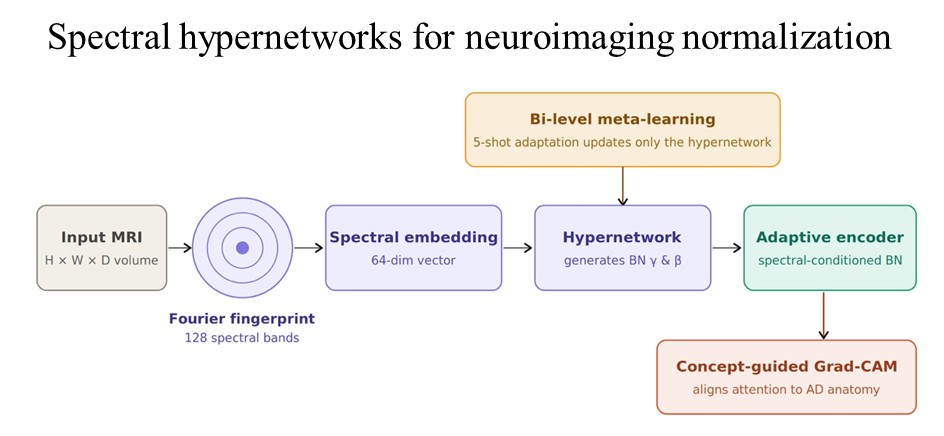
Multi-site neuroimaging studies are essential for developing clinically deployable artificial intelligence (AI) systems, yet deep learning models remain highly sensitive to scanner-induced domain shift. Variations in scanner manufacturer, field strength, acquisition protocol, reconstruction pipeline, and site-specific preprocessing can alter image intensity, texture, and spatial-frequency characteristics, thus degrading model performance when deployed on unseen scanners. This paper presents a spectral-conditioned hypernetwork framework for meta-learning neuroimaging normalization with concept-guided transparency. The proposed framework integrates a spectral-conditioned hypernetwork into the batch normalization layers of a three-dimensional convolutional encoder. For each input magnetic resonance imaging volume, a compact spectral embedding is extracted from the three-dimensional Fourier magnitude spectrum and used to dynamically generate the channel-wise normalization scale and shift parameters. This enables input-adaptive normalization without requiring explicit site labels or scanner metadata. To improve generalization to unseen imaging centers, this study formulates a bi-level meta-learning protocol in which small site-specific support sets adapt only the hypernetwork parameters, while the outer loop jointly optimizes the encoder and hypernetwork across multiple source sites. To enhance clinical interpretability, the proposed framework introduces a concept-guided regularization term that aligns gradient-weighted class activation mapping attribution maps with predefined anatomical regions of interest, including the hippocampus, ventricles, temporal pole, and entorhinal cortex. The framework is evaluated on a multi-site Alzheimer’s disease classification benchmark using leave-one-site-out validation. The proposed method improves diagnostic performance, reduces cross-site variability in the area under the receiver operating characteristic curve, and produces stronger alignment of attribution with clinically meaningful anatomical concepts compared to statistical harmonization, adversarial domain adaptation, meta-learning domain generalization, site-conditioned normalization, and concept-based interpretability baselines. These findings suggest that coupling adaptive normalization with few-shot meta-learning and anatomical concept guidance provides a practical pathway toward robust and transparent AI-assisted neuroimaging diagnosis.
- Chattopadhyay T, Joshy NA, Jagad C, et al. Comparison of Explainable AI Models for MRI-Based Alzheimer’s Disease Classification. In: 2024 20th International Symposium on Medical Information Processing and Analysis (SIPAIM). 2024:1-4. doi: 10.1109/SIPAIM62974.2024.10783631
- Fortin JP, Cullen N, Sheline YI, et al. Harmonization of cortical thickness measurements across scanners and sites. NeuroImage. 2018;167:104-120. doi: 10.1016/j.neuroimage.2017.11.024
- Fortin JP, Parker D, Tunç B, et al. Harmonization of multi-site diffusion tensor imaging data. NeuroImage. 2017;161:149-170. doi: 10.1016/j.neuroimage.2017.08.047
- Eshaghzadeh Torbati M, Minhas DS, Ahmad G, et al. A multi-scanner neuroimaging data harmonization using RAVEL and ComBat. NeuroImage. 2021;245:118703. doi: 10.1016/j.neuroimage.2021.118703
- Ganin Y, Ustinova E, Ajakan H, et al. Domain-Adversarial Training of Neural Networks. In: Csurka G, ed. Domain Adaptation in Computer Vision Applications. Advances in Computer Vision and Pattern Recognition. Springer International Publishing; 2017:189-209. doi: 10.1007/978-3-319-58347-1_10
- Guan H, Liu M. Domain Adaptation for Medical Image Analysis: A Survey. IEEE Trans Biomed Eng. 2022;69(3):1173-1185. doi: 10.1109/TBME.2021.3117407
- Li X, Gu Y, Dvornek N, Staib LH, Ventola P, Duncan JS. Multi-site fMRI analysis using privacy-preserving federated learning and domain adaptation: ABIDE results. Medical Image Analysis. 2020;65:101765. doi: 10.1016/j.media.2020.101765
- Zhou K, Liu Z, Qiao Y, Xiang T, Loy CC. Domain Generalization: A Survey. IEEE Trans Pattern Anal Mach Intell. Published online 2022:1-20. doi: 10.1109/TPAMI.2022.3195549
- Yoon JS, Oh K, Shin Y, Mazurowski MA, Suk HI. Domain Generalization for Medical Image Analysis: A Review. Proceedings of the IEEE. 2024;112(10):1583-1609. doi: 10.1109/JPROC.2024.3507831
- Ioffe S, Szegedy C. Batch Normalization: Accelerating Deep Network Training by Reducing Internal Covariate Shift. arXiv. 2015. doi: 10.48550/arXiv.1502.03167
- Dumoulin V, Shlens J, Kudlur M. A Learned Representation For Artistic Style. arXiv. 2016. doi: 10.48550/arXiv.1610.07629
- Huang X, Belongie S. Arbitrary Style Transfer in Real-Time with Adaptive Instance Normalization. In: 2017 IEEE International Conference on Computer Vision (ICCV). 2017:1510-1519. doi: 10.1109/ICCV.2017.167
- Zhang J, Xie Y, Wang Y, Xia Y. Inter-Slice Context Residual Learning for 3D Medical Image Segmentation. IEEE Trans Med Imaging. 2021;40(2):661-672. doi: 10.1109/TMI.2020.3034995
- Ha D, Dai A, Le QV. HyperNetworks. arXiv. 2016. doi: 10.48550/ARXIV.1609.09106
- Li D, Yang Y, Song YZ, Hospedales T. Learning to Generalize: Meta-Learning for Domain Generalization. AAAI. 2018;32(1). doi: 10.1609/aaai.v32i1.11596
- Balaji Y, Sankaranarayanan S, Chellappa R. MetaReg: towards domain generalization using meta-regularization. In: Proceedings of the 32nd International Conference on Neural Information Processing Systems. NIPS’18. Curran Associates Inc.; 2018:1006-1016. Accessed June 3, 2026. https://dl.acm.org/doi/10.5555/3326943.3327036
- Sun M, Li Y, Wang Y, Wang X. Towards Domain-Aware Stable Meta Learning for Out-of-Distribution Generalization. ACM Trans Knowl Discov Data. 2024;18(8):1-24. doi: 10.1145/3676558
- Finn C, Abbeel P, Levine S. Model-Agnostic Meta-Learning for Fast Adaptation of Deep Networks. arXiv. 2017. doi: 10.48550/arXiv.1703.03400
- Serebro D, Riklin-Raviv T. HyDA: Hypernetworks for Test Time Domain Adaptation in Medical Imaging Analysis. In: Gee JC, Alexander DC, Hong J, et al., eds. Medical Image Computing and Computer Assisted Intervention ¨C MICCAI 2025. Springer Nature Switzerland; 2026:251-261. doi: 10.1007/978-3-032-04971-1_24
- Selvaraju RR, Cogswell M, Das A, Vedantam R, Parikh D, Batra D. Grad-CAM: Visual Explanations from Deep Networks via Gradient-Based Localization. Int J Comput Vis. 2020;128(2):336-359. doi: 10.1007/s11263-019-01228-7
- Nauta M, Jutte A, Provoost J, Seifert C. This Looks Like That, Because ... Explaining Prototypes for Interpretable Image Recognition. In: Kamp M, Koprinska I, Bibal A, et al., eds. Machine Learning and Principles and Practice of Knowledge Discovery in Databases. Springer International Publishing; 2021:441-456. doi: 10.1007/978-3-030-93736-2_34
- Koh PW, Nguyen T, Tang YS, et al. Concept Bottleneck Models. In: Proceedings of the 37th International Conference on Machine Learning. PMLR; 2020:5338-5348. Accessed June 3, 2026. https://proceedings.mlr.press/v119/koh20a.html
- Ali H. Advancing Explainable AI for Clinical Decision Support: A Multimodal Evaluation Framework. Cloud Computing and Data Science. 2026;7(2):270-289. doi: 10.37256/ccds.7220269831
- Mueller SG, Weiner MW, Thal LJ, et al. Ways toward an early diagnosis in Alzheimer’s disease: The Alzheimer’s Disease Neuroimaging Initiative (ADNI). Alzheimer¡¯s & Dementia. 2005;1(1):55-66. doi: 10.1016/j.jalz.2005.06.003
- Kumari S, Singh P. Deep learning for unsupervised domain adaptation in medical imaging: Recent advancements and future perspectives. Computers in Biology and Medicine. 2024;170:107912. doi: 10.1016/j.compbiomed.2023.107912
- Taiyeb Khosroshahi M, Morsali S, Gharakhanlou S, et al. Explainable Artificial Intelligence in Neuroimaging of Alzheimer’s Disease. Diagnostics. 2025;15(5):612. doi: 10.3390/diagnostics15050612
- Ali H, Akhtar MT. Modality-Specific Sparse Autoencoders for Efficient Multimodal ICU Alignment: A Symmetry–Asymmetry Learning Framework. Symmetry. 2026;18(4):677. doi: 10.3390/sym18040677