
Gut microbiome dysbiosis and colorectal cancer in low- and middle-income countries and the United States: A comparative analysis

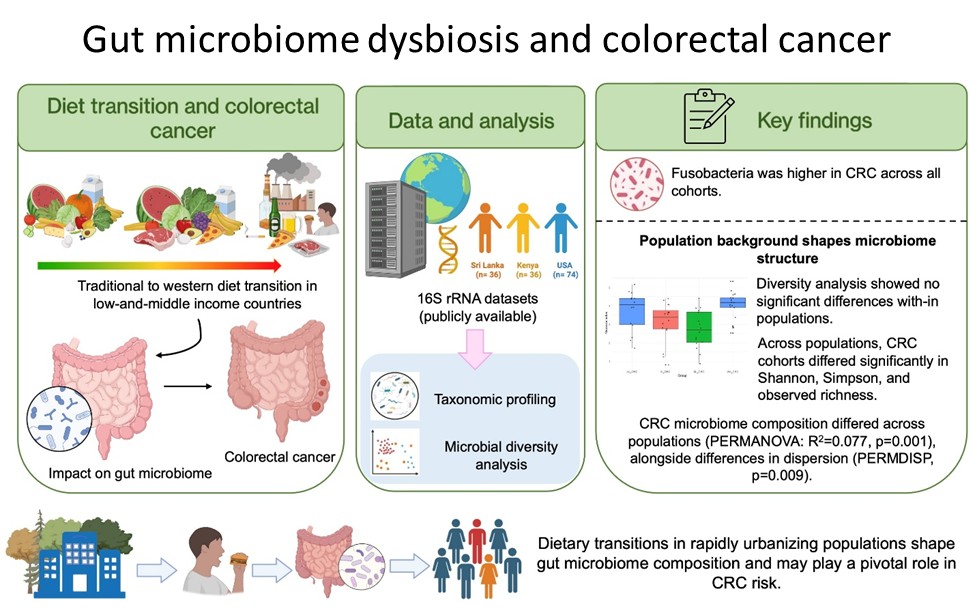
Colorectal cancer (CRC) is a major cause of cancer deaths globally, with rising cases in low- and middle-income countries (LMICs). These trends have been associated with socioeconomic and lifestyle changes accompanying urbanization and dietary Westernization. The gut microbiome has emerged as a key mediator linking environmental factors to CRC. Microbial dysbiosis has been associated with a myriad of downstream carcinogenic effects through metabolic, immune, and inflammatory pathways. However, most existing research on microbiome-related CRC risk focuses on Western populations, creating a gap in comparative characterization of CRC-associated microbiomes in LMIC populations. To fill this gap, the study analyzed publicly available 16S ribosomal RNA (rRNA) sequencing datasets from Sri Lanka, Kenya, and the United States. We performed analyses in R and Python, including taxonomic profiling and alpha- and beta-diversity assessments. The results showed a consistently higher relative abundance of Fusobacteria in CRC than in controls across all populations (8.19% vs 1.64%). Alpha diversity analysis showed slightly higher microbial diversity in controls than in CRC samples, although Wilcoxon tests found no significant within-population differences, while Kruskal–Wallis and Dunn’s tests identified significant population-level differences. Among CRC samples, United States (U.S.) cohorts exhibited the highest median Shannon diversity, followed by Kenya and Sri Lanka. Beta diversity showed substantial overlap among the U.S. cohorts, whereas Sri Lankan and Kenyan samples showed greater dispersion, indicating more variability. However, significant differences in multivariate dispersion (permutational analysis of multivariate dispersion, p = 0.006) indicated that differences in within-group heterogeneity also contributed to the observed separation. These findings highlight substantial microbial variability observed across populations, consistent with environment and lifestyle changes previously reported in transitioning populations. This research addresses a gap in the comparative characterization of CRC-associated microbiomes in underprivileged LMICs and provides a basis for future research evaluating environmental, dietary, and clinical factors.
- Brenner H, Chen C. The colorectal cancer epidemic: challenges and opportunities for primary, secondary and tertiary prevention. Br J Cancer. 2018;119(7):785-792. doi: 10.1038/s41416-018-0264-x
- Siegel RL, Wagle NS, Star J, Kratzer TB, Smith RA, Jemal A. Colorectal cancer statistics, 2026. CA Cancer J Clin. 2026;76(2). doi: 10.3322/caac.70067
- Yang G, Yu X, Weisenberger DJ, Lu T, Liang G. A multi-omics overview of colorectal cancer to address mechanisms of disease, metastasis, patient disparities and outcomes. Cancers. 2023;15(11):2934. doi: 10.3390/cancers15112934
- Cherry LM. The Genetic Etiology of Familial and Nonfamilial Colorectal Cancer. Bayl Univ Med Cent Proc. 2011;24(2):139-141. doi: 10.1080/08998280.2011.11928702
- Maddula M, Cohen J, Kumarasinghe D, et al. Risk Factors in Sporadic Early-Onset Colorectal Cancer, Current Evidence and Emerging Insights: A Systematic Review. Cancers. 2026;18(10):1515. doi: 10.3390/cancers18101515
- Merie G, Al-hashimi H. The Role of Pathogenic Mutations in Colorectal Cancer. Int J Pathol Biomark. 2025;1(1):12-31. doi: 10.71428/IJPB.2025.0102
- Sung H, Filho AM, Laversanne M, et al. Global cancer statistics 2024: GLOBOCAN estimates of incidence and mortality worldwide for 34 cancers in 186 countries. CA A Cancer J Clin. 2026;76(4):e70090. doi: 10.3322/caac.70090
- Keenan J, Waddell O, McCombie A, et al. Risk Factors for Early-Onset Colorectal Cancer: The Role of Diet, Lifestyle and Obesity. Res Sq. Preprint posted online November 5, 2025. doi: 10.21203/rs.3.rs-7707153/v1
- Bishehsari F, Mahdavinia M, Vacca M, Malekzadeh R, Mariani-Costantini R. Epidemiological transition of colorectal cancer in developing countries: environmental factors, molecular pathways, and opportunities for prevention. World J Gastroenterol. 2014;20(20):6055. doi: 10.3748/wjg.v20.i20.6055
- Owolo O. Urbanization-Induced Gut Microbiome Dysbiosis and Type 2 Diabetes in Sub-Saharan Africa: A Systematic Review of Mechanisms and Indigenous Therapeutics. Preprints.org. 2026. doi: 10.20944/preprints202601.1838.v1
- Ramaboli MC, Ocvirk S, Khan Mirzaei M, et al. Diet changes due to urbanization in South Africa are linked to microbiome and metabolome signatures of Westernization and colorectal cancer. Nat Commun. 2024;15(1):3379. doi: 10.1038/s41467-024-46265-0
- Huang P, Wong CC. Microbiome in Colorectal Cancer. In: Yu J, ed. Microbiome in Gastrointestinal Cancer. Singapore: Springer Nature; 2023:23-39. doi: 10.1007/978-981-19-4492-5_3
- Yadav D, Sainatham C, Filippov E, Kanagala SG, Ishaq SM, Jayakrishnan T. Gut microbiome–colorectal cancer relationship. Microorganisms. 2024;12(3):484. doi: 10.3390/microorganisms12030484
- Coleman OI, Haller D. Dysbiosis of the intestinal microbiota and colorectal cancer. In: Colorectal Neoplasia and the Colorectal Microbiome. Academic Press; 2020:135-155. doi: 10.1016/B978-0-12-819672-4.00007-6
- Kosumi K, Mima K, Baba H, Ogino S. Dysbiosis of the gut microbiota and colorectal cancer: the key target of molecular pathological epidemiology. J Lab Precis Med. 2018;3:76. doi: 10.21037/jlpm.2018.09.05
- Alexander JL, Scott AJ, Pouncey AL, Marchesi J, Kinross J, Teare J. Colorectal carcinogenesis: An archetype of gut microbiota–host interaction. ecancermedicalscience. 2018;12:865. doi: 10.3332/ecancer.2018.865
- Bultman SJ. Interplay between diet, gut microbiota, epigenetic events, and colorectal cancer. Mol Nutr Food Res. 2017;61(1):1500902. doi: 10.1002/mnfr.201500902
- David LA, Maurice CF, Carmody RN, et al. Diet rapidly and reproducibly alters the human gut microbiome. Nature. 2014;505(7484):559-563. doi: 10.1038/nature12820
- Ou J, Carbonero F, Zoetendal EG, et al. Diet, microbiota, and microbial metabolites in colon cancer risk in rural Africans and African Americans. Am J Clin Nutr. 2013;98(1):111-120. doi: 10.3945/ajcn.112.056689
- Vipperla K, O’Keefe SJ. Diet, microbiota, and dysbiosis: a ‘recipe’ for colorectal cancer. Food Funct. 2016;7(4):1731-1740. doi: 10.1039/c5fo01276g
- Paulo LS, Msema Bwire G, Klipstein-Grobusch K, et al. Urbanization gradient, diet, and gut microbiota in Sub-Saharan Africa: a systematic review. Front Microbiomes. 2023;2:1208166. doi: 10.3389/frmbi.2023.1208166
- Tamburini FB, Maghini D, Oduaran OH, et al. Short-and long-read metagenomics of urban and rural South African gut microbiomes reveal a transitional composition and undescribed taxa. Nat Commun. 2022;13(1):926. doi: 10.1038/s41467-021-27917-x
- Nayak SP, Sasi MP, Sreejayan MP, Mandal S. A case-control study of roles of diet in colorectal carcinoma in a South Indian Population. Asian Pac J Cancer Prev. 2009;10(4):565-568. Accessed February 19 2026. https://pubmed.ncbi.nlm.nih.gov/19827870/
- Young C, Wood HM, Seshadri RA, et al. The colorectal cancer-associated faecal microbiome of developing countries resembles that of developed countries. Genome Med. 2021;13(1):27. doi: 10.1186/s13073-021-00844-8
- Katsidzira L, Ocvirk S, Wilson A, et al. Differences in Fecal Gut Microbiota, Short-Chain Fatty Acids and Bile Acids Link Colorectal Cancer Risk to Dietary Changes Associated with Urbanization Among Zimbabweans. Nutr Cancer. 2019;71(8):1313-1324. doi: 10.1080/01635581.2019.1602659
- Lee DJ, Parikh A, Sirohi B, Cao Y, Chan AT. Emerging trends in the global burden of colorectal cancer. Nat Rev Clin Oncol. 2026;23(8):569-581. doi: 10.1038/s41571-026-01149-8
- Gamage BD, Ranasinghe D, Sahankumari A, Malavige GN. Metagenomic analysis of colonic tissue and stool microbiome in patients with colorectal cancer in a South Asian population. BMC Cancer. 2024;24(1):1124. doi: 10.1186/s12885-024-12885-4
- Elkholy A, Avuthu N, Abdalla M, et al. Microbiome diversity in African American, European American, and Egyptian colorectal cancer patients. Heliyon. 2023;9(7). doi: 10.1016/j.heliyon.2023.e18035
- Obuya S, Elkholy A, Avuthu N, et al. A signature of Prevotella copri and Faecalibacterium prausnitzii depletion, and a link with bacterial glutamate degradation in the Kenyan colorectal cancer patients. J Gastrointest Oncol. 2022;13(5):2282-2292. doi: 10.21037/jgo-22-116
- Callahan BJ, McMurdie PJ, Rosen MJ, Han AW, Johnson AJA, Holmes SP. DADA2: High-resolution sample inference from Illumina amplicon data. Nat Methods. 2016;13(7):581-583. doi: 10.1038/nmeth.3869
- Shannon CE. A mathematical theory of communication. Bell Syst Tech J. 1948;27(3):379-423. doi: 10.1002/j.1538-7305.1948.tb01338.x
- Simpson EH. Measurement of diversity. Nature. 1949;163(4148):688. doi: 10.1038/163688a0
- Bray JR, Curtis JT. An ordination of the upland forest communities of southern Wisconsin. Ecol Monogr. 1957;27(4):325-349. doi: 10.2307/1942268
- Avuthu N, Guda C. Meta-Analysis of Altered Gut Microbiota Reveals Microbial and Metabolic Biomarkers for Colorectal Cancer. Microbiol Spectr. 2022;10(4). doi: 10.1128/spectrum.00013-22
- Zeller G, Tap J, Voigt AY, et al. Potential of fecal microbiota for early-stage detection of colorectal cancer. Mol Syst Biol. 2014;10(11):766. doi: 10.15252/msb.20145645
- Thakur BK, Choudhury SR, Turpin W, Martin A. Gut microbiota and diet in colorectal cancer: Converging determinants of carcinogenesis. Gut Microbes. 2026;18(1). doi: 10.1080/19490976.2026.2664684
- Mntambo N, Arumugam T, Pramchand A, Pillay K, Ramsuran V. A review of global patterns in gut microbiota composition, health and disease: locating South Africa in the conversation. Microorganisms. 2025;13(12):2831. doi: 10.3390/microorganisms13122831
- Datorre JG, de Carvalho AC, Guimaraes DP, Reis RM. The role of Fusobacterium nucleatum in colorectal carcinogenesis. Pathobiology. 2021;88(2):127-140. doi: 10.1159/000512175
- Hill CM, Malen RC, Reedy AM, et al. Associations of epidemiologic risk factors with Fusobacterium nucleatum and bacterial alpha diversity in the colorectal tumor-associated microbiota. Cancer Causes Control. 2026;37(3):45. doi: 10.1007/s10552-026-02133-4
- Ou S, Wang H, Tao Y, et al. Fusobacterium nucleatum and colorectal cancer: From phenomenon to mechanism. Front Cell Infect Microbiol. 2022;12:1020583. doi: 10.3389/fcimb.2022.1020583
- Lu W, Aihaiti A, Abudukeranmu P, Liu Y, Gao H. Unravelling the role of intratumoral bacteria in digestive system cancers: current insights and future perspectives. J Transl Med. 2024;22(1):545. doi: 10.1186/s12967-024-05320-6
- Darnindro N, Abdullah M, Sukartini N, et al. Differences in diversity and composition of mucosa-associated colonic microbiota in colorectal cancer and non-colorectal cancer in Indonesia. World J Gastroenterol. 2025;31(7):100051. doi: 10.3748/wjg.v31.i7.100051
- Wirbel J, Pyl PT, Kartal E, et al. Meta-analysis of fecal metagenomes reveals global microbial signatures that are specific for colorectal cancer. Nat Med. 2019;25(4):679-689. doi: 10.1038/s41591-019-0406-6
- Thomas AM, Manghi P, Asnicar F, et al. Metagenomic analysis of colorectal cancer datasets identifies cross-cohort microbial diagnostic signatures and a link with choline degradation. Nat Med. 2019;25(4):667-678. doi: 10.1038/s41591-019-0405-7
- Shi J, Shen H, Huang H, et al. Gut microbiota characteristics of colorectal cancer patients in Hubei, China, and differences with cohorts from other Chinese regions. Front Microbiol. 2024;15:1395514. doi: 10.3389/fmicb.2024.1395514
- Ma J, Kim N, Cha JH, et al. A human gut metagenome-assembled genome catalogue spanning 41 countries supports genome-scale metabolic models. Nat Microbiol. 2026;11(1):317-334. doi: 10.1038/s41564-025-02206-1
- Gérard P. The crosstalk between the gut microbiota and lipids. OCL Oilseeds Fats Crops Lipids. 2020;27(12):70. doi: 10.1051/ocl/2020070
- Kong F, Cai Y. Study Insights into Gastrointestinal Cancer through the Gut Microbiota. Biomed Res Int. 2019;2019:1-8. doi: 10.1155/2019/8721503
- O’Keefe SJ, Chung D, Mahmoud N, et al. Why do African Americans get more colon cancer than Native Africans? J Nutr. 2007;137(1):175S-182S. doi: 10.1093/jn/137.1.175S
- Sharma S, O’Keefe SJ. Environmental influences on the high mortality from colorectal cancer in African Americans. Postgrad Med J. 2007;83(983):583-589. doi: 10.1136/pgmj.2007.058958
- Pardamean CI, Sudigyo D, Budiarto A, et al. Changing Colorectal Cancer Trends in Asians: Epidemiology and Risk Factors. Oncol Rev. 2023;17:10576. doi: 10.3389/or.2023.10576
- Weerasekara PC, Withanachchi CR, Ginigaddara GAS, Ploeger A. Nutrition transition and traditional food cultural changes in Sri Lanka during colonization and post-colonization. Foods. 2018;7(7):111. doi: 10.3390/foods7070111
- Vásquez A, Zúñiga P, Torres K, Quest AF, Simón L. Beneficial effects of a high-anthocyanin diet versus a Westernized diet on colorectal cancer risk: a systematic review. Front Immunol. 2026;17:1736018. doi: 10.3389/fimmu.2026.1736018
- Osswald A, Wortmann E, Wylensek D, et al. Secondary bile acid production by gut bacteria promotes Western diet-associated colorectal cancer. Gut. 2026;75(8):1505-1519. doi: 10.1136/gutjnl-2024-332243
- Kase BE, Liese AD, Zhang J, Murphy EA, Steck SE. Association Between the Dietary Index for Gut Microbiota (DI-GM) and Colorectal Cancer in the PLCO Cohort. Nutrients. 2026;18(7):1088. doi: 10.3390/nu18071088
- Rosendal LB, Bundgaard C, Zhang J, et al. Adherence to the EAT-Lancet diet and risk of colorectal cancer in the general population and among individuals with diabetes: a cohort study. Eur J Nutr. 2026;65(3):90. doi: 10.1007/s00394-026-03936-6
- Aykan NF. Red meat and colorectal cancer. Oncol Rev. 2015;9:288. doi: 10.4081/oncol.2015.288
- Zhou Z, Kleis L, Depetris-Chauvin A, et al. Beneficial microbiome and diet interplay in early-onset colorectal cancer. EMBO Mol Med. 2025;17(1):9-30. doi: 10.1038/s44321-024-00177-0
- Smolińska K, Paluszkiewicz P. Risk of colorectal cancer in relation to frequency and total amount of red meat consumption. Systematic review and meta-analysis. Arch Med Sci. 2010;6(4):605-610. doi: 10.5114/aoms.2010.14475
- Farvid MS, Sidahmed E, Spence ND, Mante Angua K, Rosner BA, Barnett JB. Consumption of red meat and processed meat and cancer incidence: a systematic review and meta-analysis of prospective studies. Eur J Epidemiol. 2021;36(9):937-951. doi: 10.1007/s10654-021-00741-9
- Cheung HS, Lu LY, So WL, Wong HW, Wong SH, Mak CM. Association of Red Meat Intake and Colorectal Cancer among East-Asians: A Systematic Review and Meta-analysis of Observational Studies Performed between 2011-2021. J Gastrointestin Liver Dis. 2023;32(3):377. doi: 10.15403/jgld-4778
- Iswarya SK, Premarajan KC, Kar SS, Kumar SS, Kate V. Risk factors for the development of colorectal carcinoma: A case control study from South India. World J Gastrointest Oncol. 2016;8(2):207. doi: 10.4251/wjgo.v8.i2.207
- Kotemori A, Kito K, Iwasaki M, et al. Dietary Inflammatory Index and Risk of Colorectal Cancer in Japanese Men. Nutrients. 2026;18(2):338. doi: 10.3390/nu18020338
- Ganesh B, Talole SD, Dikshit R. A case–control study on diet and colorectal cancer from Mumbai, India. Cancer Epidemiol. 2009;33(3-4):189-193. doi: 10.1016/j.canep.2009.07.009
- Maiyoh GK, Tuei VC. Rising Cancer Incidence and Role of the Evolving Diet in Kenya. Nutr Cancer. 2019;71(4):531-546. doi: 10.1080/01635581.2018.1542010
- Ramachandran SL, Pasupuleti N, Abdill RJ, et al. Distinct trajectories of urbanization shape the human gut microbiome across South Asia. Gut Microbes. 2026;18(1). doi: 10.1080/19490976.2026.2700042
- Huang Z, Li Y, Park H, et al. Unveiling and harnessing the human gut microbiome in the rising burden of non-communicable diseases during urbanization. Gut Microbes. 2023;15(1):2237645. doi: 10.1080/19490976.2023.2237645
- Hassan M, Butt ZA. Applying the syndemic framework to cancer research for effective cancer control in low- and middle-income countries. ecancermedicalscience. 2023;17:1532. doi: 10.3332/ecancer.2023.1532
- Moyo G, Nyanhanda T, Mude W, et al. Diet and Cancers of the Gastrointestinal Tract in Africa: A Systematic Review and Meta-Analysis. Soc Sci Res Netw. 2025. doi: 10.2139/ssrn.5317670
- Abo-Hammam RH, Salah M, Shabayek S, Hanora A, Zakeer S, Khattab RH. Metagenomic analysis of fecal samples in colorectal cancer Egyptians patients post colectomy: a pilot study. AIMS Microbiol. 2024;10(1):148. doi: 10.3934/microbiol.2024008
- Siraj YA, Biadgelign MG, Yassin MO, Chekol YZ. Mucosa‐associated cultivable aerobic gut bacterial microbiota among colorectal cancer patients attending at the referral hospitals of Amhara Regional State, Ethiopia. Gut Pathog. 2021;13(1):19. doi: 10.1186/s13099-021-00415-7
- Pu T, Gustafson A, Ghabra S, et al. Underrepresentation of racial and ethnic minorities in metastatic colorectal carcinoma clinical trials within the United States. Ann Oncol. 2023;34(suppl 1). doi: 10.1016/j.annonc.2023.04.188
- Pham YTH, Jin A, Wang R, Koh WP, Yuan JM, Luu HN. Association between dietary one-carbon metabolism-related nutrients and the risk of colorectal cancer: Findings from the Singapore Chinese Health Study. Cancer Res. 2023;83(7 suppl):6449-6449. doi: 10.1158/1538-7445.AM2023-6449