

Using artificial intelligence to study plant–microbiome interactions for sustainable agriculture

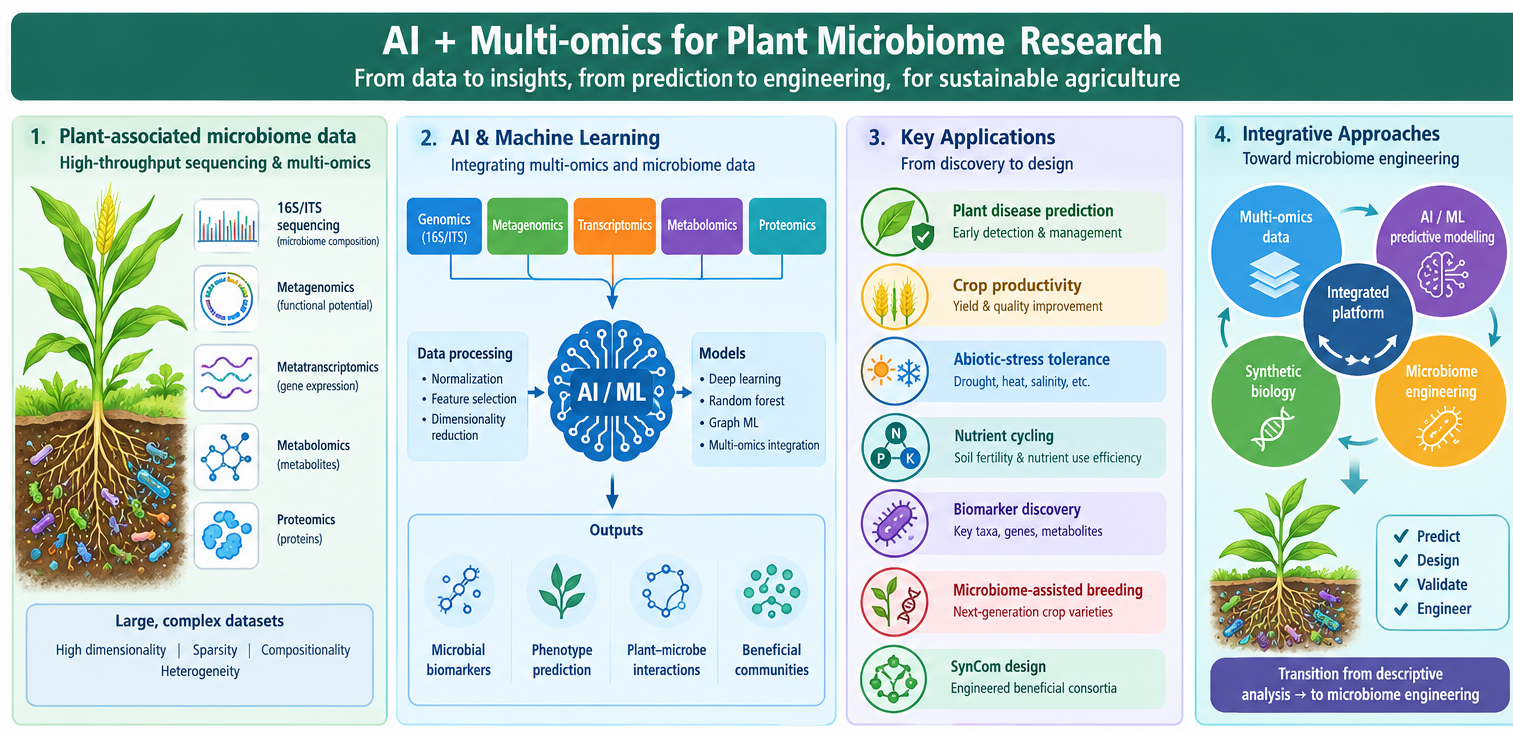
Plant microbiome research is a rapidly developing and productive field, with substantial attention directed toward the identification of the major determinants of plant growth, nutrient acquisition, stress tolerance, disease resistance, and associated agricultural productivity. Advances in high-throughput sequencing and multi-omics technologies have generated large and complex datasets describing plant-associated microbial communities. However, the high dimensionality, sparsity, compositionality, and heterogeneity of microbiome datasets create substantial analytical challenges for conventional statistical approaches. Machine learning and artificial intelligence (AI) provide new opportunities to identify microbial biomarkers, predict plant phenotypes, characterize plant–microbe interactions, and design beneficial microbial communities. Applications include plant disease prediction, crop productivity, abiotic-stress tolerance, nutrient cycling, biomarker discovery, microbiome-assisted breeding, and synthetic microbial community (SynCom) design. Recent studies increasingly combine AI with multi-omics, synthetic biology, and predictive modeling, indicating a transition from descriptive microbiome analysis toward microbiome engineering. Nevertheless, model generalizability remains constrained by small sample sizes, compositional data, technical variation, batch effects, environmental heterogeneity, and insufficient external validation. The combination of microbiome science and AI has considerable potential to support sustainable, climate-resilient crop production, but successful translation will require rigorous biological validation and field-scale testing.
- Berendsen RL, Pieterse CMJ, Bakker PAHM. The rhizosphere microbiome and plant health. Trends Plant Sci. 2012;17(8):478-486. doi: 10.1016/j.tplants.2012.04.001
- Compant S, Cassan F, Kostić T, et al. Harnessing the plant microbiome for sustainable crop production. Nat Rev Microbiol. 2025;23(1):9-23. doi: 10.1038/s41579-024-01079-1
- Busato S, Gordon M, Chaudhari M, et al. Compositionality, sparsity, spurious heterogeneity, and other data-driven challenges for machine learning algorithms within plant microbiome studies. Curr Opin Plant Biol. 2023;71:102326. doi: 10.1016/j.pbi.2022.102326
- Yoosefzadeh Najafabadi M, Khalaf EM, Mysara M, El-Baz AM. Editorial: Harnessing machine learning to decode plant-microbiome dynamics for sustainable agriculture. Front Microbiomes. 2025;4:1602938. doi: 10.3389/frmbi.2025.1602938
- Ma J, Qiao J, Cao Y, Cheng Z. Harnessing artificial intelligence to decode the rhizosphere microbiome. aBIOTECH. 2026;7(1):100005. doi: 10.1016/j.abiote.2025.100005
- Berruto CA, Demirer GS. Engineering agricultural soil microbiomes and predicting plant phenotypes. Trends Microbiol. 2024;32(9):858-873. doi: 10.1016/j.tim.2024.02.003
- Dubey A, Malla MA, Vimal SR, Kumar A, Prasad SM, Khan ML. Plant-microbiome engineering: synergistic microbial partners for crop health and sustainability. Plant Growth Regul. 2025;105(6):1825-1839. doi: 10.1007/s10725-025-01385-5
- Kamath A, Patel D, Saraf M, Patel S. Rooted intelligence: Integrating AI, Omics, and Synthetic biology to engineer the plant microbiome. 3 Biotech. 2026;16(1):10. doi: 10.1007/s13205-025-04614-w
- Prasannath K, Peter Arulraj S, Shakthivel K, Rakulan T, Karunarathna SC. Revisiting the ecological significance, composition, and functions of plant microbiome: a review. N Z J Crop Hortic Sci. 2025;53(5):1329-1361. doi: 10.1080/01140671.2025.2458811
- Zeng Q, Hu HW, Ge AH, et al. Plant–microbiome interactions and their impacts on plant adaptation to climate change. J Integr Plant Biol. 2025;67(3):826-844. doi: 10.1111/jipb.13863
- Yadav J, Gehlot P, Soni P, Jain T. Plant microbiome engineering: from inoculation to genome editing. Front Microbiol. 2026;17:1781381. doi: 10.3389/fmicb.2026.1781381
- Wei M, Lian T, Chen L, et al. The plant microbiome: From ecological foundations to precision microbial engineering for sustainable agriculture. iMeta. 2026;5(4). doi: 10.1002/imt2.70152
- Legendre P, Gallagher ED. Ecologically meaningful transformations for ordination of species data. Oecologia.2001;129(2):271-280. doi: 10.1007/s004420100716
- Lê Cao KA, Boitard S, Besse P. Sparse PLS discriminant analysis: biologically relevant feature selection and graphical displays for multiclass problems. BMC Bioinform. 2011;12(1):253. doi: 10.1186/1471-2105-12-253
- Gloor GB, Macklaim JM, Pawlowsky-Glahn V, Egozcue JJ. Microbiome datasets are compositional: and this is not optional. Front Microbiol. 2017;8:2224. doi: 10.3389/fmicb.2017.02224
- Bolker BM, Brooks ME, Clark CJ, et al. Generalized linear mixed models: a practical guide for ecology and evolution. Trends Ecol Evol. 2009;24(3):127-135. doi: 10.1016/j.tree.2008.10.008
- Rohart F, Gautier B, Singh A, Lê Cao KA. mixOmics: an R package for ‘omics feature selection and multiple data integration. PLoS Comput Biol. 2017;13(11):e1005752. doi: 10.1371/journal.pcbi.1005752
- Genomic Standards Consortium. MIxS: Minimum Information about any (x) Sequence. Genomic Standards Consortium; 2026. https://zenodo.org/records/21679212