

Obesity-associated gut dysbiosis: Metabolic dysfunction-associated steatotic liver disease as a clinical model of host–microbiome interactions

Obesity is associated with profound alterations in the composition and function of the gut microbiota that extend far beyond the gastrointestinal tract. Accumulating evidence indicates that obesity-associated gut dysbiosis influences intestinal barrier integrity, immune regulation, microbial metabolism, and systemic metabolic homeostasis through interconnected biological mechanisms. These alterations contribute to the development of chronic metabolic disorders affecting several organ systems. This review summarizes current knowledge regarding the host–microbiome interactions linking obesity-associated gut dysbiosis with metabolic dysfunction. Particular attention is given to the sequential interactions between microbial ecosystem remodeling, impaired intestinal barrier function, chronic low-grade inflammation, and metabolic disturbances that collectively promote obesity-associated diseases. Rather than focusing exclusively on liver pathology, metabolic dysfunction-associated steatotic liver disease is presented as one of the best-characterized clinical models demonstrating how disturbances originating within the gut microbiome evolve into systemic metabolic disease. Finally, emerging therapeutic strategies targeting the gut–microbiome axis are discussed, with emphasis on restoration of microbial homeostasis and early intervention aimed at interrupting pathophysiological progression before irreversible metabolic complications develop. These approaches may contribute to preventing or attenuating obesity-associated metabolic complications.
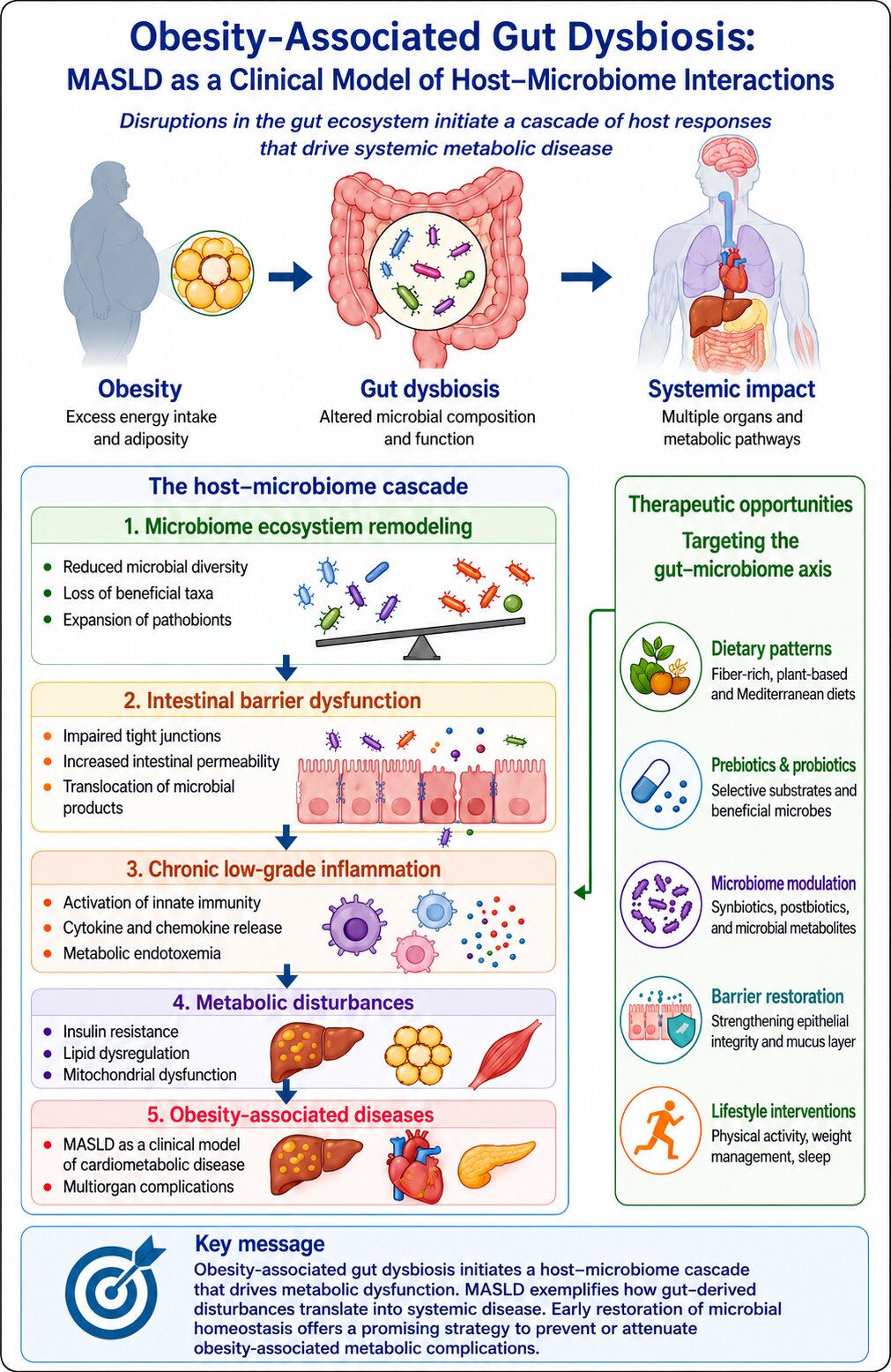
- Hesketh KD, Zheng M, Campbell KJ. Early life factors that affect obesity and the need for complex solutions. Nat Rev Endocrinol. 2025;21(1):31-44. doi: 10.1038/s41574-024-01035-2
- Schulze MB, Stefan N. Metabolically healthy obesity: from epidemiology and mechanisms to clinical implications. Nat Rev Endocrinol. 2024;20(11):633-646. doi: 10.1038/s41574-024-01008-5
- Cani PD, Van Hul M. Gut microbiota in overweight and obesity: crosstalk with adipose tissue. Nat Rev Gastroenterol Hepatol. 2024;21(3):164-183. doi: 10.1038/s41575-023-00867-z
- Ross FC, Patangia D, Grimaud G, et al. The interplay between diet and the gut microbiome: implications for health and disease. Nat Rev Microbiol. 2024;22(11):671-686. doi: 10.1038/s41579-024-01068-4
- McCallum G, Tropini C. The gut microbiota and its biogeography. Nat Rev Microbiol. 2024;22(2):105-118. doi: 10.1038/s41579-023-00969-0
- Mann ER, Lam YK, Uhlig HH. Short-chain fatty acids: linking diet, the microbiome and immunity. Nat Rev Immunol. 2024;24(8):577-595. doi: 10.1038/s41577-024-01014-8
- Benedé-Ubieto R, Cubero FJ, Nevzorova YA. Breaking the barriers: the role of gut homeostasis in Metabolic-Associated Steatotic Liver Disease (MASLD). Gut Microbes. 2024;16(1). doi: 10.1080/19490976.2024.2331460
- Huang DQ, Wong VWS, Rinella ME, et al. Metabolic dysfunction-associated steatotic liver disease in adults. Nat Rev Dis Primers. 2025;11(1). doi: 10.1038/s41572-025-00599-1
- Louis P, Flint HJ. Formation of propionate and butyrate by the human colonic microbiota. Environ Microbiol. 2017;19(1):29-41. doi: 10.1111/1462-2920.13589
- Wahlström A, Sayin SI, Marschall HU, Bäckhed F. Intestinal crosstalk between bile acids and microbiota and its impact on host metabolism. Cell Metab. 2016;24(1):41-50. doi: 10.1016/j.cmet.2016.05.005
- Agus A, Clément K, Sokol H. Gut microbiota-derived metabolites as central regulators in metabolic disorders. Gut. 2021;70(6):1174-1182. doi: 10.1136/gutjnl-2020-323071
- Cryan JF, O’Riordan KJ, Cowan CSM, et al. The Microbiota-Gut-Brain Axis. Physiol Rev. 2019;99(4):1877-2013. doi: 10.1152/physrev.00018.2018
- Morais LH, Schreiber HL IV, Mazmanian SK. The gut microbiota-brain axis in behaviour and brain disorders. Nat Rev Microbiol. 2021;19(4):241-255. doi: 10.1038/s41579-020-00460-0
- Fan Y, Pedersen O. Gut microbiota in human metabolic health and disease. Nat Rev Microbiol. 2021;19(1):55-71. doi: 10.1038/s41579-020-0433-9
- Gurung M, Li Z, You H, et al. Role of gut microbiota in type 2 diabetes pathophysiology. eBioMedicine. 2020;51:102590. doi: 10.1016/j.ebiom.2019.11.051
- Martin AM, Sun EW, Rogers GB, Keating DJ. The influence of the gut microbiome on host metabolism through the regulation of gut hormone release. Front Physiol. 2019;10:428. doi: 10.3389/fphys.2019.00428
- Vliex LMM, Penders J, Nauta A, Zoetendal EG, Blaak EE. The individual response to antibiotics and diet: insights into gut microbial resilience and host metabolism. Nat Rev Endocrinol. 2024;20(7):387-398. doi: 10.1038/s41574-024-00966-0
- Turner JR. Intestinal mucosal barrier function in health and disease. Nat Rev Immunol. 2009;9(11):799-809. doi: 10.1038/nri2653
- Allaire JM, Crowley SM, Law HT, Chang SY, Ko HJ, Vallance BA. The Intestinal Epithelium: Central Coordinator of Mucosal Immunity. Trends Immunol. 2018;39(9):677-696. doi: 10.1016/j.it.2018.04.002
- Akira S, Uematsu S, Takeuchi O. Pathogen recognition and innate immunity. Cell. 2006;124(4):783-801. doi: 10.1016/j.cell.2006.02.015
- Kayama H, Okumura R, Takeda K. Interaction Between the Microbiota, Epithelia, and Immune Cells in the Intestine. Annu Rev Immunol. 2020;38(1):23-48. doi: 10.1146/annurev-immunol-070119-115104
- Netea MG, Domínguez-Andrés J, Barreiro LB, et al. Defining trained immunity and its role in health and disease. Nat Rev Immunol. 2020;20(6):375-388. doi: 10.1038/s41577-020-0285-6
- Divangahi M, Aaby P, Khader SA, et al. Trained immunity, tolerance, priming and differentiation: distinct immunological processes. Nat Immunol. 2021;22(1):2-6. doi: 10.1038/s41590-020-00845-6
- Christ A, Günther P, Lauterbach MAR, et al. Western Diet Triggers NLRP3-Dependent Innate Immune Reprogramming. Cell. 2018;172(1-2):162-175.e14. doi: 10.1016/j.cell.2017.12.013
- Tripathi A, Debelius J, Brenner DA, et al. The gut-liver axis and the intersection with the microbiome. Nat Rev Gastroenterol Hepatol. 2018;15(7):397-411. doi: 10.1038/s41575-018-0011-z
- Albillos A, de Gottardi A, Rescigno M. The gut-liver axis in liver disease: Pathophysiological basis for therapy. J Hepatol. 2020;72(3):558-577. doi: 10.1016/j.jhep.2019.10.003
- van der Hee B, Wells JM. Microbial Regulation of Host Physiology by Short-chain Fatty Acids. Trends Microbiol. 2021;29(8):700-712. doi: 10.1016/j.tim.2021.02.001
- Wang Z, Klipfell E, Bennett BJ, et al. Gut flora metabolism of phosphatidylcholine promotes cardiovascular disease. Nature. 2011;472(7341):57-63. doi: 10.1038/nature09922
- Koeth RA, Wang Z, Levison BS, et al. Intestinal microbiota metabolism of L-carnitine, a nutrient in red meat, promotes atherosclerosis. Nat Med. 2013;19(5):576-585. doi: 10.1038/nm.3145
- Longo S, Rinaldi TG, Fernández-Real JM, Federici M. Dysregulation of the Gut-Adipose Tissue-Liver Axis: a Possible Mechanism Behind the Relationship Between Metabolic Dysfunction-Associated Steatotic Liver Disease and Type 2 Diabetes. Curr Diab Rep. 2026;26(1):10. doi: 10.1007/s11892-026-01623-8
- Saltiel AR, Olefsky JM. Inflammatory mechanisms linking obesity and metabolic disease. J Clin Invest. 2017;127(1):1-4. doi: 10.1172/JCI92035
- Pedersen BK, Febbraio MA. Muscles, exercise and obesity: skeletal muscle as a secretory organ. Nat Rev Endocrinol. 2012;8(8):457-465. doi: 10.1038/nrendo.2012.49
- Rosen ED, Spiegelman BM. What We Talk About When We Talk About Fat. Cell. 2014;156(1-2):20-44. doi: 10.1016/j.cell.2013.12.012
- Yki-Järvinen H, Luukkonen PK, Hodson L, Moore JB. Dietary carbohydrates and fats in nonalcoholic fatty liver disease. Nat Rev Gastroenterol Hepatol. 2021;18(11):770-786. doi: 10.1038/s41575-021-00472-y
- Friedman SL, Neuschwander-Tetri BA, Rinella M, Sanyal AJ. Mechanisms of NAFLD development and therapeutic strategies. Nat Med. 2018;24(7):908-922. doi: 10.1038/s41591-018-0104-9
- Rinella ME, Lazarus JV, Ratziu V, et al. A multisociety Delphi consensus statement on new fatty liver disease nomenclature. J Hepatol. 2023;79(6):1542-1556. doi: 10.1016/j.jhep.2023.06.003
- Powell EE, Wong VWS, Rinella M. Non-alcoholic fatty liver disease. Lancet. 2021;397(10290):2212-2224. doi: 10.1016/S0140-6736(20)32511-3
- Krenkel O, Tacke F. Liver macrophages in tissue homeostasis and disease. Nat Rev Immunol. 2017;17(5):306-321. doi: 10.1038/nri.2017.11
- Schwabe RF, Greten TF. Gut microbiome in HCC --- Mechanisms, diagnosis and therapy. J Hepatol. 2020;72(2):230-238. doi: 10.1016/j.jhep.2019.08.016
- Arab JP, Arrese M, Trauner M. Recent Insights into the Pathogenesis of Nonalcoholic Fatty Liver Disease. Annu Rev Pathol. 2018;13(1):321-350. doi: 10.1146/annurev-pathol-020117-043617
- Pierantonelli I, Svegliati-Baroni G. Nonalcoholic Fatty Liver Disease: Basic Pathogenetic Mechanisms in the Progression From NAFLD to NASH. Transplantation. 2019;103(1):e1-e13. doi: 10.1097/TP.0000000000002480
- Hernandez-Gea V, Friedman SL. Pathogenesis of liver fibrosis. Annu Rev Pathol. 2011;6(1):425-456. doi: 10.1146/annurev-pathol-011110-130246
- Tacke F, Horn P, Wai-Sun Wong V, et al. EASL–EASD–EASO Clinical Practice Guidelines on the management of metabolic dysfunction-associated steatotic liver disease (MASLD). J Hepatol. 2024;81(3):492-542. doi: 10.1016/j.jhep.2024.04.031
- Lazarus JV, Mark HE, Anstee QM, et al. Advancing the global public health agenda for NAFLD: a consensus statement. Nat Rev Gastroenterol Hepatol. 2022;19(1):60-78. doi: 10.1038/s41575-021-00523-4
- Younossi ZM, Golabi P, Paik JM, Henry A, Van Dongen C, Henry L. The global epidemiology of nonalcoholic fatty liver disease (NAFLD) and nonalcoholic steatohepatitis (NASH): a systematic review. Hepatology. 2023;77(4):1335-1347. doi: 10.1097/HEP.0000000000000004
- Mantovani A, Dalbeni A, Alisi A, et al. Nonalcoholic fatty liver disease and increased risk of incident extrahepatic cancers: a meta-analysis of observational cohort studies. Gut. 2022;71(4):778-788. doi: 10.1136/gutjnl-2021-324191
- Targher G, Tilg H, Byrne CD. Non-alcoholic fatty liver disease: a multisystem disease requiring a multidisciplinary and holistic approach. Lancet Gastroenterol Hepatol. 2021;6(7):578-588. doi: 10.1016/S2468-1253(21)00020-0
- Loomba R, Friedman SL, Shulman GI. Mechanisms and disease consequences of nonalcoholic fatty liver disease. Cell. 2021;184(10):2537-2564. doi: 10.1016/j.cell.2021.04.015
- Cusi K, Isaacs S, Barb D, et al. American Association of Clinical Endocrinology Clinical Practice Guideline for the Diagnosis and Management of Nonalcoholic Fatty Liver Disease in Primary Care and Endocrinology Clinical Settings. Endocr Pract. 2022;28(5):528-562. doi: 10.1016/j.eprac.2022.03.010
- Tilg H, Adolph TE, Trauner M. Gut-liver axis: Pathophysiological concepts and clinical implications. Cell Metab. 2022;34(11):1700-1718. doi: 10.1016/j.cmet.2022.09.017
- Valdes AM, Walter J, Segal E, Spector TD. Role of the gut microbiota in nutrition and health. BMJ. 2018;361:k2179. doi: 10.1136/bmj.k2179
- Zinöcker MK, Lindseth IA. The Western Diet--Microbiome-Host Interaction and Its Role in Metabolic Disease. Nutrients. 2018;10(3):365. doi: 10.3390/nu10030365
- Ahmed N, Gaur V, Kamle M, et al. Microbiome-based therapeutics for metabolic disorders: harnessing microbial intrusions for treatment. Front Med Technol. 2025;7:1695329. doi: 10.3389/fmedt.2025.1695329
- Thyfault JP, Bergouignan A. Exercise and metabolic health: beyond skeletal muscle. Diabetologia. 2020;63(8):1464-1474. doi: 10.1007/s00125-020-05177-6
- Hawley JA, Hargreaves M, Joyner MJ, Zierath JR. Integrative biology of exercise. Cell. 2014;159(4):738-749. doi: 10.1016/j.cell.2014.10.029
- Vilar-Gomez E, Martinez-Perez Y, Calzadilla-Bertot L, et al. Weight loss through lifestyle modification significantly reduces features of nonalcoholic steatohepatitis. Gastroenterology. 2015;149(2):367-378.e5. doi: 10.1053/j.gastro.2015.04.005
- Reutrakul S, Van Cauter E. Sleep influences on obesity, insulin resistance, and risk of type 2 diabetes. Metabolism. 2018;84:56-66. doi: 10.1016/j.metabol.2018.02.010
- Tahara Y, Shibata S. Entrainment of the mouse circadian clock: Effects of stress, exercise, and nutrition. Free Radic Biol Med. 2018;119:129-138. doi: 10.1016/j.freeradbiomed.2017.12.026
- Zhang Y, Cao J, Wang Y, Fan X, Deng R, Mi J. Effects of fecal microbiota transplantation on glycemic and lipid profiles in overweight or obese patients with metabolic disorders: a systematic review and meta-analysis. Front Endocrinol. 2025;16:1737543. doi: 10.3389/fendo.2025.1737543
- Hsu CL, Schnabl B. The gut-liver axis and gut microbiota in health and liver disease. Nat Rev Microbiol. 2023;21(11):719-733. doi: 10.1038/s41579-023-00904-3
- Craven L, Rahman A, Nair Parvathy S, et al. Allogenic Fecal Microbiota Transplantation in Patients With Nonalcoholic Fatty Liver Disease Improves Abnormal Small Intestinal Permeability: A Randomized Control Trial. Am J Gastroenterol. 2020;115(7):1055–1065. doi: 10.14309/ajg.0000000000000661
- Allegretti JR, Mullish BH, Kelly C, Fischer M. The evolution of the use of faecal microbiota transplantation and emerging therapeutic indications. Lancet. 2019;394(10196):420-431 doi: 10.1016/S0140-6736(19)31266-8
- Wang C, Yi Z, Jiao Y, Shen Z, Yang F, Zhu S. Gut Microbiota and Adipose Tissue Microenvironment Interactions in Obesity. Metabolites. 2023;13(7):821. doi: 10.3390/metabo13070821
- Durack J, Lynch SV. The gut microbiome: Relationships with disease and opportunities for therapy. J Exp Med. 2019;216(1):20-40. doi: 10.1084/jem.20180448
- Newsome PN, Buchholtz K, Cusi K, et al. A Placebo-Controlled Trial of Subcutaneous Semaglutide in Nonalcoholic Steatohepatitis. N Engl J Med. 2021;384(12):1113-1124. doi: 10.1056/NEJMoa2028395
- Armstrong MJ, Gaunt P, Aithal GP, et al. Liraglutide safety and efficacy in patients with non-alcoholic steatohepatitis (LEAN): a multicentre, double-blind, randomised, placebo-controlled phase 2 study. Lancet. 2016;387(10019):679-690. doi: 10.1016/S0140-6736(15)00803-X
- Garvey WT, Blüher M, Osorto Contreras CK, et al. REDEFINE 1 Study Group. Coadministered Cagrilintide and Semaglutide in Adults with Overweight or Obesity. N Engl J Med. 2025;393(7):635-647. doi: 10.1056/NEJMoa2502081
- Loomba R, Hartman ML, Lawitz EJ, et al. Tirzepatide for Metabolic Dysfunction-Associated Steatohepatitis with Liver Fibrosis. N Engl J Med. 2024;391(4):299-310. doi: 10.1056/NEJMoa2401943
- Harrison SA, Bedossa P, Guy CD, et al. MAESTRO-NASH Investigators. A Phase 3, Randomized, Controlled Trial of Resmetirom in NASH with Liver Fibrosis. N Engl J Med. 2024;390(6):497-509. doi: 10.1056/NEJMoa2309000
- Llovet JM, Kelley RK, Villanueva A, et al. Hepatocellular carcinoma. Nat Rev Dis Primers. 2021;7(1):6. doi: 10.1038/s41572-020-00240-3