

Cyclospora cayetanensis at a crossroads: A critical re-evaluation of foundational assumptions in research and public health

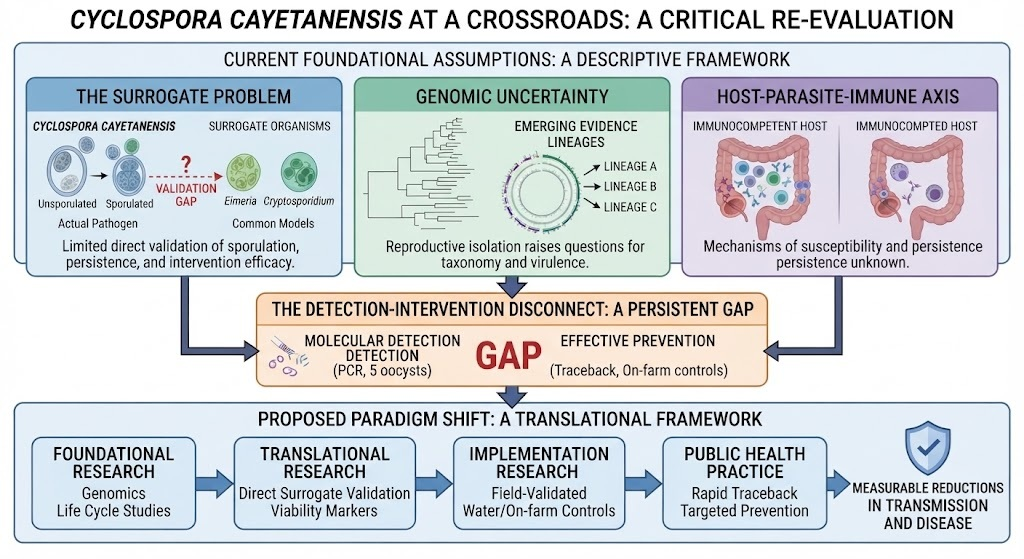
Cyclospora cayetanensis remains a poorly controlled foodborne pathogen despite decades of research and major advances in molecular detection and genomic characterization. This review critically re-evaluates three foundational assumptions that continue to shape research, diagnostics, and public health practice. First, the widespread use of Eimeria and Cryptosporidium as surrogate organisms is examined in light of the limited direct validation of their ability to reproduce key biological characteristics of C. cayetanensis, particularly with respect to sporulation, environmental persistence, and intervention efficacy. Second, emerging phylogenetic and genomic evidence indicates that human-infecting Cyclospora comprises multiple genetically distinct lineages with reproductive isolation, raising important questions regarding taxonomy, epidemiology, transmission, and virulence. Third, the host-parasite-immune axis remains incompletely understood, particularly the mechanisms underlying the greater severity, persistence, and recurrence of infection in immunocompromised individuals. Across these three areas, the evidence reveals a persistent gap between what can be detected and what can be effectively prevented or controlled. The review therefore proposes a translational research framework that links foundational biological investigation to intervention development, implementation, and public health practice. Key priorities include direct validation of surrogate models, improved genomic resolution, standardized methods for assessing oocyst viability and infectivity, stronger agricultural water and on-farm controls, real-time molecular surveillance and traceback, and improved therapeutic and preventive strategies for vulnerable populations. Progress in controlling cyclosporiasis will require a shift from predominantly descriptive research toward evidence-based, actionable approaches that translate biological and technological advances into measurable reductions in transmission and disease.
- Ortega YR, Gilman RH, Sterling CR. A new coccidian parasite (Apicomplexa: Eimeriidae) from humans. J Parasitol. 1994;80(4):625-629. doi: 10.2307/3283201
- Centers for Disease Control and Prevention. Cyclospora Case Data. Updated August 25, 2026. Accessed September 7, 2026. https://www.cdc.gov/cyclosporiasis/cases/index.html
- Centers for Disease Control and Prevention. Domestically Acquired Cyclosporiasis Cases in Multiple U.S. States, 2026. Health Alert Network Health Advisory CDCHAN-00531. Published July 14, 2026. Accessed September 7, 2026. https://www.cdc.gov/han/php/notices/han00531.html
- Herwaldt BL, Ackers ML; Cyclospora Working Group. An outbreak in 1996 of cyclosporiasis associated with imported raspberries. N Engl J Med. 1997;336(22):1548-1556. doi: 10.1056/NEJM199705293362202
- Strausbaugh LJ, Herwaldt BL. Cyclospora cayetanensis: a review, focusing on the outbreaks of cyclosporiasis in the 1990s. Clin Infect Dis. 2000;31(4):1040-1057. doi: 10.1086/314051
- Mansfield LS, Gajadhar AA. Cyclospora cayetanensis, a food- and waterborne coccidian parasite. Vet Parasitol. 2004;126(1-2):73-90. doi: 10.1016/j.vetpar.2004.09.011
- Ortega YR, Sanchez R. Update on Cyclospora cayetanensis, a food-borne and waterborne parasite. Clin Microbiol Rev. 2010;23(1):218-234. doi: 10.1128/CMR.00026-09
- Chacín-Bonilla L. Epidemiology of Cyclospora cayetanensis: a review focusing in endemic areas. Acta Trop. 2010;115(3):181-193. doi: 10.1016/j.actatropica.2010.04.001
- Almeria S, Cinar HN, Dubey JP. Cyclospora cayetanensis and cyclosporiasis: an update. Microorganisms. 2019;7(9):317. doi: 10.3390/microorganisms7090317
- Li J, Wang R, Chen Y, Xiao L, Zhang L. Cyclospora cayetanensis infection in humans: biological characteristics, clinical features, epidemiology, detection method and treatment. Parasitology. 2020;147(2):160-170. doi: 10.1017/S0031182019001471
- Almeria S, Chacin-Bonilla L, Maloney JG, Santin M. Cyclospora cayetanensis: a perspective (2020-2023) with emphasis on epidemiology and detection methods. Microorganisms. 2023;11(9):2171. doi: 10.3390/microorganisms11092171
- McCaughan KJ, Kniel KE. Current knowledge and future directions for Cyclospora cayetanensis research and its surrogates. Compr Rev Food Sci Food Saf. 2026;25(1):e70327. doi: 10.1111/1541-4337.70327
- Michigan Department of Health and Human Services. MDHHS Updates Guidance on Cyclosporiasis Outbreak Regarding Lettuce and Salad Greens. Published August 6, 2026. Accessed September 7, 2026. https://www.michigan.gov/mdhhs/inside-mdhhs/newsroom/2026/08/06/mdhhs-updates-guidance-on-cyclosporiasis-outbreak-regarding-lettuce-and-salad-greens
- Tucker MS, Khan A, Jenkins MC, Dubey JP, Rosenthal BM. Hastening progress in Cyclospora requires studying Eimeria surrogates. Microorganisms. 2022;10(10):1977. doi: 10.3390/microorganisms10101977
- Eberhard ML, Ortega YR, Hanes DE, et al. Attempts to establish experimental Cyclospora cayetanensis infection in laboratory animals. J Parasitol. 2000;86(3):577-582. doi: 10.1645/0022-3395(2000)086[0577:ATEECC]2.0.CO;2
- Dubey JP, Khan A, Rosenthal BM. Life cycle and transmission of Cyclospora cayetanensis: knowns and unknowns. Microorganisms. 2022;10(1):118. doi: 10.3390/microorganisms10010118
- National Advisory Committee on Microbiological Criteria for Foods (NACMCF). Response to Questions Posed by the Food and Drug Administration (FDA): Cyclospora cayetanensis in Produce. U.S. Department of Agriculture, Food Safety and Inspection Service; 2023. Accessed September 7, 2026. https://www.fsis.usda.gov/sites/default/files/media_file/documents/NACMCF_Cyclospora_Report_2023_Final.pdf
- Cama VA, Ortega YR. Cyclospora cayetanensis. In: Ortega YR, Sterling CR, eds. Foodborne Parasites. Food Microbiology and Food Safety. Springer; 2018. doi: 10.1007/978-3-319-67664-7_3
- Thompson P, Rosenthal BM. Phylogeny of coccidian parasites. In: Dubey JP, ed. Coccidiosis in Livestock, Poultry, Companion Animals, and Humans. 1st ed. CRC Press; 2019:37-41. doi: 10.1201/9780429294105
- López-Osorio S, Chaparro-Gutiérrez JJ, Gómez-Osorio LM. Overview of poultry Eimeria life cycle and host-parasite interactions. Front Vet Sci. 2020;7:384. doi: 10.3389/fvets.2020.00384
- Tucker MS, O’Brien CN, Jenkins MC, Rosenthal BM. Dynamically expressed genes provide candidate viability biomarkers in a model coccidian. PLoS One. 2021;16(10):e0258157. doi: 10.1371/journal.pone.0258157
- Belli SI, Smith NC, Ferguson DJ. The coccidian oocyst: a tough nut to crack! Trends Parasitol. 2006;22(9):416-423. doi: 10.1016/j.pt.2006.07.004
- Marugan-Hernandez V, Fiddy R, Nurse-Francis J, Smith O, Pritchard L, Tomley FM. Characterization of novel microneme adhesive repeats (MAR) in Eimeria tenella. Parasit Vectors. 2017;10:491. doi: 10.1186/s13071-017-2454-4
- Lee MB, Lee EH. Coccidial contamination of raspberries: Mock contamination with Eimeria acervulina as a model for decontamination treatment studies. J Food Prot. 2001;64(11):1854-1857. doi: 10.4315/0362-028X-64.11.1854
- Dubey JP, Thayer DW, Speer CA, Shen SK. Effect of gamma irradiation on unsporulated and sporulated Toxoplasma gondii oocysts. Int J Parasitol. 1998;28(3):369-375. doi: 10.1016/S0020-7519(97)83432-7
- Dubey JP, Jenkins MC, Thayer DW, Kwok OCH, Shen SK. Killing of Toxoplasma gondii oocysts by irradiation and protective immunity induced by vaccination with irradiated oocysts. J Parasitol. 1996;82:724-727. doi: 10.2307/3283882
- Augendre L, Costa D, Escotte-Binet S, et al. Surrogates of foodborne and waterborne protozoan parasites: A review. Food Waterborne Parasitol. 2023;33:e00212. doi: 10.1016/j.fawpar.2023.e00212
- Sinclair RG, Rose JB, Hashsham SA, Gerba CP, Haas CN. Criteria for selection of surrogates used to study the fate and control of pathogens in the environment. Appl Environ Microbiol. 2012;78(6):1969-1977. doi: 10.1128/AEM.06582-11
- Gutierrez A, Tucker MS, Yeager C, et al. Zero-valent iron and sand filtration reduces levels of Cyclospora cayetanensis surrogates, Eimeria tenella and Eimeria acervulina, in water. Microorganisms. 2024;12(11):2344. doi: 10.3390/microorganisms12112344
- Hussein EM, Ahmed SA, Mokhtar AB, et al. Antiprotozoal activity of magnesium oxide (MgO) nanoparticles against Cyclospora cayetanensis oocysts. Parasitol Int. 2018;67(6):666-674. doi: 10.1016/j.parint.2018.06.009
- Baumann AA, Myers AK, Khajeh-Kazerooni N, et al. Aqueous ozone exposure inhibits sporulation in the Cyclospora cayetanensis surrogate Eimeria acervulina. J Food Prot. 2024;87(5):100260. doi: 10.1016/j.jfp.2024.100260
- Kniel KE, Shearer AEH, Cascarino JL, Wilkins GC, Jenkins MC. High hydrostatic pressure and UV light treatment of produce contaminated with Eimeria acervulina as a Cyclospora cayetanensis surrogate. J Food Prot. 2007;70(12):2837-2842. doi: 10.4315/0362-028X-70.12.2837
- Lindsay DS, Holliman D, Flick GJ, Goodwin DG, Mitchell SM, Dubey JP. Effects of high pressure processing on Toxoplasma gondii oocysts on raspberries. J Parasitol. 2008;94(3):757-758. doi: 10.1645/GE-1471.1
- Chandra V, Torres M, Ortega YR. Efficacy of wash solutions in recovering Cyclospora cayetanensis, Cryptosporidium parvum, and Toxoplasma gondii from basil. J Food Prot. 2014;77(8):1348-1354. doi: 10.4315/0362-028X.JFP-13-381
- Shields JM, Olson BH. Cyclospora cayetanensis: a review of an emerging parasitic coccidian. Int J Parasitol. 2003;33(4):371-391. doi: 10.1016/s0020-7519(02)00268-0
- Relman DA, Schmidt TM, Gajadhar A, et al. Molecular phylogenetic analysis of Cyclospora, the human intestinal pathogen, suggests that it is closely related to Eimeria species. J Infect Dis. 1996;173(2):440-445. doi: 10.1093/infdis/173.2.440
- Tang K, Guo Y, Zhang L, et al. Genetic similarities between Cyclospora cayetanensis and cecum-infecting avian Eimeria spp. in apicoplast and mitochondrial genomes. Parasit Vectors. 2015;8:358. doi: 10.1186/s13071-015-0966-3
- Cinar HN, Gopinath G, Jarvis K, Murphy HR. The complete mitochondrial genome of the foodborne parasitic pathogen Cyclospora cayetanensis. PLoS One. 2015;10(6):e0128645. doi: 10.1371/journal.pone.0128645
- Shields JM. Cyclospora cayetanensis: A review of the genome. In: Fratamico PM, Liu Y, Kathariou S, eds. Genomes of Foodborne and Waterborne Pathogens. ASM Press; 2010:299-308. doi: 10.1128/9781555816902.ch21
- Barratt JLN, Peterson A, Qvarnstrom Y. Cyclospora comparative genomics. In: Recent Advances in Parasitomics. Springer; 2025:173-187. doi: 10.1007/978-3-031-70591-5_10
- Cinar HN, Qvarnstrom Y, Wei-Pridgeon Y, et al. Comparative sequence analysis of Cyclospora cayetanensis apicoplast genomes originating from diverse geographical regions. Parasit Vectors. 2016;9:611. doi: 10.1186/s13071-016-1896-4
- Barratt JLN, Shen J, Houghton K, et al. Cyclospora cayetanensis comprises at least 3 species that cause human cyclosporiasis. Parasitology. 2023;150(3):269-285. doi: 10.1017/S003118202200172X
- Guo Y, Li N, Ortega YR, et al. Population genetic characterization of Cyclospora cayetanensis from discrete geographical regions. Exp Parasitol. 2018;184:121-127. doi: 10.1016/j.exppara.2017.12.006
- Guo Y, Roellig DM, Li N, et al. Multilocus sequence typing tool for Cyclospora cayetanensis. Emerg Infect Dis. 2016;22(8):1464-1467. doi: 10.3201/eid2208.150696
- Hofstetter JN, Nascimento FS, Park S, et al. Evaluation of multilocus sequence typing of Cyclospora cayetanensis based on microsatellite markers. Parasite. 2019;26:3. doi: 10.1051/parasite/2019004
- Barratt J, Houghton K, Richins T, et al. Investigation of US Cyclospora cayetanensis outbreaks in 2019 and evaluation of an improved Cyclospora genotyping system against 2019 cyclosporiasis outbreak clusters. Epidemiol Infect. 2021;149:e214. doi: 10.1017/S0950268821002090
- Leonard SR, Mammel MK, Gharizadeh B, et al. Development of a targeted amplicon sequencing method for genotyping Cyclospora cayetanensis from fresh produce and clinical samples with enhanced genomic resolution and sensitivity. Front Microbiol. 2023;14:1212863. doi: 10.3389/fmicb.2023.1212863
- Feng K, Guo Y, Li N, Xiao L, Feng Y. Cyclospora in humans, animals, fresh produce and water in China: implications for host specificity of Cyclospora species and zoonotic transmission of C. cayetanensis. One Health Adv. 2025;3:24. doi: 10.1186/s44280-025-00094-y
- Morton V, Janicki R, Dumoulin D, Dixon B, Guy R. Epidemiology of Cyclospora cayetanensis infections in Canada: 2000-2022. Foodborne Pathog Dis. 2026;23(10):701-708. doi: 10.1177/15353141251377318
- Ghorbani A, Menati R, Kakian F, et al. Prevalence and associated risk factors of Cyclospora cayetanensis in immunocompromised patients: a systematic review and meta-analysis. Can J Infect Dis Med Microbiol. 2025;2025:8837624. doi: 10.1155/cjid/8837624
- Pape JW, Verdier RI, Boncy M, Boncy J, Johnson WD Jr. Cyclospora infection in adults infected with HIV. Clinical manifestations, treatment, and prophylaxis. Ann Intern Med. 1994;121(9):654-657. doi: 10.7326/0003-4819-121-9-199411010-00004
- Sarfo FS, Dompreh A, Asibey SO, et al. The clinical features and immunological signature of Cyclospora cayetanensis co-infection among people living with HIV in Ghana. Microorganisms. 2022;10(7):1407. doi: 10.3390/microorganisms10071407
- Sifuentes-Osornio J, Porras-Cortes G, Bendall RP, Morales-Villarreal F, Reyes-Teran G, Ruiz-Palacios GM. Cyclospora cayetanensis infection in patients with and without AIDS: Biliary disease as another clinical manifestation. Clin Infect Dis. 1995;21(5):1092-1097. doi: 10.1093/clinids/21.5.1092
- Ramezanzadeh S, Beloukas A, Pagheh AS, et al. Global burden of Cyclospora cayetanensis infection and associated risk factors in people living with HIV and/or AIDS. Viruses. 2022;14(6):1279. doi: 10.3390/v14061279
- Zar FA, El-Bayoumi E, Yungbluth MM. Histologic proof of acalculous cholecystitis due to Cyclospora cayetanensis. Clin Infect Dis. 2001;33(12):E140-E141. doi: 10.1086/324586
- Ortega YR, Nagle R, Gilman RH, et al. Pathologic and clinical findings in patients with cyclosporiasis and a description of intracellular parasite life-cycle stages. J Infect Dis. 1997;176(6):1584-1589. doi: 10.1086/514158
- Dubey JP, Charlesworth JE, Pritt BS. Transmission electron microscopy on a case of Cyclospora cayetanensis infection from an immune-competent case confirms and extends prior detailed descriptions of its notably small endogenous stage. Parasitology. 2022;149(11):1397-1405. doi: 10.1017/S0031182022000786
- Wang KX, Li CP, Wang J, Tian Y. Cyclospora cayetanensis in Anhui, China. World J Gastroenterol. 2002;8(6):1144-1148. doi: 10.3748/wjg.v8.i6.1144
- Fryauff DJ, Krippner R, Prodjodipuro P, et al. Cyclospora cayetanensis among expatriate and indigenous populations of West Java, Indonesia. Emerg Infect Dis. 1999;5(4):585-588. doi: 10.3201/eid0504.990426
- Torres-Slimming PA, Mundaca CC, Moran M, et al. Outbreak of cyclosporiasis at a naval base in Lima, Peru. Am J Trop Med Hyg. 2006;75(3):546-548. doi: 10.4269/ajtmh.2006.75.546
- Mundaca CC, Torres-Slimming PA, Araujo-Castillo RV, et al. Use of PCR to improve diagnostic yield in an outbreak of cyclosporiasis in Lima, Peru. Trans R Soc Trop Med Hyg. 2008;102(7):712-717. doi: 10.1016/j.trstmh.2008.03.003
- Gómez Martínez E, Figuera L, Guilarte D, et al. Primer reporte de Cyclospora cayetanensis en una comunidad indígena Kariña del municipio Sucre, estado Sucre, Venezuela [First report of Cyclospora cayetanensis in a Kariña indigenous community in Sucre Municipality, Sucre State, Venezuela]. Bol Malariol Salud Ambient. 2016;56(1):19-29. [In Spanish]
- Hoge CW, Gaudio P, Echeverria P, et al. Placebo-controlled trial of co-trimoxazole for Cyclospora infections among travellers and foreign residents in Nepal. Lancet. 1995;345(8951):691-693. doi: 10.1016/S0140-6736(95)90868-4
- Madico G, McDonald J, Gilman RH, Cabrera L, Sterling CR. Epidemiology and treatment of Cyclospora cayetanensis infection in Peruvian children. Clin Infect Dis. 1997;24(5):977-981. doi: 10.1093/clinids/24.5.977
- Verdier RI, Fitzgerald DW, Johnson WD Jr, Pape JW. Trimethoprim-sulfamethoxazole compared with ciprofloxacin for treatment and prophylaxis of Isospora belli and Cyclospora cayetanensis infection in HIV-infected patients: A randomized, controlled trial. Ann Intern Med. 2000;132(11):885-888. doi: 10.7326/0003-4819-132-11-200006060-00006
- Quiñones C, Porte L, Vollrath V, Weitzel T. Clinical and epidemiological characteristics of travel-associated cyclosporiasis in Santiago, Chile: Descriptive analysis over 5 years. New Microbes New Infect. 2026;69:101693. doi: 10.1016/j.nmni.2025.101693
- Branda F, Ceccarelli G, Scarpa F, Ciccozzi M. The silence of the alarms: Cyclospora and the fragility of foodborne surveillance. Lancet Microbe. 2026:101512. doi: 10.1016/j.lanmic.2026.101512
- Zimmer SM, Schuetz AN, Franco-Paredes CE. Efficacy of nitazoxanide for cyclosporiasis in patients with sulfa allergy. Clin Infect Dis. 2007;44(3):466-467. doi: 10.1086/510744
- Diaz E, Mondragon J, Ramirez E, Bernal R. Epidemiology and control of intestinal parasites with nitazoxanide in children in Mexico. Am J Trop Med Hyg. 2003;68(4):384-385. doi: 10.4269/ajtmh.2003.68.384
- Hagras NA, Makled S, Sheta E, El-hawary MA, Mogahed NMFH. Potent efficiency of the novel nitazoxanide-loaded nanostructured lipid carriers against experimental cyclosporiasis. PLoS Negl Trop Dis. 2023;17(12):e0011845. doi: 10.1371/journal.pntd.0011845
- Ahmed S, Rahman MN, Hasan M, Hasan MdA, Mia MdM. Immunogenic multi-epitope-based vaccine development to combat cyclosporiasis of immunocompromised patients applying computational biology method. Exp Parasitol. 2023;248:108497. doi: 10.1016/j.exppara.2023.108497
- Almeria S, Grocholl J, Durigan M, Ewing-Peeples L. BAM Chapter 19b: Molecular Detection of Cyclospora cayetanensis in Fresh Produce Using Real-Time PCR (May 2026 Edition). U.S. Food and Drug Administration. Published 2026. Accessed September 7, 2026. https://www.fda.gov/food/laboratory-methods-food/bam-chapter-19b-molecular-detection-cyclospora-cayetanensis-fresh-produce-using-real-time-pcr
- Rogers E, Almeria S. Validating the Updated BAM Chapter 19b Method for the Detection of Cyclospora cayetanensis in Outbreak-Linked Fresh Produce. J Food Prot. 2026;89(6):100782. doi: 10.1016/j.jfp.2026.100782
- Leonard SR, Mammel MK, Almeria S, et al. Evaluation of the increased genetic resolution and utility for source tracking of a recently developed method for genotyping Cyclospora cayetanensis. Microorganisms. 2024;12(5):848. doi: 10.3390/microorganisms12050848
- Wise J. Cyclosporiasis: should people avoid fruit and vegetables? BMJ. 2026;394:e100324. doi: 10.1136/bmj-2026-100324
- Schweitzer K. What the Cyclospora Outbreak Reveals About the State of US Foodborne Disease Surveillance. JAMA. 2026. doi: 10.1001/jama.2026.16678
- Markon AO, Karasick A, Punzalan C, da Silva AJ, Wolpert B. Evaluating foodborne cyclosporiasis using Foodborne Diseases Active Surveillance Network and Foodborne Disease Outbreak Surveillance System data, 2015–2019. Am J Trop Med Hyg. 2025;112(2):319-326. doi: 10.4269/ajtmh.24-0208
- Lalonde L, Oakley J, Fries P. Verification and Use of the US-FDA BAM 19b Method for Detection of Cyclospora cayetanensis in a Survey of Fresh Produce by CFIA Laboratory. Microorganisms. 2022;10(3):559. doi: 10.3390/microorganisms10030559
- Janies D, Guirales-Medrano S, Santos Silva ACD, Ford CT. A map of the historical spread of Cyclospora cayetanensis with a focus on the United States of America (USA). medRxiv. Preprint posted online 2026. doi: 10.64898/2026.08.01.26359445
- Goetzman J, Carter A, Oliveira A, Ingram LA. Outbreak of cyclosporiasis among patrons of a Mexican-style restaurant, Limestone County, Alabama, May-June 2023. MMWR Morb Mortal Wkly Rep. 2025;74(13):217-221. doi: 10.15585/mmwr.mm7413a1
- Ayed M, Cadavez V, Gonzales-Barron U. Current research trends towards the control of protozoans in foods. Ital J Food Saf. 2026. doi: 10.4081/ijfs.2026.15114
- Rattanapitoon NK, La N, Arunsan P, Rattanapitoon SK. Letter: From Surveillance to Prediction: Reframing the Epidemiology of Cyclospora cayetanensis in Canada. Foodborne Pathog Dis. 2026. doi: 10.1177/15353141251413373
- Valente MJ, Streett H, Turner R, et al. Morphological and autofluorescence assessment of oocysts differentiate live from dead coccidian parasites. Int J Parasitol. 2025;55(8-9):475-484. doi: 10.1016/j.ijpara.2025.04.003
- Giangaspero A, Papini RA, Berrilli F, et al. A narrative review of Cyclospora in Europe: Unravelling the epidemiology and public health implications of cyclosporiasis. Food Control. 2027;191:112381. doi: 10.1016/j.foodcont.2026.112381
- Mahdavi F, Pouryousef A, Mohammadi MR, et al. Worldwide epidemiology of Cyclospora cayetanensis in HIV/AIDS patients: A systematic review and meta-analysis. Acta Parasitol. 2025;70(4):163. doi: 10.1007/s11686-025-01099-8