

Synthetic cells: Potential benefits and risks of interactions with commensal and pathogenic microorganisms

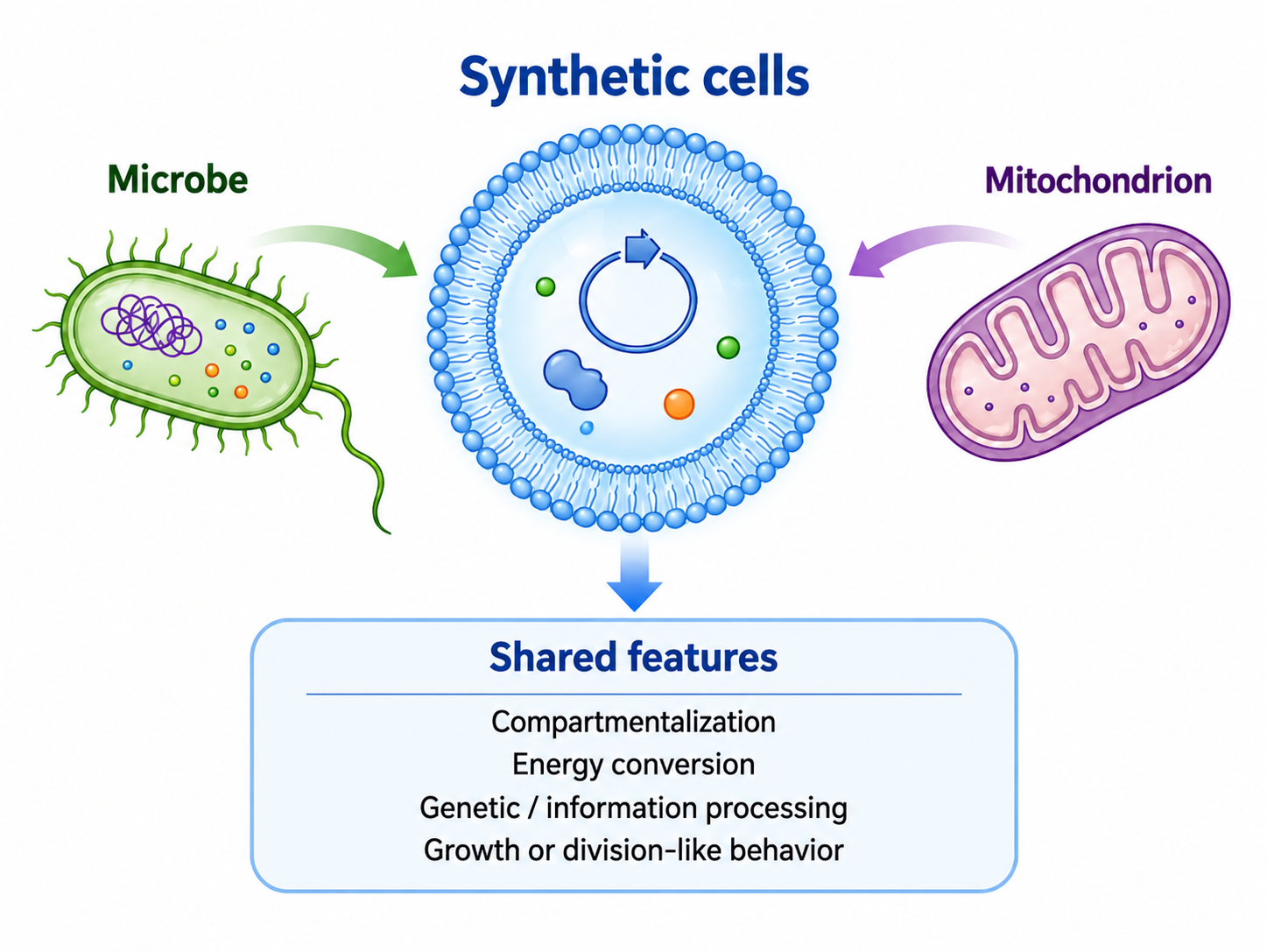
Synthetic cells are shifting biology from the observation and modification of existing life toward the deliberate construction of cell-like systems. The term, however, includes two biologically different entities: bottom-up protocells assembled from nonliving molecular components and top-down cells whose natural genomes have been minimized, rewritten, or replaced. These two classes occupy the extremes of a much broader landscape of engineered living systems, one that also includes conventional bacteria, yeasts, and mammalian and immune cells carrying synthetic gene circuits, logic programs, and redesigned metabolic pathways. This Perspective is deliberately centered on the two extremes, because they bracket the range of biological autonomy and pose the sharpest contrast between a programmable chemical package and a self-replicating organism; the wider landscape is noted and is drawn upon throughout wherever it bears directly on interaction with microbial communities. Both approaches can clarify the minimum requirements for cellular organization, test hypotheses about the origin and evolution of life, expand biological chemistry, and support programmable sensing or therapy. Their most consequential future setting may not be an isolated laboratory vessel but a microbial ecosystem. Synthetic cells could detect pathogens, intercept virulence signals, deliver antimicrobials locally, support commensal organisms, or restore metabolic functions lost from a disturbed microbiome. The same capacity for molecular communication could also disrupt commensal networks, impose new selective pressures, transfer genetic information, provide exploitable metabolites, or behave unpredictably in complex communities. Because the deep architecture of life—an informational core, a bioenergetic engine, and a membrane-bounded interface under selection—is broadly conserved and governed by conformational matching, engineered constructs will be interpreted through the same molecular languages that natural organisms use to recognize nutrients, competitors, hosts, and threats. It is proposed that synthetic-cell safety should therefore be evaluated relationally: not only by what an engineered cell does alone, but by how natural microorganisms recognize, use, resist, modify, or reorganize around it. Throughout this Perspective, interactions are described as desired or unwanted relative to an explicitly stated design intention, rather than as beneficial or negative, because the same molecular event may be desirable in one ecological and clinical context and unwanted in another. The central challenge is to engineer compatibility where benefit is intended while preserving strong limits on persistence, evolution, and ecological reach.
- Schwille P, Spatz J, Landfester K, et al. MaxSynBio: Avenues towards creating cells from the bottom up. Angew Chem Int Ed Engl. 2018;57(41):13382-13392. doi: 10.1002/anie.201802288
- Xu C, Hu S, Chen X. Artificial cells: From basic science to applications. Mater Today. 2016;19(9):516-532. doi: 10.1016/j.mattod.2016.02.020
- Gardner TS, Cantor CR, Collins JJ. Construction of a genetic toggle switch in Escherichia coli. Nature. 2000;403(6767):339-342. doi: 10.1038/35002131
- Elowitz MB, Leibler S. A synthetic oscillatory network of transcriptional regulators. Nature. 2000;403(6767):335-338. doi: 10.1038/35002125
- Riglar DT, Silver PA. Engineering bacteria for diagnostic and therapeutic applications. Nat Rev Microbiol. 2018;16(4):214-225. doi: 10.1038/nrmicro.2017.172
- Isabella VM, Ha BN, Castillo MJ, et al. Development of a synthetic live bacterial therapeutic for the human metabolic disease phenylketonuria. Nat Biotechnol. 2018;36(9):857-864. doi: 10.1038/nbt.4222
- Bacchus W, Aubel D, Fussenegger M. Biomedically relevant circuit-design strategies in mammalian synthetic biology. Mol Syst Biol. 2013;9:691. doi: 10.1038/msb.2013.48
- Morsut L, Roybal KT, Xiong X, et al. Engineering customized cell sensing and response behaviors using synthetic Notch receptors. Cell. 2016;164(4):780-791. doi: 10.1016/j.cell.2016.01.012
- Roybal KT, Rupp LJ, Morsut L, et al. Precision tumor recognition by T cells with combinatorial antigen-sensing circuits. Cell. 2016;164(4):770-779. doi: 10.1016/j.cell.2016.01.011
- Ro DK, Paradise EM, Ouellet M, et al. Production of the antimalarial drug precursor artemisinic acid in engineered yeast. Nature. 2006;440(7086):940-943. doi: 10.1038/nature04640
- Gibson DG, Glass JI, Lartigue C, et al. Creation of a bacterial cell controlled by a chemically synthesized genome. Science. 2010;329(5987):52-56. doi: 10.1126/science.1190719
- Hutchison CA III, Chuang R-Y, Noskov VN, et al. Design and synthesis of a minimal bacterial genome. Science. 2016;351(6280):aad6253. doi: 10.1126/science.aad6253
- Dai Z, Aoki W, Chaiyen P, et al. A framework for building a synthetic cell from the SynCell Asia Initiative. Nat Biotechnol. 2026;44(7):1084-1088. doi: 10.1038/s41587-026-03153-w
- Noireaux V, Libchaber A. A vesicle bioreactor as a step toward an artificial cell assembly. Proc Natl Acad Sci USA. 2004;101(51):17669-17674. doi: 10.1073/pnas.0408236101
- Fredens J, Wang K, de la Torre D, et al. Total synthesis of Escherichia coli with a recoded genome. Nature. 2019;569(7757):514-518. doi: 10.1038/s41586-019-1192-5
- Gaut NJ, Deich C, Cash B, Hoog T, Engelhart AE, Adamala KP. A Chemically Defined Synthetic Cell Capable Of Growth And Replication. bioRxiv. Preprint posted online July 2, 2026. doi: 10.64898/2026.07.01.735724
- Ozturk SF, Sasselov DD. Life’s homochirality: Across a prebiotic network. Proc Natl Acad Sci USA. 2025;122(34):e2505126122. doi: 10.1073/pnas.2505126122
- Adamala KP, Agashe D, Belkaid Y, et al. Confronting risks of mirror life. Science. 2024;386(6728):1351-1353. doi: 10.1126/science.ads9158
- Rutherford ST, Bassler BL. Bacterial quorum sensing: Its role in virulence and possibilities for its control. Cold Spring Harb Perspect Med. 2012;2(11):a012427. doi: 10.1101/cshperspect.a012427
- Lentini R, Martín NY, Forlin M, et al. Two-way chemical communication between artificial and natural cells. ACS Cent Sci. 2017;3(2):117-123. doi: 10.1021/acscentsci.6b00330
- Ding Y, Contreras-Llano LE, Morris E, Mao M, Tan C. Minimizing context dependency of gene networks using artificial cells. ACS Appl Mater Interfaces. 2018;10(36):30137-30146. doi: 10.1021/acsami.8b10029
- Sedlmayer F, Hell D, Müller M, Ausländer D, Fussenegger M. Designer cells programming quorum-sensing interference with microbes. Nat Commun. 2018;9(1):1822. doi: 10.1038/s41467-018-04223-7
- Sedlmayer F, Jaeger T, Jenal U, Fussenegger M. Quorum-quenching human designer cells for closed-loop control of Pseudomonas aeruginosa biofilms. Nano Lett. 2017;17(8):5043-5050. doi: 10.1021/acs.nanolett.7b02270
- Mandell DJ, Lajoie MJ, Mee MT, et al. Biocontainment of genetically modified organisms by synthetic protein design. Nature. 2015;518(7537):55-60. doi: 10.1038/nature14121
- Rovner AJ, Haimovich AD, Katz SR, et al. Recoded organisms engineered to depend on synthetic amino acids. Nature. 2015;518(7537):89-93. doi: 10.1038/nature14095
- Chan CT, Lee JW, Cameron DE, Bashor CJ, Collins JJ. ‘Deadman’ and ‘Passcode’ microbial kill switches for bacterial containment. Nat Chem Biol. 2016;12(2):82-86. doi: 10.1038/nchembio.1979
- Chang CY, Vila JCC, Bender M, et al. Engineering complex communities by directed evolution. Nat Ecol Evol. 2021;5(7):1011-1023. doi: 10.1038/s41559-021-01457-5
- Stefano GB. Life as a thermodynamic continuum: Genetic sharing and the unified architecture of biological systems. Biomed J Sci Tech Res. 2026;65(4):57865-57870. doi: 10.26717/BJSTR.2026.65.010221
- Stefano GB. Immunity as an evolutionary stabilizer: Microbial competition, biological complexity, and thermodynamic organization. Microbes Immun. 2026. doi: 10.36922/MI026240066
- Berens C, Hillen W. Gene regulation by tetracyclines. Constraints of resistance regulation in bacteria shape TetR for application in eukaryotes. Eur J Biochem. 2003;270(15):3109-3121. doi: 10.1046/j.1432-1033.2003.03694.x
- Nevozhay D, Adams RM, Murphy KF, Josić K, Balázsi G. Negative autoregulation linearizes the dose-response and suppresses the heterogeneity of gene expression. Proc Natl Acad Sci USA. 2009;106(13):5123-5128. doi: 10.1073/pnas.0809901106