

A four-domain framework for secondary immunodeficiency after CAR T-cell and T-cell-engaging antibody therapy

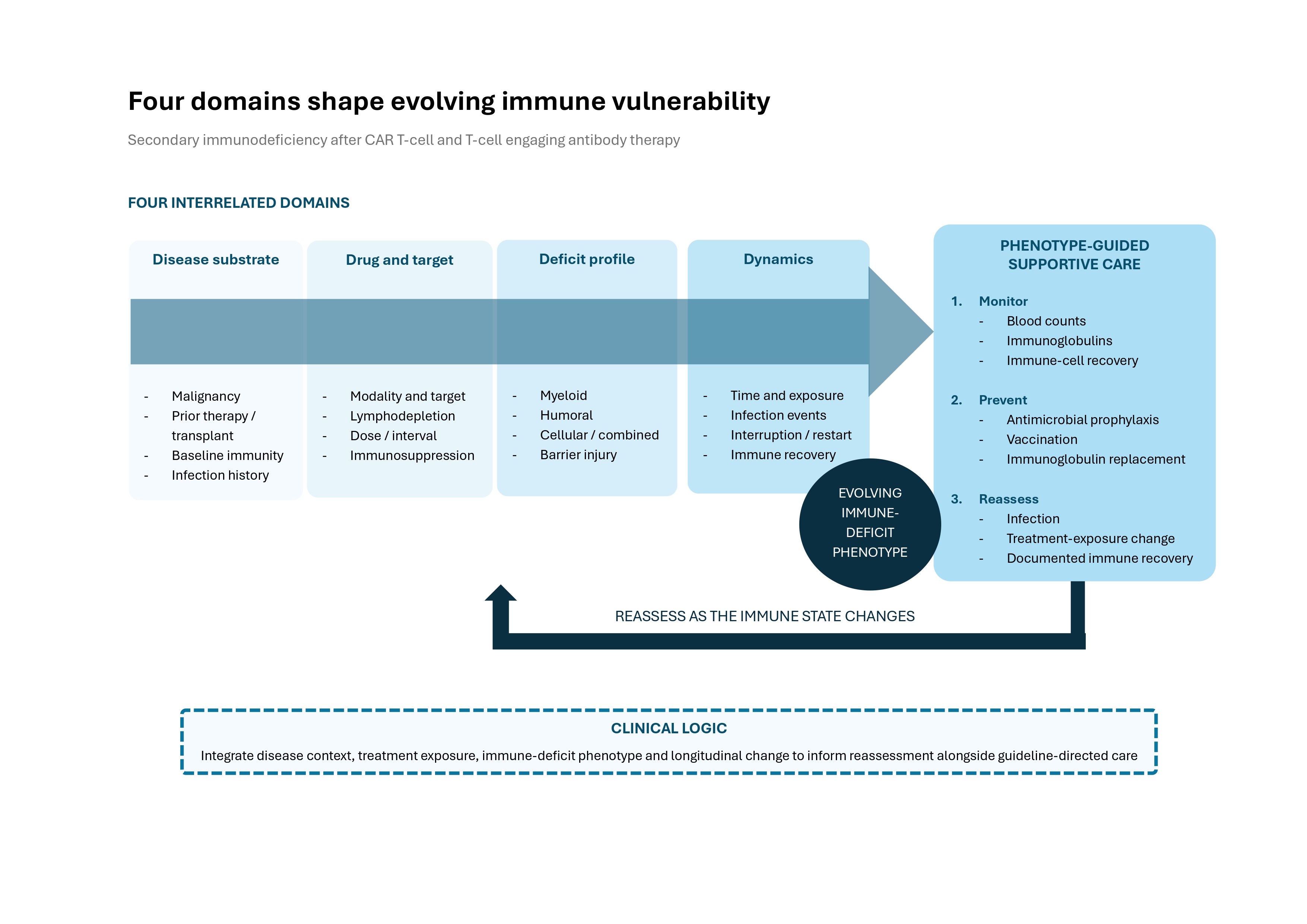
Chimeric antigen receptor (CAR) T-cell therapies and T-cell-engaging antibodies have transformed the treatment of hematologic malignancies but can induce prolonged, overlapping, and dynamically evolving immune deficits that are not adequately captured by hypogammaglobulinemia alone. Infection susceptibility reflects the interplay among the underlying disease and prior treatment, the immune-effector modality and therapeutic target, the predominant immune-deficit phenotype, and its evolution over time. We therefore propose a four-domain framework—Disease substrate, Drug and target, Deficit profile, and Dynamics—as a pragmatic structure for longitudinal characterization of secondary immunodeficiency after CAR T-cell and T-cell-engaging antibody therapy. The framework integrates myeloid, humoral, cellular, combined, and mucosal or epithelial barrier deficits with treatment-specific exposures and patterns of immune recovery, linking them to phenotype- and phase-adapted monitoring and prevention. We synthesize evidence on infection epidemiology, immune reconstitution, vaccination, antimicrobial prophylaxis, and immunoglobulin replacement while distinguishing established recommendations from practices supported mainly by observational data or expert consensus. A dynamic, phenotype-guided approach may improve targeting of preventive interventions while limiting avoidable prophylactic exposure. Priority research needs include standardized immune and infection end points, prospective longitudinal immune phenotyping, externally validated dynamic risk models, and comparative-effectiveness studies of immunoglobulin replacement, response-adapted extension of dosing intervals for T-cell-engaging antibodies, and antimicrobial prophylaxis.
- Shahid Z, Jain T, Dioverti V, et al. Best Practice Considerations by The American Society of Transplant and Cellular Therapy: Infection Prevention and Management After Chimeric Antigen Receptor T Cell Therapy for Hematological Malignancies. Transplant Cell Ther. 2024;30(10):955-969. doi: 10.1016/j.jtct.2024.07.018
- Raje N, Anderson K, Einsele H, et al. Monitoring, prophylaxis, and treatment of infections in patients with MM receiving bispecific antibody therapy: consensus recommendations from an expert panel. Blood Cancer J. 2023;13(1):116. doi: 10.1038/s41408-023-00879-7
- Mohan M, Chakraborty R, Bal S, et al. Recommendations on prevention of infections during chimeric antigen receptor T-cell and bispecific antibody therapy in multiple myeloma. Br J Haematol. 2023;203(5):736-746. doi: 10.1111/bjh.18909
- Ludwig H, Terpos E, van de Donk NWCJ, et al. Prevention and management of adverse events during treatment with bispecific antibodies and CAR T cells in multiple myeloma: a consensus report of the European Myeloma Network. Lancet Oncol. 2023;24(6):e255-e269. doi: 10.1016/S1470-2045(23)00159-6
- Sutherland NM, Zhou B, Zhang L, et al. Association of CD19-targeted chimeric antigen receptor T-cell therapy with hypogammaglobulinemia, infection, and mortality. J Allergy Clin Immunol. 2025;155(2):605-615. doi: 10.1016/j.jaci.2024.10.021
- Munshi NC, Anderson LD Jr, Shah N, et al. Idecabtagene vicleucel in relapsed and refractory multiple myeloma. N Engl J Med. 2021;384(8):705-716. doi: 10.1056/NEJMoa2024850
- Berdeja JG, Madduri D, Usmani SZ, et al. Ciltacabtagene autoleucel, a B-cell maturation antigen-directed chimeric antigen receptor T-cell therapy in patients with relapsed or refractory multiple myeloma (CARTITUDE-1): a phase 1b/2 open-label study. Lancet. 2021;398(10297):314-324. doi: 10.1016/S0140-6736(21)00933-8
- Moreau P, Garfall AL, van de Donk NWCJ, et al. Teclistamab in relapsed or refractory multiple myeloma. N Engl J Med. 2022;387(6):495-505. doi: 10.1056/NEJMoa2203478
- Chari A, Minnema MC, Berdeja JG, et al. Talquetamab, a T-cell-redirecting GPRC5D bispecific antibody for multiple myeloma. N Engl J Med. 2022;387(24):2232-2244. doi: 10.1056/NEJMoa2204591
- Lesokhin AM, Tomasson MH, Arnulf B, et al. Elranatamab in relapsed or refractory multiple myeloma: phase 2 MagnetisMM-3 trial results. Nat Med. 2023;29(9):2259-2267. doi: 10.1038/s41591-023-02528-9
- Hill JA, Seo SK. How I prevent infections in patients receiving CD19-targeted chimeric antigen receptor T cells for B-cell malignancies. Blood. 2020;136(8):925-935. doi: 10.1182/blood.2019004000
- Frerichs KA, Verkleij CPM, Mateos MV, et al. Teclistamab impairs humoral immunity in patients with heavily pretreated myeloma: importance of immunoglobulin supplementation. Blood Adv. 2024;8(1):194-206. doi: 10.1182/bloodadvances.2023011658
- Smits F, Groen K, Korst CLBM, et al. Immunoglobulin supplementation and longer dosing intervals reduce risk of infections in patients with RRMM treated with teclistamab. Blood Cancer J. 2026;16(1):26. doi: 10.1038/s41408-026-01451-9
- Hammons L, Szabo A, Janardan A, et al. The changing spectrum of infection with BCMA and GPRC5D targeting bispecific antibody (bsAb) therapy in patients with relapsed refractory multiple myeloma. Haematologica. 2024;109(3):906-914. doi: 10.3324/haematol.2023.283590
- Mazahreh F, Mazahreh L, Schinke C, et al. Risk of infections associated with the use of bispecific antibodies in multiple myeloma: a pooled analysis. Blood Adv. 2023;7(13):3069-3074. doi: 10.1182/bloodadvances.2022009435
- Rodriguez-Otero P, Usmani S, Cohen AD, et al. International Myeloma Working Group immunotherapy committee consensus guidelines and recommendations for optimal use of T-cell-engaging bispecific antibodies in multiple myeloma. Lancet Oncol. 2024;25(5):e205-e216. doi: 10.1016/S1470-2045(24)00043-3
- Benda M, Reimann P, Willenbacher W, et al. Infectious toxicities associated with bispecific antibodies and CAR-T Cells in multiple myeloma: a systematic review. Ann Hematol. 2026;105(9). doi: 10.1007/s00277-026-07140-8
- Spataro F, Desantis V, Dicuonzo G, et al. Real-world evidence on infection risk in multiple myeloma treated with BiTEs and CAR-T cells: a meta-analysis. Exp Hematol Oncol. 2026;15(1):56. doi: 10.1186/s40164-026-00798-w
- Lancman G, Parsa K, Kotlarz K, et al. IVIg Use Associated with Ten-Fold Reduction of Serious Infections in Multiple Myeloma Patients Treated with Anti-BCMA Bispecific Antibodies. Blood Cancer Discov. 2023;4(6):440-451. doi: 10.1158/2643-3230.BCD-23-0049
- Mohan M, Szabo A, Cheruvalath H, et al. Effect of Intravenous Immunoglobulin (IVIG) Supplementation on infection-free survival in recipients of BCMA-directed bispecific antibody therapy for multiple myeloma. Blood Cancer J. 2025;15(1):74. doi: 10.1038/s41408-025-01282-0
- Fleischer A, Roll M, Panther F, et al. Supportive care for talquetamab-related dysgeusia in multiple myeloma: mixed-methods evidence, nutrition-focused flowchart, and digital companion concept. Support Care Cancer. 2026;34(7):668. doi: 10.1007/s00520-026-10863-z
- Fleischer A, Kurth S, Duell J, et al. Neuropsychiatric manifestations following chimeric antigen receptor T cell therapy for cancer: a systematic review of clinical outcomes and management strategies. J Immunother Cancer. 2024;12(12):e009174. doi: 10.1136/jitc-2024-009174
- Rejeski K, Perez A, Iacoboni G, et al. The CAR-HEMATOTOX risk-stratifies patients for severe infections and disease progression after CD19 CAR-T in R/R LBCL. J Immunother Cancer. 2022;10(5):e004475. doi: 10.1136/jitc-2021-004475
- de Boer JW, Keijzer K, van Dorp S, et al. Population-based validation of the CAR-HEMATOTOX for hematotoxicity, infections, and survival after CART in R/R LBCL. Blood Adv. 2025;9(21):5641-5650. doi: 10.1182/bloodadvances.2025016689
- van Besien H, Easwar N, Demetres M, et al. Comparative infection risk in CAR T vs bispecific antibodies in B-cell lymphoma: a systematic review and meta-analysis. Blood Adv. 2025;9(23):6063-6075. doi: 10.1182/bloodadvances.2025016291
- Kim DH, Lee N, Koh Y, et al. Infections after bispecific antibodies in B-cell lymphomas. Blood Adv. 2026;10(6):2006-2015. doi: 10.1182/bloodadvances.2025017366
- Khatsuria F, McMullan C, Aiyegbusi OL, et al. Development of a conceptual framework for an electronic patient-reported outcome (ePRO) system measuring symptoms and impacts of CAR T-cell therapies in patients with haematological malignancies. Lancet Oncol. 2024;25(10):e476-e488. doi: 10.1016/S1470-2045(24)00256-0
- Hughes SE, Khatsuria F, McMullan C, et al. Measure selection for an electronic patient-reported outcome (ePRO) system for CAR T-cell therapy patients: a modified Delphi consensus study. EClinicalMedicine. 2025;84:103256. doi: 10.1016/j.eclinm.2025.103256
- Spanjaart AM, Pennings ERA, Kos M, et al. Development of a core set of patient- and caregiver-reported signs and symptoms to facilitate early recognition of acute chimeric antigen receptor T-cell therapy toxicities. JCO Oncol Pract. 2023;19(3):e407-e416. doi: 10.1200/OP.22.00501
- Moore SL, Peterson GJ, Montoya SR, et al. Using technology for patient-centered care at home after CAR T-cell therapy or stem cell transplant: a prospective feasibility study. Front Immunol. 2025;16:1403249. doi: 10.3389/fimmu.2025.1403249