

Reverse vaccinology approach for the design of a transmission-blocking vaccine by targeting the malaria vector Anopheles

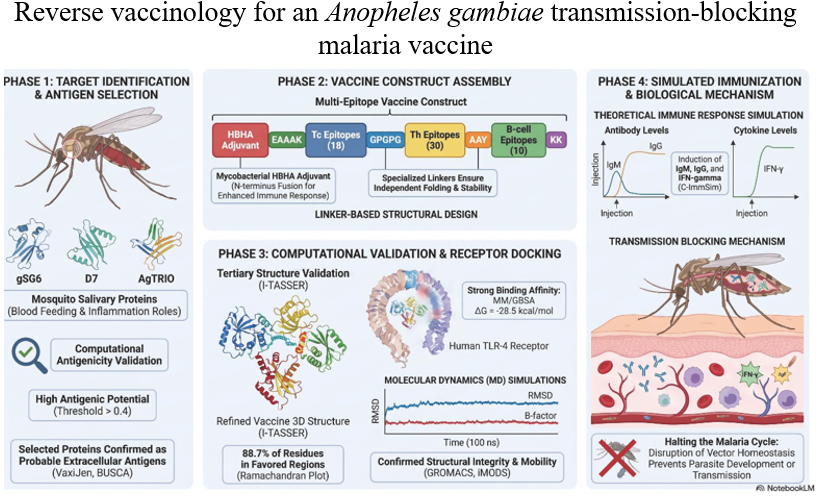
According to the latest update from WHO, approximately 263 million cases of malaria were reported globally. The mosquito species Anopheles gambiae is the primary vector transmitting the malaria-causing pathogen Plasmodium spp. Scientists have recently focused on developing a transmission-blocking vaccine (TBV) to combat malaria by targeting vector homeostasis rather than specific Plasmodium species, which vary in their genomes and drug susceptibilities. To create this TBV, three salivary proteins (gSG6, D7, and AgTRIO) were selected as potential antigens. From these proteins, epitopes recognized by cytotoxic T cells (18), helper T cells (30), and B cells (10) were selected. These potentially positive antigens were then combined with mycobacterial tuberculosis heparin-binding hemagglutinin using suitable peptide linkers. The resulting vaccine sequence underwent prediction of biochemical properties and secondary and tertiary structure. The best model was generated using the I-TASSER platform, refined, validated, and docked to Toll-like receptor-4 (TLR-4) via the InterEvDock 2 server. The consensus docked complex demonstrated stability, mobility, and flexibility, as assessed through the Internal Coordinates Normal Mode Analysis Server and Groningen Machine for Chemical Simulations dynamics simulations. Furthermore, the vaccine exhibited a well-defined three-dimensional structure and strong binding to TLR-4 through multiple bonds. Molecular mechanics/generalized Born surface area yielded a ΔG of −28.5 kcal mol−1; however, stable binding was not achieved during the 100 ns molecular dynamics simulation, as indicated by a root mean square deviation of 1.25 nm. Following in silico simulation of vaccination, the vaccine was predicted to significantly induce robust B-cell and T-cell responses, antibody production (both IgM and IgG), and interferon-γ secretion. Importantly, this multi-epitope malaria TBV demonstrated predicted immunogenic potency without evidence of allergenicity or toxicity, suggesting its potential to limit the transmission of multidrug-resistant Plasmodium strains. However, these computational predictions require validation through in vitro and in vivo studies.
- WHO. Fact sheet about malaria. 2024. Available from: https://www.who.int/news-room/fact-sheets/detail/malaria. Accessed July 3, 2025.
- González-Sanz M, Berzosa P, Norman FF. Updates on Malaria Epidemiology and Prevention Strategies. Curr Infect Dis Rep. 2023;25(7):131-139. doi: 10.1007/s11908-023-00805-9
- Steffen R, Lautenschlager S, Fehr J. Travel restrictions and lockdown during the COVID-19 pandemic—impact on notified infectious diseases in Switzerland. J Travel Med. 2020;27(8):taaa180. doi: 10.1093/jtm/taaa180
- Norman FF, Treviño-Maruri B, Ruiz Giardín JM, et al. Trends in imported malaria during the COVID-19 pandemic, Spain (+Redivi Collaborative Network). J Travel Med. 2022;29(6):taac083. doi: 10.1093/jtm/taac083
- Choy B, Bristowe H, Khozoee B, Lampejo T. Increased imported severe Plasmodium falciparum malaria involving hyperparasitaemia (>10%) in a UK hospital following relaxation of COVID-19 restrictions compared to the pre-pandemic period. J Travel Med. 2022;29(8):taac116. doi: 10.1093/jtm/taac116
- Chawla J, Oberstaller J, Adams JH. Targeting Gametocytes of the Malaria Parasite Plasmodium falciparum in a Functional Genomics Era: Next Steps. Pathogens. 2021;10(3):346. doi: 10.3390/pathogens10030346
- Alemayehu A. Biology and epidemiology of Plasmodium falciparum and Plasmodium vivax gametocyte carriage: Implication for malaria control and elimination. Parasite Epidemiol Control. 2023;21:e00295. doi: 10.1016/j.parepi.2023.e00295
- Carter LM, Kafsack BFC, Llinás M, Mideo N, Pollitt LC, Reece SE. Stress and sex in malaria parasites: Why does commitment vary?Evol Med Public Health. 2013;2013(1):135-147. doi: 10.1093/emph/eot011
- Meibalan E, Marti M. Biology of Malaria Transmission. Cold Spring Harb Perspect Med. 2017;7(3):a025452. doi: 10.1101/cshperspect.a025452
- Oduma CO, Koepfli C. Plasmodium falciparum and Plasmodium vivax Adjust Investment in Transmission in Response to Change in Transmission Intensity: A Review of the Current State of Research. Front Cell Infect Microbiol. 2021;11:786317. doi: 10.3389/fcimb.2021.786317
- Daily JP. Malaria 2017: Update on the Clinical Literature and Management. Curr Infect Dis Rep. 2017;19(8):28. doi: 10.1007/s11908-017-0583-8
- Siddiqui AJ, Bhardwaj J, Saxena J, et al. A Critical Review on Human Malaria and Schistosomiasis Vaccines: Current State, Recent Advancements, and Developments. Vaccines. 2023;11(4):792. doi: 10.3390/vaccines11040792
- Draper SJ, Sack BK, King CR, et al. Malaria Vaccines: Recent Advances and New Horizons. Cell Host Microbe. 2018;24(1):43-56. doi: 10.1016/j.chom.2018.06.008
- Alven S, Aderibigbe B. Combination Therapy Strategies for the Treatment of Malaria. Molecules. 2019;24(19):3601. doi: 10.3390/molecules24193601
- Koepfli C, Nguitragool W, Almeida ACG de, et al. Identification of the asymptomatic Plasmodium falciparum and Plasmodium vivax gametocyte reservoir under different transmission intensities. PLOS Neglected Trop Dis. 2021;15(8):e0009672. doi: 10.1371/journal.pntd.0009672
- Oduma CO, Ogolla S, Atieli H, et al. Increased investment in gametocytes in asymptomatic Plasmodium falciparum infections in the wet season. BMC Infect Dis. 2021;21(1):44. doi: 10.1186/s12879-020-05761-6
- Challenger JD, Olivera Mesa D, Da DF, et al. Predicting the public health impact of a malaria transmission-blocking vaccine. Nat Commun. 2021;12(1):1494. doi: 10.1038/s41467-021-21775-3
- Takashima E, Tachibana M, Morita M, Nagaoka H, Kanoi BN, Tsuboi T. Identification of Novel Malaria Transmission-Blocking Vaccine Candidates. Front Cell Infect Microbiol. 2021;11:805482. doi: 10.3389/fcimb.2021.805482
- Duffy PE. Current approaches to malaria vaccines. Curr Opin Microbiol. 2022;70:102227. doi: 10.1016/j.mib.2022.102227
- Oseno B, Marura F, Ogwang R, et al. Characterization of Anopheles gambiae D7 salivary proteins as markers of human–mosquito bite contact. Parasites Vectors. 2022;15(1):11. doi: 10.1186/s13071-021-05130-5
- Kearney EA, Agius PA, Chaumeau V, Cutts JC, Simpson JA, Fowkes FJ. Anopheles salivary antigens as serological biomarkers of vector exposure and malaria transmission: A systematic review with multilevel modelling. eLife. 2021;10:e73080. doi: 10.7554/eLife.73080
- Savojardo C, Martelli PL, Fariselli P, Profiti G, Casadio R. BUSCA: an integrative web server to predict subcellular localization of proteins. Nucleic Acids Res. 2018;46(W1):W459-W466. doi: 10.1093/nar/gky320
- Doytchinova IA, Flower DR. VaxiJen: a server for prediction of protective antigens, tumour antigens and subunit vaccines. BMC Bioinform. 2007;8(1):4. doi: 10.1186/1471-2105-8-4
- Larsen MV, Lundegaard C, Lamberth K, Buus S, Lund O, Nielsen M. Large-scale validation of methods for cytotoxic T-lymphocyte epitope prediction. BMC Bioinform. 2007;8:424. doi: 10.1186/1471-2105-8-424
- Vita R, Mahajan S, Overton JA, et al. The Immune Epitope Database (IEDB): 2018 update. Nucleic Acids Res. 2019;47(D1):D339-D343. doi: 10.1093/nar/gky1006
- Dhanda SK, Vir P, Raghava GP. Designing of interferon-gamma inducing MHC class-II binders. Biology Direct. 2013;8(1):30. doi: 10.1186/1745-6150-8-30
- Jespersen MC, Peters B, Nielsen M, Marcatili P. BepiPred-2.0: improving sequence-based B-cell epitope prediction using conformational epitopes. Nucleic Acids Res. 2017;45(W1):W24-W29. doi: 10.1093/nar/gkx346
- Wei L, Ye X, Sakurai T, Mu Z, Wei L. ToxIBTL: prediction of peptide toxicity based on information bottleneck and transfer learning. Bioinformatics. 2022;38(6):1514-1524. doi: 10.1093/bioinformatics/btac006
- Nguyen MN, Krutz NL, Limviphuvadh V, Lopata AL, Gerberick GF, Maurer-Stroh S. AllerCatPro 2.0: a web server for predicting protein allergenicity potential. Nucleic Acids Res. 2022;50(W1):W36-W43. doi: 10.1093/nar/gkac446
- Menozzi FD, Reddy VM, Cayet D, et al. Mycobacterium tuberculosis heparin-binding haemagglutinin adhesin (HBHA) triggers receptor-mediated transcytosis without altering the integrity of tight junctions. Microbes Infect. 2006;8(1):1-9. doi: 10.1016/j.micinf.2005.03.023
- Shamriz S, Ofoghi H, Moazami N. Effect of linker length and residues on the structure and stability of a fusion protein with malaria vaccine application. Comput Biol Med. 2016;76:24-29. doi: 10.1016/j.compbiomed.2016.06.015
- Johnson M, Zaretskaya I, Raytselis Y, Merezhuk Y, McGinnis S, Madden TL. NCBI BLAST: a better web interface. Nucleic Acids Res. 2008;36(2):W5-W9. doi: 10.1093/nar/gkn201
- Garg VK, Avashthi H, Tiwari A, et al. MFPPI–multi FASTA ProtParam interface. Bioinformation. 2016;12(2):74-77. doi: 10.6026/97320630012074
- Hebditch M, Carballo-Amador MA, Charonis S, Curtis R, Warwicker J. Protein–Sol: a web tool for predicting protein solubility from sequence. Bioinformatics. 2017;33(19):3098-3100. doi: 10.1093/bioinformatics/btx345
- Høie MH, Kiehl EN, Petersen B, et al. NetSurfP-3.0: accurate and fast prediction of protein structural features by protein language models and deep learning. Nucleic Acids Res. 2022;50(W1):W510 - W515. doi: 10.1093/nar/gkac439
- Yang J, Yan R, Roy A, Xu D, Poisson J, Zhang Y. The I-TASSER Suite: protein structure and function prediction. Nat Methods. 2015;12(1):7-8. doi: 10.1038/nmeth.3213
- Shuvo MH, Gulfam M, Bhattacharya D. DeepRefiner: high-accuracy protein structure refinement by deep network calibration. Nucleic Acids Res. 2021;49(W1):W147-W152. doi: 10.1093/nar/gkab361
- Laskowski RA, MacArthur MW, Thornton JM. PROCHECK: validation of protein-structure coordinates. In: International Tables for Crystallography. International Union of Crystallography; 2012:684-687. doi: 10.1107/97809553602060000882
- Quignot C, Rey J, Yu J, Tufféry P, Guerois R, Andreani J. InterEvDock2: an expanded server for protein docking using evolutionary and biological information from homology models and multimeric inputs. Nucleic Acids Res. 2018;46(W1):W408-W416. doi: 10.1093/nar/gky377
- Laskowski RA, Swindells MB. LigPlot+: Multiple Ligand–Protein Interaction Diagrams for Drug Discovery. J Chem Inf Model. 2011;51(10):2778-2786. doi: 10.1021/ci200227u
- Weng G, Wang E, Wang Z, et al. HawkDock: a web server to predict and analyze the protein–protein complex based on computational docking and MM/GBSA. Nucleic Acids Res. 2019;47(W1):W322-W330. doi: 10.1093/nar/gkz397
- WebGro | UAMS. Accessed February 4, 2023. https://simlab.uams.edu/index.php.
- López-Blanco JR, Aliaga JI, Quintana-Ortí ES, Chacón P. iMODS: internal coordinates normal mode analysis server. Nucleic Acids Res. 2014;42(W1):W271-W276.
- Craig DB, Dombkowski AA. Disulfide by Design 2.0: a web-based tool for disulfide engineering in proteins. BMC Bioinform. 2013;14:346. doi: 10.1186/1471-2105-14-346
- McWilliam H, Li W, Uludag M, et al. Analysis tool web services from the EMBL-EBI. Nucleic Acids Res. 2013;41(W1):W597-W600. doi: 10.1093/nar/gkt376
- Grote A, Hiller K, Scheer M, et al. JCat: a novel tool to adapt codon usage of a target gene to its potential expression host. Nucleic Acids Res. 2005;33(2):W526-W531. doi: 10.1093/nar/gki376
- Langdon WB, Petke J, Lorenz R. Evolving Better RNAfold Structure Prediction. In: Castelli M, Sekanina L, Zhang M, Cagnoni S, García-Sánchez P, eds. Genetic Programming. Vol 10781. Lecture Notes in Computer Science. Springer International Publishing; 2018:220-236. doi: 10.1007/978-3-319-77553-1_14
- Rapin N, Lund O, Bernaschi M, Castiglione F. Computational Immunology Meets Bioinformatics: The Use of Prediction Tools for Molecular Binding in the Simulation of the Immune System. PLoS ONE. 2010;5(4):e9862. doi: 10.1371/journal.pone.0009862
- Banjoko AW, Ng’uni T, Naidoo N, Ramsuran V, Hyrien O, Ndhlovu ZM. High resolution class I HLA-A, -B, and -C diversity in Eastern and Southern African populations. Sci Rep. 2025;15(1):23667. doi: 10.1038/s41598-025-06704-4
- Janse Van Rensburg WJ, De Kock A, Bester C, Kloppers JF. HLA major allele group frequencies in a diverse population of the Free State Province, South Africa. Heliyon. 2021;7(4):e06850. doi: 10.1016/j.heliyon.2021.e06850
- Martinelli DD. In silico vaccine design: A tutorial in immunoinformatics. Healthc Anal. 2022;2:100044. doi: 10.1016/j.health.2022.100044
- Sharma V, Singh S, Ratnakar TS, Prajapati VK. Chapter 29 - Immunoinformatics and reverse vaccinology methods to design peptide-based vaccines. In: Tripathi T, Dubey VK, eds. Advances in Protein Molecular and Structural Biology Methods. Academic Press; 2022:477-487. doi: 10.1016/B978-0-323-90264-9.00029-5
- Laurens MB. RTS,S/AS01 vaccine (MosquirixTM): an overview. Hum Vaccin Immunother. 2019;16(3):480-489. doi: 10.1080/21645515.2019.1669415
- Miller LH, Duffy PE, Culleton R. Transmission-Blocking Vaccines: From Conceptualization to Realization. Am J Trop Med Hyg. 2022;107(3):1-2. doi: 10.4269/ajtmh.22-0023
- Duffy PE, Patrick Gorres J. Malaria vaccines since 2000: progress, priorities, products. npj Vaccines. 2020;5(1):48. doi: 10.1038/s41541-020-0196-3
- Miura K, Flores-Garcia Y, Long CA, Zavala F. Vaccines and monoclonal antibodies: new tools for malaria control. Clin Microbiol Rev. 2024;37:e00071-23. doi: 10.1128/cmr.00071-23
- Mitran CJ, Yanow SK. The Case for Exploiting Cross-Species Epitopes in Malaria Vaccine Design. Front Immunol. 2020;11:335. doi: 10.3389/fimmu.2020.00335
- Cao Y, Bansal GP, Merino K, Kumar N. Immunological Cross-Reactivity between Malaria Vaccine Target Antigen P48/45 in Plasmodium vivax and P. falciparum and Cross–Boosting of Immune Responses. PLoS ONE. 2016;11(7):e0158212. doi: 10.1371/journal.pone.0158212
- Vijay S, Rawat M, Sharma A. Mass spectrometry based proteomic analysis of salivary glands of urban malaria vector Anopheles stephensi. Biomed Res Int. 2014;2014:686319. doi: 10.1155/2014/686319
- Zhang Y, Zhu X, Feng Y, et al. TLR4 and TLR9 signals stimulate protective immunity against blood-stage Plasmodium yoelii infection in mice. Exp Parasitol. 2016;170:73-81. doi: 10.1016/j.exppara.2016.09.003
- Al‐Madhagi H, Kanawati A, Tahan Z. Design of multi‐epitope chimeric vaccine against Monkeypox virus and SARS‐CoV‐2: A vaccinomics perspective. J Cellular Molecular Medi. 2024;28(10):e18452. doi: 10.1111/jcmm.18452
- Shilling PJ, Mirzadeh K, Cumming AJ, Widesheim M, Köck Z, Daley DO. Improved designs for pET expression plasmids increase protein production yield in Escherichia coli. Commun Biol. 2020;3(1):214. doi: 10.1038/s42003-020-0939-8
- Godat B, Engel L, Betz NA, Johnson TM. Methods for the purification of HQ-tagged proteins. Methods Mol Biol. 2008;421:151-168. doi: 10.1007/978-1-59745-582-4_11
- Loughran ST, Bree RT, Walls D. Purification of Polyhistidine-Tagged Proteins. Methods Mol Biol. 2017;1485:275-303. doi: 10.1007/978-1-4939-6412-3_14
- Maharaj L, Adeleke VT, Fatoba AJ, et al. Immunoinformatics approach for multi-epitope vaccine design against P. falciparum malaria. Infect Genet Evol. 2021;92:104875. doi: 10.1016/j.meegid.2021.104875
- Pritam M, Singh G, Swaroop S, Singh AK, Singh SP. Exploitation of reverse vaccinology and immunoinformatics as promising platform for genome-wide screening of new effective vaccine candidates against Plasmodium falciparum. BMC Bioinform. 2019;19(S13):468. doi: 10.1186/s12859-018-2482-x
- Ajibola O, Diop MF, Ghansah A, et al. In silico characterisation of putative Plasmodium falciparum vaccine candidates in African malaria populations. Sci Rep. 2021;11(1):16215. doi: 10.1038/s41598-021-95442-4
- Atapour A, Vosough P, Jafari S, Sarab GA. A multi-epitope vaccine designed against blood-stage of malaria: an immunoinformatic and structural approach. Sci Rep. 2022;12(1):11683. doi: 10.1038/s41598-022-15956-3
- Pandey RK, Bhatt TK, Prajapati VK. Novel Immunoinformatics Approaches to Design Multi-epitope Subunit Vaccine for Malaria by Investigating Anopheles Salivary Protein. Sci Rep. 2018;8(1):1125. doi: 10.1038/s41598-018-19456-1