

Integrated evaluation of immune system perturbation using structural, functional, and cellular immunotoxicity endpoints in rats

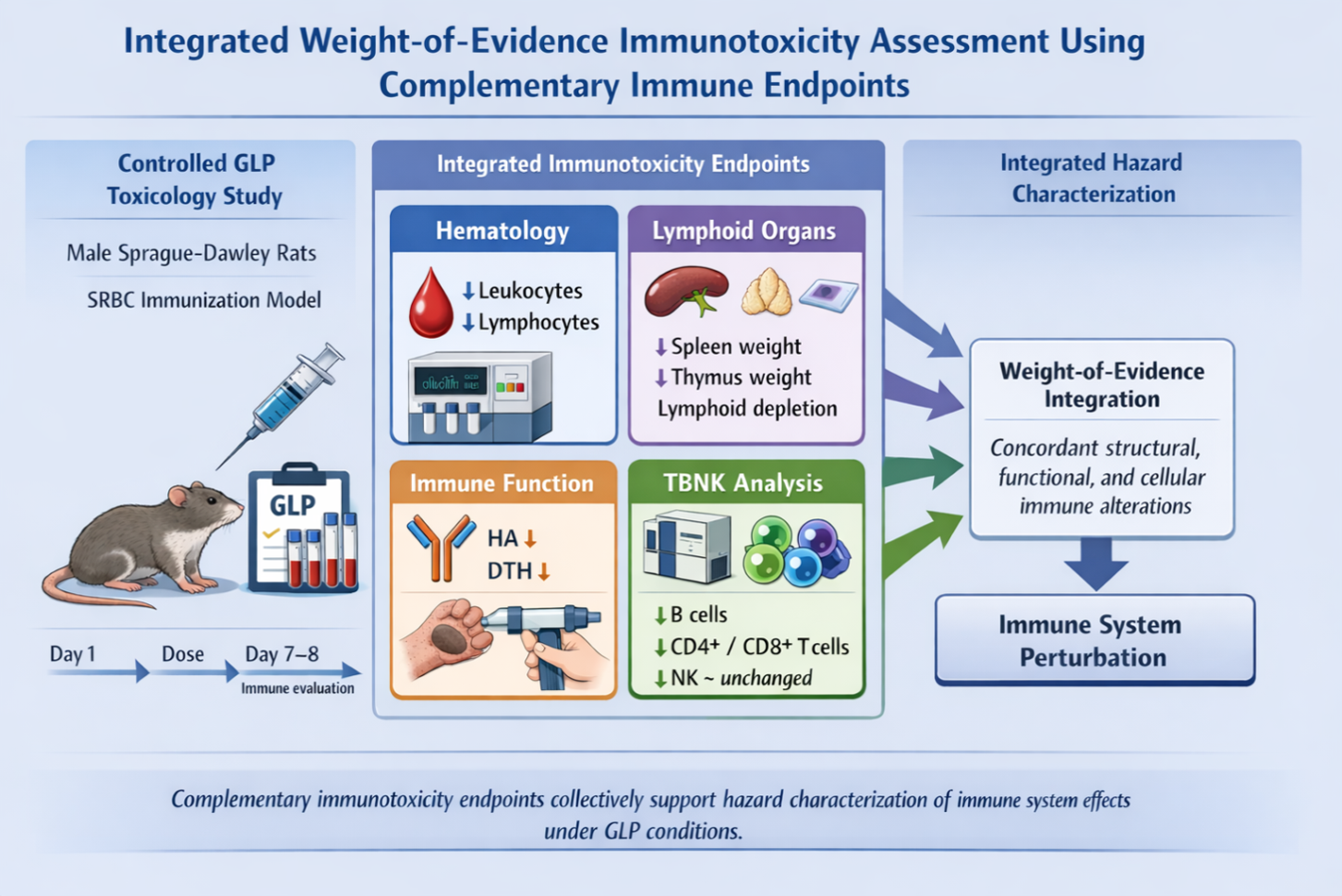
Evaluation of unintended immunotoxicity represents an important component of nonclinical safety assessment, as perturbation of immune function may increase susceptibility to infection, impair vaccine responses, and disrupt immune homeostasis. Regulatory guidance, including the International Council for Harmonisation S8 immunotoxicity guideline, recommends a weight-of-evidence approach in which observations from conventional toxicological endpoints are integrated with functional immune assays to support interpretation of immune system effects. In this study, an integrated immunotoxicity evaluation framework was applied to examine concordance among structural, functional, and cellular immune endpoints in male Sprague–Dawley rats using a well-characterized immunosuppressive reference compound. Hematological evaluation revealed leukopenia characterized primarily by lymphocyte depletion. Reductions in spleen and thymus weights were accompanied by histopathological evidence of lymphoid depletion in multiple immune tissues, including spleen, thymus, lymph nodes, Peyer’s patches, and bone marrow. Functional immune competence was assessed through hemagglutination antibody responses to sheep red blood cells and delayed-type hypersensitivity assays, both of which demonstrated marked suppression of adaptive immune responses. Flow cytometric immunophenotyping further demonstrated substantial reductions in B cell populations and decreases in CD4+ and CD8+ T cell counts, whereas natural killer-cell populations were comparatively less affected. The concordance of hematological alterations, lymphoid tissue changes, impaired functional immune responses, and lymphocyte subset depletion provides integrated evidence of immune system perturbation. These findings demonstrate that complementary immunotoxicity endpoints collectively support hazard characterization of immune system effects under Good Laboratory Practice conditions.
- Luster MI, Portier C, Pait DG, et al. Risk assessment in immunotoxicology. Toxicol Sci. 1992;18(2):200-210. doi: 10.1093/toxsci/18.2.200
- Luster MI, Portier C, Pait DG, et al. Risk assessment in immunotoxicology. Toxicol Sci. 1993;21(1):71-82. doi: 10.1093/toxsci/21.1.71
- Chandrasekar V, Panicker AJ, Dey AK, et al. Integrated approaches for immunotoxicity risk assessment: challenges and future directions. Discov Toxicol. 2024;1(1). doi: 10.1007/s44339-024-00010-w
- World Health Organization & International Programme on Chemical Safety. Guidance for immunotoxicity risk assessment for chemicals. World Health Organization. 2012. https://iris.who.int/handle/10665/330098
- Wexler P, ed. Encyclopedia of Toxicology. 4th edition. Academic Press, Elsevier; 2023. https://www.sciencedirect.com/referencework/9780323854344/encyclopedia-of-toxicology
- Emadi A, Jones RJ, Brodsky RA. Cyclophosphamide and cancer: golden anniversary. Nat Rev Clin Oncol. 2009;6(11):638-647. doi: 10.1038/nrclinonc.2009.146
- Aguilera-Lizarraga J, Hussein H, Boeckxstaens GE. Immune activation in irritable bowel syndrome: what is the evidence? Nat Rev Immunol. 2022;22(11):674-686. doi: 10.1038/s41577-022-00700-9
- Descotes J. Regulatory aspects of immunotoxicity evaluation. In: Descotes J, ed. Immunotoxicology of Drugs and Chemicals: An Experimental and Clinical Approach. Volume I: Principles and Methods of Immunotoxicology. Elsevier; 2004:257-268. doi: 10.1016/S1873-9822(04)80010-8
- International Council for Harmonisation. S8 immunotoxicity studies for human pharmaceuticals. ICH Harmonised Guideline; Step 5. Published 2005. https://database.ich.org/sites/default/files/S8_Guideline.pdf
- European Medicines Agency (EMA). Non-clinical guidelines. EMA. https://www.ema.europa.eu/en/human-regulatory-overview/research-development/scientific-guidelines/non-clinical-guidelines
- Center for Drug Evaluation and Research. Nonclinical Evaluation of the Immunotoxic Potential of Pharmaceuticals. US Food and Drug Administration. Published 2023. https://www.fda.gov/regulatory-information/search-fda-guidance-documents/nonclinical-evaluation-immunotoxic-potential-pharmaceuticals
- Organization for Economic Co-operation and Development (OECD). Test No. 407: Repeated Dose 28-day Oral Toxicity Study in Rodents. OECD Guidelines for the Testing of Chemicals. OECD Publishing; 2025. doi: 10.1787/9789264070684-en
- Karmaus AL, Kreutz AL, Oyetade O, et al. Perspectives on variability of in vivo toxicology studies: considerations for next-generation toxicology. Front Toxicol. 2026;8. doi: 10.3389/ftox.2026.1778353
- Downie AE, Barre RS, Robinson A, et al. Assessing immune phenotypes using simple proxy measures: promise and limitations. Discov Immunol. 2024;3(1). doi: 10.1093/discim/kyae010
- Stevenson LF. From tiers to truth - a biomarker-based framework for clinically relevant immunogenicity assessment. Bioanalysis. 2026;18(4):403-413. doi: 10.1080/17576180.2026.2672455
- Weaver RJ, Blomme EA, Chadwick AE, et al. Managing the challenge of drug-induced liver injury: a roadmap for the development and deployment of preclinical predictive models. Nat Rev Drug Discov. 2019;19(2):131-148. doi: 10.1038/s41573-019-0048-x
- Grudzinska-Goebel J, Benstein K, Bloem K, et al. Immunogenicity risk assessment for tailored mitigation and monitoring of biotherapeutics during development: recommendations from the European Immunogenicity Platform. Front Immunol. 2025;16. doi: 10.3389/fimmu.2025.1581153
- Garvey GJ, Anderson JK, Goodrum PE, et al. Weight of evidence evaluation for chemical-induced immunotoxicity for PFOA and PFOS: findings from an independent panel of experts. Crit Rev Toxicol. 2023;53(1):34-51. doi: 10.1080/10408444.2023.2194913
- Germolec DR, Lebrec H, Anderson SE, et al. Consensus on the Key Characteristics of Immunotoxic Agents as a Basis for Hazard Identification. Environ Health Perspect. 2022;130(10). doi: 10.1289/EHP10800
- Anderson SE, Shane HL. Investigative Immunotoxicology. In: Methods in Molecular Biology. Springer New York; 2018:27-46. doi: 10.1007/978-1-4939-8549-4_3
- Sparks R, Lau WW, Tsang JS. Expanding the immunology toolbox: embracing public-data reuse and crowdsourcing. Immunity. 2016;45(6):1191-1204. doi: 10.1016/j.immuni.2016.12.008
- Ogungbesan A, Neal-Kluever A, Rice P. Exploring the use of current immunological assays for the developmental immunotoxicity assessment of food contact materials. Food Chem Toxicol. 2019;133:110801. doi: 10.1016/j.fct.2019.110801
- Tourdot S, Karle AC, Rosenbaum M, et al. T cell assays for non-clinical immunogenicity risk assessment: best practices recommended by the European Immunogenicity Platform. Front Immunol. 2025;16. doi: 10.3389/fimmu.2025.1723110
- Brennan FR, Andrews L, Arulanandam AR, et al. Current strategies in the non-clinical safety assessment of biologics: new targets, new molecules, new challenges. Regul Toxicol Pharmacol. 2018;98:98-107. doi: 10.1016/j.yrtph.2018.07.009
- Bhatt LK, Dwivedi P, Ranvir RK, Sundar R, Jain MR. Integrating immune adverse outcome pathways into vaccine safety evaluation. Arch Toxicol. 2025;100(1):405-410. doi: 10.1007/s00204-025-04202-0
- Mazein A, Shoaib M, Alb M, et al. Using interactive platforms to encode, manage and explore immune-related adverse outcome pathways. J Immunotoxicol. 2024;21(sup1). doi: 10.1080/1547691X.2024.2345154
- Awad MS, Sen’kova AV, Markov AV, Salomatina OV, Zenkova MA, Markov OV. Cyclophosphamide-mediated induction of myeloid-derived suppressor cells in vivo: kinetics of accumulation, immune profile, and immunomodulation by oleanane-type triterpenoids. Int J Mol Sci. 2026;27(2):564. doi: 10.3390/ijms27020564
- Siriarchavatana P, Suthamnatpo N, Limpanasitthikul W. Immunoprotective properties of Scaphium scaphigerum fruits in cyclophosphamide-induced immunosuppressed mice targeting humoral and cell-mediated immunity. Vet Integr Sci. 2026;24(1). doi: 10.12982/VIS.2026.024
- McIntosh KR, Segre M, Segre D. Characterization of cyclophosphamide-induced suppressor cells. Immunopharmacology. 1982;4(4):279-289. doi: 10.1016/0162-3109(82)90049-2
- Putman E, van der Laan JW, van Loveren H. Assessing immunotoxicity: guidelines. Fundam Clin Pharmacol. 2003;17(5):615-626. doi: 10.1046/j.1472-8206.2003.00181.x
- Yuandani, Nugraha SE, Laila L, Satria D. Immunomodulatory effects of standardized extract of Curcuma mangga Val. on cytokines, antibody and delayed-type hypersensitivity response in Wistar rats. Res Pharm Sci. 2021;16(1):16-25. doi: 10.4103/1735-5362.305185
- Spanhaak S. The ICH S8 immunotoxicity guidance. Immune function assessment and toxicological pathology: autonomous or synergistic methods to predict immunotoxicity? Exp Toxicol Pathol. 2006;57(5-6):373-376. doi: 10.1016/j.etp.2006.03.013
- Utaiwat P, Senawong G, Khongsukwiwat K, et al. Stimulation of humoral and cell-mediated immunities in healthy and cyclophosphamide-induced immunosuppressed rats by lyophilized Houttuynia cordata fermented drink. Food Agric Immunol. 2021;32(1):798-819. doi: 10.1080/09540105.2021.2003304
- Kelleher P, Greathead L, Whitby L, et al. European flow cytometry quality assurance guidelines for the diagnosis of primary immune deficiencies and assessment of immune reconstitution following B-cell depletion therapies and transplantation. Cytometry B Clin Cytom. 2024;106(6):424-436. doi: 10.1002/cyto.b.22195
- Probst HC, Stoitzner P, Amon L, et al. Guidelines for dendritic cell preparation and flow cytometry analysis of mouse nonlymphoid tissues. Eur J Immunol. 2022;53(11). doi: 10.1002/eji.202249819
- Cossarizza A, Chang HD, Radbruch A, et al. Guidelines for the use of flow cytometry and cell sorting in immunological studies (third edition). Eur J Immunol. 2021;51(12):2708-3145. doi: 10.1002/eji.202170126
- Organisation for Economic Co-operation and Development (OECD). Detailed Review Paper on In Vitro Test Addressing Immunotoxicity With a Focus on Immunosuppression. OECD Series on Testing and Assessment. Published 2022. doi: 10.1787/667965bc-en
- Johnson VJ, Luster MI, Maier A, Boles C, Miller EW, Arrieta DE. Application and interpretation of immunophenotyping data in nonclinical safety assessment. Front Toxicol. 2024;6. doi: 10.3389/ftox.2024.1409365
- Nandre RM, Terse PS. An overview of immunotoxicity in drug discovery and development. Toxicol Lett. 2025;403:66-75. doi: 10.1016/j.toxlet.2024.11.007
- Semwal R, Semwal RB, Lehmann J, Semwal DK. Recent advances in immunotoxicity and its impact on human health: causative agents, effects and existing treatments. Int Immunopharmacol. 2022;108:108859. doi: 10.1016/j.intimp.2022.108859
- Bi J, Mo C, Li S, et al. Immunotoxicity of metal and metal oxide nanoparticles: from toxic mechanisms to metabolism and outcomes. Biomater Sci. 2023;11(12):4151-4183. doi: 10.1039/D3BM00271C
- D’Souza LC, Paithankar JG, Stopper H, Pandey A, Sharma A. Environmental chemical-induced reactive oxygen species generation and immunotoxicity: a comprehensive review. Antioxid Redox Signal. 2024;40(10-12):691-714. doi: 10.1089/ars.2022.0117
- Nam M, Park W, Kim HY, Cho D. Natural Killer Cell Assays: Clinical Applications and Future Directions. Ann Lab Med. 2026;46(3):244-256. doi: 10.3343/alm.2025.0508