

Assessment of blood parameters for accurate sepsis diagnosis

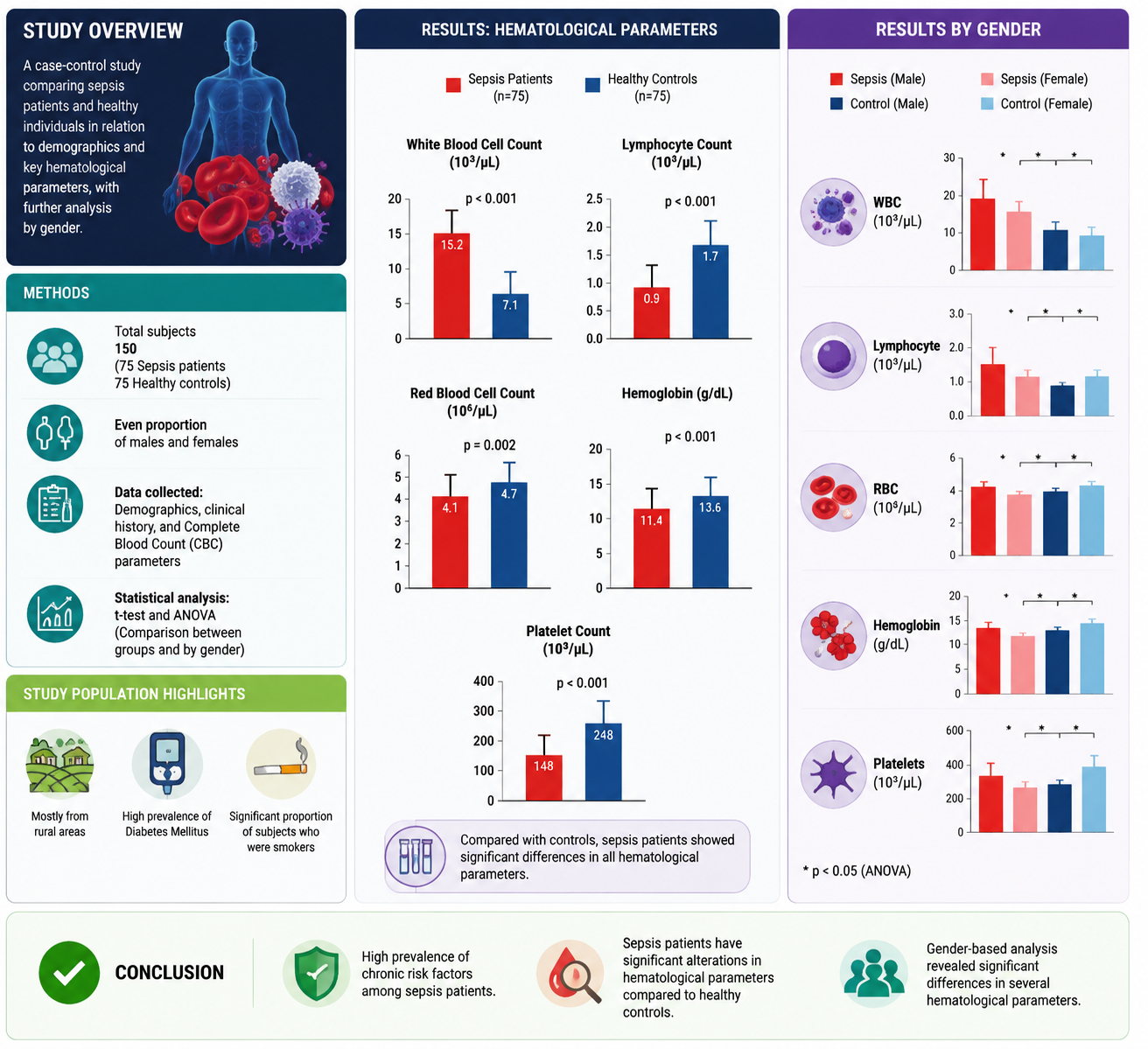
Background: Sepsis is a life-threatening medical emergency characterized by an exaggerated inflammatory response by the immune system to infection, which triggers a damaging cascade of events in the body’s tissues and organs. While all cases of sepsis originate from an infection, the main danger of the condition lies in excessive inflammation, which can result in organ failure and severe hypotension known as septic shock. Aim: This case-control study compared patients with sepsis with healthy individuals for demographics and key hematological parameters, with further analyses stratified by gender. Methods: A total of 150 subjects were recruited, with an equal proportion of males and females, and were classified as either patients with sepsis or controls. The study population was found to be mostly from rural areas with a high prevalence of diabetes mellitus and a significant proportion of subjects who were smokers. The values of complete blood count, a set of parameters including white blood cell count, lymphocyte count, red blood cell count, hemoglobin, and platelet count, were analyzed for differences between groups using t-test and analysis of variance. Results: Compared with the control group, sepsis patients showed significant differences in hematological parameters. Additionally, several specific hematological abnormalities were noted among individuals with sepsis compared to those who were healthy, such as anemia, marked lymphopenia, and evidence of leukocytosis. Both lymphocytes and platelets, which are indicative of the immune response, were differentially regulated by gender. Conclusion: There was a high prevalence of chronic risk factors among the sepsis group. Sepsis involves chronic risk factors, distinct hematological impairments, and gender-specific regulation of lymphocytes and platelets. Relevance for patients: Understanding these changes in blood parameters and gender differences can improve early sepsis detection and individualized care.
- Singer M, Deutschman CS, Seymour CW, et al. The Third International Consensus Definitions for Sepsis and Septic Shock (Sepsis-3). JAMA. 2016;315(8):801-810. doi: 10.1001/jama.2016.0287
- Hotchkiss RS, Monneret G, Payen D. Sepsis-induced immunosuppression: from cellular dysfunctions to immunotherapy. Nat Rev Immunol. 2013;13(12):862-874. doi: 10.1038/nri3552
- Pieracci FM, Barie PS. Diagnosis and management of iron-related anemias in critical illness. Crit Care Med. 2006;34(7):1898-1905. doi: 10.1097/01.CCM.0000220495.10510.C1
- Venkata C, Kashyap R, Farmer JC, Afessa B. Thrombocytopenia in adult patients with sepsis: incidence, risk factors, and its association with clinical outcome. J Intensive Care. 2013;1(1):9. doi: 10.1186/2052-0492-1-9
- Evans L, Rhodes A, Alhazzani W, et al. Surviving sepsis campaign: international guidelines for management of sepsis and septic shock 2021. Intensive Care Med. 2021;47(11):1181-1247. doi: 10.1007/s00134-021-06506-y
- Venkata C, Kashyap R, Farmer JC, Afessa B. Thrombocytopenia in adult patients with sepsis: incidence, risk factors, and its association with clinical outcome. J Intensive Care Med. 2013;1(1). doi: 10.1186/2052-0492-1-9
- Markwart R, Saito H, Harder T, et al. Epidemiology and burden of sepsis acquired in hospitals and intensive care units: A systematic review and meta-analysis. Intensive Care Med. 2020;46(8):1536-1551. doi: 10.1007/s00134-020-06106-2
- Langley RJ, Tsalik EL, van Velkinburgh JC, et al. An integrated clinico-metabolomic model improves prediction of death in sepsis. Sci Transl Med. 2013;5(195):195ra95. doi: 10.1126/scitranslmed.3005893
- Reinhart K, Daniels R, Kissoon N, Machado FR, Schachter RD, Finfer S. Recognizing Sepsis as a Global Health Priority—A WHO Resolution. N Engl J Med. 2017;377(5):414-417. doi: 10.1056/NEJMp1707170
- Shashikumar SP, Stanley MD, Sadiq I, et al. Early sepsis detection in critical care patients using multiscale blood pressure and heart rate dynamics. J Electrocardiol. 2017;50(6):739-743. doi: 10.1016/j.jelectrocard.2017.08.013
- Kataria Y, Remick D. Sepsis Biomarkers. Methods Mol Biol. 2021;2321:177-189. doi: 10.1007/978-1-0716-1488-4_16
- Agnello L, Bivona G, Parisi E, et al. Presepsin and Midregional Proadrenomedullin in Pediatric Oncologic Patients with Febrile Neutropenia. Lab Med. 2020;51(6):585-591. doi: 10.1093/labmed/lmaa011
- Bellia C, Agnello L, Lo Sasso B, et al. Mid-regional pro-adrenomedullin predicts poor outcome in non-selected patients admitted to an intensive care unit. Clin Chem Lab Med. 2019;57(4):549-555. doi: 10.1515/cclm-2018-0645
- Velissaris D, Zareifopoulos N, Karamouzos V, et al. Presepsin as a Diagnostic and Prognostic Biomarker in Sepsis. Cureus. 2021;13(5):e15019. doi: 10.7759/cureus.15019
- Rittirsch D, Flierl MA, Ward PA. Harmful molecular mechanisms in sepsis. Nat Rev Immunol. 2008;8(10):776-787. doi: 10.1038/nri2402
- Bone RC, Balk RA, Cerra FB, et al. Definitions for sepsis and organ failure and guidelines for the use of innovative therapies in sepsis. The ACCP/SCCM Consensus Conference Committee. American College of Chest Physicians/Society of Critical Care Medicine. Chest. 1992;101(6):1644-1655. doi: 10.1378/chest.101.6.1644
- Levy MM, Fink MP, Marshall JC, et al. 2001 SCCM/ESICM/ACCP/ATS/SIS International Sepsis Definitions Conference. Intensive Care Med. 2003;29(4):530-538. doi: 10.1007/s00134-003-1662-x
- Nedeva C, Menassa J, Puthalakath H. Sepsis: Inflammation Is a Necessary Evil. Front Cell Dev Biol. 2019;7:108. doi: 10.3389/fcell.2019.00108
- Brady J, Horie S, Laffey JG. Role of the adaptive immune response in sepsis. Intensive Care Med Exp. 2020;8(Suppl 1):20. doi: 10.1186/s40635-020-00309-z
- Pyo JY, Park JS, Park YB, Lee SK, Ha YJ, Lee SW. Delta neutrophil index as a marker for differential diagnosis between flare and infection in febrile systemic lupus erythematosus patients. Lupus. 2013;22(10):1102-1109. doi: 10.1177/0961203313499957
- Pyo JY, Ha YJ, Song JJ, Park YB, Lee SK, Lee SW. Delta neutrophil index contributes to the differential diagnosis between acute gout attack and cellulitis within 24 hours after hospitalization. Rheumatology. 2017;56(5):795-801. doi: 10.1093/rheumatology/kew471
- Saleem M, Cheema SM, Azam M. Hematological Scoring System for Early Diagnosis of Neonatal Sepsis. J Rawalpindi Med Coll. 2014;18(1). https://www.journalrmc.com/index.php/JRMC/article/view/391
- Muthukumaran N, Gowri V. To Enumerate the Nucleated Red Blood Cells in Neonatal Sepsis as an Early Response Element to Inflammation in Infection. J Med Sci Clin Res. 2018;6(10). doi: 10.18535/jmscr/v6i10.205
- BS V, Girish GN, Adhikari S, Hugara S. Evaluation of Septic Screen as a Diagnostic Tool for Neonatal Sepsis in a Tertiary Hospital at Mysore. Sch J Appl Med Sci. 2015;3(2):1005-1010. doi: 10.36347/sjams.2015.v03i02.095
- Elsayed M, Hassan A, Hashim A, Kasem Y. The role of Hematological Scoring System (HSS) in early diagnosis of Neonatal Sepsis. Ann Neonatol J. 2021;3(1):85-106. doi: 10.21608/anj.2021.140120
- Dey D, Sultana R, Ahmed W, Chowdhury MA, Akter F, Dasgupta S. Role of Hematological Score in Early Diagnosis of Neonatal Sepsis. Chattagram Maa-O-Shishu Hosp Med Coll J. 2020;18(2):45-48. doi: 10.3329/cmoshmcj.v18i2.47776
- Khair KB, Rahman MA, Sultana T, et al. Role of Hematologic Scoring System in Early Diagnosis of Neonatal Septicemia. Bangabandhu Sheikh Mujib Med Univ J. 2011;3(2):62-67. doi: 10.3329/bsmmuj.v3i2.7053.
- Yusuf MM, Yasmeen BN, Chowdhury MAK. Evaluation of Hematological Scoring System (HSS) for Early Diagnosis of Neonatal Sepsis. North Int Med Coll J. 2016;7(2):135-138. doi: 10.3329/nimcj.v7i2.29656
- Ibrahim MMM, El-Sewefy DA, Ibrahim MJA, Pessar SA. Diagnostic Evaluation of Hematological Sepsis Score and Presepsin in Neonatal Sepsis. Iran J Pediatr Hematol Oncol. 2022;12(2):101-113. doi: 10.18502/ijpho.v12i2.9075
- Sawadkar MM, Dharwadkar A, Gore CR, Chandanwale S, Buch A. Hematological Scoring System and its Significance in Early Diagnosis of Neonatal Sepsis. Sch J Pathol Med. 2020;5(2):108-114. doi: 10.36348/sjpm.2020.v05i02.012
- Derbala S, Handoka N, Hasan B, El-Sayed H. Performance of the Hematological Scoring System for Early Diagnosis of Neonatal Sepsis in a Neonatal Intensive Care Unit of a Developing Country. Infect Dis Trop Med. 2017;3(4):e429.
- Barman M, Das B. A Study of Validity of Haematological Parameters in the Diagnosis of Neonatal Sepsis. Int J Curr Res. 2016;6(3):532-535.
- Khanal DB, Shariff M, Deb M. Neonatal Septicaemia: A Hospital Based Study in Eastern Nepal. J Nepal Med Assoc. 2004;43(155). doi: 10.31729/jnma.488
- Yadav SK, Yadav SP, Bhatta NK, Kanodia P, Singh RR, Khanal B. Risk factors for hospital acquired bloodstream infections in neonatal intensive care unit of B.P. Koirala Institute of Health Sciences, Nepal. Sri Lanka J Child Health. 2017;46(1):16-22. doi: 10.4038/sljch.v46i1.8236
- Effenberger-Neidnicht K, Hartmann M. Mechanisms of hemolysis during sepsis. Inflammation. 2018;41(5):1569-1581. doi: 10.1007/s10753-018-0810-y
- Vincent JL, Baron JF, Reinhart K, et al. Anemia and blood transfusion in critically ill patients. JAMA. 2002;288(12):1499-1507. doi: 10.1001/jama.288.12.1499
- Bateman RM, Sharpe MD, Singer M, Ellis CG. The Effect of Sepsis on the Erythrocyte. Int J Mol Sci. 2017;18(9):1932. doi: 10.3390/ijms18091932
- Guo L, Rondina MT. The Era of Thromboinflammation: Platelets Are Dynamic Sensors and Effector Cells During Infectious Diseases. Front Immunol. 2019;10:2204. doi: 10.3389/fimmu.2019.02204
- Assinger A, Schrottmaier WC, Salzmann M, Rayes J. Platelets in Sepsis: An Update on Experimental Models and Clinical Data. Front Immunol. 2019;10:1687. doi: 10.3389/fimmu.2019.01687
- Ma AC, Kubes P. Platelets, neutrophils, and neutrophil extracellular traps (NETs) in sepsis. J Thromb Haemost. 2008;6(3):415-420. doi: 10.1111/j.1538-7836.2007.02865.x
- Dewitte A, Lepreux S, Villeneuve J, et al. Blood platelets and sepsis pathophysiology: A new therapeutic prospect in critically ill patients? Ann Intensive Care. 2017;7(1):115. doi: 10.1186/s13613-017-0337-7
- Levi M. Platelets in Critical Illness. Semin Thromb Hemost. 2016;42(3):252-257. doi: 10.1055/s-0035-1570080
- Claushuis TA, van Vught LA, Scicluna BP, et al. Thrombocytopenia is associated with a dysregulated host response in critically ill sepsis patients. Blood. 2016;127(24):3062-3072. doi: 10.1182/blood-2015-11-680744
- Vardon-Bounes F, Gratacap MP, Groyer S, et al. Kinetics of mean platelet volume predicts mortality in patients with septic shock. PLoS ONE. 2019;14(10):e0223553. doi: 10.1371/journal.pone.0223553