

Reactive oxygen species imbalance in atherosclerosis: Biomarker phenotyping, residual risk, and a translational framework for precision prevention

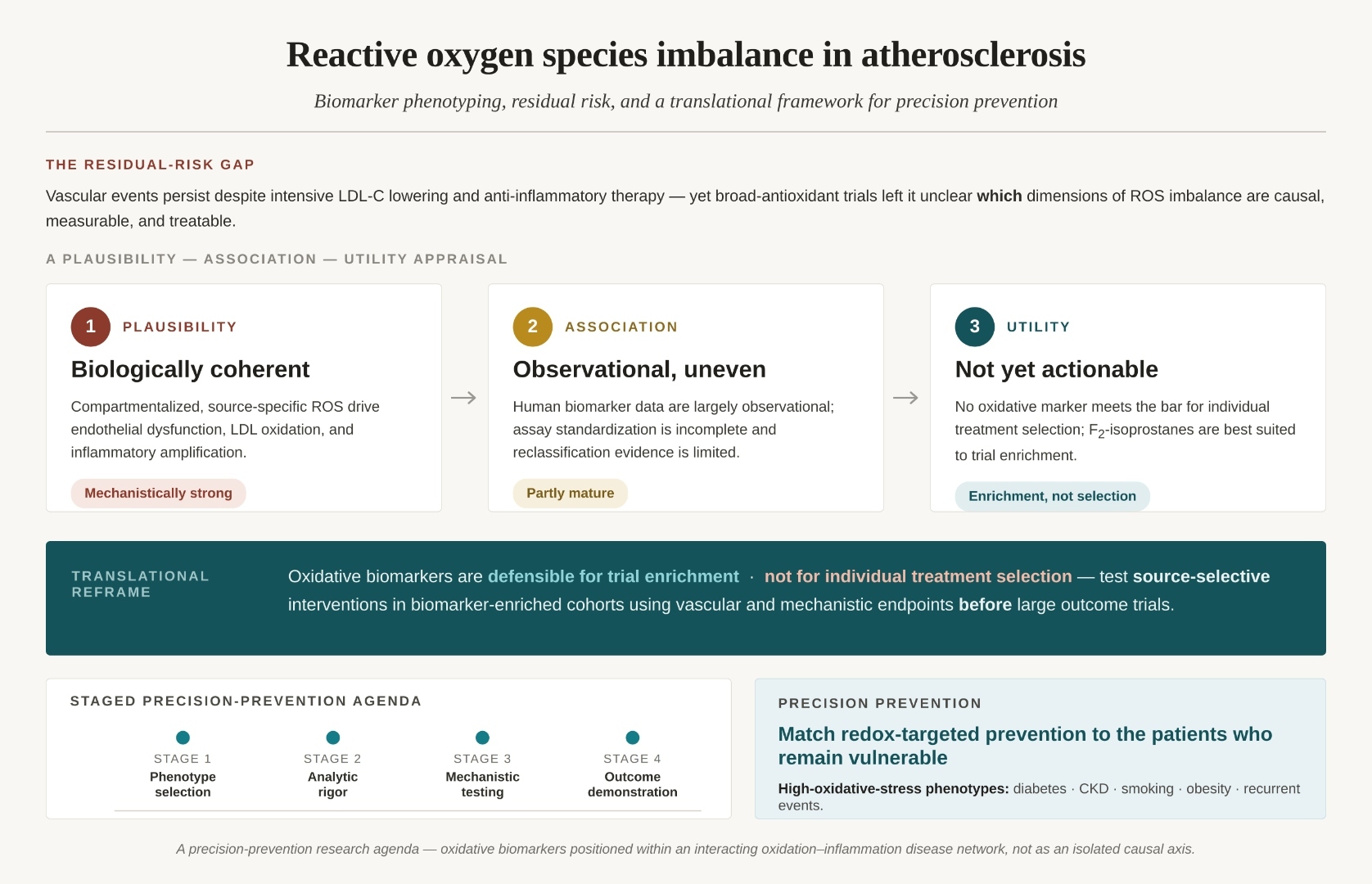
Background: Atherosclerotic cardiovascular disease (ASCVD) leaves substantial residual risk despite intensive low-density lipoprotein-cholesterol lowering and anti-inflammatory therapy. Reactive oxygen species (ROS) have long been implicated, yet neutral broad-antioxidant trials left unclear which dimensions of ROS imbalance are causal, clinically informative, and therapeutically tractable. Aim: To critically appraise ROS imbalance in atherosclerosis through a plausibility–association–utility hierarchy and to propose a staged framework for precision cardiovascular prevention. Methods: We synthesized mechanistic, biomarker, and translational evidence from targeted PubMed/MEDLINE, Embase, and Cochrane searches (January 2000–February 2026), combining terms for ROS, oxidative stress, atherosclerosis, oxidative biomarkers, and residual cardiovascular risk, with citation chaining. Mass-spectrometry biomarker work, prospective cohorts, and randomized trials received greater interpretive weight. Systematic-review procedures were not applied. Results: Compartmentalized, source-specific ROS imbalance contributes to endothelial dysfunction, lipoprotein oxidation, inflammatory amplification, and plaque progression, particularly in high-risk cardiometabolic phenotypes. Human biomarker data are predominantly observational, assay standardization is incomplete, and risk-reclassification evidence is limited. F2-isoprostanes are a relatively mature lipid-peroxidation marker better suited to trial enrichment than treatment selection. Conclusion: Oxidative biomarkers are defensibly used for trial enrichment but not individual treatment selection. A staged precision-prevention agenda should test source-selective interventions in biomarker-enriched cohorts using vascular and mechanistic endpoints before large outcome trials. Relevance for Patients: Adults whose cardiovascular risk remains high despite cholesterol-lowering and anti-inflammatory treatment—including those with diabetes, kidney disease, smoking, obesity, or recurrent events—may eventually benefit if oxidative stress tests can identify who remains vulnerable and guide targeted prevention.
- Tsao CW, Aday AW, Almarzooq ZI, et al. Heart Disease and Stroke Statistics—2023 Update: A Report From the American Heart Association. Circulation. 2023;147(8):e93-e621. doi: 10.1161/CIR.0000000000001123
- Roth GA, Mensah GA, Johnson CO, et al. Global Burden of Cardiovascular Diseases and Risk Factors, 1990-2019. J Am Coll Cardiol. 2020;76(25):2982-3021. doi: 10.1016/j.jacc.2020.11.010
- Libby P. The changing landscape of atherosclerosis. Nature. 2021;592(7855):524-533. doi: 10.1038/s41586-021-03392-8
- Cannon CP, Blazing MA, Giugliano RP, et al. Ezetimibe Added to Statin Therapy after Acute Coronary Syndromes. N Engl J Med. 2015;372(25):2387-2397. doi: 10.1056/NEJMoa1410489
- Schwartz GG, Steg PG, Szarek M, et al. Alirocumab and Cardiovascular Outcomes after Acute Coronary Syndrome. N Engl J Med. 2018;379(22):2097-2107. doi: 10.1056/NEJMoa1801174
- Ridker PM, Everett BM, Thuren T, et al. Antiinflammatory Therapy with Canakinumab for Atherosclerotic Disease. N Engl J Med. 2017;377(12):1119-1131. doi: 10.1056/NEJMoa1707914
- Tardif JC, Kouz S, Waters DD, et al. Efficacy and Safety of Low-Dose Colchicine after Myocardial Infarction. N Engl J Med. 2019;381(26):2497-2505. doi: 10.1056/NEJMoa1912388
- Libby P, Ridker PM, Maseri A. Inflammation and Atherosclerosis. Circulation. 2002;105(9):1135-1143. doi: 10.1161/hc0902.104353
- Libby P. Inflammation in atherosclerosis. Nature. 2002;420(6917):868-874. doi: 10.1038/nature01323
- Madamanchi NR, Runge MS. Mitochondrial Dysfunction in Atherosclerosis. Circ Res. 2007;100(4):460-473. doi: 10.1161/01.RES.0000258450.44413.96
- Förstermann U, Sessa WC. Nitric oxide synthases: regulation and function. Eur Heart J. 2012;33(7):829-837. doi: 10.1093/eurheartj/ehr304
- Yusuf S, Dagenais G, Pogue J, Bosch J, Sleight P; Heart Outcomes Prevention Evaluation Study Investigators. Vitamin E supplementation and cardiovascular events in high-risk patients. N Engl J Med. 2000;342(3):154-160. doi: 10.1056/NEJM200001203420302
- Bjelakovic G, Nikolova D, Gluud LL, Simonetti RG, Gluud C. Mortality in randomized trials of antioxidant supplements for primary and secondary prevention: systematic review and meta-analysis. J Am Med Assoc. 2007;297(8):842-857. doi: 10.1001/jama.297.8.842
- Sies H, Jones DP. Reactive oxygen species (ROS) as pleiotropic physiological signalling agents. Nat Rev Mol Cell Biol. 2020;21(7):363-383. doi: 10.1038/s41580-020-0230-3
- Sies H. Oxidative stress: a concept in redox biology and medicine. Redox Biol. 2015;4:180-183. doi: 10.1016/j.redox.2015.01.002
- Steinberg D. Beyond Cholesterol: Modifications of Low-Density Lipoprotein That Increase Its Atherogenicity. N Engl J Med. 1989;320(14):915-924. doi: 10.1056/NEJM198904063201407
- Libby P, Buring JE, Badimon L, et al. Atherosclerosis. Nat Rev Dis Primers. 2019;5(1):56. doi: 10.1038/s41572-019-0106-z
- Barabási AL, Gulbahce N, Loscalzo J. Network medicine: a network-based approach to human disease. Nat Rev Genet. 2011;12(1):56-68. doi: 10.1038/nrg2918
- Leopold JA, Maron BA, Loscalzo J. The application of big data to cardiovascular disease: paths to precision medicine. J Clin Invest. 2020;130(1):29-38. doi: 10.1172/JCI129203
- Wang R, Maron BA, Loscalzo J. Multiomics network medicine approaches to precision medicine and therapeutics in cardiovascular diseases. Arterioscler Thromb Vasc Biol. 2023;43(4):493-503. doi: 10.1161/ATVBAHA.122.318731
- Page MJ, McKenzie JE, Bossuyt PM, et al. The PRISMA 2020 statement: an updated guideline for reporting systematic reviews. BMJ. 2021;372:n71. doi: 10.1136/bmj.n71
- Drummond GR, Selemidis S, Griendling KK, Sobey CG. Combating oxidative stress in vascular disease: NADPH oxidases as therapeutic targets. Nat Rev Drug Discov. 2011;10(6):453-471. doi: 10.1038/nrd3403
- Lassègue B, San Martín A, Griendling KK. Biochemistry, physiology, and pathophysiology of NADPH oxidases in the cardiovascular system. Circ Res. 2012;110(10):1364-1390. doi: 10.1161/CIRCRESAHA.111.243972
- Griendling KK, Sorescu D, Ushio-Fukai M. NAD(P)H oxidase: role in cardiovascular biology and disease. Circ Res. 2000;86(5):494-501. doi: 10.1161/01.res.86.5.494
- Goldin A, Beckman JA, Schmidt AM, Creager MA. Advanced glycation end products: sparking the development of diabetic vascular injury. Circulation. 2006;114(6):597-605. doi: 10.1161/CIRCULATIONAHA.106.621854
- Nishikawa T, Edelstein D, Du XL, et al. Normalizing mitochondrial superoxide production blocks three pathways of hyperglycaemic damage. Nature. 2000;404(6779):787-790. doi: 10.1038/35008121
- Giacco F, Brownlee M. Oxidative stress and diabetic complications. Circ Res. 2010;107(9):1058-1070. doi: 10.1161/CIRCRESAHA.110.223545
- Berry CE, Hare JM. Xanthine oxidoreductase and cardiovascular disease: molecular mechanisms and pathophysiological implications. J Physiol. 2004;555(3):589-606. doi: 10.1113/jphysiol.2003.055913
- Noman A, Ang DS, Ogston S, Lang CC, Struthers AD. Effect of high-dose allopurinol on exercise in patients with chronic stable angina: a randomised, placebo controlled crossover trial. Lancet. 2010;375(9732):2161-2167. doi: 10.1016/S0140-6736(10)60391-1
- Zorov DB, Juhaszova M, Sollott SJ. Mitochondrial reactive oxygen species (ROS) and ROS-induced ROS release. Physiol Rev. 2014;94(3):909-950. doi: 10.1152/physrev.00026.2013
- Pacher P, Beckman JS, Liaudet L. Nitric oxide and peroxynitrite in health and disease. Physiol Rev. 2007;87(1):315-424. doi: 10.1152/physrev.00029.2006
- Leiper J, Nandi M, Torondel B, et al. Disruption of methylarginine metabolism impairs vascular homeostasis. Nat Med. 2007;13(2):198-203. doi: 10.1038/nm1543
- Vita JA, Keaney JF Jr. Endothelial function: a barometer for cardiovascular risk? Circulation. 2002;106(6):640-642. doi: 10.1161/01.cir.0000028581.07992.56
- Ras RT, Streppel MT, Draijer R, Zock PL. Flow-mediated dilation and cardiovascular risk prediction: a systematic review with meta-analysis. Int J Cardiol. 2013;168(1):344-351. doi: 10.1016/j.ijcard.2012.09.047
- Tabas I, Williams KJ, Borén J. Subendothelial lipoprotein retention as the initiating process in atherosclerosis: update and therapeutic implications. Circulation. 2007;116(16):1832-1844. doi: 10.1161/CIRCULATIONAHA.106.676890
- Witztum JL, Steinberg D. The oxidative modification hypothesis of atherosclerosis: does it hold for humans? Trends Cardiovasc Med. 2001;11(3-4):93-102. doi: 10.1016/s1050-1738(01)00111-6
- Moore KJ, Tabas I. Macrophages in the pathogenesis of atherosclerosis. Cell. 2011;145(3):341-355. doi: 10.1016/j.cell.2011.04.005
- Moore KJ, Sheedy FJ, Fisher EA. Macrophages in atherosclerosis: a dynamic balance. Nat Rev Immunol. 2013;13(10):709-721. doi: 10.1038/nri3520
- Libby P, Ridker PM, Hansson GK. Inflammation in Atherosclerosis: From Pathophysiology to Practice. J Am Coll Cardiol. 2009;54(23):2129-2138. doi: 10.1016/j.jacc.2009.09.009
- Tabas I. Macrophage death and defective inflammation resolution in atherosclerosis. Nat Rev Immunol. 2010;10(1):36-46. doi: 10.1038/nri2675
- Halliwell B, Whiteman M. Measuring reactive species and oxidative damage in vivo and in cell culture: how should you do it and what do the results mean? Br J Pharmacol. 2004;142(2):231-255. doi: 10.1038/sj.bjp.0705776
- Ridker PM, Danielson E, Fonseca FA, et al. Rosuvastatin to prevent vascular events in men and women with elevated C-reactive protein. N Engl J Med. 2008;359(21):2195-2207. doi: 10.1056/NEJMoa0807646
- Brennan ML, Penn MS, Van Lente F, et al. Prognostic value of myeloperoxidase in patients with chest pain. N Engl J Med. 2003;349(17):1595-1604. doi: 10.1056/NEJMoa035003
- Tsimikas S, Brilakis ES, Miller ER, et al. Oxidized phospholipids, Lp(a) lipoprotein, and coronary artery disease. N Engl J Med. 2005;353(1):46-57. doi: 10.1056/NEJMoa043175
- Morrow JD, Awad JA, Boss HJ, Blair IA, Roberts LJ 2nd. Non-cyclooxygenase-derived prostanoids (F2-isoprostanes) are formed in situ on phospholipids. Proc Natl Acad Sci USA. 1992;89(22):10721-10725. doi: 10.1073/pnas.89.22.10721
- Roberts LJ 2nd, Morrow JD. Measurement of F2-isoprostanes as an index of oxidative stress in vivo. Free Radic Biol Med. 2000;28(4):505-513. doi: 10.1016/s0891-5849(99)00264-6
- Milne GL, Sanchez SC, Musiek ES, Morrow JD. Quantification of F2-isoprostanes as a biomarker of oxidative stress. Nat Protoc. 2007;2(1):221-226. doi: 10.1038/nprot.2006.375
- Morrow JD, Frei B, Longmire AW, et al. Increase in circulating products of lipid peroxidation (F2-isoprostanes) in smokers. N Engl J Med. 1995;332(18):1198-1203. doi: 10.1056/NEJM199505043321804
- Gopaul NK, Anggård EE, Mallet AI, Betteridge DJ, Wolff SP, Nourooz-Zadeh J. Plasma 8-epi-PGF2 alpha levels are elevated in individuals with non-insulin dependent diabetes mellitus. FEBS Lett. 1995;368(2):225-229. doi: 10.1016/0014-5793(95)00649-t
- Milne GL, Yin H, Hardy KD, Davies SS, Roberts LJ 2nd. Isoprostane generation and function. Chem Rev. 2011;111(10):5973-5996. doi: 10.1021/cr200160h
- Klawitter J, Haschke M, Shokati T, Klawitter J, Christians U. Quantification of 15-F2t-isoprostane in human plasma and urine: results from enzyme-linked immunoassay and liquid chromatography/tandem mass spectrometry cannot be compared. Rapid Commun Mass Spectrom. 2011;25(4):463-468. doi: 10.1002/rcm.4871
- Da Silva MS, Bilodeau JF, Julien P, Rudkowska I. Dietary fats and F2-isoprostanes: A review of the clinical evidence. Crit Rev Food Sci Nutr. 2017;57(18):3929-3941. doi: 10.1080/10408398.2016.1196646
- Burke A, Lawson JA, Meagher EA, Rokach J, FitzGerald GA. Specific analysis in plasma and urine of 2,3-dinor-5,6-dihydro-isoprostane F2alpha-III, a metabolite of isoprostane F2alpha-III and an oxidation product of gamma-linolenic acid. J Biol Chem. 2000;275(4):2499-2504. doi: 10.1074/jbc.275.4.2499
- Milne GL. Classifying oxidative stress by F2-isoprostane levels in human disease: the re-imagining of a biomarker. Redox Biol. 2017;12:897-905. doi: 10.1016/j.redox.2017.04.028
- Rohatgi A, Khera A, Berry JD, et al. HDL cholesterol efflux capacity and incident cardiovascular events. N Engl J Med. 2014;371(25):2383-2393. doi: 10.1056/NEJMoa1409065
- Adorni MP, Ronda N, Bernini F, Zimetti F. High density lipoprotein cholesterol efflux capacity and atherosclerosis in cardiovascular disease: pathophysiological aspects and pharmacological perspectives. Cells. 2021;10(3):574. doi: 10.3390/cells10030574
- Shao B, Oda MN, Oram JF, Heinecke JW. Myeloperoxidase: an oxidative pathway for generating dysfunctional high-density lipoprotein. Chem Res Toxicol. 2010;23(3):447-454. doi: 10.1021/tx9003775
- Roest M, Voorbij HAM, Van der Schouw YT, Peeters PHM, Teerlink T, Scheffer PG. High levels of urinary F2-isoprostanes predict cardiovascular mortality in postmenopausal women. J Clin Lipidol. 2008;2(4):298-303. doi: 10.1016/j.jacl.2008.06.004
- Tsimikas S. A test in context: lipoprotein(a): diagnosis, prognosis, controversies, and emerging therapies. J Am Coll Cardiol. 2017;69(6):692-711. doi: 10.1016/j.jacc.2016.11.042
- Tsimikas S, Fazio S, Ferdinand KC, et al. NHLBI Working Group Recommendations to Reduce Lipoprotein(a)-Mediated Risk of Cardiovascular Disease and Aortic Stenosis. J Am Coll Cardiol. 2018;71(2):177-192. doi: 10.1016/j.jacc.2017.11.014
- Kelley N, Jeltema D, Duan Y, He Y. The NLRP3 inflammasome: an overview of mechanisms of activation and regulation. Int J Mol Sci. 2019;20(13):3328. doi: 10.3390/ijms20133328
- Fiolet ATL, Silvis MJM, Opstal TSJ, et al. Short-term effect of low-dose colchicine on inflammatory biomarkers, lipids, blood count and renal function in chronic coronary artery disease and elevated high-sensitivity C-reactive protein. PLoS One. 2020;15(8):e0237665. doi: 10.1371/journal.pone.0237665
- Ridker PM. How Common Is Residual Inflammatory Risk? Circ Res. 2017;120(4):617-619. doi: 10.1161/CIRCRESAHA.116.310527
- Tabas I, Bornfeldt KE. Intracellular and intercellular aspects of macrophage immunometabolism in atherosclerosis. Circ Res. 2020;126(9):1209-1227. doi: 10.1161/CIRCRESAHA.119.315939
- Groh L, Keating ST, Joosten LAB, Netea MG, Riksen NP. Monocyte and macrophage immunometabolism in atherosclerosis. Semin Immunopathol. 2018;40(2):203-214. doi: 10.1007/s00281-017-0656-7
- van Tuijl J, Joosten LAB, Netea MG, Bekkering S, Riksen NP. Immunometabolism orchestrates training of innate immunity in atherosclerosis. Cardiovasc Res. 2019;115(9):1416-1424. doi: 10.1093/cvr/cvz107
- Davi G, Ciabattoni G, Consoli A, et al. In vivo formation of 8-iso-prostaglandin F2alpha and platelet activation in diabetes mellitus: effects of improved metabolic control and vitamin E supplementation. Circulation. 1999;99(2):224-229. doi: 10.1161/01.cir.99.2.224
- Tracz J, Luczak M. Applying proteomics and integrative “omics” strategies to decipher the chronic kidney disease-related atherosclerosis. Int J Mol Sci. 2021;22(14):7492. doi: 10.3390/ijms22147492
- Luczak M, Formanowicz D, Marczak Ł, et al. Deeper insight into chronic kidney disease-related atherosclerosis: comparative proteomic studies of blood plasma using 2DE and mass spectrometry. J Transl Med. 2015;13:20. doi: 10.1186/s12967-014-0378-8
- Himmelfarb J, Stenvinkel P, Ikizler TA, Hakim RM. The elephant in uremia: oxidant stress as a unifying concept of cardiovascular disease in uremia. Kidney Int. 2002;62(5):1524-1538. doi: 10.1046/j.1523-1755.2002.00600.x
- Watral J, Formanowicz D, Perek B, et al. Comprehensive proteomics of monocytes indicates oxidative imbalance functionally related to inflammatory response in chronic kidney disease-related atherosclerosis. Front Mol Biosci. 2024;11:1229648. doi: 10.3389/fmolb.2024.1229648
- Arnson Y, Shoenfeld Y, Amital H. Effects of tobacco smoke on immunity, inflammation and autoimmunity. J Autoimmun. 2010;34(3):J258-J265. doi: 10.1016/j.jaut.2009.12.003
- Furukawa S, Fujita T, Shimabukuro M, et al. Increased oxidative stress in obesity and its impact on metabolic syndrome. J Clin Invest. 2004;114(12):1752-1761. doi: 10.1172/JCI21625
- Sabatine MS, Giugliano RP, Keech AC, et al. Evolocumab and Clinical Outcomes in Patients with Cardiovascular Disease. N Engl J Med. 2017;376(18):1713-1722. doi: 10.1056/NEJMoa1615664
- Miller AA, De Silva TM, Jackman KA, Sobey CG. Effect of gender on NADPH-oxidase activity, expression, and function in the cerebral circulation: role of estrogen. Stroke. 2007;38(7):2142-2149. doi: 10.1161/STROKEAHA.106.477406
- Csiszar A, Ungvari Z, Edwards JG, et al. Aging-induced phenotypic changes and oxidative stress impair coronary arteriolar function. Circ Res. 2002;90(11):1159-1166. doi: 10.1161/01.RES.0000020401.61826.EA
- Ridker PM. Residual inflammatory risk: addressing the obverse side of the atherosclerosis prevention coin. Eur Heart J. 2016;37(22):1720-1722. doi: 10.1093/eurheartj/ehw024
- Davi G, Patrono C. Platelet activation and atherothrombosis. N Engl J Med. 2007;357(24):2482-2494. doi: 10.1056/NEJMra071014
- Nidorf SM, Fiolet ATL, Mosterd A, et al. Colchicine in Patients with Chronic Coronary Disease. N Engl J Med. 2020;383(19):1838-1847. doi: 10.1056/NEJMoa2021372
- Fuster JJ, Walsh K. Somatic mutations and clonal hematopoiesis: unexpected potential new drivers of age-related cardiovascular disease. Circ Res. 2018;122(3):523-532. doi: 10.1161/CIRCRESAHA.117.312115
- Ridker PM, Everett BM, Pradhan A, et al. Low-Dose Methotrexate for the Prevention of Atherosclerotic Events. N Engl J Med. 2019;380(8):752-762. doi: 10.1056/NEJMoa1809798
- Nissen SE, Lincoff AM, Brennan D, et al. Bempedoic Acid and Cardiovascular Outcomes in Statin-Intolerant Patients. N Engl J Med. 2023;388(15):1353-1364. doi: 10.1056/NEJMoa2215024
- Antman EM, Loscalzo J. Precision medicine in cardiology. Nat Rev Cardiol. 2016;13(10):591-602. doi: 10.1038/nrcardio.2016.101
- Heart Protection Study Collaborative Group. MRC/BHF Heart Protection Study of antioxidant vitamin supplementation in 20,536 high-risk individuals: a randomised placebo-controlled trial. Lancet. 2002;360(9326):23-33. doi: 10.1016/S0140-6736(02)09328-5
- The Alpha-Tocopherol, Beta Carotene Cancer Prevention Study Group. The effect of vitamin E and beta carotene on the incidence of lung cancer and other cancers in male smokers. N Engl J Med. 1994;330(15):1029-1035. doi: 10.1056/NEJM199404143301501
- Liao JK, Laufs U. Pleiotropic effects of statins. Annu Rev Pharmacol Toxicol. 2005;45:89-118. doi: 10.1146/annurev.pharmtox.45.120403.095748
- Oesterle A, Laufs U, Liao JK. Pleiotropic effects of statins on the cardiovascular system. Circ Res. 2017;120(1):229-243. doi: 10.1161/CIRCRESAHA.116.308537
- Griendling KK, Camargo LL, Rios FJ, Alves-Lopes R, Montezano AC, Touyz RM. Oxidative stress and hypertension. Circ Res. 2021;128(7):993-1020. doi: 10.1161/CIRCRESAHA.121.318063
- Drucker DJ. The Cardiovascular Biology of Glucagon-like Peptide-1. Cell Metab. 2016;24(1):15-30. doi: 10.1016/j.cmet.2016.06.009
- Marso SP, Daniels GH, Brown-Frandsen K, et al. Liraglutide and Cardiovascular Outcomes in Type 2 Diabetes. N Engl J Med. 2016;375(4):311-322. doi: 10.1056/NEJMoa1603827
- Nesti L, Natali A. Metformin effects on the heart and the cardiovascular system: a review of experimental and clinical data. Nutr Metab Cardiovasc Dis. 2017;27(8):657-669. doi: 10.1016/j.numecd.2017.04.009
- UK Prospective Diabetes Study (UKPDS) Group. Effect of intensive blood-glucose control with metformin on complications in overweight patients with type 2 diabetes (UKPDS 34). Lancet. 1998;352(9131):854-865. doi: 10.1016/S0140-6736(98)07037-8
- Smith RA, Murphy MP. Animal and human studies with the mitochondria-targeted antioxidant MitoQ. Ann N Y Acad Sci. 2010;1201:96-103. doi: 10.1111/j.1749-6632.2010.05627.x
- Murphy MP, Smith RA. Targeting antioxidants to mitochondria by conjugation to lipophilic cations. Annu Rev Pharmacol Toxicol. 2007;47:629-656. doi: 10.1146/annurev.pharmtox.47.120505.105110