
Canal culture integration in canal-side urban squares: Comparative evidence from Qinzhou, China

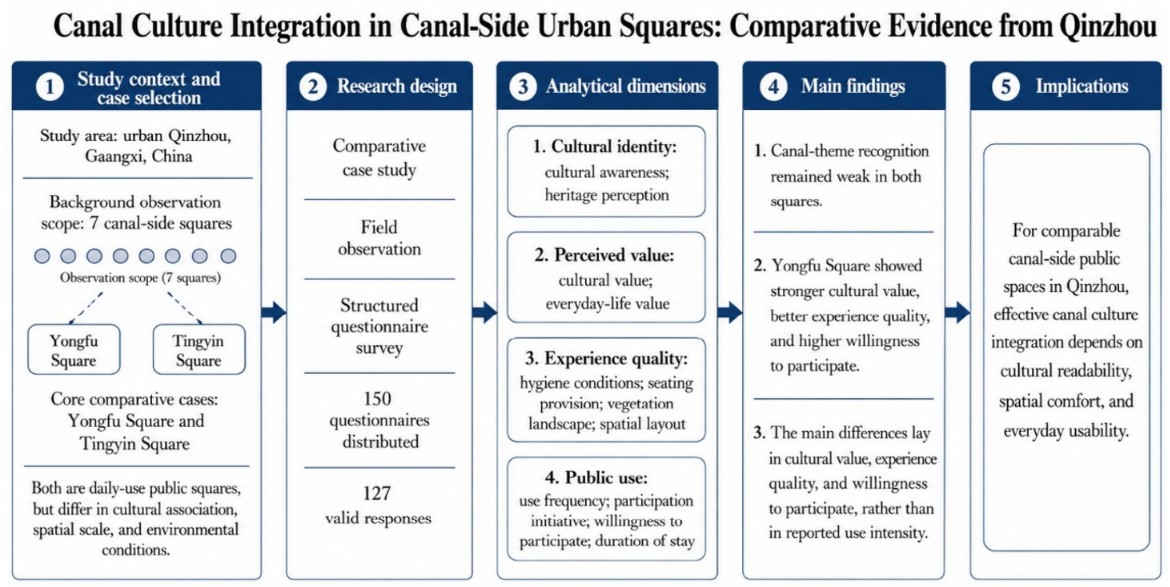
Canal-side public spaces are increasingly expected to translate canal heritage and contemporary canal development into everyday urban experience. This study investigates the effectiveness of canal culture integration in urban squares along the Pinglu Canal corridor in Qinzhou, Guangxi, China, and examines how such spaces can carry canal-related cultural expression into everyday public life within the context of canal-side public space development. Based on a preliminary survey of seven canal-side squares in the urban area of Qinzhou, Yongfu Square and Tingyin Square were selected as representative cases for comparative analysis. Both squares provide leisure and public service functions, but they differ substantially in spatial scale, environmental quality, and modes of cultural display. The study combined field observation with a structured questionnaire survey. A total of 127 valid responses were analyzed through descriptive statistics and between-group tests across four dimensions: cultural identity, perceived value, experience quality, and public use. The results indicate that public recognition of canal-themed cultural content remains generally weak in both squares, suggesting that the existing cultural symbols have not yet achieved sufficient readability in everyday use. At the same time, the two cases showed differences in selected dimensions. Yongfu Square showed stronger performance in cultural value, experience-quality indicators, and willingness to participate. These findings suggest that canal culture integration in daily-use public spaces requires attention to cultural readability, spatial quality, and everyday usability, and they provide case-based empirical support for the renewal of comparable canal-side public spaces in Qinzhou.
Agresti, A. (2018). An introduction to categorical data analysis (3rd ed.). Hoboken, NJ, USA: Wiley. https://doi.org/10.1002/0470114754
Alraouf, A. A. (2024). Conservation and regeneration of architectural and urban heritage: The case of the Xinmalu historical site, Ningbo, Zhejiang, China. Journal of Chinese Architecture and Urbanism, 6(4):2623. https://doi.org/10.36922/jcau.2623
Birer, E., & Çalışır Adem, P. (2022). Role of public space design on the perception of historical environment: A pilot study in Amasya. Frontiers of Architectural Research, 11(1):13–30. https://doi.org/10.1016/j.foar.2021.09.003
Baker, R., Brick, J. M., Bates, N. A., Battaglia, M., Couper, M. P., Dever, J. A., Gile, K. J., & Tourangeau, R. (2013). Summary report of the AAPOR task force on non-probability sampling. Journal of Survey Statistics and Methodology, 1(2):90–143. https://doi.org/10.1093/jssam/smt008
Bazrafshan, M., Spielhofer, R., Wissen Hayek, U., Kienast, F., & Grêt-Regamey, A. (2023). Greater place attachment to urban parks enhances relaxation: Examining affective and cognitive responses of locals and bi-cultural migrants to virtual park visits. Landscape and Urban Planning, 232:104650. https://doi.org/10.1016/j.landurbplan.2022.104650
Bernabeu-Bautista, Á., Serrano-Estrada, L., & Martí, P. (2023). The role of successful public spaces in historic centres: Insights from social media data. Cities, 137:104337. https://doi.org/10.1016/j.cities.2023.104337
Carmona, M. (2021). Public places urban spaces: The dimensions of urban design (3rd ed.). Abingdon, UK: Routledge. https://doi.org/10.4324/9781315158457
Chen, F., Ludwig, C., & Sykes, O. (2021). Heritage conservation through planning: A comparison of policies and principles in England and China. Planning Practice & Research, 36(5):578–601. https://doi.org/10.1080/02697459.2020.1752472
Cheshmehzangi, A., & Tang, T. (2022). Beibu Gulf city cluster: A new strategic pivot to foster new growth drivers. In: A. Cheshmehzangi & T. Tang, China’s city cluster development in the race to carbon neutrality (pp. 161–173). Singapore: Springer. https://doi.org/10.1007/978-981-19-7673-5_12
Dai, T., Zheng, X., & Yan, J. (2021). Contradictory or aligned? The nexus between authenticity in heritage conservation and heritage tourism, and its impact on satisfaction. Habitat International, 107:102307. https://doi.org/10.1016/j.habitatint.2020.102307
Feng, H., Jin, Z., Chu, X., Wang, W., & Yao, H. (2025). Route selection for the extension line of Pinglu Canal: A comparative study. Land, 14(6):1266. https://doi.org/10.3390/land14061266
Foroughi, M., de Andrade, B., Pereira Roders, A., & Wang, T. (2023). Public participation and consensus-building in urban planning from the lens of heritage planning: A systematic literature review. Cities, 135:104235. https://doi.org/10.1016/j.cities.2023.104235
Gao, B. W., Zhu, C., Song, H., & Belisle Dempsey, I. M. (2022). Interpreting the perceptions of authenticity in virtual reality tourism through postmodernist approach. Information Technology & Tourism, 24(1):31–55. https://doi.org/10.1007/s40558-022-00221-0
Gehl, J., & Svarre, B. (2013). How to study public life. Washington, D.C., USA: Island Press. https://doi.org/10.5822/978-1-61091-525-0
ICOMOS & TICCIH. (2011). Joint ICOMOS–TICCIH principles for the conservation of industrial heritage sites, structures, areas and landscapes. Accessed March 17, 2026. https:// ticcih.org/about/about-ticcih/dublin-principles/
Inland Waterways Association. (2021). Our unique heritage: Case studies: Lost & saved. Accessed March 15, 2026. https:// waterways.org.uk/wp-content/uploads/2021/08/Heritage- Report-Part-2-web2.pdf
Li, J., Guo, X., You, J., He, Z., Yang, Z., & Wang, L. (2025). Perception and drivers of cultural ecosystem services in waterfront green spaces: Insights from social media text analysis. Anthropocene, 50:100477. https://doi.org/10.1016/j.ancene.2025.100477
Li, J., Krishnamurthy, S., Pereira Roders, A., & van Wesemael, P. (2020). Informing or consulting? Exploring community participation within urban heritage management in China. Habitat International, 105:102268. https://doi.org/10.1016/j.habitatint.2020.102268
Li, L., & Wang, L. (2025). Insights into people’s perceptions towards urban public spaces through analysis of social media reviews: A case study of Shanghai. Buildings, 15(17):3033. https://doi.org/10.3390/buildings15173033
Li, Y., & Gu, K. (2024). The making of the Chinese urban landscape: Exploring a framework for analysis. Journal of Chinese Architecture and Urbanism, 6(3):261. https://doi.org/10.36922/jcau.261
Li, Y., Cao, L., & Gao, W. (2025). Perceptual dimensions of heritage canal landscapes and their impact on conservation value cognition. Ecological Indicators, 176:113626. https://doi.org/10.1016/j.ecolind.2025.113626
Luo, J., Zhao, T., Cao, L., & Biljecki, F. (2022). Water view imagery: Perception and evaluation of urban waterscapes worldwide. Ecological Indicators, 145:109615. https://doi.org/10.1016/j.ecolind.2022.109615
Luo, S., Xie, J., & Furuya, K. (2023). Effects of perceived physical and aesthetic quality of urban blue spaces on user preferences: A case study of three urban blue spaces in Japan. Heliyon, 9(4):e15033. https://doi.org/10.1016/j.heliyon.2023.e15033
Ma, Y., Su, N., & Tu, T. (2023). Urban public space quality evaluation methods and practices in China. Transactions in Urban Data, Science, and Technology, 2(2–3):59–80. https://doi.org/10.1177/27541231231166095
Mann, H. B., & Whitney, D. R. (1947). On a test of whether one of two random variables is stochastically larger than the other. The Annals of Mathematical Statistics, 18(1):50–60. https://doi.org/10.1214/aoms/1177730491
McHugh, M. L. (2013). The chi-square test of independence. Biochemia Medica, 23(2):143–149. https://doi.org/10.11613/BM.2013.018
Mehta, V. (2014). Evaluating public space. Journal of Urban Design, 19(1):53–88. https://doi.org/10.1080/13574809.2013.854698
Roberts, H. E., Kellar, I., Conner, M., Gidlow, C., Kelly, B., Nieuwenhuijsen, M., & McEachan, R. (2019). Associations between park features, park satisfaction and park use in a multi-ethnic deprived urban area. Urban Forestry & Urban Greening, 46:126485. https://doi.org/10.1016/j.ufug.2019.126485
UNESCO World Heritage Centre. (n.d.). Seventeenth-century canal ring area of Amsterdam inside the Singelgracht. 2026. Accessed February 23, 2026. https://whc.unesco.org/en/ list/1349/
Varna, G., & Tiesdell, S. (2010). Assessing the publicness of public space: The star model of publicness. Journal of Urban Design, 15(4):575–598. https://doi.org/10.1080/13574809.2010.502350
Yin, R. K. (2018). Case study research and applications: Design and methods (6th ed.). Thousand Oaks, CA, USA: SAGE Publications.
Zhang, S., Liu, J., Pei, T., Chan, C. S., Gao, C., & Meng, B. (2023). Perception in cultural heritage tourism: An analysis of tourists to the Beijing-Hangzhou Grand Canal, China. Journal of Tourism and Cultural Change, 21(5):569–591. https://doi.org/10.1080/14766825.2023.2222693
Zhang, S., Liu, J., Pei, T., Chan, C. S., Wang, M., & Meng, B. (2023). Tourism value assessment of linear cultural heritage: The case of the Beijing–Hangzhou Grand Canal in China. Currrnt Issues in Tourism.26(1):47–69. https://doi.org/10.1080/13683500.2021.2014791
Zhang, S., Lu, J., Guo, R., & Yang, Y. (2024). Exploring the relationship between visual perception of the urban riverfront core landscape area and the vitality of riverfront road: A case study of Guangzhou. Land, 13(12):2142. https://doi.org/10.3390/land13122142
Zhou, Y., Zhou, Z., Cai, P., & Utaberta, N. (2025). Parametric visualization, climate adaptability evaluation, and optimization of strategies for the subtropical Hakka enclosed house: The Guangludi case in Meizhou. Buildings, 15(19):3530. https://doi.org/10.3390/buildings15193530
Zhu, Y., Zhang, Y., & Biljecki, F. (2025). Understanding the user perspective on urban public spaces: A systematic review and opportunities for machine learning. Cities, 156:105535. https://doi.org/10.1016/j.cities.2024.105535