
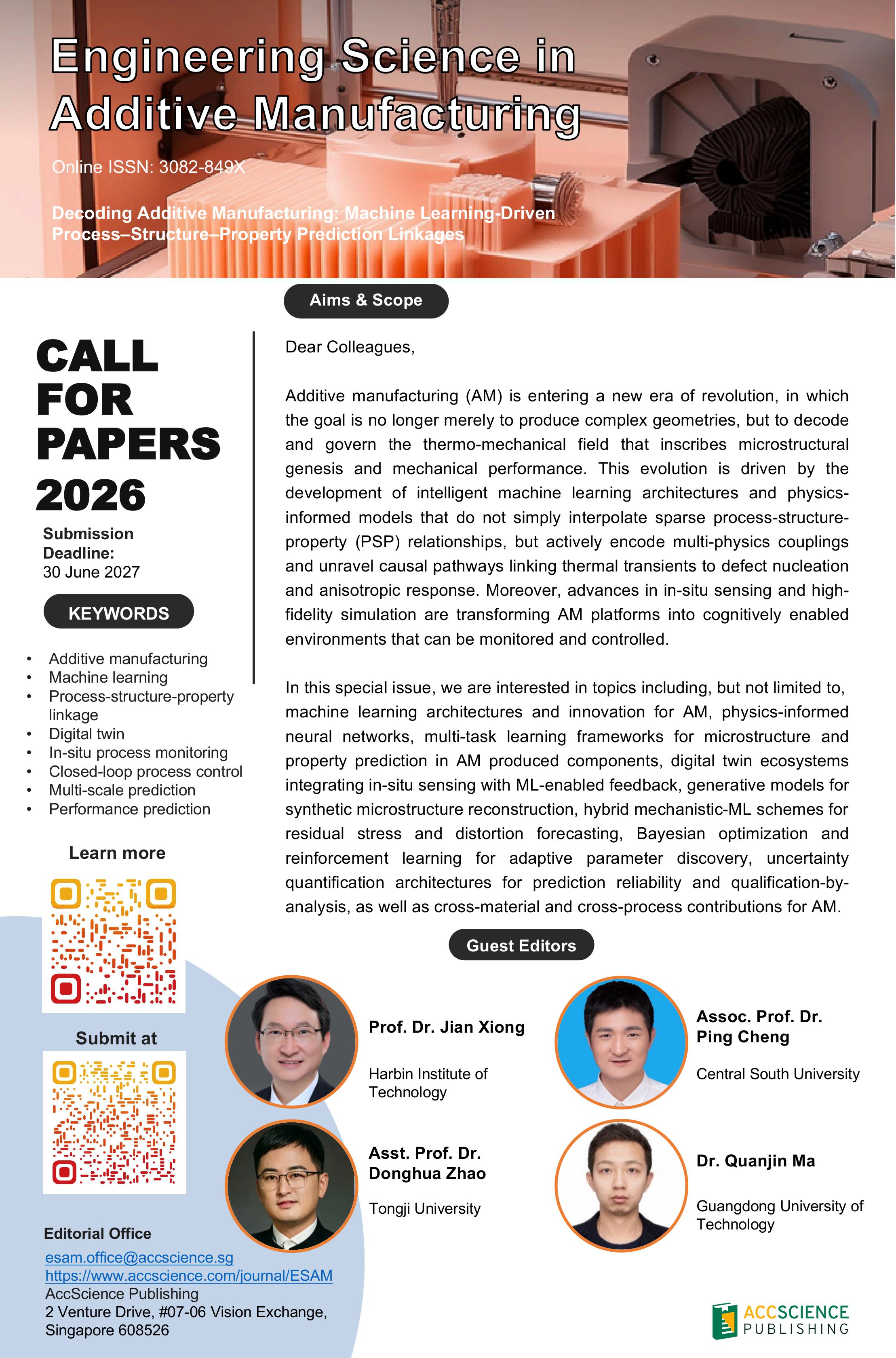
Decoding Additive Manufacturing: Machine Learning-Driven Process–Structure–Property Prediction Linkages

Affiliation: Engineering Mechanics Center for Composite Materials and Structures, Harbin Institute of Technology, Harbin 150080, Chinamechanics of lightweight composite materials and structures, including composite materials, cellular materials, porous materials, biomaterials, sandwich panels, lightweight structures, multi-functional structures

School of Traffic &Transportation Engineering, Central South University, Changsha 410075, Chinamechanics of composite materials, additive manufacturing of fiber reinforced composite materials, composite lightweight structures, structural-functional integration of composite materials


Dear Colleagues,
Additive manufacturing (AM) is entering a new era of revolution, in which the goal is no longer merely to produce complex geometries, but to decode and govern the thermo-mechanical field that inscribes microstructural genesis and mechanical performance. This evolution is driven by the development of intelligent machine learning architectures and physics-informed models that do not simply interpolate sparse process-structure-property (PSP) relationships, but actively encode multi-physics couplings and unravel causal pathways linking thermal transients to defect nucleation and anisotropic response. Moreover, advances in in-situ sensing and high-fidelity simulation are transforming AM platforms into cognitively enabled environments that can be monitored and controlled.
In this special issue, we are interested in topics including, but not limited to, machine learning architectures and innovation for AM, physics-informed neural networks, multi-task learning frameworks for microstructure and property prediction in AM-produced components, digital twin ecosystems integrating in-situ sensing with ML-enabled feedback, generative models for synthetic microstructure reconstruction, hybrid mechanistic-ML schemes for residual stress and distortion forecasting, Bayesian optimization and reinforcement learning for adaptive parameter discovery, uncertainty quantification architectures for prediction reliability and qualification-by-analysis, as well as cross-material and cross-process contributions for AM.