
Engineering science of additively manufactured patient-specific mandibular implants

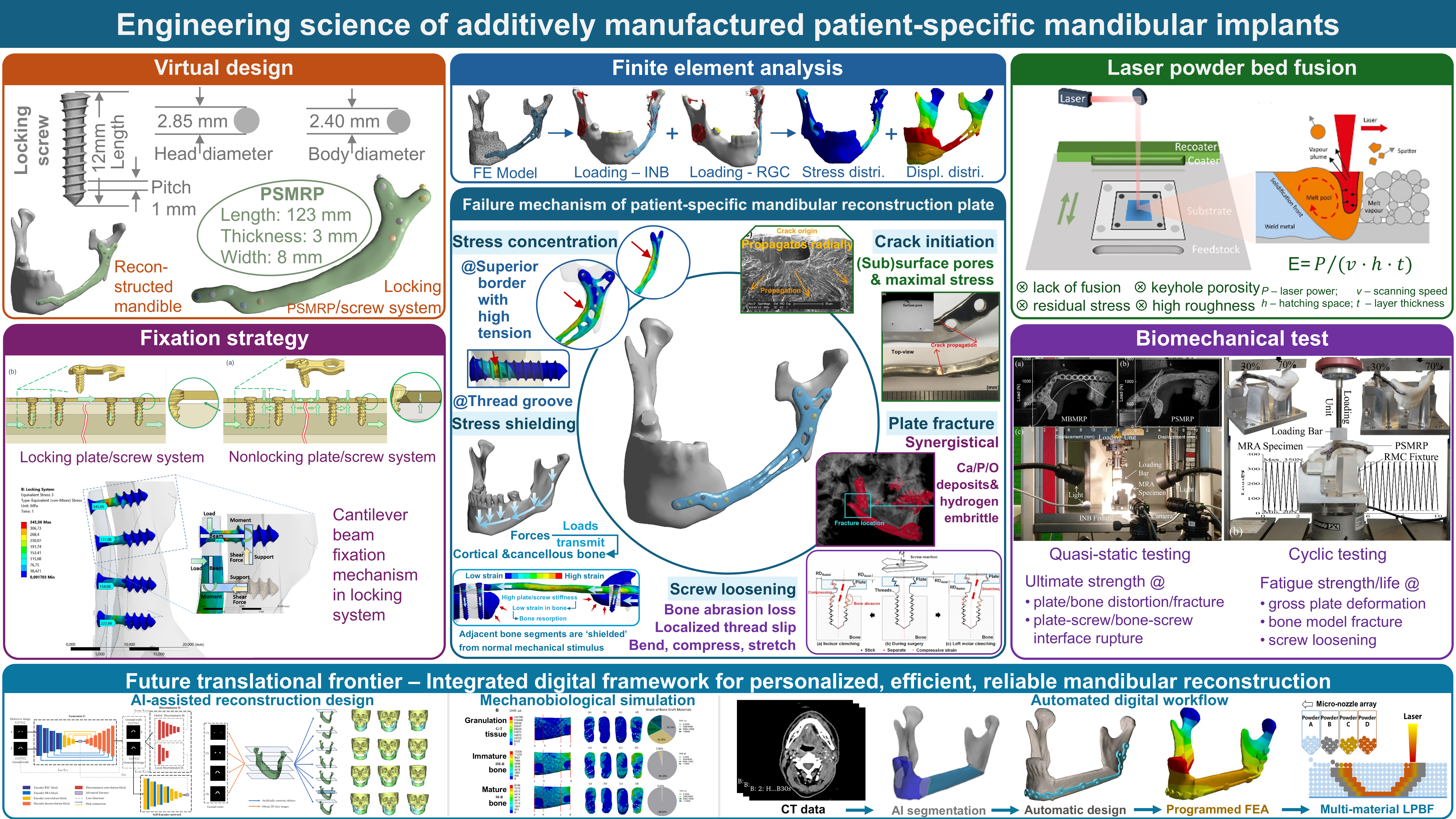
Mandibular reconstruction is a major biomechanical challenge because it requires simultaneous restoration of anatomical form and structural stability under dynamic masticatory loading. While the structural degradation and poor conformity inherent to manually bent systems are overcome by patient-specific mandibular reconstruction plates (PSMRPs) fabricated via laser powder bed fusion (LPBF), clinical longevity remains constrained by manufacturing-induced defects and fatigue failure. In this critical review, the foundational engineering science governing LPBF-fabricated titanium alloy PSMRPs is examined, and an integrated paradigm spanning manufacturing science, computational biomechanics, structural optimization, and experimental validation is established. The process–structure–property relationships in LPBF are systematically evaluated, with specific detail given to how porosity morphology, residual stress, microstructural anisotropy, and surface integrity are dictated by volumetric energy density and complex thermal histories, ultimately governing fatigue crack initiation under cyclic loading. Moving from material to system-level mechanics, assembly failure modes are analyzed, while the biomechanical performance of locking versus non-locking fixation is compared. The role of finite element analysis alongside advanced structural optimization strategies is critically evaluated, and the mitigation of stress concentrations and stress shielding through size, shape, and topology optimization is demonstrated. Furthermore, state-of-the-art experimental validation methodologies are scrutinized, with emphasis placed on full-field strain characterization via digital image correlation and biomimetic cyclic fatigue testing. Finally, future translational frontiers are outlined, including artificial intelligence-driven generative design and mechanobiological simulations of long-term osseous remodeling. Collectively, the evidence suggests that the mastery of the interplay between additive manufacturing parameters and multi-scale biomechanics is paramount to the engineering of predictable, optimized cranio-maxillofacial patient-specific implants.
- Kumar BP, Venkatesh V, Kumar KJ, Yadav BY, Mohan SR. Mandibular reconstruction: overview. J Maxillofac Oral Surg. 2016;15(4):425-441. doi: 10.1007/s12663-015-0766-5
- Awadalkreem F, Kamal H. Mandibular Resection: Disabilities, Challenges, Reconstruction Techniques, Advances, and Quality of Life. In: Bourzgui F, ed. Cranio- Maxillofacial Surgery-Orthognathic and Orthodontic Techniques. IntechOpen; 2025. doi: 10.5772/intechopen.1009198
- Paré A, Bossard A, Laure B, Weiss P, Gauthier O, Corre P. Reconstruction of segmental mandibular defects: Current procedures and perspectives. Laryngoscope Investig Otolaryngol. 2019;4(6):587-596. doi: 10.1002/lio2.325
- Vincent A, Hohman MH. Mandible Reconstruction. StatPearls Publishing. Updated 2023. Available from: https:// www.ncbi.nlm.nih.gov/books/NBK563241/ [Last accessed on May 29, 2026].
- Coletti D, Ord R, Liu X. Mandibular reconstruction and second generation locking reconstruction plates: outcome of 110 patients. Int J Oral Maxillofac Surg. 2009;38(9):960-963. doi: 10.1016/j.ijom.2009.03.721
- Zhong S, Zhang Y, Shi Q, et al. Biomechanics of manual-bent versus patient-specific mandibular implants. J Biomech Eng. 2025;147(12):121001. doi: 10.1115/1.4069665
- Gutwald R, Jaeger R, Lambers FM. Customized mandibular reconstruction plates improve mechanical performance in a mandibular reconstruction model. Comput Methods Biomech Biomed Engin. 2017;20(4):426-435. doi: 10.1080/10255842.2016.1240788
- Wilde F, Cornelius C-P, Schramm A. Computer-assisted mandibular reconstruction using a patient-specific reconstruction plate fabricated with computer-aided design and manufacturing techniques. Craniomaxillofac Trauma Reconstr. 2014;7(2):158-166. doi: 10.1055/s-0034-1371356
- Alasseri N, Alasraj A. Patient-specific implants for maxillofacial defects: challenges and solutions. Maxillofac Plast Reconstr Surg. 2020;42(1):15. doi: 10.1186/s40902-020-00262-7
- Memon AR, Wang E, Hu J, Egger J, Chen X. A review on computer-aided design and manufacturing of patient- specific maxillofacial implants. Expert Rev Med Devices. 2020;17(4):345-356. doi: 10.1080/17434440.2020.1736040
- Sing SL, Yeong WY. Laser powder bed fusion for metal additive manufacturing: perspectives on recent developments. Virtual Phys Prototyp. 2020;15(3):359-370. doi: 10.1080/17452759.2020.1779999
- Vaezi M, Chianrabutra S, Mellor B, Yang S. Multiple material additive manufacturing–Part 1: a review: this review paper covers a decade of research on multiple material additive manufacturing technologies which can produce complex geometry parts with different materials. Virtual Phys Prototyp. 2013;8(1):19-50. doi: 10.1080/17452759.2013.778175
- Zhang LC, Attar H. Selective laser melting of titanium alloys and titanium matrix composites for biomedical applications: a review. Adv Eng Mater. 2016;18(4):463-475. doi: 10.1002/adem.201500419
- Shi Q, Sun Y, Yang S, et al. Failure analysis of an in-vivo fractured patient-specific Ti6Al4V mandible reconstruction plate fabricated by selective laser melting. Eng Fail Anal. 2021;124:105353. doi: 10.1016/j.engfailanal.2021.105353
- Wei W, Zhu L, Wu W, Fan S. TiC/Ti6Al4V functionally graded composite fabricated by in-situ laser additive manufacturing via gas–liquid reaction. J Alloys Compd. 2022;900:163406. doi: 10.1016/j.jallcom.2021.163406
- Li L, Shi Q, Yang S. In-situ bonding of horizontal bimetallic interface by laser offset during laser powder bed fusion of copper/nickel multi-material structures and underlying thermodynamic mechanisms. J Mater Process Technol. 2025;339:118831. doi: 10.1016/j.jmatprotec.2025.118831
- Li X, Wang C, Fan H, Shi Q, Li K, Yang S. In-situ fabrication of compositionally gradient interfaces via programmable powder deposition in multi-material laser powder bed fusion. Virtual Phys Prototyp. 2026;21(1):e2656556. doi: 10.1080/17452759.2026.2656556
- Shi Q, Yang S, Sun Y, et al. In-situ formation of Ti-Mo biomaterials by selective laser melting of Ti/Mo and Ti/Mo2C powder mixtures: A comparative study on microstructure, mechanical and wear performance, and thermal mechanisms. J Mater Sci Technol. 2022;115:81-96. doi: 10.1016/j.jmst.2021.09.017
- Shi Q, Hu Y, Fan H, Yang S. Fundamental role of vertical building sequence and its thermodynamic mechanisms during multi-material additive manufacturing of 18Ni300- CuSn10 structures with IN718 interlayer. J Manuf Process. 2025;144:243-260. doi: 10.1016/j.jmapro.2025.04.048
- Wang C, Wang Y, Fan H, Sun Y, Yang S. Crack-free nickel-copper (Monel K500/GRCop-42) interfaces formed under alternating build sequences via multi-material laser powder bed fusion. Addit Manuf. 2025;114:105037. doi: 10.1016/j.addma.2025.105037
- Zhong S, Shi Q, Sun Y, et al. Biomechanical comparison of locking and non-locking patient-specific mandibular reconstruction plate using finite element analysis. J Mech Behav Biomed Mater. 2021;124:104849. doi: 10.1016/j.jmbbm.2021.104849
- van Kootwijk A, Jonker BP, Wolvius EB, et al. Biomechanical evaluation of additively manufactured patient-specific mandibular cage implants designed with a semi-automated workflow: A cadaveric and retrospective case study. J Mech Behav Biomed Mater. 2023;146:106097. doi: 10.1016/j.jmbbm.2023.106097
- Zhong S, Shi Q, Van Dessel J, et al. Biomechanical feasibility of non-locking system in patient-specific mandibular reconstruction using fibular free flaps. J Mech Behav Biomed Mater. 2023;148:106197. doi: 10.1016/j.jmbbm.2023.106197
- Zhong S, Shi Q, Van Dessel J, et al. Biomechanical validation of structural optimized patient-specific mandibular reconstruction plate orienting additive manufacturing. Comput Methods Programs Biomed. 2022;224:107023. doi: 10.1016/j.cmpb.2022.107023
- Shi Q, Sun Y, Yang S, et al. Preclinical study of additive manufactured plates with shortened lengths for complete mandible reconstruction: Design, biomechanics simulation, and fixation stability assessment. Comput Biol Med. 2021;139:105008. doi: 10.1016/j.compbiomed.2021.105008
- Zhong S, Shi Q, Van Dessel J, Politis C, Sun Y, Yang S. From virtual design to physical prototype: Topology-optimised patient-specific mandibular reconstruction plate. Virtual Phys Prototyp. 2026;21(1):e2653335. doi: 10.1080/17452759.2026.2653335
- Koper DC, Leung CAW, Smeets LCP, Laeven PFJ, Tuijthof GJM, Kessler P. Topology optimization of a mandibular reconstruction plate and biomechanical validation. J Mech Behav Biomed Mater. 2021;113:104157. doi: 10.1016/j.jmbbm.2020.104157
- Schupp W, Arzdorf M, Linke B, Gutwald R. Biomechanical testing of different osteosynthesis systems for segmental resection of the mandible. J Oral Maxillofac Surg. 2007;65(5):924-30. doi: 10.1016/j.joms.2006.06.306
- Zhang H, Hsu JT, Fuh LJ, Huang HL. Biomechanical evaluation of 3D-printed porous lattice versus solid mandibular implants: an in vitro study. Sci Rep. 2026. doi: 10.1038/s41598-026-50741-6
- Zhong S, Zhang Y, Shi Q, et al. Superior biomechanics of patient-specific mandibular reconstruction plate: A validated computational-experimental framework. Ann Biomed Eng. 2026;54(1):225-247. doi: 10.1007/s10439-025-03878-w
- Heller MO. Finite element analysis in orthopedic biomechanics. In: Innocenti B, Galbusera F, eds. Human orthopaedic biomechanics. Elsevier; 2022:637-658. doi: 10.1016/B978-0-12-824481-4.00026-3
- Taylor M, Prendergast PJ. Four decades of finite element analysis of orthopaedic devices: where are we now and what are the opportunities? J Biomech. 2015;48(5):767-78. doi: 10.1016/j.jbiomech.2014.12.019
- Erdemir A, Guess TM, Halloran J, Tadepalli SC, Morrison TM. Considerations for reporting finite element analysis studies in biomechanics. J Biomech. 2012;45(4):625-633. doi: 10.1016/j.jbiomech.2011.11.038
- Zhang Y, Yamanaka A, Cooreman S, Kuwabara T, Coppieters S. Inverse identification of plastic anisotropy through multiple non-conventional mechanical experiments. Int J Solids Struct. 2023;285:112534. doi: 10.1016/j.ijsolstr.2023.112534
- Wegner N, Klein M, Scholz R, Kotzem D, Macias Barrientos M, Walther F. Mechanical in vitro fatigue testing of implant materials and components using advanced characterization techniques. J Biomed Mater Res B Appl Biomater. 2022;110(4):898-909. doi: 10.1002/jbm.b.34970
- Sutton MA, Hild F. Recent advances and perspectives in digital image correlation. Exp Mech. 2015;55(1):1-8. doi: 10.1007/s11340-015-9991-6
- Wu J, Jiang L, Shao L, et al. A mandibular defect dataset for autonomous reconstruction planning in oral and maxillofacial surgery. Sci Data. 2025;12(1):1763. doi: 10.1038/s41597-025-06048-8
- Peng W-m, Cheng K-j, Liu Y-f, et al. Biomechanical and mechanostat analysis of a titanium layered porous implant for mandibular reconstruction: The effect of the topology optimization design. Mater Sci Eng C. 2021;124:112056. doi: 10.1016/j.msec.2021.112056
- Gao H, Li X, Wang C, Ji P, Wang C. Mechanobiologically optimization of a 3D titanium-mesh implant for mandibular large defect: A simulated study. Mater Sci Eng C Mater Biol Appl. 2019;104:109934. doi: 10.1016/j.msec.2019.109934
- Zheng L, Wang C, Hu M, et al. An innovative additively manufactured implant for mandibular injuries: Design and preparation processes based on simulation model. Front Bioeng Biotechnol. 2022;10:1065971. doi: 10.3389/fbioe.2022.1065971
- Van Kootwijk A, Moosabeiki V, Saldivar MC, et al. Semi-automated digital workflow to design and evaluate patient-specific mandibular reconstruction implants. J Mech Behav Biomed Mater. 2022;132:105291. doi: 10.1016/j.jmbbm.2022.105291
- Biswal R, Syed AK, Zhang X. Assessment of the effect of isolated porosity defects on the fatigue performance of additive manufactured titanium alloy. Addit Manuf. 2018;23:433-442. doi: 10.1016/j.addma.2018.08.024
- Kruth JP, Levy G, Klocke F, Childs THC. Consolidation phenomena in laser and powder-bed based layered manufacturing. CIRP Ann. 2007;56(2):730-759. doi: 10.1016/j.cirp.2007.10.004
- Luo Q, Yin L, Simpson TW, Beese AM. Effect of processing parameters on pore structures, grain features, and mechanical properties in Ti-6Al-4V by laser powder bed fusion. Addit Manuf. 2022;56:102915. doi: 10.1016/j.addma.2022.102915
- Tammas-Williams S, Withers PJ, Todd I, Prangnell P. The influence of porosity on fatigue crack initiation in additively manufactured titanium components. Sci Rep. 2017;7(1):7308. doi: 10.1038/s41598-017-06504-5
- Cunningham R, Zhao C, Parab N, et al. Keyhole threshold and morphology in laser melting revealed by ultrahigh-speed x-ray imaging. Science. 2019;363(6429):849-852. doi: 10.1126/science.aav4687
- Ni C, Zhu J, Zhang B, et al. Recent advance in laser powder bed fusion of Ti–6Al–4V alloys: microstructure, mechanical properties and machinability. Virtual Phys Prototyp. 2025;20(1):e2446952. doi: 10.1080/17452759.2024.2446952
- Wilson-Heid AE, Qin S, Beese AM. Anisotropic multiaxial plasticity model for laser powder bed fusion additively manufactured Ti-6Al-4V. Mater Sci Eng A. 2018;738:90-97. doi: 10.1016/j.msea.2018.09.077
- Wei W-H, Shen J. Effect of laser energy density on microstructures and mechanical properties of selective laser melted Ti-6Al-4V alloy. Int J Mater Res. 2018;109(5):437- 442. doi: 10.3139/146.111615
- Shi Q, Gu D, Xia M, Cao S, Rong T. Effects of laser processing parameters on thermal behavior and melting/solidification mechanism during selective laser melting of TiC/Inconel 718 composites. Opt Laser Technol. 2016;84:9-22. doi: 10.1016/j.optlastec.2016.04.009
- Simonelli M, Tse YY, Tuck C. The formation of α+ β microstructure in as-fabricated selective laser melting of Ti–6Al–4V. J Mater Res. 2014;29(17):2028-2035. doi: 10.1557/jmr.2014.166
- Leuders S, Lieneke T, Lammers S, Tröster T, Niendorf T. On the fatigue properties of metals manufactured by selective laser melting–The role of ductility. J Mater Res. 2014;29(17):1911-1919. doi: 10.1557/jmr.2014.157
- Levkulich N, Semiatin S, Gockel J, Middendorf J, DeWald A, Klingbeil N. The effect of process parameters on residual stress evolution and distortion in the laser powder bed fusion of Ti-6Al-4V. Addit Manuf. 2019;28:475-484. doi: 10.1016/j.addma.2019.05.015
- Vrancken B, Thijs L, Kruth J-P, Van Humbeeck J. Heat treatment of Ti6Al4V produced by Selective Laser Melting: Microstructure and mechanical properties. J Alloys Compd. 2012;541:177-185. doi: 10.1016/j.jallcom.2012.07.022
- Vrancken B, Cain V, Knutsen R, Van Humbeeck J. Residual stress via the contour method in compact tension specimens produced via selective laser melting. Scr Mater. 2014;87:29- 32. doi: 10.1016/j.scriptamat.2014.05.016
- Mercelis P, Kruth JP. Residual stresses in selective laser sintering and selective laser melting. Rapid Prototyp J. 2006;12(5):254-265. doi: 10.1108/13552540610707013
- Parry L, Ashcroft I, Wildman RD. Understanding the effect of laser scan strategy on residual stress in selective laser melting through thermo-mechanical simulation. Addit Manuf. 2016;12:1-15. doi: 10.1016/j.addma.2016.05.014
- Wan B, Yoda N, Zheng K, et al. On effect of residual stress on fracture behavior of mandibular reconstruction plates. Eng Fract Mech. 2024;305:110158. doi: 10.1016/j.engfracmech.2024.110158
- Valentinčič J, Koroth JE, Zeidler H. Advancements in surface finish for additive manufacturing of metal parts: a comprehensive review of plasma electrolytic polishing (PEP). Virtual Phys Prototyp. 2024;19(1):e2364222. doi: 10.1080/17452759.2024.2364222
- Xiang H, Zhou Y, Zhang X, et al. Supportfree printing in laser powder bed fusion: Formation mechanisms of discontinuity, dross and surface roughness. Opt Laser Technol. 2024;177:111201. doi: 10.1016/j.optlastec.2024.111201
- Pegues J, Roach M, Williamson RS, Shamsaei N. Surface roughness effects on the fatigue strength of additively manufactured Ti-6Al-4V. Int J Fatigue. 2018;116:543-552. doi: 10.1016/j.ijfatigue.2018.07.013
- Narra N, Valasek J, Hannula M, et al. Finite element analysis of customized reconstruction plates for mandibular continuity defect therapy. J Biomech. 2014;47(1):264-8. doi: 10.1016/j.jbiomech.2013.11.016
- Zeller A, Neuhaus M, Weissbach L, et al. Patient-specific mandibular reconstruction plates increase accuracy and long-term stability in immediate alloplastic reconstruction of segmental mandibular defects. J Maxillofac Oral Surg. 2020;19(4):609-615. doi: 10.1007/s12663-019-01323-9
- Ellis E, Schubert W. Locking plate principles. In: Gossous Z, Luqman U, Cypriano R, Aquilina P, Shah I, Thieringer FM, eds. Maxillomandibular fixation (MMF). 2020:chap Biomechanics. Accessed May 29, 2026. https:// surgeryreference.aofoundation.org/cmf/basic-technique/ locking-plate-principles.
- Smith WR, Ziran BH, Anglen JO, Stahel PF. Locking plates: tips and tricks. J Bone Joint Surg. 2007;89(10):2298-2307. doi: 10.2106/00004623-200710000-00028
- Bel J-C. Pitfalls and limits of locking plates. Orthop Traumatol Surg Res. 2019;105(1):S103-S109. doi: 10.1016/j.otsr.2018.04.031
- Gibson I, Rosen D, Stucker B, Khorasani M. Additive manufacturing technologies. 3rd ed. Cham: Springer; 2021:675. doi: 10.1007/978-3-030-56127-7
- Zhong S, Shi Q, Deng Y, Sun Y, Politis C, Yang S. High-performance zirconia ceramic additively manufactured via NanoParticle Jetting. Ceram Int. 2022;48(22):33485-33498. doi: 10.1016/j.ceramint.2022.07.294
- Zhong G, Kang M, Yang S. Precision obtained using an artificial neural network for predicting the material removal rate in ultrasonic machining. Appl Sci. 2017;7(12):1268. doi: 10.3390/app7121268
- Vaezi M, Seitz H, Yang S. A review on 3D micro-additive manufacturing technologies. Int J Adv Manuf Technol. 2013;67(5):1721-1754. doi: 10.1007/s00170-012-4605-2
- Vandenbroucke B, Kruth JP. Selective laser melting of biocompatible metals for rapid manufacturing of medical parts. Rapid Prototyp J. 2007;13(4):196-203. doi: 10.1108/13552540710776142
- Moosabeiki V, de Winter N, Cruz Saldivar M, et al. 3D printed patient-specific fixation plates for the treatment of slipped capital femoral epiphysis: Topology optimization vs. conventional design. J Mech Behav Biomed Mater. 2023;148:106173. doi: 10.1016/j.jmbbm.2023.106173
- Solórzano-Requejo W, Martínez Cendrero A, Altun AA, et al. Topology optimisation and lithography-based ceramic manufacturing of short-stem hip prostheses with enhanced biomechanical and mechanobiological performance. Virtual Phys Prototyp. 2024;19(1):e2387280. doi: 10.1080/17452759.2024.2387280
- Mehboob A, Barsoum I, Mehboob H, Abu Al-Rub RK, Ouldyerou A. Topology optimization and biomechanical evaluation of bone plates for tibial bone fractures considering bone healing. Virtual Phys Prototyp. 2024;19(1):e2391475. doi: 10.1080/17452759.2024.2391475
- Li CH, Wu CH, Lin CL. Design of a patient-specific mandible reconstruction implant with dental prosthesis for metal 3D printing using integrated weighted topology optimization and finite element analysis. J Mech Behav Biomed Mater. 2020;105:103700. doi: 10.1016/j.jmbbm.2020.103700
- Park S-M, Park S, Park J, Choi M, Kim L, Noh G. Design process of patient-specific osteosynthesis plates using topology optimization. J Comput Des Eng. 2021;8(5):1257- 1266. doi: 10.1093/jcde/qwab047
- Sun C, Kang J, Wang L, Jin Z, Liu C, Li D. Stress-dependent design and optimization methodology of gradient porous implant and application in femoral stem. Comput Methods Biomech Biomed Eng. 2023;26(11):1308-1319. doi: 10.1080/10255842.2022.2115291
- Sing SL, Yeong WY, Wiria FE, et al. Direct selective laser sintering and melting of ceramics: a review. Rapid Prototyp J. 2017;23(3):611-623. doi: 10.1108/RPJ-11-2015-0178
- Dhekne PP, Bönisch M, Seefeldt M, Vanmeensel K. In-situ synchrotron X-ray diffraction investigation of martensite decomposition in Laser Powder Bed Fusion (L-PBF) processed Ti–6Al–4V. Mater Sci Eng A. 2024;899:146421. doi: 10.1016/j.msea.2024.146421
- Chowdhury S, Yadaiah N, Prakash C, et al. Laser powder bed fusion: a state-of-the-art review of the technology, materials, properties & defects, and numerical modelling. J Mater Res Technol. 2022;20:2109-2172. doi: 10.1016/j.jmrt.2022.07.11
- Thijs L, Verhaeghe F, Craeghs T, Van Humbeeck J, Kruth J-P. A study of the microstructural evolution during selective laser melting of Ti–6Al–4V. Acta Mater. 2010;58(9):3303- 3312. doi: 10.1016/j.actamat.2010.02.004
- Yadroitsev I. Selective laser melting: direct manufacturing of 3D-objects by selective laser melting of metal powders. LAP Lambert Academic Publishing; 2009:280.
- Buhairi MA, Foudzi FM, Jamhari FI, et al. Review on volumetric energy density: influence on morphology and mechanical properties of Ti6Al4V manufactured via laser powder bed fusion. Prog Addit Manuf. 2023;8(2):265-283. doi: 10.1007/s40964-022-00328-0
- Haase F, Siemers C, Rosler J. Laser powder bed fusion (LPBF) of commercially pure titanium and alloy development for the LPBF process. Front Bioeng Biotechnol. 2023;11:1260925. doi: 10.3389/fbioe.2023.1260925
- Javidrad H, Koc B, Bayraktar H, Simsek U, Gunaydin K. Fatigue performance of metal additive manufacturing: a comprehensive overview. Virtual Phys Prototyp. 2024;19(1):e2302556. doi: 10.1080/17452759.2024.2302556
- Wan B, Entezari A, Zhang Z, et al. On fatigue failure prediction of prosthetic devices through XFEM analysis. Int J Fatigue. 2021;147:106160. doi: 10.1016/j.ijfatigue.2021.106160
- Wan B, Yoda N, Zheng K, et al. On interaction between fatigue of reconstruction plate and time-dependent bone remodeling. J Mech Behav Biomed Mater. 2022;136:105483. doi: 10.1016/j.jmbbm.2022.105483
- Do J, Han JJ, Lee JH, Kwon IJ. Clinical outcomes and mechanical evaluation of patient-specific mandibular reconstruction following tumor resection: a retrospective study with finite element analysis. World J Surg Oncol. 2026;24(1):167. doi: 10.1186/s12957-026-04283-w
- Li L, Shi Q, Xin M, Zhang Z, Yu H, Yang S. Achieving heterogeneous interface uniformity in micronozzle-controlled laser powder bed fusion via continuously variable transmission-inspired in-layer gradients of powder deposition. Int J Mach Tools Manuf. 2026;217:104384. doi: 10.1016/j.ijmachtools.2026.104384
- Yang Y, Zhang J, Wei W. Microstructure and mechanical properties of TiC/Ti6Al4V nanocomposites fabricated by gas–liquid reaction laser powder bed fusion. Mater Sci Eng A. 2023;869:144829. doi: 10.1016/j.msea.2023.144829
- Lu Z, Ho NSK, Pang JHL, et al. Process optimisation on fatigue performance of additive manufactured Ti-6Al-4V in high layer thickness for PBF-LB/M. Virtual Phys Prototyp. 2026;21(1):e2633869. doi: 10.1080/17452759.2026.2633869
- Park SJ, Yang J, Lee JH, et al. High-strength of additive-manufactured PEEK and Ti6Al4V structure via warm isostatic pressing: applications in medical implants and injection moulds. Virtual Phys Prototyp. 2025;20(1):e2449566. doi: 10.1080/17452759.2024.2449566
- Mao Y, Yuan J, Heng Y, Feng K, Cai D, Wei Q. Effect of hot isostatic pressing treatment on porosity reduction and mechanical properties enhancement of 316L stainless steel fabricated by binder jetting. Virtual Phys Prototyp. 2023;18(1):e2174703. doi: 10.1080/17452759.2023.2174703
- Longhitano GA, Chiarelli M, Prada D, de Carvalho Zavaglia CA, Maciel Filho R. Personalized lattice-structured prosthesis as a graftless solution for mandible reconstruction and prosthetic restoration: A finite element analysis. J Mech Behav Biomed Mater. 2024;152:106460. doi: 10.1016/j.jmbbm.2024.106460
- Heins JI, Merema BBJ, Kraeima J, Witjes MJH, Krushynska AO. Mandibular implants: A metamaterial-based approach to reducing stress shielding. Adv Healthc Mater. 2025;14(13):e2500405. doi: 10.1002/adhm.202500405
- Peto M, García-Ávila J, Rodriguez CA, Siller HR, da Silva JVL, Ramírez-Cedillo E. Review on structural optimization techniques for additively manufactured implantable medical devices. Front Mech Eng. 2024;10:1353108. doi: 10.3389/fmech.2024.1353108
- Alomar Z, Aramesh M, Thor A, Persson C, Concli F, D’Elia F. Towards improved functionality of mandibular reconstruction plates enabled by additively manufactured triply periodic minimal surface structures. J Mech Behav Biomed Mater. 2025;162:106826. doi: 10.1016/j.jmbbm.2024.106826
- Li K, Fang J, Zhan J, et al. A critical review of biomimetic structures via laser powder bed fusion: Toward multi-functional application. J Manuf Process. 2024;131:2443- 2472. doi: 10.1016/j.jmapro.2024.09.087
- Niebur GL, Keaveny TM. Computational modeling of trabecular bone mechanics. In: De S, Guilak F, Mofrad M, eds. Computational Modeling in Biomechanics. Dordrecht: Springer; 2010:581. doi: 10.1007/978-90-481-3575-2
- Daqiq O, Roossien CC, Wubs FW, van Minnen B. Biomechanical assessment of mandibular fracture fixation using finite element analysis validated by polymeric mandible mechanical testing. Sci Rep. 2024;14(1):11795. doi: 10.1038/s41598-024-62011-4
- Ben Achour A, Apfeld F, Lauer G, et al. Development of a test bench for biomechanical simulation—a preliminary study of mandibular forces. Front Bioeng Biotechnol. 2024;12:1335159. doi: 10.3389/fbioe.2024.1335159
- Merema BBJ, Kraeima J, Glas HH, Spijkervet FKL, Witjes MJH. Patient-specific finite element models of the human mandible: Lack of consensus on current set-ups. Oral Dis. 2021;27(1):42-51. doi: 10.1111/odi.13381
- Santanna E, Anflor C, Nascimento F. Integrated nonlinear biomechanical modeling, topology optimization, and LPBF process simulation for customized mandibular fracture fixation plates. Int J Solids Struct. 2025;326:113776. doi: 10.1016/j.ijsolstr.2025.113776
- Ingawale SM, Krishnan DG, Goswami T. Validation of experimental and finite element biomechanical evaluation of human cadaveric mandibles. Lubricants. 2022;10(8):169. doi: 10.3390/lubricants10080169
- Oliveira-Santos N, Jacobs R, Picoli FF, Lahoud P, Niclaes L, Groppo FC. Automated segmentation of the mandibular canal and its anterior loop by deep learning. Sci Rep. 2023;13(1):10819. doi: 10.1038/s41598-023-37798-3
- Demir E, Yalçın G, Kalaycı A. Finite element analysis of biplanar customized reconstruction plates for lateral and central segmental defects of mandible. Comput Methods Biomech Biomed Engin. 2024;27(4):489-497. doi: 10.1080/10255842.2023.2188105
- Meng L, Zhang W, Quan D, et al. From topology optimization design to additive manufacturing: Today’s success and tomorrow’s roadmap. Arch Comput Methods Eng. 2020;27(3):805-830. doi: 10.1007/s11831-019-09331-1
- Lang JJ, Bastian M, Foehr P, et al. Improving mandibular reconstruction by using topology optimization, patient specific design and additive manufacturing?-A biomechanical comparison against miniplates on human specimen. PLoS ONE. 2021;16(6):e0253002. doi: 10.1371/journal.pone.0253002
- Wu N, Li S, Zhang B, et al. The advances of topology optimization techniques in orthopedic implants: A review. Med Biol Eng Comput. 2021;59(9):1673-1689. doi: 10.1007/s11517-021-02361-7
- Haug RH, Street CC, Goltz M. Does plate adaptation affect stability? A biomechanical comparison of locking and nonlocking plates. J Oral Maxillofac Surg. 2002;60(11):1319- 1326. doi: 10.1053/joms.2002.35732
- Szypryt P, Forward D. The use and abuse of locking plates. Orthop Trauma. 2009;23(4):281-290.
doi: 10.1016/j.mporth.2009.07.002
- Fischer RD, Klasen J, Shmatok A, Prorok BC. An additively manufactured locking fixation system for potential application in patient-specific implants. J Mech Behav Biomed Mater. 2021;124:104867. doi: 10.1016/j.jmbbm.2021.104867
- Dong X, Shi Q, Yang S. Machine learning-assisted thickness prediction and 3D surface reconstruction for multi-material powder beds in micronozzle-controlled laser powder bed fusion. Powder Technol. 2026;480:122659. doi: 10.1016/j.powtec.2026.122659
- Kasper R, Winter K, Pietzka S, Schramm A, Wilde F. Biomechanical in vitro study on the stability of patient-specific CAD/CAM mandibular reconstruction plates: a comparison between selective laser melted, milled, and hand-bent plates. Craniomaxillofac Trauma Reconstr. 2021;14(2):135-143. doi: 10.1177/1943387520952684
- Lin CL, Wang YT, Chang CM, Wu CH, Tsai WH. Design criteria for patient-specific mandibular continuity defect reconstructed implant with lightweight structure using weighted topology optimization and validated with biomechanical fatigue testing. Int J Bioprint. 2022;8(1):437. doi: 10.18063/ijb.v8i1.437
- Malefane LB, du Preez W, Maringa M. High cycle fatigue properties of as-built Ti6Al4V (Eli) produced by direct metal laser sintering. S Afr J Ind Eng. 2017;28(3):188-199. doi: 10.7166/28-3-1861
- Polak S, Beever L, Wade A, Fukuoka M, Worth A. Biomechanical comparison of titanium alloy additively manufactured and conventionally manufactured plate-screw constructs. N Z Vet J. 2024;72(1):17-27. doi: 10.1080/00480169.2023.2264805
- Merema BBJ, Spijkervet FKL, Kraeima J, Witjes MJH. A non-metallic PEEK topology optimization reconstruction implant for large mandibular continuity defects, validated using the MANDYBILATOR apparatus. Sci Rep. 2025;15(1):644. doi: 10.1038/s41598-024-82964-w
- Khoo S-W, Karuppanan S, Tan C-S. A review of surface deformation and strain measurement using two-dimensional digital image correlation. Metrol Meas Syst. 2016;23(3):461- 480. doi: 10.1515/mms-2016-0028
- Sutradhar A, Park J, Carrau D, Miller MJ. Experimental validation of 3D printed patient-specific implants using digital image correlation and finite element analysis. Comput Biol Med. 2014;52:8-17. doi: 10.1016/j.compbiomed.2014.06.002
- Nasajpour-Esfahani N, Karimi S, Nasseri S, et al. Advancements and applications of digital image correlation to characterize residual stress: A review. Mater Charact. 2025;228:115416. doi: 10.1016/j.matchar.2025.115416
- Grassi L, Väänänen SP, Ristinmaa M, Jurvelin JS, Isaksson H. How accurately can subject-specific finite element models predict strains and strength of human femora? Investigation using full-field measurements. J Biomech. 2016;49(5):802- 806. doi: 10.1016/j.jbiomech.2016.02.032
- Dall’Ara E, Tozzi G. Digital volume correlation for the characterization of musculoskeletal tissues: Current challenges and future developments. Front Bioeng Biotechnol. 2022;10:1010056. doi: 10.3389/fbioe.2022.1010056
- Beberniss TJ, Ehrhardt DA. High-speed 3D digital image correlation vibration measurement: Recent advancements and noted limitations. Mech Syst Signal Process. 2017;86:35- 48. doi: 10.1016/j.ymssp.2016.04.014
- Seidt J, Kuokkala V, Smith J, Gilat A. Synchronous full-field strain and temperature measurement in tensile tests at low, intermediate and high strain rates. Exp Mech. 2017;57(2):219-229. doi: 10.1007/s11340-016-0237-z
- Qiao Y, Salviato M. Micro-computed tomography analysis of damage in notched composite laminates under multi-axial fatigue. Compos B Eng. 2020;187:107789. doi: 10.1016/j.compositesb.2020.107789
- Lava P, Jones EM, Wittevrongel L, Pierron F. Validation of finite‐element models using full‐field experimental data: Levelling finite‐element analysis data through a digital image correlation engine. Strain. 2020;56(4):e12350. doi: 10.1111/str.12350
- Zdero R, Bougherara H. Orthopaedic biomechanics: a practical approach to combining mechanical testing and finite element analysis. In: Moratal D, ed. Finite Element Analysis. IntechOpen; 2010:698. doi: 10.5772/10077
- Zhang Y, Evans JRG, Yang S. Exploring correlations between properties using artificial neural networks. Metall Mater Trans A. 2019;51(1):58-75. doi: 10.1007/s11661-019-05502-8
- Lin Z, Wu H, Zhang Z, et al. Inter-layer multi-material powder bed fusion additive manufacturing of a chainmail-like 3D interlocking bonding structure. Virtual Phys Prototyp. 2025;20(1):e2525985. doi: 10.1080/17452759.2025.2525985
- Ten Brink RSA, Merema BJ, den Otter ME, Jensma ML, Witjes MJH, Kraeima J. Automatic MRI segmentation of masticatory muscles using deep learning enables large-scale muscle parameter analysis. Int J Oral Maxillofac Surg. 2025;54(10):956-962. doi: 10.1016/j.ijom.2025.05.008
- Lawand G, Gonzaga L, Issa J, et al. Artificial intelligence segmentation errors in implant planning software programs: An overview. Clin Implant Dent Relat Res. 2025;27(5):e70095. doi: 10.1111/cid.70095
- Huang J, Jie J, Ma H, et al. Deep learning for automated mandibular canal segmentation in CBCT scans. BMC Oral Health. 2025;25(1):1699. doi: 10.1186/s12903-025-07098-5
- Zhou X, Zhang G, Huang A, Zhou H. The topology optimization design and processing of 3D-printed bio-fixed bone plate applied to the mandible. BMC Oral Health. 2025;25(1):1-14. doi: 10.1186/s12903-025-06923-1
- Beisekenov N, Azamatov B, Sadenova M, et al. Data-driven design and additive manufacturing of patient-specific lattice titanium scaffolds for mandibular bone reconstruction. J Funct Biomater. 2025;16(9):350. doi: 10.3390/jfb16090350
- Rodriguez-Molinero J, Prados-Privado M. Time-resolved prediction of dental implant biomechanics through integration of finite element analysis, osseointegration dynamics, and deep learning. J Mech Behav Biomed Mater. 2026;175:107316. doi: 10.1016/j.jmbbm.2025.107316
- Tel A, Kornfellner E, Moscato F, et al. Optimizing efficiency in the creation of patient-specific plates through field-driven generative design in maxillofacial surgery. Sci Rep. 2023;13(1):12082. doi: 10.1038/s41598-023-39327-8
- Peng B, Wei Y, Qin Y, et al. Machine learning-enabled constrained multi-objective design of architected materials. Nat Commun. 2023;14(1):6630. doi: 10.1038/s41467-023-42415-y
- Zhong C, Xiong Y, Tang W, Guo J. A stage-wise residual attention generation adversarial network for mandibular defect repairing and reconstruction. Int J Neural Syst. 2024;34(7):2450033. doi: 10.1142/S0129065724500333
- Elgarba BM, Fontenele RC, Du X, et al. Artificial intelligence versus human intelligence in presurgical implant planning: A preclinical validation. Clin Oral Implants Res. 2025;36(7):835-845. doi: 10.1111/clr.14429
- Lian ZQ, Guan H, Loo YC, Ivanovski S, Johnson NW. Finite element simulation of bone remodelling in human mandible around osseointegrated dental implant. IOP Conf Ser Mater Sci Eng. 2010;10:012125. doi: 10.1088/1757-899x/10/1/012125
- Su K, Gao C, Qiu G, Yuan L, Yang J, Du J. Numerical simulation of mechanically adaptive bone remodeling around teeth and implants: A comparison with clinical images. JOM. 2022;74(12):4640-4651. doi: 10.1007/s11837-022-05533-4
- Yoda N, Zheng K, Chen J, et al. Biomechanical analysis of bone remodeling following mandibular reconstruction using fibula free flap. Med Eng Phys. 2018;56:1-8. doi: 10.1016/j.medengphy.2018.03.008