
L-theanine as a multifunctional neuroprotective and cardiomodulatory agent: Hydroxyl radical scavenging, neurotransmitter modulation, and attenuation of stress-induced cardiac responses

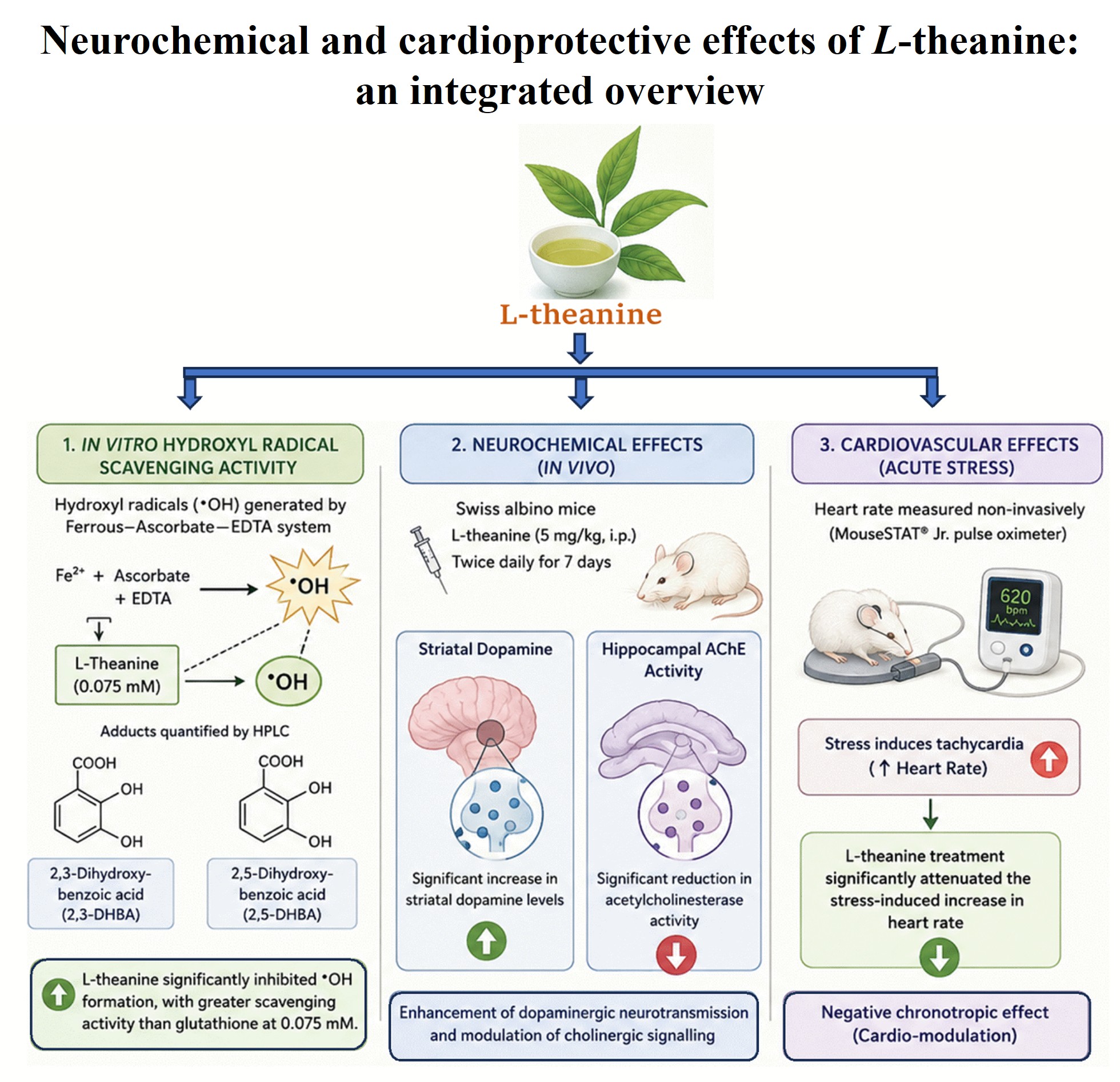
Oxidative stress, resulting from excessive free radical production, plays a pivotal role in the pathogenesis of neurodegenerative and cardiovascular disorders. L-theanine, a unique non-protein amino acid present in tea (Camellia sinensis), is recognized for its antioxidant, neuroprotective, and anxiolytic properties; however, its direct hydroxyl radical scavenging activity and effects on neurochemical pathways and cardiovascular responses remain inadequately understood. The present study evaluated the in vitro hydroxyl radical (•OH) scavenging capacity of L-theanine and investigated its effects on dopaminergic and cholinergic neurotransmission, as well as stress-induced cardiac chronotropic responses in Swiss albino mice. Hydroxyl radicals were generated using a ferrous–ascorbate–EDTA system in the presence of L-theanine or reference antioxidants (catalase, melatonin, and glutathione), and the hydroxyl radical adducts, 2,3- and 2,5-dihydroxybenzoic acid, were quantified using high-performance liquid chromatography. Mice received intraperitoneal L-theanine (5 mg/kg) twice daily for seven days. Striatal dopamine levels and hippocampal acetylcholinesterase activity were subsequently determined, while heart rate was measured non-invasively using a MouseSTAT® Jr. pulse oximeter under acute stress conditions. L-theanine significantly inhibited hydroxyl radical formation, with greater scavenging activity than glutathione at 0.075 mM. The treatment also significantly increased striatal dopamine levels and reduced hippocampal acetylcholinesterase activity, indicating enhanced dopaminergic neurotransmission and modulation of cholinergic signaling. In addition, L-theanine attenuated the stress-induced increase in heart rate, demonstrating a negative chronotropic effect. These findings demonstrate that L-theanine possesses potent antioxidant, neuroprotective, and cardiomodulatory properties, supporting its potential as a multifunctional therapeutic candidate for oxidative stress-associated neurodegenerative and cardiovascular disorders.
- Cabrera C, Artacho R, Giménez R. Beneficial effects of green tea--a review. J Am Coll Nutr. 2006;25(2):79-99. doi: 10.1080/07315724.2006.10719518
- Gomez-Ramirez M, Kelly SP, Montesi JL, Foxe JJ. The effects of L-theanine on alpha-band oscillatory brain activity during a visuo-spatial attention task. Brain Topogr. 2009;22(1):44-51. doi: 10.1007/s10548-008-0068-z
- Hidese S, Ogawa S, Ota M, et al. Effects of L-Theanine Administration on Stress-Related Symptoms and Cognitive Functions in Healthy Adults: A Randomized Controlled Trial. Nutrients. 2019;11(10):2362. doi: 10.3390/NU11102362
- White DJ, de Klerk S, Woods W, Gondalia S, Noonan C, Scholey AB. Anti-Stress, Behavioural and Magnetoencephalography Effects of an L-Theanine-Based Nutrient Drink: A Randomised, Double-Blind, Placebo-Controlled, Crossover Trial. Nutrients. 2016;8(1):53. doi: 10.3390/NU8010053
- Erkkinen MG, Kim MO, Geschwind MD. Clinical Neurology and Epidemiology of the Major Neurodegenerative Diseases. Cold Spring Harb Perspect Biol. 2018;10(4):a033118. doi: 10.1101/CSHPERSPECT.A033118
- Marogianni C, Sokratous M, Dardiotis E, Hadjigeorgiou GM, Bogdanos D, Xiromerisiou G. Neurodegeneration and Inflammation-An Interesting Interplay in Parkinson’s Disease. Int J Mol Sci. 2020;21(22):8421. doi: 10.3390/IJMS21228421
- Goyal R, Mittal P, Gautam RK, et al. Natural products in the management of neurodegenerative diseases. Nutr Metab (Lond). 2024;21(1):26. doi: 10.1186/S12986-024-00800-4
- Kimura K, Ozeki M, Juneja LR, Ohira H. L-Theanine reduces psychological and physiological stress responses. Biol Psychol. 2007;74(1):39-45. doi: 10.1016/j.biopsycho.2006.06.006
- Tian X, Sun L, Gou L, et al. Protective effect of L-theanine on chronic restraint stress-induced cognitive impairments in mice. Brain Res. 2013;1503:24-32. doi: 10.1016/j.brainres.2013.01.048
- Slivkas A, Cohen G. Hydroxyl Radical Attack on Dopamine. J Biol Chem. 1985;260(29):15466-15472. doi: 10.1016/S0021-9258(17)36277-4
- Ohkuwa T, Sato Y, Naoi M. Hydroxyl radical formation in diabetic rats induced by streptozotocin. Life Sci. 1995;56(21):1789-1798. doi: 10.1016/0024-3205(95)00150-5
- Mazumder MK, Paul R, Bhattacharya P, Borah A. Neurological sequel of chronic kidney disease: From diminished Acetylcholinesterase activity to mitochondrial dysfunctions, oxidative stress and inflammation in mice brain. Sci Rep. 2019;9(1):3097. doi: 10.1038/S41598-018-37935-3
- Iyriboz Y, Powers S, Morrow J, Ayers D, Landry G. Accuracy of pulse oximeters in estimating heart rate at rest and during exercise. Br J Sports Med. 1991;25(3):162-164. doi: 10.1136/BJSM.25.3.162
- Ho D, Zhao X, Gao S, Hong C, Vatner DE, Vatner SF. Heart Rate and Electrocardiography Monitoring in Mice. Curr Protoc Mouse Biol. 2011;1(1):123-139. doi: 10.1002/9780470942390.MO100159
- Borah A, Mohanakumar KP. Long-term L-DOPA treatment causes indiscriminate increase in dopamine levels at the cost of serotonin synthesis in discrete brain regions of rats. Cell Mol Neurobiol. 2007;27(8):985-996. doi: 10.1007/S10571-007-9213-6
- Muralikrishnan D, Mohanakumar KP. Neuroprotection by bromocriptine against 1-methyl-4-phenyl-1,2,3,6-tetrahydropyridine-induced neurotoxicity in mice. FASEB J. 1998;12(10):905-912. doi: 10.1096/FASEBJ.12.10.905
- Banerjee R, Sreetama S, Saravanan KS, Chandra G, Nath De S, Mohanakumar KP. Intrastriatal infusion of the Parkinsonian neurotoxin, MPP+, induces damage of striatal cell nuclei in Sprague-Dawley rats. J Chem Neuroanat. 2006;32(2-4):90-100. doi: 10.1016/j.jchemneu.2006.05.004
- Triarhou LC. Dopamine and Parkinson’s disease. In: Madame Curie Bioscience Database [Internet]. Landes Bioscience; 2000-2013. Accessed October 6, 2025. https://www.ncbi.nlm.nih.gov/books/NBK6271/
- Ramesh S, Arachchige ASPM. Depletion of dopamine in Parkinson’s disease and relevant therapeutic options: A review of the literature. AIMS Neurosci. 2023;10(3):200-231. doi: 10.3934/NEUROSCIENCE.2023017
- Moyaert P, Beun S, Achten E, Clement P. Effect of Acetylcholinesterase Inhibitors on Cerebral Perfusion and Cognition: A Systematic Review. J Alzheimers Dis. 2023;93(4):1211-1221. doi: 10.3233/JAD-221125
- Ruchel JB, Braun JBS, Adefegha SA, et al. Guarana (Paullinia cupana) ameliorates memory impairment and modulates acetylcholinesterase activity in Poloxamer-407-induced hyperlipidemia in rat brain. Physiol Behav. 2017;168:11-19. doi: 10.1016/j.physbeh.2016.10.003
- Mahmoudvand H, Sheibani V, Keshavarz H, Shojaee S, Esmaeelpour K, Ziaali N. Acetylcholinesterase Inhibitor Improves Learning and Memory Impairment Induced by Toxoplasma gondii Infection. Iran J Parasitol. 2016;11(2):177-185.
- Cavalcante SF de A, Simas ABC, Barcellos MC, et al. Acetylcholinesterase: The “Hub” for Neurodegenerative Diseases and Chemical Weapons Convention. Biomolecules. 2020;10(3):414. doi: 10.3390/BIOM10030414
- Owen GN, Parnell H, De Bruin EA, Rycroft JA. The combined effects of L-theanine and caffeine on cognitive performance and mood. Nutr Neurosci. 2008;11(4):193-199. doi: 10.1179/147683008X301513
- Lopes Sakamoto F, Metzker Pereira Ribeiro R, Amador Bueno A, Oliveira Santos H. Psychotropic effects of L-theanine and its clinical properties: From the management of anxiety and stress to a potential use in schizophrenia. Pharmacol Res. 2019;147:104395. doi: 10.1016/j.phrs.2019.104395
- Zhang W, Yan Y, Wu Y, et al. Medicinal herbs for the treatment of anxiety: A systematic review and network meta-analysis. Pharmacol Res. 2022;179:106204. doi: 10.1016/J.PHRS.2022.106204
- Lin MT, Beal MF. Mitochondrial dysfunction and oxidative stress in neurodegenerative diseases. Nature. 2006;443(7113):787-795. doi: 10.1038/NATURE05292
- Pivtoraiko VN, Stone SL, Roth KA, Shacka JJ. Oxidative stress and autophagy in the regulation of lysosome-dependent neuron death. Antioxid Redox Signal. 2009;11(3):481-496. doi: 10.1089/ARS.2008.2263
- Dai H, Chen X, He J, et al. Dietary L-theanine supplementation improves antioxidant capacity and lipid metabolism in finishing pigs. J Funct Foods. 2023;110:105831. doi: 10.1016/J.JFF.2023.105831
- Nathan PJ, Lu K, Gray M, Oliver C. The neuropharmacology of L-theanine(N-ethyl-L-glutamine): A possible neuroprotective and cognitive enhancing agent. J Herb Pharmacother. 2006;6(2):21-30.
- Hayes MT. Parkinson’s Disease and Parkinsonism. Am J Med. 2019;132(7):802-807. doi: 10.1016/J.AMJMED.2019.03.001
- Deb S, Borah A. L-theanine, the unique constituent of tea, improves neuronal survivability by curtailing inflammatory responses in MPTP model of Parkinson’s disease. Neurochem Int. 2024;179:105830. doi: 10.1016/J.NEUINT.2024.105830
- Zhang Y, Jia X, Chen X, et al. L-theanine and Neumentix mixture improves sleep quality and modulates brain neurotransmitter levels in mice. Ann Palliat Med. 2021;10(4):4572-4581. doi: 10.21037/APM-21-663
- Gaur R, Ke JP, Zhang P, Yang Z, Bao GH. Novel Cinnamoylated Flavoalkaloids Identified in Tea with Acetylcholinesterase Inhibition Effect. J Agric Food Chem. 2020;68(10):3140-3148. doi: 10.1021/ACS.JAFC.9B08285