

Microstructural gradients and associated mechanical and fatigue behavior in DED Ti-6Al-4V across the build height

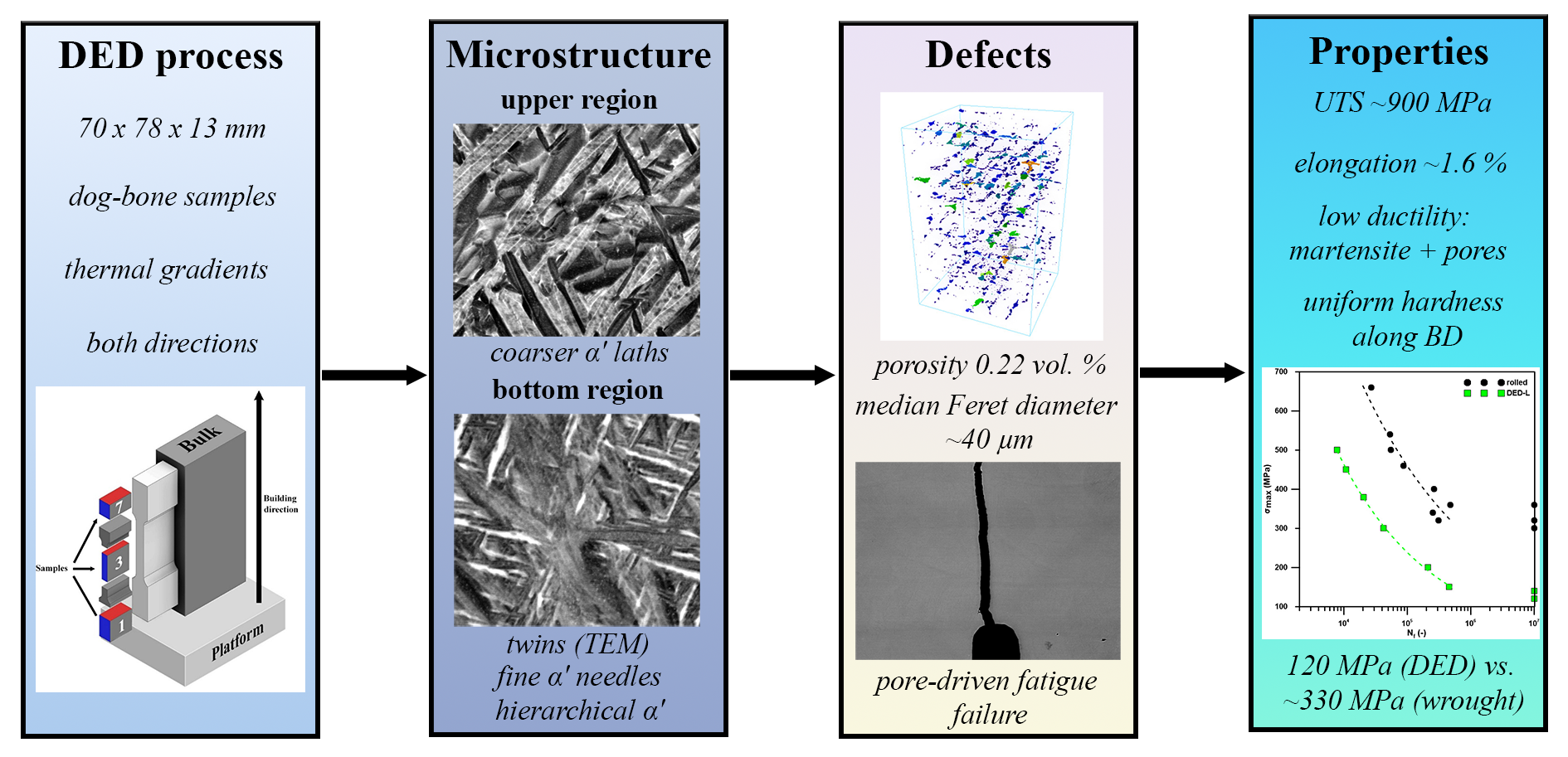
Directed energy deposition enables efficient fabrication of complex Ti-6Al-4V components, yet process-induced microstructural gradients and porosity across the build height remain poorly understood with respect to their effects on mechanical and fatigue performance. In this study, we investigate the relationships between directed energy deposition process parameters, the resulting microstructure, and anisotropic mechanical behavior. The study expands the current understanding of directed energy deposition-processed Ti-6Al-4V by providing a detailed analysis of microstructural evolution in both build directions and presenting new insights into fatigue properties. The microstructural and mechanical characteristics of the alloy are systematically described with an emphasis on their mutual relationship. The material exhibited a predominantly α’ martensitic microstructure, with no significant variation in phase fraction as a function of distance from the build platform, consistent with the measured hardness. Electron backscatter diffraction analysis did not reveal a pronounced crystallographic texture, whereas transmission electron microscopy observations identified deformation twins within the α’ phase. Porosity was mainly oriented perpendicular to the build direction. The combination of a martensitic microstructure and the presence of pores resulted in low ductility. Under cyclic loading, pores acted as crack initiation sites, while their planar orientation limited their effect on crack propagation, indicating that the mechanical response was governed primarily by the martensitic microstructure rather than pore-assisted crack growth. Overall, the results highlight the critical role of microstructure and inherent defects in controlling the mechanical behavior of additively manufactured components and provide a basis for process optimization and post-processing strategies such as heat treatment or hot isostatic pressing.
- Welsch G, Boyer R, Collings E. Materials Properties Handbook: Titanium Alloys. Materials Park, OH: ASM International; 1993.
- Niinomi M. Mechanical properties of biomedical titanium alloys. Mater Sci Eng A. 1998;243(1-2):231-236. doi: 10.1016/s0921-5093(97)00806-x
- Liu S, Shin YC. Additive manufacturing of Ti6Al4V alloy: A review. Mater Des. 2019;164:107552. doi: 10.1016/j.matdes.2018.107552
- Molinari A, Straffelini G, Tesi B, et al. Dry sliding wear mechanisms of the Ti6Al4V alloy. Wear. 1997;208(1-2):105-112. doi: 10.1016/s0043-1648(96)07454-6
- Ezugwu EO, Wang ZM. Titanium alloys and their machinability—a review. J Mater Process Technol. 1997;68(3):262-274. doi: 10.1016/s0924-0136(96)00030-1
- Nguyen HD, Pramanik A, Basak AK, et al. A critical review on additive manufacturing of Ti-6Al-4V alloy: microstructure and mechanical properties. J Mater Res Technol. 2022;18:4641-4661. doi: 10.1016/j.jmrt.2022.04.055
- Oh H, Lee J, Kim JG, Kim S. Effect of defects on environment-assisted fracture (EAF) behavior of Ti–6Al–4V alloy fabricated by direct energy deposition (DED). J Mater Res Technol. 2022;20:4365-4377. doi: 10.1016/j.jmrt.2022.08.158
- Shalnova SA, Gushchina MO, Strekalovskaya DA, et al. Electrochemical properties of the heat-treated Ti-6Al-4V alloy manufactured by direct energy deposition. J Alloys Compd. 2022;899:163226. doi: 10.1016/j.jallcom.2021.163226
- Wolff S, Lee T, Faierson E, et al. Anisotropic properties of directed energy deposition (DED)-processed Ti–6Al–4V. J Manuf Process. 2016;24:397-405. doi: 10.1016/j.jmapro.2016.06.020
- Dutta B. Directed Energy Deposition (DED) Technology. In: Caballero FG, ed. Encyclopedia of Materials: Metals and Alloys. Amsterdam, Netherlands: Elsevier; 2022:66-84.
- Mosallanejad MH, Abdi A, Karpasand F, et al. Additive Manufacturing of Titanium Alloys: Processability, Properties, and Applications. Adv Eng Mater. 2023;25(24). doi: 10.1002/adem.202301122
- Zhang W, Yang M, Mao W, et al. The effect of productive and quality deposition strategies on residual stress for Directed Energy Deposition (DED) process. Manuf Lett. 2024;41:868-878. doi: 10.1016/j.mfglet.2024.09.107
- Zhang F, Huang K, Zhao K, et al. Directed energy deposition combining high-throughput technology and machine learning to investigate the composition-microstructure-mechanical property relationships in titanium alloys. J Mater Process Technol. 2023;311:117800. doi: 10.1016/j.jmatprotec.2022.117800
- Svetlizky D, Das M, Zheng B, et al. Directed energy deposition (DED) additive manufacturing: Physical characteristics, defects, challenges and applications. Mater Today. 2021;49:271-295. doi: 10.1016/j.mattod.2021.03.020
- Wang X, Lv F, Shen LD, et al. Influence of Island Scanning Strategy on Microstructures and Mechanical Properties of Direct Laser-Deposited Ti–6Al–4V Structures. Acta Metall Sin (Engl Lett). 2018;32(9):1173-1180. doi: 10.1007/s40195-018-0858-6
- Carrozza A, Aversa A, Mazzucato F, et al. An investigation on the effect of different multi-step heat treatments on the microstructure, texture and mechanical properties of the DED-produced Ti-6Al-4V alloy. Mater Charact. 2022;189:111958. doi: 10.1016/j.matchar.2022.111958
- Školáková A, Pinc J, Kubík R, et al. The effect of pulsed laser on the surface state of 3D-printed triply periodic structures in TiAl6V4 alloy. Prog Addit Manuf. 2025;10(12):10627-10647. doi: 10.1007/s40964-025-01254-7
- Chung S, Kim JJ, Kim J, et al. Synergistic effect of boron and nitrogen on strength enhancement and anisotropy mitigation in Ti6Al4V fabricated via directed energy deposition. J Mater Res Technol. 2025;36:613-626. doi: 10.1016/j.jmrt.2025.03.113
- Carroll BE, Palmer TA, Beese AM. Anisotropic tensile behavior of Ti–6Al–4V components fabricated with directed energy deposition additive manufacturing. Acta Mater. 2015;87:309-320. doi: 10.1016/j.actamat.2014.12.054
- Wijesinghe K, Herath C, Michopoulos JG, et al. Hierarchical anisotropic material response of directed energy deposited (DED) Ti-6Al-4V alloy. Acta Mater. 2024;276:120080. doi: 10.1016/j.actamat.2024.120080
- Fan W, Peng Y, Wang Y, et al. Effect of grain boundary Widmanstätten α colony on the anisotropic tensile properties of directed energy deposited Ti-6Al-4V alloy. J Mater Sci Technol. 2024;184:145-156. doi: 10.1016/j.jmst.2023.09.057
- Yao M, Yao Z, Tao X, et al. Microstructure and tensile properties of Ti6Al4V with layered structures fabricated by electron beam directed energy deposition. Vacuum. 2024;227:113343. doi: 10.1016/j.vacuum.2024.113343
- Wijesinghe K, Dayner B, Michopoulos JG, et al. Boron addition for enhanced mechanical properties in directed energy deposited (DED) Ti–6Al–4V: Underlying deformation mechanisms. J Alloys Compd. 2025;1034:181282. doi: 10.1016/j.jallcom.2025.181282
- Smirnov SA, Filippova AV, Dubinin ON, et al. In situ alloying of directed energy deposition fabricated Ti6Al4V with nitrogen. J Alloys Compd. 2025;1016:178872. doi: 10.1016/j.jallcom.2025.178872
- Dang L, He X, Tang D, et al. Pore-induced fatigue failure: Critical pore criterion for Ti-6Al-4V alloy manufactured by laser-directed energy deposition. Theor Appl Fract Mech. 2024;129:104204. doi: 10.1016/j.tafmec.2023.104204
- Kistler NA, Corbin DJ, Nassar AR, et al. Effect of processing conditions on the microstructure, porosity, and mechanical properties of Ti-6Al-4V repair fabricated by directed energy deposition. J Mater Process Technol. 2019;264:172-181. doi: 10.1016/j.jmatprotec.2018.08.041
- Milošev I, Rodič P, Kapun B, et al. Composition, microstructure and corrosion resistance of DED-LB additively manufactured Ti–6Al–4V alloy: Comparison with wrought alloy. J Alloys Compd. 2025;1033:181280. doi: 10.1016/j.jallcom.2025.181280
- Zhou X, Zhang M, Xu D, et al. Microstructural evolution, corrosion behavior and cytotoxicity of Ti-6Al-4V/ZrO2 composite fabricated by directed energy deposition for implant biomaterial. J Alloys Compd. 2022;892:161820. doi: 10.1016/j.jallcom.2021.161820
- Shamsaei N, Yadollahi A, Bian L, et al. An overview of Direct Laser Deposition for additive manufacturing; Part II: Mechanical behavior, process parameter optimization and control. Addit Manuf. 2015;8:12-35. doi: 10.1016/j.addma.2015.07.002
- Gostick J, Aghighi M, Hinebaugh J, et al. OpenPNM: A Pore Network Modeling Package. Comput Sci Eng. 2016;18(4):60-74. doi: 10.1109/MCSE.2016.49
- Cizek J, Kovarik O, Cupera J, et al. Measurement of mechanical and fatigue properties using unified, simple-geometry specimens: Cold spray additively manufactured pure metals. Surf Coat Technol. 2021;412:126929. doi: 10.1016/j.surfcoat.2021.126929
- Kovářík O. Differential compliance from time domain vibration waveform fit and its application to fatigue crack growth rate testing. Int J Fract. 2025;249(4). doi: 10.1007/s10704-025-00881-z
- Yoo MH. Slip, twinning, and fracture in hexagonal close-packed metals. Metall Trans A. 1981;12(3):409-418. doi: 10.1007/BF02648537
- Ho A, Zhao H, Fellowes JW, et al. On the origin of microstructural banding in Ti-6Al4V wire-arc based high deposition rate additive manufacturing. Acta Mater. 2019;166:306-323. doi: 10.1016/j.actamat.2018.12.038
- Lee J, Kim K, Choi J, et al. Comparative study on fatigue crack propagation behavior of Ti–6Al–4V products made by DED (direct energy deposition) and L-PBF (laser-powder bed fusion) process. J Mater Res Technol. 2023;23:4499-4512. doi: 10.1016/j.jmrt.2023.02.096
- Hartman A, Schijve J. The effects of environment and load frequency on the crack propagation law for macro fatigue crack growth in aluminium alloys. Eng Fract Mech. 1970;1(4):615-631. doi: 10.1016/0013-7944(70)90003-2
- Schwalbe KH. On the Beauty of Analytical Models for Fatigue Crack Propagation and Fracture—A Personal Historical Review. In: Fatigue and Fracture Mechanics: 9th International Volume, 37th Volume. West Conshohocken, PA: ASTM International; 2009:3-71. doi: 10.1520/stp49280s
- Kovarik O, Cizek J, Klecka J. Fatigue Crack Growth Rate Description of RF-Plasma-Sprayed Refractory Metals and Alloys. Materials. 2023;16(4):1713. doi: 10.3390/ma16041713
- Saboori A, Gallo D, Biamino S, et al. An Overview of Additive Manufacturing of Titanium Components by Directed Energy Deposition: Microstructure and Mechanical Properties. Appl Sci. 2017;7(9):883. doi: 10.3390/app7090883
- Pal S, Bončina T, Lojen G, et al. Fine martensite and beta-grain variational effects on mechanical properties of Ti–6Al–4V while laser parameters change in laser powder bed fusion. Mater Sci Eng A. 2024;892:146052. doi: 10.1016/j.msea.2023.146052
- Bartsch K, Bossen B, Chaudhary W, et al. Thermal Conductivity of Ti-6Al-4V in Laser Powder Bed Fusion. Front Mech Eng. 2022;8. doi: 10.3389/fmech.2022.830104
- Heigel JC, Michaleris P, Reutzel EW. Thermo-mechanical model development and validation of directed energy deposition additive manufacturing of Ti–6Al–4V. Addit Manuf. 2015;5:9-19. doi: 10.1016/j.addma.2014.10.003
- Masoomi M, Thompson SM, Shamsaei N. Laser powder bed fusion of Ti-6Al-4V parts: Thermal modeling and mechanical implications. Int J Mach Tools Manuf. 2017;118-119:73-90. doi: 10.1016/j.ijmachtools.2017.04.007
- Wang J, Zhu R, Liu Y, et al. Understanding melt pool characteristics in laser powder bed fusion: An overview of single- and multi-track melt pools for process optimization. Adv Powder Mater. 2023;2(4):100137. doi: 10.1016/j.apmate.2023.100137
- Barriobero-Vila P, Artzt K, Stark A, et al. Mapping the geometry of Ti-6Al-4V: From martensite decomposition to localized spheroidization during selective laser melting. Scr Mater. 2020;182:48-52. doi: 10.1016/j.scriptamat.2020.02.043
- Zhong HZ, Zhang XY, Wang SX, et al. Examination of the twinning activity in additively manufactured Ti-6Al-4V. Mater Des. 2018;144:14-24. doi: 10.1016/j.matdes.2018.02.015
- Zahiri AH, Ombogo J, Lotfpour M, et al. Twinning in Hexagonal Close-Packed Materials: The Role of Phase Transformation. Metals. 2023;13(3):525. doi: 10.3390/met13030525
- Tariq U, Wu SH, Mahmood MA, et al. Effect of Pre-Heating on Residual Stresses and Deformation in Laser-Based Directed Energy Deposition Repair: A Comparative Analysis. Materials. 2024;17(10):2179. doi: 10.3390/ma17102179