
Hybrid multimaterial composite processed in a monomaterial additive manufacturing equipment for biomedical applications

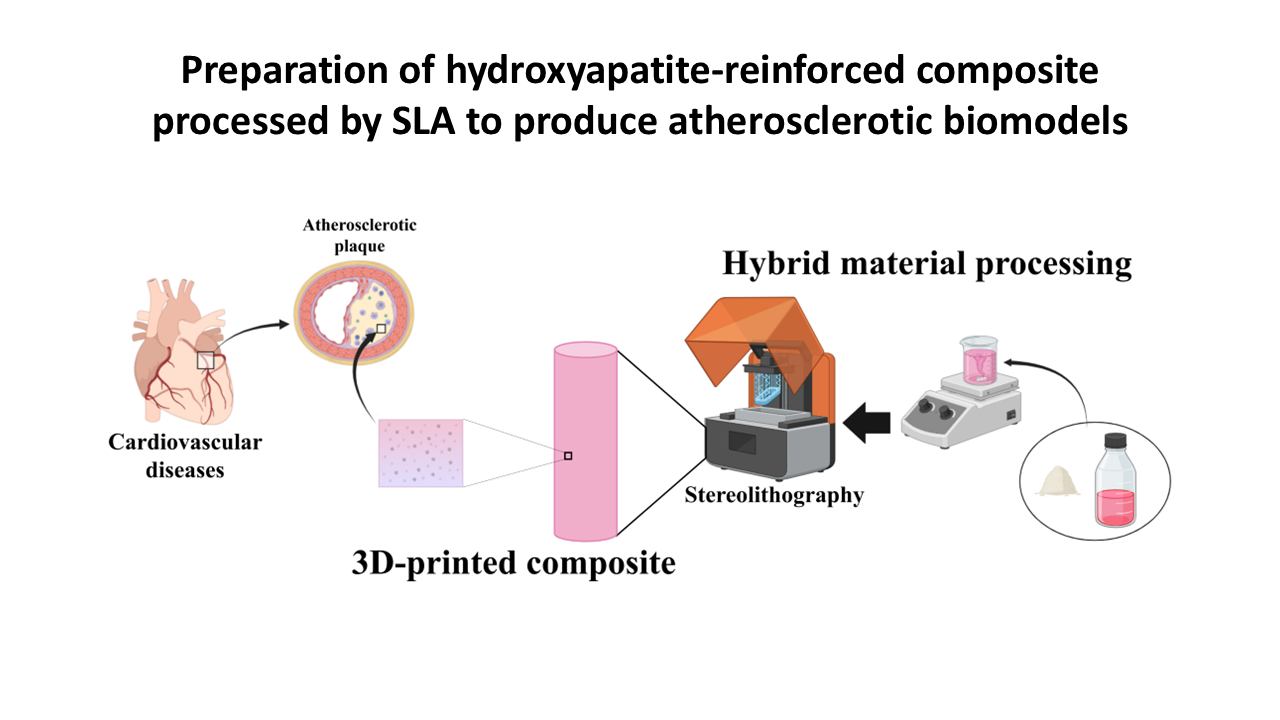
Atherosclerosis is characterized by the buildup of lipids and other substances within blood vessels, leading to plaque formation. In conjunction with thrombosis, atherosclerosis constitutes a primary cause of myocardial infarction and sudden death. Medical imaging is used to plan cardiovascular interventions to solve this problem; however, it cannot provide an exact spatial relationship among tissues. Therefore, the development of materials that can provide patient-specific physical models and replicate the mechanical properties of the relevant tissues would significantly enhance medical training and planning. Consequently, this work explores the use of hydroxyapatite-reinforced polymeric resins to mimic atherosclerotic plaques. Composites were prepared by adding hydroxyapatite at 0%, 0.1%, 0.5%, and 1% (wt/wt) to the resin, then processed via stereolithography to mimic the early stages of atherosclerosis. Post-processed composites were thoroughly characterized, and the results confirm that ceramic powder can be successfully incorporated into the polymeric matrix. The reinforcement percentages are small, implying that mechanical and surface properties, such as wettability and surface energy, do not differ significantly. However, the results are within the range of mechanical properties of atherosclerotic vessels, and the composite materials exhibit surface behavior favorable for producing three-dimensional-printed physical models of diseased vascular.
- Nedkoff L, Briffa T, Zemedikun D, Herrington S, Wright FL. Global Trends in Atherosclerotic Cardiovascular Disease. Clin Ther. 2023;45(11):1087–1091. doi: 10.1016/j.clinthera.2023.09.020
- Li Y, Cao G, Jing W, Liu J, Liu M. Global trends and regional differences in incidence and mortality of cardiovascular disease, 1990−2019: findings from 2019 global burden of disease study. Eur J Prev Cardiol. 2023;30(3):276–286. doi: 10.1093/eurjpc/zwac285
- Akyildiz AC, Speelman L, Gijsen FJH. Mechanical properties of human atherosclerotic intima tissue. J Biomech. 2014;47(4):773–783. doi: 10.1016/j.jbiomech.2014.01.019
- Stary HC. Natural History and Histological Classification of Atherosclerotic Lesions. Arterioscler Thromb Vasc Biol. 2000;20(5):1177–1178. doi: 10.1161/01.ATV.20.5.1177
- Liu Y, Luo X, Jia H, Yu B. The Effect of Blood Pressure Variability on Coronary Atherosclerosis Plaques. Front Cardiovasc Med. 2022;9:803810. doi: 10.3389/fcvm.2022.803810
- Cunnane EM, Mulvihill JJE, Barrett HE Hennessy MM, Kavanagh EG, Walsh MT. Mechanical properties and composition of carotid and femoral atherosclerotic plaques: A comparative study. J Biomech. 2016;49(15):3697–3704. doi: 10.1016/j.jbiomech.2016.09.036
- Kobielarz M, Kozuń M, Gąsior-Głogowska M, Chwiłkowska A. Mechanical and structural properties of different types of human aortic atherosclerotic plaques. J Mech Behav Biomed Mater. 2020;109:103837. doi: 10.1016/j.jmbbm.2020.103837
- Valverde I, Gomez G, Coserria JF, et al. 3D printed models for planning endovascular stenting in transverse aortic arch hypoplasia. Catheter Cardiovasc Interv 2015;85(6):1006–1012. doi: 10.1002/ccd.25810
- Yang H, Zhang X, Wang S, Wang Y, Xiong R, Huang C. Creating Biomimetic Bouligand Architectures for Biomedical and Healthcare Applications. Interd Mater. 2025;4(4):539-567. doi: 10.1002/idm2.12260
- Cabrera MS, Sanders B, Goor OJGM, Driessen-Mol A, Oomens CWJ, Baaijens FPT. Computationally Designed 3D Printed Self-Expandable Polymer Stents with Biodegradation Capacity for Minimally Invasive Heart Valve Implantation: A Proof-of-Concept Study. 3D Print Addit Manuf. 2017;4(1):19–29. doi: 10.1089/3dp.2016.0052
- Henriques J, Amaro AM, Piedade AP. Understanding Atherosclerosis Pathophysiology: Can Additive Manufacturing Be Helpful?. Polymers. 2023;15(3):480. doi: 10.3390/polym15030480
- Henriques J, Amaro AM, Piedade AP. Biomimicking Atherosclerotic Vessels: A Relevant and (Yet) Sub-Explored Topic. Biomimetics. 2024;9(3):135. doi: 10.3390/biomimetics9030135
- Hangge P, Pershad Y, Witting AA, Albadawi H, Oklu R. Three-dimensional (3D) printing and its applications for aortic diseases. Cardiovasc Diagn Ther. 2018;8(S1):S19–S25. doi: 10.21037/cdt.2017.10.02
- Adugna YM, Akessa AD, Lemu HG. Overview study on challenges of additive manufacturing for a healthcare application. IOP Conf Ser Mater Sci Eng. 2021;1201(1):012041. doi: 10.1088/1757-899X/1201/1/012041
- International Organization for Standardization. Additive Manufacturing — General Principles — Fundamentals and Vocabulary. ISO 52900:2021. 2nd ed. International Organization for Standardization; 2021. Accessed April 29, 2026. https://www.iso.org/obp/ui/#iso:std:iso-astm:52900:ed-2:v1:en
- Jędrzejczak K, Antonowicz A, Butruk-Raszeja B, et al. Three-Dimensionally Printed Elastic Cardiovascular Phantoms for Carotid Angioplasty Training and Personalized Healthcare. J Clin Med. 2024;13(17):5115. doi: 10.3390/jcm13175115
- Carvalho V, Rodrigues N, Ribeiro R, et al. Hemodynamic study in 3D printed stenotic coronary artery models: experimental validation and transient simulation. Comput Methods Biomech Biomed Engin. 2021;24(6):623–636. doi: 10.1080/10255842.2020.1842377
- Carvalho V, Rodrigues N, Ribeiro R, Costa PF, Lima RA, Teixeira SFCF. 3D Printed Biomodels for Flow Visualization in Stenotic Vessels: An Experimental and Numerical Study. Micromachines. 2020;11(6):549. doi: 10.3390/mi11060549
- Song Z, Zhu P, Yang L, Liu Z, Li H, Zhu W. Study on the radial sectional velocity distribution and wall shear stress associated with carotid artery stenosis. Phys Fluid. 2022;34(5):051904. doi: 10.1063/5.0085796
- Jiang R, Pu J, Wang Y, et al. Tailored wrinkles for tunable sensing performance by stereolithography. Interd Mat. 2024;3(3):414-424. doi: 10.1002/idm2.12161
- Afridi A, Al Rashid A, Koç M. Recent advances in the development of stereolithography-based additive manufacturing processes: A review of applications and challenges. Bioprinting. 2024;43:e00360. doi: 10.1016/j.bprint.2024.e00360
- Susanto B, Putro AJN, Ristyawan NR, et al. Enhanced Mechanical Properties of the Additively Manufactured Modified Hybrid Stereolithography (SLA)–Glass Powder. J Compos Sci. 2025;9(5):205. doi: 10.3390/jcs9050205
- Müller M, Urban J, Svobodová J, Mishra RK. Modification of the Mechanical Properties of Photosensitive Resin by Using Biobased Fillers During Stereolithography (SLA) 3D Printing. Materials. 2025;18(12):2699. doi: 10.3390/ma18122699
- He Z, Luo J, Lv M, et al. Characteristics and evaluation of atherosclerotic plaques: an overview of state-of-the-art techniques. Front Neurol. 2023;14:1159288. doi: 10.3389/fneur.2023.1159288
- ASTM International. Standard Test Method for Rubber Property—Durometer Hardness. ASTM D2240-15(2021). ASTM International; 2021. Accessed April 29, 2026. https://store.astm.org/d2240-15r21.html
- Young T. An essay on the cohesion of fluids. Philos Trans R Soc Lond. 1805;95:65–87. doi: 10.1098/rstl.1805.0005
- Deng Y, Peng C, Dai M, et al. Recent development of super-wettable materials and their applications in oil-water separation. J Clean Prod. 2020;266:121624. doi: 10.1016/j.jclepro.2020.121624
- Jie-Rong C, Wakida T. Studies on the surface free energy and surface structure of PTFE film treated with low temperature plasma. J Appl Polym Sci. 1997;63(13):1733–1739. doi: 10.1002/(SICI)1097-4628(19970328)63:13<1733::AID-APP4>3.0.CO;2-H
- Weng Z, Zhou Y, Lin W, Senthil T, Wu L. Structure-property relationship of nano enhanced stereolithography resin for desktop SLA 3D printer. Compos Part A Appl Sci Manuf. 2016;88:234–242. doi: 10.1016/j.compositesa.2016.05.035
- Jašek V, Melčová V, Figalla S, Fučík J, Menčík P, Přikryl R. Study of the Thermomechanical Properties of Photocured Resins Based on Curable Monomers from PLA and PHB for SLA 3D Printing. ACS Appl Polym Mater. 2023;5(12):9909–9917. doi: 10.1021/acsapm.3c01730
- Coates J. Interpretation of Infrared Spectra, A Practical Approach. In: R.A. Meyers, M.L. McKelvy (Eds.), Encyclopedia of Analytical Chemistry. John Wiley & Sons; 2006. doi: 10.1002/9780470027318.a5606
- Gheisari H, Karamian E, Abdellahi M. A novel hydroxyapatite –Hardystonite nanocomposite ceramic. Ceram Int. 2015;41(4):5967–5975. doi: 10.1016/j.ceramint.2015.01.033
- Prasanna APS, Venkatasubbu GD. Sustained release of amoxicillin from hydroxyapatite nanocomposite for bone infections. Prog Biomater. 2018;7(4):289–296. doi: 10.1007/s40204-018-0103-4
- Wang X, Chen H, Chen C, Li H. Chemical degradation of thermoplastic polyurethane for recycling polyether polyol. Fibers Polym. 2011;12(7):857–863. doi: 10.1007/s12221-011-0857-y
- Zhou ZM, Wang K, Lin K, Wang YH, Li JZ. Influence of Characteristics of Thermoplastic Polyurethane on Graphene-Thermoplastic Polyurethane Composite Film. Micromachines. 2021;12(2):129. doi: 10.3390/mi12020129
- Prasad MB, Sahu SK. Tensile and flexural properties of thermoplastic polyurethane reinforced with nanodiamond using experimental and FEM method. J Mechl Sci Technol. 2025;39(11):6431–6438. doi: 10.1007/s12206-025-2303-x
- Hernandez-Sanchez D, Comtois-Bona M, Muñoz M, Ruel M, Suuronen EJ, Alarcon EI. Manufacturing and validation of small-diameter vascular grafts: A mini review. IScience. 2024;27(6):109845. doi: 10.1016/j.isci.2024.109845
- Wang Y, Ding Y, Yu K, Dong G. Innovative polymer‐based composite materials in additive manufacturing: A review of methods, materials, and applications. Polym Compos. 2024;45(17):15389–15420. doi: 10.1002/pc.28854
- Park G, Cho NK, Lee Y, Kim CS. Comprehensive parametric analyses on the mechanical performance of 3D printed continuous carbon fiber reinforced plastic. Compos Struct. 2024;329:117804. doi: 10.1016/j.compstruct.2023.117804
- Pizzorni M, Benvenuto M, Lertora E, Mandolfino C. Adhesive bonding of CFRP with a 3D-printed short-fiber composite: An experimental study on the effects of geometry and adhesive system on joint performance. Compos B Eng. 2025;294:112155. doi: 10.1016/j.compositesb.2025.112155
- Spoerk M, Savandaiah C, Arbeiter F, Traxler G, Cardon L, Holzer C, Sapkota J. Anisotropic properties of oriented short carbon fibre filled polypropylene parts fabricated by extrusion-based additive manufacturing. Compos Part A Appl Sci Manuf. 2018;113:95–104. doi: 10.1016/j.compositesa.2018.06.018
- Lakes RS. Composites Biomaterials. In: Joon B. Park, Joseph D. Bronzino. Biomaterials. Boca Raton, FL: CRC Press; 2002:95-110. doi: 10.1201/9781420040036-6
- Henriques JF, Gonçalves L, Amaro AM, Piedade AP. 3D printed polymers that mimic the mechanical properties of atherosclerotic blood vessels for training models: the advantageous degradation induced by UV radiation and hydrolysis. 3D Print Med. 2025;11(1):34. doi: 10.1186/s41205-025-00288-5
- Romero-Sabat G, Granda LA, Medel S. Synthesis of UV-curable polyurethane-acrylate hybrids with tuneable hardness and viscoelastic properties on-demand. Mater Adv. 2022;3(12):5118–5130. doi: 10.1039/D2MA00228K
- Shan W, Liu P, Bui TQ, Duan H. Shape memory polymers structure with different printing direction: Effect of fracture toughness. Theor Appl Fract Mech. 2023;127:104002. doi: 10.1016/j.tafmec.2023.104002
- Smoleń J, Olesik P, Nowacki B, et al. The influence of UV radiation on the properties of GFRP laminates in underwater conditions. Sci Rep. 2024;14(1):7446. doi: 10.1038/s41598-024-57999-8
- Chatzistergos PE, Allan D, Chockalingam N, Naemi R. Shore hardness is a more representative measurement of bulk tissue biomechanics than of skin biomechanics. Med Eng Phys. 2022;105(1):103816. doi: 10.1016/j.medengphy.2022.103816
- Salewski C, Spintzyk S, von Steuben T, et al. ECMO implantation training: Needle penetration in 3D printable materials and porcine aorta. Perfusion. 2020;36(8):798–802. doi: 10.1177/0267659120967194
- Du Q, Zhou P, Pan Y, et al. Influence of hydrophobicity and roughness on the wetting and flow resistance of water droplets on solid surface: A many-body dissipative particle dynamics study. Chem Eng Sci. 2022;249:117327. doi: 10.1016/j.ces.2021.117327
- Li Y, Zhang Z, Ji Y, Wang L, Li D. Influence of surface roughness on the fluid flow in microchannel. J Phys Conf Ser. 2024;2740(1):012059. doi: 10.1088/1742-6596/2740/1/012059
- Phan THT, Kim SJ, Super-hydrophobic microfluidic channels fabricated via xurography-based polydimethylsiloxane (PDMS) micromolding. Chem Eng Sci. 2022;258:117768. doi: 10.1016/j.ces.2022.117768
- Vogler EA. Structure and reactivity of water at biomaterial surfaces. Adv Colloid Interface Sci. 1998;74(1-3):69–117. doi: 10.1016/S0001-8686(97)00040-7
- Hamad QA, Al-Hasani FJ, Faheed NK. Comparative Study of Biotin and Hydroxyapatite on Biological Properties of Composite Coating. Int J Biomater. 2022;2022:1–11. doi: 10.1155/2022/8802111
- Zeng Q, Wang B, Guo Z. Recent advances in microfluidics by tuning wetting behaviors. Mater Today Phys. 2024;40:101324. doi: 10.1016/j.mtphys.2023.101324
- Akkas T, Citak C, Sirkecioglu A, Güner FS. Which is more effective for protein adsorption: surface roughness, surface wettability or swelling? Case study of polyurethane films prepared from castor oil and poly(ethylene glycol). Polym Int. 2013;62(8):1202–1209. doi: 10.1002/pi.4408
- Zhu J, Wang M, Zhang H, et al. Effects of Hydrophilicity, Adhesion Work, and Fluid Flow on Biofilm Formation of PDMS in Microfluidic Systems. ACS Appl Bio Mater. 2020;3(12):8386–8394. doi: 10.1021/acsabm.0c00660
- Pavlin-Premrl D, Boopathy SR, Nemes A, et al. Computational Fluid Dynamics in Intracranial Atherosclerosis - Lessons from Cardiology: A Review of CFD in Intracranial Atherosclerosis. J Stroke Cerebrovasc Dis. 2021;30(10):106009. doi: 10.1016/j.jstrokecerebrovasdis.2021.106009
- Zimnyakov D, Alonova M, Ushakova E, Ushakova O, Isaeva A, Isaeva E. Dynamic Light Scattering by Foamed Polymers during Preparation of Scaffold Prototypes: Events Statistics Analysis versus Evaluation of Correlation Time in Data Interpretation. Photonics. 2021;8(12):549. doi: 10.3390/photonics8120549
- Wickramasinghe S, Do T, Tran P. FDM-Based 3D Printing of Polymer and Associated Composite: A Review on Mechanical Properties, Defects and Treatments. Polymers. 2020;12(7):1529. doi: 10.3390/polym12071529