

Mechanical degradation of bio-based FDM filaments under thermal ageing and moisture exposure: PLA, PETG, and PLA-Wood comparison

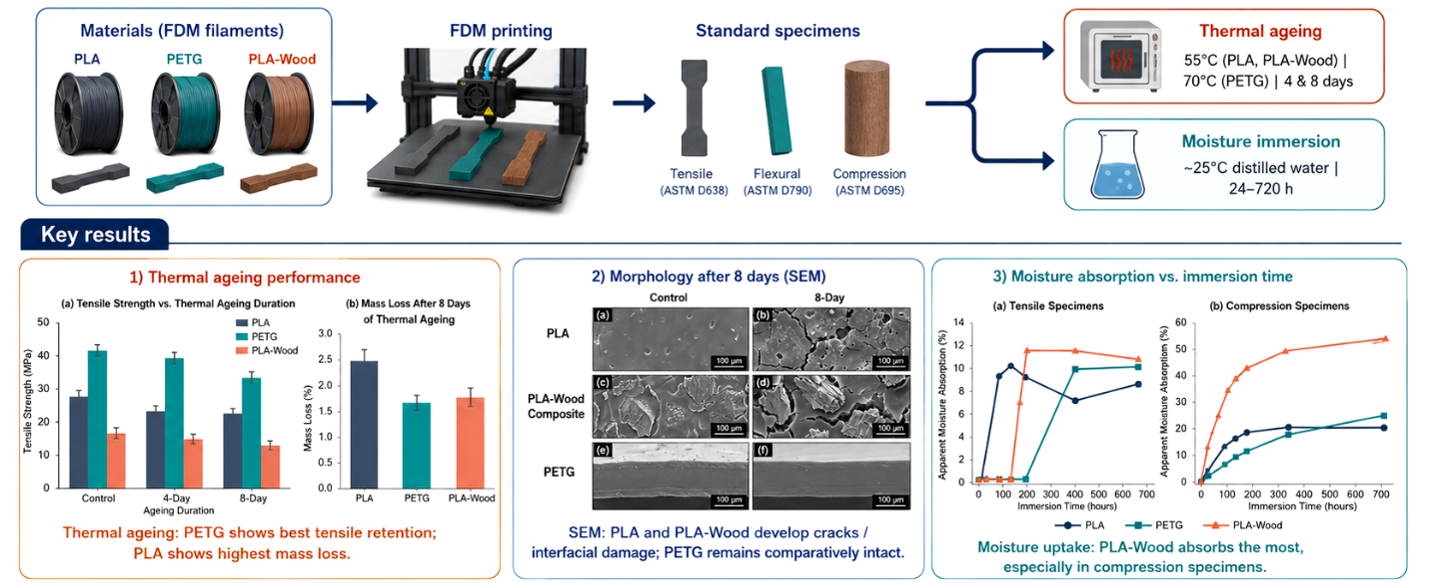
Thermoplastic filaments used in fused deposition modelling (FDM) are increasingly adopted for functional components, yet their durability under thermal and moisture-related service conditions remains incompletely characterised. This study presents a multi-modal investigation of the mechanical degradation of three commercial FDM filaments, namely polylactic acid (PLA), polyethene terephthalate glycol (PETG), and wood-filled PLA (PLA-Wood), subjected to two independent degradation pathways: accelerated isothermal thermal ageing at material-relevant glass-transition temperatures for four and eight days, and immersion in distilled water for 24–720 h. Specimens were fabricated according to American Society for Testing and Materials (ASTM) D638, ASTM D790, and ASTM D695 standards using 70% concentric infill, then evaluated through tensile, flexural, and compressive testing, gravimetric mass and moisture analysis, and scanning electron microscopy (SEM). Under thermal ageing, PETG exhibited the highest tensile strength retention, maintaining 40.87 ± 1.18 MPa after eight days, with the smallest proportional tensile modulus reduction of ≤ 5.1%. PLA-Wood sustained the greatest compressive modulus loss of 15.6%, attributed to combined PLA matrix chain scission and hygroscopic wood-filler desorption. Under moisture exposure, PETG maintained stable wet-state tensile strengths of 24.38–25.60 MPa after initial conditioning, whereas PLA-Wood absorbed approximately 50% apparent moisture in compression specimens and suffered a 57% flexural strength reduction. PLA showed transient increases in stiffness associated with secondary crystallisation before degradation. SEM confirmed distinct material–stressor degradation pathways. These results establish the first integrated dual-stressor degradation profile for this filament triad, providing quantitative selection criteria for FDM applications involving thermal or humid service environments.
- Kristiawan RB, Imaduddin F, Ariawan D, Ubaidillah, Arifin Z. A review on the fused deposition modeling (FDM) 3D printing: Filament processing, materials, and printing parameters. Open Eng. 2021;11(1):639-649. doi: 10.1515/eng-2021-0063
- Mendenhall R, Eslami B. Experimental investigation on effect of temperature on FDM 3D printing polymers: ABS, PETG, and PLA. Appl Sci. 2023;13(20):11503. doi: 10.3390/app132011503
- Saqib MA, Abbas MS, Tanaka H. Sustainability and innovation in 3D printing: Outlook and trends. Clean Technol Recycl. 2024;4(1):1-21. doi: 10.3934/ctr.2024001
- Bhagia S, Bornani K, Agrawal R, et al. Critical review of FDM 3D printing of PLA biocomposites filled with biomass resources, characterization, biodegradability, upcycling and opportunities for biorefineries. Appl Mater Today. 2021;24:101078. doi: 10.1016/j.apmt.2021.101078
- Farah S, Anderson DG, Langer R. Physical and mechanical properties of PLA, and their functions in widespread applications: A comprehensive review. Adv Drug Deliv Rev. 2016;107:367-392. doi: 10.1016/j.addr.2016.06.012
- Patel KS, Shah DB, Joshi SJ, Aldawood FK, Kchaou M. Effect of process parameters on the mechanical performance of FDM printed carbon fiber reinforced PETG. J Mater Res Technol. 2024;30:8006-8018. doi: 10.1016/j.jmrt.2024.05.184
- Martins RF, Branco R, Martins M, et al. Mechanical properties of additively manufactured polymeric materials—PLA and PETG—for biomechanical applications. Polymers (Basel). 2024;16(13):1868. doi: 10.3390/polym16131868
- Sultan MM, Aized T, Farooq M, et al. Optimization of PETG 3D printing parameters for the design and development of biocompatible bone implants. Front Bioeng Biotechnol. 2025;13:1549191. doi: 10.3389/fbioe.2025.1549191
- Ulkir O, Karadağ A. Sustainable additive manufacturing with FDM: Taguchi-based parameter optimization and AI-driven prediction of mechanical and environmental metrics. J Thermoplast Compos Mater. Published online 2026. doi: 10.1177/08927057261415795
- Sultana J, Rahman MM, Wang Y, Ahmed A, Xiaohu C. Influences of 3D printing parameters on the mechanical properties of wood PLA filament: An experimental analysis by Taguchi method. Prog Addit Manuf. 2024;9(4):1239-1251. doi: 10.1007/s40964-023-00516-6
- Barbaz-Isfahani R, Saber-Samandari S, Salehi M. Multi-scale modeling and experimental study on electrosprayed multicore microcapsule-based self-healing polymers. Mech Adv Mater Struct. 2024;31(12):2581-2594. doi: 10.1080/15376494.2022.2162638
- Jha S, Akula B, Enyioma H, Novak M, Amin V, Liang H. Biodegradable biobased polymers: A review of the state of the art, challenges, and future directions. Polymers (Basel). 2024;16(16):2262. doi: 10.3390/polym16162262
- Islam MA, Basaruddin KS, Hassan M, Kamarrudin NS, Rashid AHA, Hoang TD. Influence of infill pattern on tensile strength and material efficiency of fused deposition modelling (FDM)-printed polylactic acid (PLA) parts. Int J Nanoelectron Mater. 2026;19(2):213-222. doi: 10.58915/ijneam.v19i2.3093
- Korkut V, Daricik F, Aktitiz I, Aydin K. Failure of surface modification 3D printed polymer materials by UV/ozone irradiation. Eng Fail Anal. 2023;152:107466. doi: 10.1016/j.engfailanal.2023.107466
- Fijol N, Mathew AP. Accelerated ageing of 3D printed water purification filters based on PLA reinforced with green nanofibers. Polym Test. 2023;129:108303. doi: 10.1016/j.polymertesting.2023.108270
- Banjo AD, Agrawal V, Auad ML, Celestine ADN. Moisture-induced changes in the mechanical behavior of 3D printed polymers. Compos Part C Open Access. 2022;7:100243. doi: 10.1016/j.jcomc.2022.100243
- Ecker JV, Haider A, Burzic I, Huber A, Eder G, Hild S. Mechanical properties and water absorption behaviour of PLA and PLA/wood composites prepared by 3D printing and injection moulding. Rapid Prototyp J. 2019;25(4):672-678. doi: 10.1108/RPJ-06-2018-0149
- Bergaliyeva S, Sales DL. Effect of thermal and hydrothermal accelerated aging on 3D printed polylactic acid. Polymers (Basel). 2022;14(23):5256. doi: 10.3390/polym14235256
- Krapež Tomec D, Schöflinger M, Leßlhumer J, Žigon J, Humar M, Kariž M. Effect of thermal modification of wood on the rheology, mechanical properties and dimensional stability of wood composite filaments and 3D-printed parts. Wood Mater Sci Eng. 2024;19(6):1251-1265. doi: 10.1080/17480272.2024.2316740
- Quader R, Dramko E, Grewell D, Randall J, Narayanan LK. Characterizing the effect of filament moisture on tensile properties and morphology of fused deposition modeled polylactic acid/polybutylene succinate parts. 3D Print Addit Manuf. 2024;11(3):e1151-e1161. doi: 10.1089/3dp.2022.0222
- Triawan F, Syefira D, Rismalia M, et al. The influence of infill density and pattern on the mechanical and fracture behavior of 3D printed structure subjected to uniaxial tensile load. J Eng Sci Technol. 2022;17(5):3254-3266.
- Orellana-Barrasa J, Ferrández-Montero A, Ferrari B, Pastor JY. Natural ageing of PLA filaments: Can it be frozen? Polymers (Basel). 2022;14(16):3361. doi: 10.3390/polym14163361
- Tüfekci K, Cakan BG, Kucukakarsu VM. Stress relaxation of 3D printed PLA of various infill orientations under tensile and bending loadings. J Appl Polym Sci. 2023;140(39):e54456. doi: 10.1002/app.54463
- Li B, Baxevanakis KP, Silberschmidt VV. Water diffusion in additively manufactured PETG: Microstructure-based modelling. Mech Mach Sci. 2024;152:793-801. doi: 10.1007/978-3-031-49421-5_82
- Kannan G, Kurien RA, Khoklang K, Sriamornsak P, Suttiruengwong S. Biodegradable polymers and biocomposites in sustainable additive manufacturing: A review. Int J Biol Macromol. 2025;333(1):148611. doi: 10.1016/j.ijbiomac.2025.148611
- Martínez-Sánchez JA, Romero PE, Comino F, Molero E, Ruiz de Adana M. Effect of material extrusion process parameters to enhance water vapour adsorption capacity of PLA/wood composite printed parts. Polymers (Basel). 2024;16(20):2934. doi: 10.3390/polym16202934
- Joseph A, Mahesh V, Mahesh V, Harursampath D, Loja MAR. Effects of hygrothermal aging on the mechanical properties of the biocomposites. In: Aging Effects on Natural Fiber-Reinforced Polymer Composites. Composites Science and Technology. Singapore: Springer; 2022. doi: 10.1007/978-981-16-8360-2_5
- Kariž M, Sernek M, Obućina M, Kuzman MK. Effect of printing layer thickness on water absorption and mechanical properties of 3D-printed wood/PLA composite materials. Int J Adv Manuf Technol. 2019;102(5-8):2195-2200. doi: 10.1007/s00170-019-03299-9
- Trivedi AK, Gupta MK. PLA based biocomposites for sustainable products: A review. Adv Ind Eng Polym Res. 2023;6(4):382-395. doi: 10.1016/j.aiepr.2023.02.002
- Hsueh MH, Lai CJ, Wang SH, et al. Effect of printing parameters on the thermal and mechanical properties of 3D-printed PLA and PETG, using fused deposition modeling. Polymers (Basel). 2021;13(11):1758. doi: 10.3390/polym13111758
- Ramírez-Revilla S, Camacho-Valencia D, Gonzales-Condori EG, Márquez G. Evaluation and comparison of the degradability and compressive and tensile properties of 3D printing polymeric materials: PLA, PETG, PC, and ASA. MRS Commun. 2023;13(1):55-62. doi: 10.1557/s43579-022-00311-4
- Li W, Zhao X, Liu Y, Ouyang Y, Chen D, Ye D. Hygrothermal aging behavior and flexural property of carbon fiber-reinforced polyethylene terephthalate glycol composites. Text Res J. 2023;93(5-6):1005-1018. doi: 10.1177/00405175221126005
- Aguado RJ, Bastida GA, Espinach FX, et al. Comparative study on the stiffness of poly (lactic acid) reinforced with untreated and bleached hemp fibers. Polymers (Basel). 2023;15(13):2960. doi: 10.3390/polym15132960
- Stojković JR, Turudija R, Vitković N, et al. An experimental study on the impact of layer height and annealing parameters on the tensile strength and dimensional accuracy of FDM 3D printed parts. Materials (Basel). 2023;16(13):4574. doi: 10.3390/ma16134574
- Eryildiz M, Kosa E, Akgun IC, Yavuzer B. Enhancing the mechanical performance of fused deposition modeling-printed recycled polypropylene through annealing temperature, duration, and cooling method. J Mater Eng Perform. 2025;34(15):16032-16048. doi: 10.1007/s11665-025-11539-1
- Dallal S, Eslami B, Tiari S. Recent advances in PEEK for biomedical applications: A comprehensive review of material properties, processing, and additive manufacturing. Polymers (Basel). 2025;17(14):1968. doi: 10.3390/polym17141968
- Xu W, Li M, Xu Y, Entezari A, Fang J. Mechanical characterization of fused deposition modeling-printed wood-polylactic acid composites under water conditioning. Polym Compos. 2026;47(6):5205-5221. doi: 10.1002/pc.70484
- Magalhães FDC, Rubio CVC, Rubio JCC. Enhancing mechanical and structural properties of PLA/wood composites through annealing. Mater Res. 2025;28:e20250640. doi: 10.1590/1980-5373-MR-2025-0640
- Ulkir O, Karadağ A. Effect of infill geometry on the structural performance and fracture morphology of FDM-printed PLA composites. Multidiscip Model Mater Struct. 2026;22(5):1218-1231. doi: 10.1108/MMMS-02-2026-0047
- Wang C, Xue H, Wan Q, et al. TPMS-based PLA/PETG interpenetrating composites: The synergistic enhancement of mechanical properties for bone implant. Compos Struct. 2025;373:119644. doi: 10.1016/j.compstruct.2025.119644
- Tyagi B, Velu R, Raj A. Failure analysis and statistical validation of fused filament fabricated PETG composite for transtibial prosthetics. Prog Addit Manuf. 2025;10(10):8239-8264. doi: 10.1007/s40964-025-01113-5
- Daskalakis E, Hassan M, Omar A, et al. 3D-printed PETG/BC scaffolds for bone tissue repair. Int J Bioprint. 2025;12(1):413-431. doi: 10.36922/IJB025210212