

Engineering the chimeric lysin Art-15 via NZ2114–PlySs2 fusion enhances strain-specific antibacterial activity

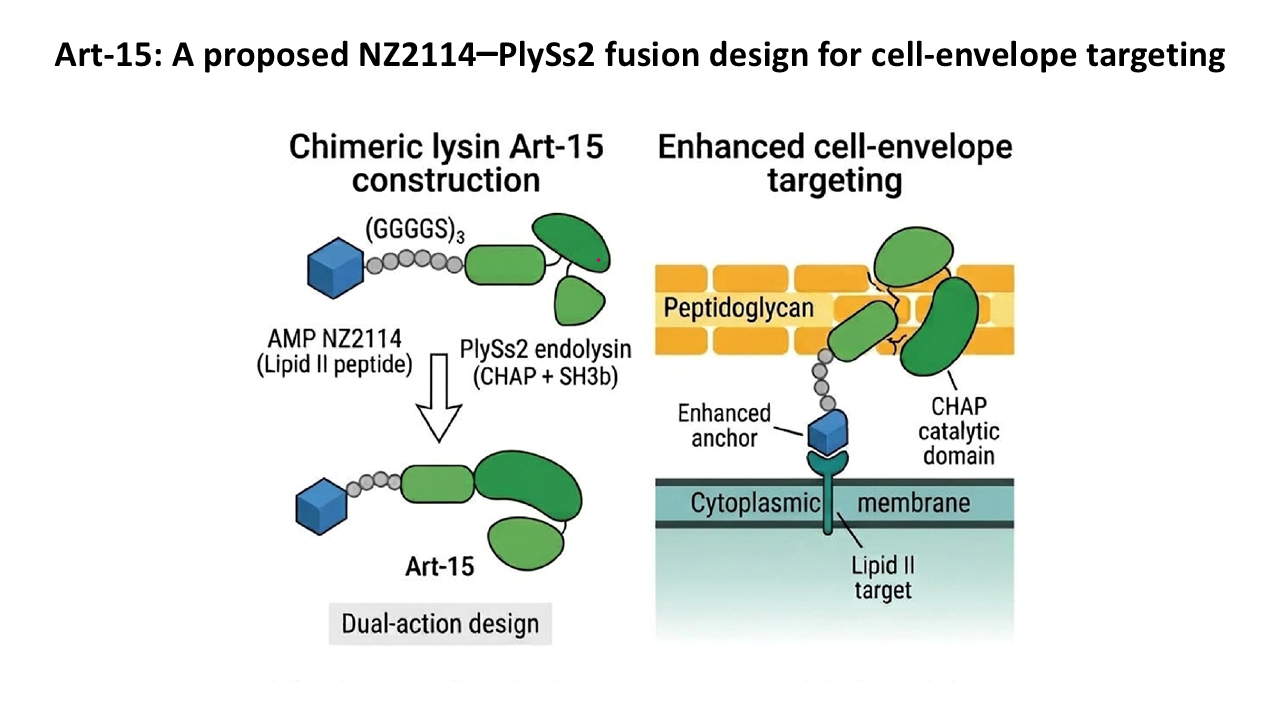
The global rise of multidrug-resistant Gram-positive pathogens demands new antimicrobial strategies. Phage-derived endolysins such as PlySs2 show promising cell-wall targeting activity but may be limited by strain-dependent cell-envelope accessibility. We engineered Art-15, a chimeric lysin that fuses the lipid II-targeting peptide NZ2114 to PlySs2, to test whether enhanced targeting improves antibacterial activity. Art-15 was constructed using a (GGGGS)3 linker, expressed in E. coli, and purified by nickel affinity chromatography. Structural features were analyzed using AlphaFold2 and a transmembrane hidden Markov model. Antibacterial activity was evaluated through spot-on-lawn assays, minimum inhibitory concentration (MIC) determination, and five-hour OD600 turbidity assays. Art-15 was successfully expressed, with a recoverable soluble fraction corresponding to a ~36 kDa recombinant protein. Structural prediction indicated a compact fold without transmembrane helices. In spot assays, Art-15 showed a narrower activity spectrum than PlySs2 (12/51 vs. 27/51 isolates). However, against strain STA2505001, Art-15 exhibited a lower MIC (64 µg/mL) than PlySs2 or NZ2114 alone (128 µg/mL). In OD600 assays, Art-15 suppressed growth more effectively over five hours than either parental component. Art-15 appears to trade broader-spectrum activity for increased strain-specific potency. The findings suggest NZ2114 may contribute to altered cell-envelope targeting and local exposure of the PlySs2 catalytic domain to peptidoglycan, although host-range narrowing indicates target accessibility remains strain-dependent.
- Marino A, Maniaci A, Lentini M, et al. The Global Burden of Multidrug-Resistant Bacteria. Epidemiologia. 2025;6(2):21. doi: 10.3390/epidemiologia6020021
- Diop M, Bassoum O, Ndong A, et al. Prevalence of multidrug-resistant bacteria in healthcare and community settings in West Africa: systematic review and meta-analysis. BMC Infect Dis. 2025;25(1). doi: 10.1186/s12879-025-10562-w
- Miethke M, Pieroni M, Weber T, et al. Towards the sustainable discovery and development of new antibiotics. Nat Rev Chem. 2021;5(10):726-749. doi: 10.1038/s41570-021-00313-1
- Fischetti VA. Development of Phage Lysins as Novel Therapeutics: A Historical Perspective. Viruses. 2018;10(6):310. doi: 10.3390/v10060310
- Schmelcher M, Donovan DM, Loessner MJ. Bacteriophage Endolysins as Novel Antimicrobials. Future Microbiol. 2012;7(10):1147-1171. doi: 10.2217/fmb.12.97
- Lee C, Kim H, Ryu S. Bacteriophage and endolysin engineering for biocontrol of food pathogens/pathogens in the food: recent advances and future trends. Crit Rev Food Sci Nutr. 2022;63(27):8919-8938. doi: 10.1080/10408398.2022.2059442
- Liu H, Hu Z, Li M, Yang Y, Lu S, Rao X. Therapeutic potential of bacteriophage endolysins for infections caused by Gram-positive bacteria. J Biomed Sci. 2023;30(1). doi: 10.1186/s12929-023-00919-1
- Rahman MU, Wang W, Sun Q, et al. Endolysin, a Promising Solution against Antimicrobial Resistance. Antibiotics. 2021;10(11):1277. doi: 10.3390/antibiotics10111277
- Loeffler JM, Nelson D, Fischetti VA. Rapid Killing of Streptococcus pneumoniae with a Bacteriophage Cell Wall Hydrolase. Science. 2001;294(5549):2170-2172. doi: 10.1126/science.1066869
- Gilmer DB, Schmitz JE, Euler CW, Fischetti VA. Novel Bacteriophage Lysin with Broad Lytic Activity Protects against Mixed Infection by Streptococcus pyogenes and Methicillin-Resistant Staphylococcus aureus. Antimicrob Agents Chemother. 2013;57(6):2743-2750. doi: 10.1128/aac.02526-12
- Briers Y, Lavigne R. Breaking Barriers: Expansion of the use of Endolysins as Novel Antibacterials Against Gram-Negative Bacteria. Future Microbiol. 2015;10(3):377-390. doi: 10.2217/fmb.15.8
- Nelson DC, Schmelcher M, Rodriguez-Rubio L, et al. Endolysins as Antimicrobials. In: Advances in Virus Research. Amsterdam, Netherlands: Elsevier; 2012:299-365. doi: 10.1016/b978-0-12-394438-2.00007-4
- Fischetti VA. Bacteriophage lytic enzymes: novel anti-infectives. Trends Microbiol. 2005;13(10):491-496. doi: 10.1016/j.tim.2005.08.007
- Rohde M. The Gram-Positive Bacterial Cell Wall. Microbiol Spectr. 2019;7(3). doi: 10.1128/microbiolspec.gpp3-0044-2018
- Brown S, Santa Maria JP Jr, Walker S. Wall Teichoic Acids of Gram-Positive Bacteria. Annu Rev Microbiol. 2013;67(1):313-336. doi: 10.1146/annurev-micro-092412-155620
- Rajagopal M, Walker S. Envelope Structures of Gram-Positive Bacteria. In: Current Topics in Microbiology and Immunology. Cham: Springer International Publishing; 2015:1-44. doi: 10.1007/82_2015_5021
- Gerstmans H, Rodríguez-Rubio L, Lavigne R, Briers Y. From endolysins to Artilysin®s: novel enzyme-based approaches to kill drug-resistant bacteria. Biochem Soc Trans. 2016;44(1):123-128. doi: 10.1042/bst20150192
- Rodríguez-Rubio L, Chang WL, Gutiérrez D, et al. ‘Artilysation’ of endolysin λSa2lys strongly improves its enzymatic and antibacterial activity against streptococci. Sci Rep. 2016;6(1). doi: 10.1038/srep35382
- Xu D, Zhao S, Dou J, Xu X, Zhi Y, Wen L. Engineered endolysin-based “artilysins” for controlling the gram-negative pathogen Helicobacter pylori. AMB Expr. 2021;11(1). doi: 10.1186/s13568-021-01222-8
- Lim J, Jang J, Myung H, Song M. Eradication of drug-resistant Acinetobacter baumannii by cell-penetrating peptide fused endolysin. J Microbiol. 2022;60(8):859-866. doi: 10.1007/s12275-022-2107-y
- Wang T, Zheng Y, Dai J, Zhou J, Yu R, Zhang C. Design SMAP29-LysPA26 as a Highly Efficient Artilysin against Pseudomonas aeruginosa with Bactericidal and Antibiofilm Activity. Microbiol Spectr. 2021;9(3). doi: 10.1128/spectrum.00546-21
- Islam MM, Kim D, Kim K, et al. Engineering of lysin by fusion of antimicrobial peptide (cecropin A) enhances its antibacterial properties against multidrug-resistant Acinetobacter baumannii. Front Microbiol. 2022;13. doi: 10.3389/fmicb.2022.988522
- Carratalá JV, Arís A, Garcia-Fruitós E, Ferrer-Miralles N. Design strategies for positively charged endolysins: Insights into Artilysin development. Biotechnol Adv. 2023;69:108250. doi: 10.1016/j.biotechadv.2023.108250
- Zheng T, Zhang C. Engineering strategies and challenges of endolysin as an antibacterial agent against Gram‐negative bacteria. Microb Biotechnol. 2024;17(4). doi: 10.1111/1751-7915.14465
- Yang N, Zhang Q, Mao R, et al. Effect of NZ2114 against Streptococcus dysgalactiae biofilms and its application in murine mastitis model. Front Microbiol. 2022;13. doi: 10.3389/fmicb.2022.1010148
- Xiong YQ, Hady WA, Deslandes A, et al. Efficacy of NZ2114, a Novel Plectasin-Derived Cationic Antimicrobial Peptide Antibiotic, in Experimental Endocarditis Due to Methicillin-Resistant Staphylococcus aureus. Antimicrob Agents Chemother. 2011;55(11):5325-5330. doi: 10.1128/aac.00453-11
- Schneider T, Kruse T, Wimmer R, et al. Plectasin, a Fungal Defensin, Targets the Bacterial Cell Wall Precursor Lipid II. Science. 2010;328(5982):1168-1172. doi: 10.1126/science.1185723
- Chen X, Zaro JL, Shen WC. Fusion protein linkers: Property, design and functionality. Adv Drug Deliv Rev. 2013;65(10):1357-1369. doi: 10.1016/j.addr.2012.09.039
- Gerstmans H, Criel B, Briers Y. Synthetic biology of modular endolysins. Biotechnol Adv. 2018;36(3):624-640. doi: 10.1016/j.biotechadv.2017.12.009
- Hassannia M, Naderifar M, Salamy S, Akbarizadeh MR, Mohebi S, Moghadam MT. Engineered phage enzymes against drug-resistant pathogens: a review on advances and applications. Bioprocess Biosyst Eng. 2023;47(3):301-312. doi: 10.1007/s00449-023-02938-6
- Münch D, Roemer T, Lee SH, Engeser M, Sahl HG, Schneider T. Identification and in vitro Analysis of the GatD/MurT Enzyme-Complex Catalyzing Lipid II Amidation in Staphylococcus aureus. Peschel A, ed. PLoS Pathog. 2012;8(1):e1002509. doi: 10.1371/journal.ppat.1002509
- Briers Y, Walmagh M, Van Puyenbroeck V, et al. Engineered Endolysin-Based “Artilysins” To Combat Multidrug-Resistant Gram-Negative Pathogens. Hendrix R, ed. mBio. 2014;5(4). doi: 10.1128/mbio.01379-14
- Cremelie E, Vázquez R, Briers Y. A comparative guide to expression systems for phage lysin production. Essays Biochem. 2024;68(5):645-659. doi: 10.1042/ebc20240019
- Abdelkader K, Gutiérrez D, Tamés-Caunedo H, et al. Engineering a Lysin with Intrinsic Antibacterial Activity (LysMK34) by Cecropin A Fusion Enhances Its Antibacterial Properties against Acinetobacter baumannii. Appl Environ Microbiol. 2022;88(1). doi: 10.1128/aem.01515-21
- Dzuvor CKO, Shanbhag BK, Younas T, Shen HH, Haritos VS, He L. Engineering Self-Assembled Endolysin Nanoparticles against Antibiotic-Resistant Bacteria. ACS Appl Bio Mater. 2022;5(10):4993-5003. doi: 10.1021/acsabm.2c00741
- Gouveia A, Pinto D, Veiga H, Antunes W, Pinho MG, São-José C. Synthetic antimicrobial peptides as enhancers of the bacteriolytic action of staphylococcal phage endolysins. Sci Rep. 2022;12(1). doi: 10.1038/s41598-022-05361-1
- Field D, Cotter PD, Hill C, Ross RP. Bioengineering Lantibiotics for Therapeutic Success. Front Microbiol. 2015;6. doi: 10.3389/fmicb.2015.01363
- Al-Juhani A, Desoky MS, Almuhaimid AA, et al. Efficacy of Gut Microbiome-Targeted Therapies in Modulating Systemic Inflammation and Low-Grade Chronic Inflammatory States in Adults With Metabolic Disorders: A Systematic Review. Cureus. 2025. doi: 10.7759/cureus.92881
- Avis T, Wilson FX, Khan N, Mason CS, Powell DJ. Targeted microbiome-sparing antibiotics. Drug Discov Today. 2021;26(9):2198-2203. doi: 10.1016/j.drudis.2021.07.016
- Aitken M, Abeysekera G, Billington C, Dobson RCJ. Recent Advances in Endolysin Engineering. Antibiotics. 2025;14(12):1285. doi: 10.3390/antibiotics14121285
- Tyagi JL, Gupta P, Ghate MM, Kumar D, Poluri KM. Assessing the synergistic potential of bacteriophage endolysins and antimicrobial peptides for eradicating bacterial biofilms. Arch Microbiol. 2024;206(6). doi: 10.1007/s00203-024-04003-6