
Determinants of immunization practice among frontline healthcare workers in Sub-Saharan Africa: A rural–urban comparative cross-sectional study from North-Central Nigeria

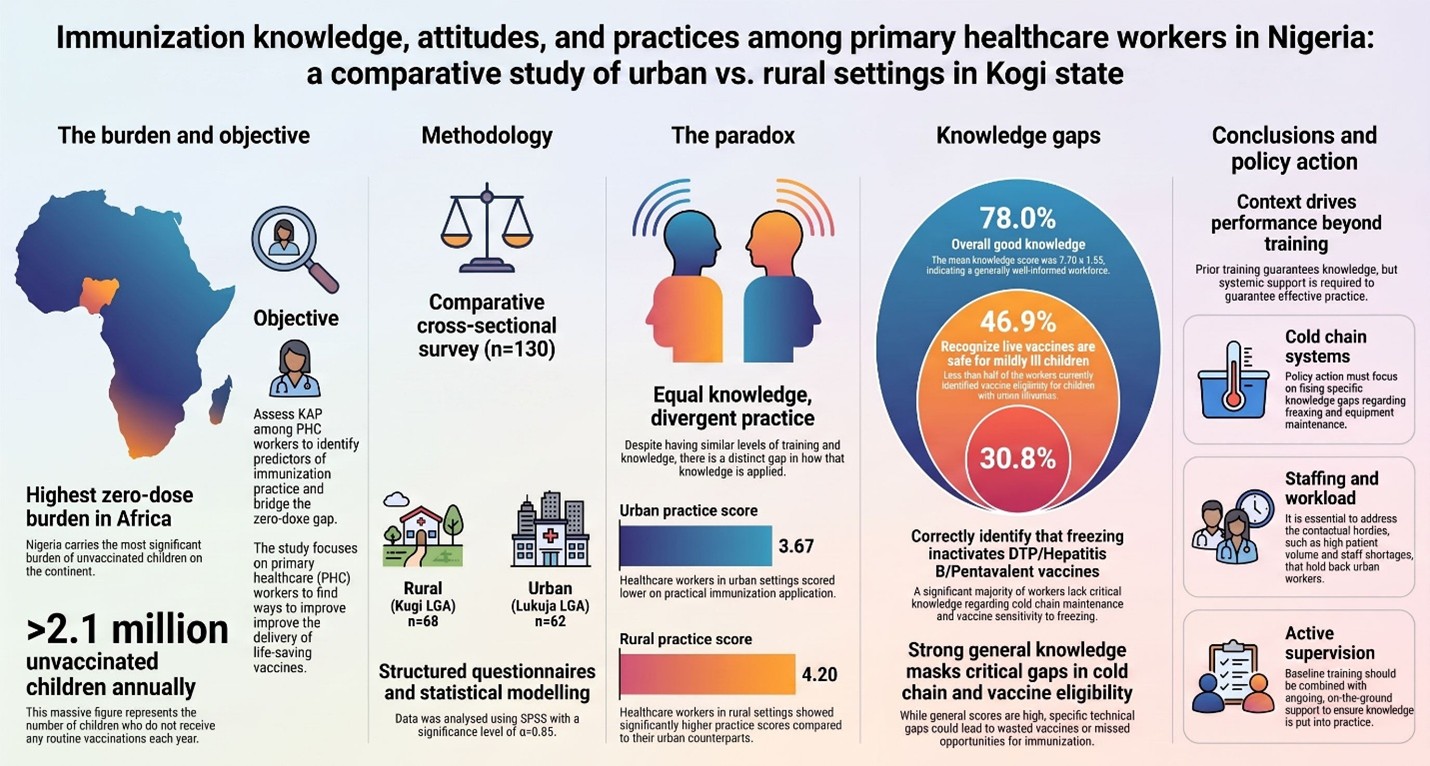
Primary healthcare (PHC) workers are central to immunization delivery, yet knowledge and practice gaps continue to undermine the control of vaccine-preventable diseases across sub-Saharan Africa. Nigeria carries the heaviest zero-dose burden on the continent, with over 2.1 million children remaining unvaccinated annually. This study assessed immunization knowledge, attitudes, and practices among PHC workers in rural Kogi local government area (LGA) and urban Lokoja LGA, and identified predictors of immunization practice. A comparative cross-sectional survey enrolled 130 PHC workers through stratified random sampling (Kogi: n = 68; Lokoja: n = 62), using a structured questionnaire and analyzing data with independent-samples t-tests, χ2 tests, and linear and logistic regression in SPSS (α = 0.05). Overall, 78.0% of participants demonstrated good knowledge (mean = 7.70 ± 1.55); however, gaps persisted. Only 30.8% correctly identified that freezing inactivates diphtheria-tetanus-pertussis/Hepatitis B/Pentavalent vaccines, and fewer than half (46.9%) recognized that live vaccines are safe for mildly ill children. Knowledge significantly predicted practice (β = 0.192, p = 0.028), though it accounted for only 3.7% of the variance in practice. A multivariable model explained 15.5% of variance, with knowledge (p = 0.028) and rural location (β = 0.198, p = 0.034) as significant independent predictors. Rural workers reported better immunization practices than their urban counterparts (4.20 vs. 3.67; p = 0.034) despite comparable knowledge levels, suggesting that contextual factors, including supervision intensity and workload distribution, shape performance beyond individual knowledge. Prior training was the strongest predictor of good knowledge (odds ratio = 10.52, p = 0.001). These findings show that addressing Nigeria’s immunization gap requires more than training alone; sustained improvements in staffing, supervisory systems, and cold chain infrastructure are equally essential.
- Shattock AJ, Coleman Jones H, Jit M, et al. Contribution of vaccination to improved survival and health: modelling 50 years of the Expanded Programme on Immunization. Lancet. 2024;403(10441):2307-2316. doi: 10.1016/S0140-6736(24)00850-X
- World Health Organization. Immunization Agenda 2030 Annual Progress Report 2022. Geneva, Switzerland: WHO; 2023. Accessed July 15, 2026. https://www.immunizationagenda2030.org/images/documents/TPR23_vf.Sept23.pdf
- UNICEF, World Health Organization. Progress and Challenges with Achieving Universal Immunization Coverage: 2023 WHO/UNICEF Estimates of National Immunization Coverage. Geneva, Switzerland: WHO; 2024. Accessed June 25, 2026. https://data.unicef.org/wp-content/uploads/2025/07/WUENIC-progress-and-challenges.pdf
- Abdullahi KO, Ghiyasvandian S, Hasanpour M. Theory-practice gap: the knowledge and perception of Nigerian nurses. Iran J Nurs Midwifery Res. 2022;27(1):30-34. doi: 10.4103/ijnmr.IJNMR_294_19
- World Health Organization. Immunization Agenda 2030 Annual Progress Report 2023. Geneva, Switzerland: WHO; 2024. Accessed July 15, 2026. https://www.immunizationagenda2030.org/images/documents/Immunization_Agenda_2030_Global_Progress_Report_2024_final.pdf
- National Bureau of Statistics, UNICEF. Nigeria Multiple Indicator Cluster Survey (MICS) 2021. Abuja, Nigeria: National Bureau of Statistics; 2022. Accessed June 25, 2026. https://www.unicef.org/nigeria/media/6316/file/2021%20MICS%20full%20report%20.pdf
- National Population Commission [Nigeria] and ICF. Nigeria Demographic and Health Survey 2023-24: Key Indicators Report. Abuja, Nigeria: National Population Commission and ICF; 2024. Accessed June 25, 2026. https://dhsprogram.com/pubs/pdf/PR157/PR157.pdf
- Endalamew SG, Gebeye E, Assefa SK, Geremew BM. Immunization coverage and its determinants among children aged 12-23 months in East Africa: a Bayesian hierarchical modeling approach. BioMed Res Int. 2025;2025(1):6645541. doi: 10.1155/bmri/6645541
- Mahachi K, Kessels J, Boateng K, et al. Zero- or missed-dose children in Nigeria: contributing factors and interventions to overcome immunization service delivery challenges. Vaccine. 2022;40(37):5433-5444. doi: 10.1016/j.vaccine.2022.07.058
- Ameen HA, Salaudeen AG, Musa OI, Aderibigbe SA, Akande TM, Ameen K. Predictors of vaccine management practices among primary healthcare workers in Ilorin, North Central Nigeria. Res J Health Sci. 2023;4(2):148-161. Accessed June 25, 2026. https://rjhs.org/index.php/home/article/view/150
- Azhar S, Rashid L, Islam T, Siddique N, Bilal M, Shehzad M. Knowledge, attitudes, and practices of vaccinators about expanded programs on immunization: a cross-sectional study. Front Public Health. 2024;12:1366378. doi: 10.3389/fpubh.2024.1366378
- Gibson E, Zameer M, Alban R, Kouwanou LM. Community health workers as vaccinators: a rapid review of the global landscape, 2000-2021. Glob Health Sci Pract. 2023;11(1):e2200307. doi: 10.9745/GHSP-D-22-00307
- Olaoye I, Fatiregun A, Myrissa K, et al. Health workers' knowledge, attitudes, and practices on reporting adverse events following immunization in Nigeria: a cross-sectional study. J Health Res. 2023;37(4):224-234. doi: 10.56808/2586-940X.1030
- Gaviola GC, McCarville M, Shendale S, et al. A review of health worker vaccination programs in low, middle and upper middle-income countries. Public Health Pract (Oxf). 2023;6:100415. doi: 10.1016/j.puhip.2023.100415
- Obi-Jeff C, Oguntimehin F, Adejumo A, et al. Strengthening capacity for tailored immunization programs using adult learning principles: a case study from Nigeria. Glob Health Sci Pract. 2024;12(5):e2300465. doi: 10.9745/GHSP-D-23-00465
- Qeran MA, Habour AB baker A, Hassan EHE. Knowledge of healthcare providers in expanded program on immunization, Sa'adah, Yemen. Univ J Pharm Res. 2023;8(1). doi: 10.22270/ujpr.v8i1.896
- Gare KP, Siamisang K, Ramogalana K, et al. The impact of integrated management of childhood illness training on knowledge levels of healthcare workers in Botswana. PLoS Glob Public Health. 2025;5(2):e0003899. doi: 10.1371/journal.pgph.0003899
- Tchoualeu DD, Fleming M, Traicoff DA. A systematic review of pre-service training on vaccination and immunization. Vaccine. 2023;41(20):3156-3170. doi: 10.1016/j.vaccine.2023.03.062
- Kogi State Ministry of Health. 2023-2025 Medium Term Sector Strategy (MTSS). Lokoja, Nigeria: Kogi State Ministry of Health; 2022. Accessed June 25, 2026. https://kogistate.gov.ng/wp-admin/admin-post.php?action=force_download&attachment_id=17075
- Boateng ET, McBain AJ, Majewska KA, et al. Public health surveillance through community health workers: a scoping review of evidence from 25 low-income and middle-income countries. BMJ Open. 2024;14(4):e079776. doi: 10.1136/bmjopen-2023-079776
- Nwachukwu B, Alatishe-Muhammad B, Ibizugbe S, Alake I, Bolarinwa O. Low immunization completion among under-five children: are underserved nomadic and farming communities in a North Central State of Nigeria doing better? Niger J Clin Pract. 2023;26(suppl 1):S92-S102. doi: 10.4103/njcp.njcp_640_22
- Umar HJ, Onah SI, Popoola O, Jibril HH, Oyewole F. Widening geographical inequities in DTP vaccination coverage and zero-dose prevalence across Nigeria: an ecological trend analysis (2018-2024). Vaccines (Basel). 2025;13(11):1135. doi: 10.3390/vaccines13111135
- Isah ZA, Imama A, Sadiq ME, Bello Y, Adamu H, Imam A. Vaccine cold chain management practices among routine immunization service providers in Sokoto State. Texila Int J Public Health. 2024;12(4). doi: 10.21522/TIJPH.2013.12.04.Art089
- Olaniyan A, Isiguzo C, Agbomeji S, et al. Barriers, facilitators, and recommendations for childhood immunisation in Nigeria: perspectives from caregivers, community leaders, and healthcare workers. Pan Afr Med J. 2022;43:97. doi: 10.11604/pamj.2022.43.97.35797
- Ogunwale WO, Oladapo JS, Ojo PA, Okanya PC, Fasheyi KO, Ogunrinu OG, Olajide ND. Knowledge and practice of primary healthcare workers on the routine childhood immunization schedule in Osun State. Int J Community Med Public Health. 2025;12(5):1978-1985. doi: 10.18203/2394-6040.ijcmph20251349
- Ergetie FS, Kassaw AT, Sendekie AK. Vaccine cold chain management practices in primary health centers providing an expanded immunization program in Northwest Ethiopia. Front Public Health. 2023;11:1194807. doi: 10.3389/fpubh.2023.1194807
- Nigatu T, Abraham L, Willems H, et al. The status of immunization program and challenges in Ethiopia: a mixed method study. SAGE Open Med. 2024;12. doi: 10.1177/20503121241237115
- Ifezulike MA, Ishaleku D, Ugwu DC, Abdullahi YY, Dogo DP. Health system determinants of vaccine cold chain performance at the primary healthcare facilities in Nasarawa State, Nigeria: a mixed-methods study. Int J Community Med Public Health. 2026;13(6):2689-2694. doi: 10.18203/2394-6040.ijcmph20261745
- Ifezulike AM, Ugwu DC, Egwuenu A, Muhammad FS, Ishaleku D. Challenges and innovations of vaccine cold chain distribution in developing countries: a narrative review. Int J Res Sci Innov. 2026;12(12):1404-1417. doi: 10.51244/IJRSI.2025.12120121
- Pambudi NA, Sarifudin A, Gandidi IM, Romadhon R. Vaccine cold chain management and cold storage technology to address the challenges of vaccination programs. Energy Rep. 2022;8:955-972. doi: 10.1016/j.egyr.2021.12.039
- Rukundo G, Moore M, Semukunzi H, et al. Vaccine cold chain and understanding what underpins vaccine security for vaccine preventable diseases. BMJ Med. 2026;5(1):e001835. doi: 10.1136/bmjmed-2025-001835
- Asresie MB, Fekadu GA, Dagnew GW. Urban-rural disparities in immunization coverage among children aged 12-23 months in Ethiopia: multivariate decomposition analysis. BMC Health Serv Res. 2023;23(1):969. doi: 10.1186/s12913-023-09940-4
- Geneti L, Shallo SA, Yebasa MA, Daba DB. Health workers' knowledge and practices toward vaccine cold chain management and its associated factors in Sheger, Oromia, Ethiopia: a multicenter cross-sectional study. BMC Pediatr. 2024;24(1):786. doi: 10.1186/s12887-024-05284-y
- Alshagrawi SS. Predicting COVID-19 vaccine uptake: comparing the health belief model and theory of planned behavior. Hum Vaccin Immunother. 2024;20(1). doi: 10.1080/21645515.2024.2361503
- Lockett B, Willemse JJ, Modeste RM. A systematic review on factors influencing immunisation adherence among children under 12 years of age. Health SA Gesondheid. 2025;30:a2864. doi: 10.4102/hsag.v30i0.2864
- Awoyale OD, Dairo MD, Fagbamigbe AF, et al. Yellow fever in plain sight: assessing disease surveillance officers' knowledge and self-efficacy in identification and reporting in Kwara State, Nigeria. BMC Public Health. 2025;25:2127. doi: 10.1186/s12889-025-23344-5
- Clinton Health Access Initiative (CHAI). Introducing an e-learning platform for health workers: The Immunization Academy in Nigeria. Clinton Health Access Initiative. Published February 24, 2022. Accessed June 25, 2026. https://www.clintonhealthaccess.org/blog/introducing-an-e-learning-platform-for-health-workers-the-immunization-academy-in-nigeria/
- Karnik A, Wadi F, Juneja S, Hasan Y. Outcomes and Lessons Learned From Immunization in Practice Training. Cureus. 2026;18(5):e108375. doi: 10.7759/cureus.108375