
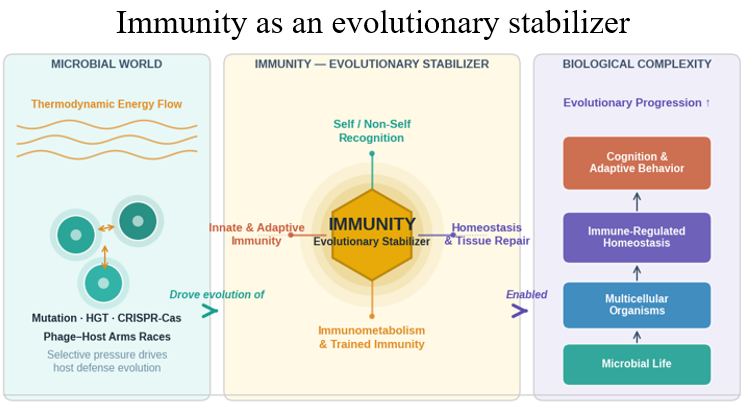
Immunity as an evolutionary stabilizer: Microbial competition, biological complexity, and thermodynamic organization

Life operates within thermodynamic constraints requiring continuous energy acquisition, utilization, and dissipation. Among evolution’s most consequential innovations is immunity, which stabilizes increasingly complex organisms against continual microbial challenge. Microbial competition, pathogen–host interactions, and immune regulation are dynamic processes sustaining biological homeostasis under changing selective conditions. As life diversified, mechanisms that distinguish self from non-self became essential for preserving internal stability—thereby positioning immunity as an evolutionary gatekeeper enabling the transition from simple microbial systems to complex multicellular organisms capable of cognition. Advances in immunometabolism, trained immunity, and microbiome research confirm that immune processes are fundamentally linked to energy allocation, information exchange, and metabolic regulation. Collectively, microbial competition and immune stabilization represent central manifestations of thermodynamic organization, enabling biological persistence, diversification, and increasing complexity.
- Guth AH. Inflationary universe: A possible solution to the horizon and flatness problems. Phys Rev D. 1981;23(2):347– 356. doi: 10.1103/PhysRevD.23.347
- Prigogine I. Time, Structure, and Fluctuations. Science. 1978;201(4358):777-785. doi: 10.1126/science.201.4358.777
- England JL. Statistical physics of self-replication. J Chem Phys. 2013;139(12):121923. doi: 10.1063/1.4818538
- Medzhitov R. Recognition of microorganisms and activation of the immune response. Nature. 2007;449(7164):819–826. doi: 10.1038/nature06246
- Thaiss CA, Zmora N, Levy M, Elinav E. The microbiome and innate immunity. Nature. 2016;535(7610):65–74. doi: 10.1038/nature18847
- Linde AD. A new inflationary universe scenario: A possible solution of the horizon, flatness, homogeneity, isotropy and primordial monopole problems. Phys Lett B. 1982;108(6):389–393. doi: 10.1016/0370-2693(82)91219-9
- Deamer D. The role of lipid membranes in life’s origin. Life. 2017;7(1):5. doi: 10.3390/life7010005
- Ruiz-Mirazo K, Briones C, de la Escosura A. Prebiotic systems chemistry: New perspectives for the origins of life. Chem Rev. 2014;114(1):285–366. doi: 10.1021/cr2004844
- Walker SI, Davies PCW. The algorithmic origins of life. J R Soc Interface. 2013;10(79):20120869. doi: 10.1098/rsif.2012.0869
- McFall-Ngai M, Hadfield MG, Bosch TCG, et al. Animals in a bacterial world, a new imperative for the life sciences. Proc Natl Acad Sci USA. 2013;110(9):3229–3236. doi: 10.1073/pnas.1218525110
- Soucy SM, Huang J, Gogarten JP. Horizontal gene transfer: Building the web of life. Nat Rev Genet. 2015;16(8):472–482. doi: 10.1038/nrg3962
- Barrangou R, Marraffini LA. CRISPR-Cas systems: Prokaryotes upgrade to adaptive immunity. Mol Cell. 2014;54(2):234–244. doi: 10.1016/j.molcel.2014.03.011
- Hille F, Richter H, Wong SP, Bratovič M, Ressel S, Charpentier E. The biology of CRISPR-Cas: Backward and forward. Cell. 2018;172(6):1239–1259. doi: 10.1016/j.cell.2017.11.032
- Lane N. The Vital Question: Energy, Evolution, and the Origins of Complex Life. New York: W.W. Norton & Company; 2015.
- Medzhitov R. Origin and physiological roles of inflammation. Nature. 2008;454:428–435. doi: 10.1038/nature07201
- O’Neill LAJ, Kishton RJ, Rathmell J. A guide to immunometabolism for immunologists. Nat Rev Immunol. 2016;16(9):553–565. doi: 10.1038/nri.2016.70
- Netea MG, Domínguez-Andrés J, Barreiro LB, et al. Defining trained immunity and its role in health and disease. Nat Rev Immunol. 2020;20(6):375–388. doi: 10.1038/s41577-020-0285-6
- Domínguez-Andrés J, Netea MG, Joosten LAB. Trained immunity: Adaptation within innate immune mechanisms. Physiol Rev. 2023;103(1):313–346. doi: 10.1152/physrev.00031.2021
- Ochando J, Mulder WJM, Madsen JC, Netea MG, Duivenvoorden R. Trained immunity—basic concepts and contributions to immunopathology. Nat Rev Nephrol. 2023;19(1):23–37. doi: 10.1038/s41581-022-00633-5
- O’Neill LAJ, Pearce EJ. Immunometabolism governs dendritic cell and macrophage function. J Exp Med. 2016;213(1):15–23. doi: 10.1084/jem.20151570
- Buck MD, O’Sullivan D, Pearce EL. T cell metabolism drives immunity. J Exp Med. 2015;212(9):1345–1360. doi: 10.1084/jem.20151159
- Stefano GB, Weissenberger S, Ptacek R, Anders M, Raboch J, Büttiker P. Viruses and mitochondrial dysfunction in neurodegeneration and cognition: An evolutionary perspective. Cell Mol Neurobiol.2024;44(1):68. doi: 10.1007/s10571-024-01503-3
- Stefano GB. Adaptability Beyond Darwin: Microbial evolution, mitochondria, and the thermodynamic frontiers of survival. Front Biosci Landmark 2025;30(10):45962. doi: 10.31083/FBL45962
- Stefano GB. Hantaviruses and Mitochondria: Evolutionarily Conserved Viral Targeting of Cellular Bioenergetics and Neuroimmune Function. Biomed J Sci Tech Res. 2026;65(5). doi: 10.26717/BJSTR.2026.65.010252
- Artyomov MN, Van den Bossche J. Immunometabolism in the single-cell era. Cell Metab. 2020;32(5):710–725. doi: 10.1016/j.cmet.2020.09.013
- Geltink RIK, Kyle RL, Pearce EL. Unraveling the complex interplay between T cell metabolism and function. Annual Rev Immunol. 2018;36(1):461–488. doi: 10.1146/annurev-immunol-042617-053019
- Blalock JE. The immune system as the sixth sense. J Intern Med. 2005;257(2):126–138. doi: 10.1111/j.1365-2796.2004.01441.x
- Dantzer R. Neuroimmune interactions: From the brain to the immune system and vice versa. Physiol Rev. 2018;98(1):477– 504. doi: 10.1152/physrev.00039.2016
- Kipnis J. Multifaceted interactions between adaptive immunity and the central nervous system. Science. 2016;353(6301):766–771. doi: 10.1126/science.aag2638
- Filiano AJ, Gadani SP, Kipnis J. Interactions of innate and adaptive immunity in brain development and function. Brain Res. 2015;1617:18–27. doi: 10.1016/j.brainres.2014.07.050
- Cryan JF, O’Riordan KJ, Cowan CSM, et al. The microbiota-gut-brain axis. Physiol Rev. 2019;99(4):1877–2013. doi: 10.1152/physrev.00018.2018
- Morais LH, Schreiber HL IV, Mazmanian SK. The gut microbiota-brain axis in behaviour and brain disorders. Nat Rev Microbiol. 2021;19(4):241–255. doi: 10.1038/s41579-020-00460-0
- Raichle ME, Gusnard DA. Appraising the brain’s energy budget. Proc Natl Acad Sci USA. 2002;99(16):10237–10239. doi: 10.1073/pnas.172399499
- Yirmiya R, Goshen I. Immune modulation of learning, memory, neural plasticity and neurogenesis. Brain Behav Immun. 2011;25(2):181–213. doi: 10.1016/j.bbi.2010.10.015
- Friston K. The free-energy principle: A unified brain theory? Nat Rev Neurosci. 2010;11(2):127–138. doi: 10.1038/nrn2787
- Büttiker P, Stefano GB, Weissenberger S, et al. HIV, HSV, SARS-CoV-2 and Ebola share long-term neuropsychiatric sequelae. Neuropsychiatr Dis Treat. 2022;18:2229–2239. doi: 10.2147/NDT.S382308
- Stefano GB. Mitochondria: A covert chronic infection masquerading as a symbiotic partner? Front Biosci - Landmark 2025;30(6):42854. doi: 10.31083/FBL42854
- Prigogine I, Nicolis G, Babloyantz A. Thermodynamics of evolution. Phys Today. 1972;25(12):38–44. doi: 10.1063/1.3071140
- Lane N, Martin WF. The energetics of genome complexity. Nature. 2010;467(7318):929–934. doi: 10.1038/nature09486