

Evaluation of chicken egg yolk immunoglobulin Y-based ELISA for serodiagnosis of hepatitis E virus in swine

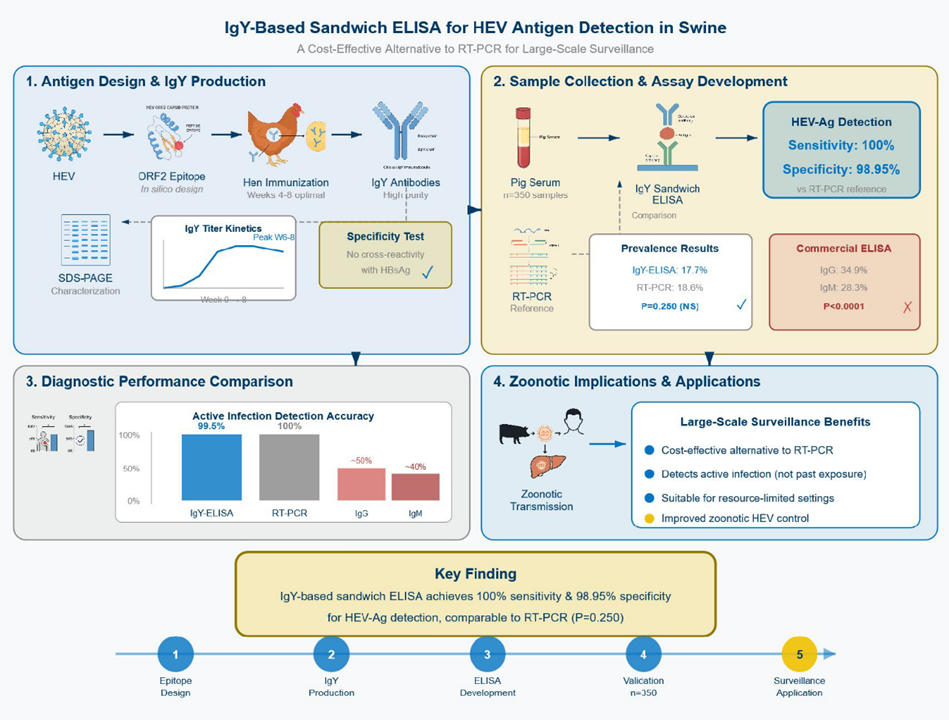
Hepatitis E virus (HEV) is a major zoonotic pathogen, and pigs are an important reservoir. Serology for anti-HEV antibodies poorly reflects active infection, while reverse transcription polymerase chain reaction (RT-PCR) is sensitive but not always feasible for large-scale surveillance. This study aimed to develop an immunoglobulin Y (IgY)-based sandwich enzyme-linked immunosorbent assay (ELISA) for direct detection of HEV antigen (HEV-Ag). An antigenic epitope from the HEV open reading frame 2 capsid protein was identified in silico, synthesized, and used to immunize laying hens; IgY was purified from egg yolk and characterized by sodium dodecyl sulfate–polyacrylamide gel electrophoresis. An in-house sandwich ELISA was subsequently developed using the anti-HEV IgY antibodies. Its diagnostic performance was evaluated against RT-PCR using 350 field-collected pig serum samples and compared with commercial anti-HEV IgG and IgM ELISA kits. Immunization yielded high-purity IgY antibodies, with antigen-specific antibody kinetics showing a significant increase in specific immunoreactivity from week 4 onward and peak sensitivity at weeks 6–8 post-immunization. The anti-HEV IgY showed high specificity, with no cross-reactivity observed against a heterologous antigen (HBsAg). The optimized sandwich ELISA detected HEV-Ag with a sensitivity of 95.4% and a specificity of 100% relative to RT-PCR. The prevalence of HEV-Ag was 17.7% (62/350), which was not significantly different from RT-PCR (18.6%, 65/350; p=0.250). In contrast, commercial IgG and IgM ELISAs showed high seroprevalence rates (34.9% and 28.3%, respectively) but exhibited significant discrepancies with RT-PCR (p<0.0001), indicating limited utility for identifying active infection. Overall, the developed IgY-based sandwich ELISA demonstrated high diagnostic performance for detecting active HEV infection. This assay represents a viable alternative to RT-PCR for large-scale surveillance, particularly in resource-constrained settings, and may contribute to improved control of zoonotic HEV transmission.
- Lagare A, Abdoulkader IK, Fall G, et al. Molecular epidemiology of hepatitis E virus among humans in the Niger Republic, 2017-2023. J Clin Virol. 2025;176:105761. doi: 10.1016/j.jcv.2025.105761
- WHO. News Room Fact Sheets Detail Hepatitis-E. World Health Organization; 2025. Available from: https://www. who.int/news-room/fact-sheets/detail/hepatitis-e [Last accessed on 2025 Jun 11].
- Modiyinji AF, Atsama MA, Monamele GC, Nola M, Njouom R. High seroprevalence of hepatitis E among pigs suggests an animal reservoir in Cameroon. J Infect Dev Ctries. 2018;12(8):676-679. doi: 10.3855/jidc.10310
- Purdy MA, Harrison TJ, Jameel S, et al. ICTV virus taxonomy profile: Hepeviridae. J Gen Virol. 2017;98(11):2645-2646. doi: 10.1099/jgv.0.000940
- Cao LC, Ha LNN, Giang TT, et al. Characterization of zoonotic hepatitis E virus in domestic pigs and wild boar in Vietnam: Implications for public health. One Health. 2024;19:100857. doi: 10.1016/j.onehlt.2024.100857
- Meng XJ. From barnyard to food table: The omnipresence of hepatitis E virus and risk for zoonotic infection and food safety. Virus Res. 2011;161(1):23-30. doi: 10.1016/j.virusres.2011.01.016
- Monini M, Di Bartolo I, De Sabato L, Ianiro G, Agostinelli F, Ostanello F. Hepatitis E virus (HEV) in heavy pigs in slaughterhouses of Northern Italy: Investigation of seroprevalence, viraemia, and faecal shedding. Animals. 2023;13(18):2942. doi: 10.3390/ani13182942
- Boxman ILA, Verhoef L, Dop PY, Vennema H, Dirks RAM, Opsteegh M. High prevalence of acute hepatitis E virus infection in pigs in Dutch slaughterhouses. Int J Food Microbiol. 2022;379:109830. doi: 10.1016/j.ijfoodmicro.2022.109830
- He Z, Liu D, Liu B, et al. Prevalence of hepatitis E virus in swine in China: A systematic review with meta-analysis (2004-2023). Front Vet Sci. 2025;11:1472658. doi: 10.3389/fvets.2024.1472658
- Modiyinji AF, Bigna JJ, Kenmoe S, et al. Epidemiology of hepatitis E virus infection in animals in Africa: A systematic review and meta-analysis. BMC Vet Res. 2021;17:50. doi: 10.1186/s12917-021-02749-5
- Yugo DM, Meng XJ. Hepatitis E virus: Foodborne, waterborne and zoonotic transmission. Int J Environ Res Public Health. 2013;10(10):4507-4533. doi: 10.3390/ijerph10104507
- Luo Q, Chen J, Zhang Y, et al. Viral hepatitis E: Clinical manifestations, treatment, and prevention. Liver Res. 2024;8(1):11-21. doi: 10.1016/j.livres.2024.01.001
- Rein DB, Stevens GA, Theaker J, Wittenborn JS, Wiersma ST. The global burden of hepatitis E virus genotypes 1 and 2 in 2005. Hepatology. 2012;55(4):988-997. doi: 10.1002/hep.25505
- Kamar N, Izopet J, Pavio N, et al. Hepatitis E virus infection. Nat Rev Dis Primers. 2017;3:17086. doi: 10.1038/nrdp.2017.86
- Wu C, Wu X, Xia J. Hepatitis E virus infection during pregnancy. Virol J. 2020;17(1):73. doi: 10.1186/s12985-020-01343-9
- Karpe YA. Processing of the hepatitis E virus ORF1 nonstructural polyprotein. Front Virol. 2024;3:38. doi: 10.3389/fviro.2023.1327745
- Kenney SP, Meng XJ. Hepatitis E virus genome structure and replication strategy. Cold Spring Harb Perspect Med. 2019;9(1):a031724. doi: 10.1101/cshperspect.a031724
- Wang B, Meng XJ. Structural and molecular biology of hepatitis E virus. Comput Struct Biotechnol J. 2021;19: 1907-1916. doi: 10.1016/j.csbj.2021.03.038
- Ankavay M, Montpellier C, Sayed IM, et al. New insights into the ORF2 capsid protein, a key player in the hepatitis E virus lifecycle. Sci Rep. 2019;9:6243. doi: 10.1038/s41598-019-42737-2
- Riddell MA, Li F, Anderson DA. Identification of immunodominant and conformational epitopes in the capsid protein of hepatitis E virus by using monoclonal antibodies. J Virol. 2000;74(17):8011-8017. doi: 10.1128/jvi.74.17.8011-8017.2000
- Li Y, Yang HS, Klasse PJ, Zhao Z. The significance of antigen-antibody-binding avidity in clinical diagnosis. Crit Rev Clin Lab Sci. 2025;62(1):9-23. doi: 10.1080/10408363.2024.2379286
- Adams NM, Leelawong M, Benton A, Quinn C, Haselton FR, Schmitz JE. COVID‐19 diagnostics for resource‐limited settings: Evaluation of “unextracted” qRT‐PCR. J Med Virol. 2021;93(1):559-563. doi: 10.1002/jmv.26328
- Lee L, Samardzic K, Wallach M, Frumkin LR, Mochly- Rosen D. Immunoglobulin Y for potential diagnostic and therapeutic applications in infectious diseases. Front Immunol. 2021;12:696003. doi: 10.3389/fimmu.2021.696003
- Pereira EPV, Van Tilburg MF, Florean EOPT, Guedes MIF. Egg yolk antibodies (IgY) and their applications in human and veterinary health: A review. Int Immunopharmacol. 2019;73:293-303. doi: 10.1016/j.intimp.2019.05.015
- Modiyinji AF, Tankeu LTA, Monamele CG, et al. Hepatitis E virus infections among patients with acute febrile jaundice in two regions of Cameroon: First molecular characterization of hepatitis E virus genotype 4. PLoS One. 2024;19(2):e0298723. doi: 10.1371/journal.pone.0298723
- Locarnini SA, Yuen L. Molecular genesis of drug-resistant and vaccine-escape HBV mutants. Antivir Ther. 2010;15(3 Pt B):451-461. doi: 10.3851/IMP1499
- Can H, Köseoğlu AE, Erkunt Alak S, et al. In silico discovery of antigenic proteins and epitopes of SARS-CoV-2 for the development of a vaccine or a diagnostic approach for COVID-19. Sci Rep. 2020;10:22387. doi: 10.1038/s41598-020-79645-9
- Chaudhuri D, Datta J, Majumder S, Giri K. In silico designing of peptide based vaccine for hepatitis viruses using reverse vaccinology approach. Infect Genet Evol. 2020;84:104388. doi: 10.1016/j.meegid.2020.104388
- Shams M, Nourmohammadi H, Asghari A, et al. Construction of a multi-epitope protein for human Toxocara canis detection: Immunoinformatics approach multi-epitope construct for T. Canis serodiagnosis. Inform Med Unlocked. 2021;26:100732. doi: 10.1016/j.imu.2021.100732
- Shey RA, Ghogomu SM, Esoh KK, et al. In-silico design of a multi-epitope vaccine candidate against onchocerciasis and related filarial diseases. Sci Rep. 2019;9:4409. doi: 10.1038/s41598-019-40833-x
- Hodek P, Trefil P, Simunek J, Hudecek J, Stiborova M. Optimized protocol of chicken antibody (IgY) purification providing electrophoretically homogenous preparations. Int J Electrochem Sci. 2013;8(1):113-124. doi: 10.1016/S1452-3981(23)14006-5
- Lowry OH, Rosebrough NJ, Farr AL, Randall RJ. Protein measurement with the Folin phenol reagent. J Biol Chem. 1951;193(1):265-275.
- Bagulo H, Majekodunmi AO, Welburn SC, Bimi L. Hepatitis E seroprevalence and risk factors in humans and pig in Ghana. BMC Infect Dis. 2022;22:132. doi: 10.1186/s12879-022-07127-6
- Mbencho MN, Hafza N, Cao LC, et al. Prevalence, genotype distribution, and risk factors of hepatitis E virus in blood donors, HIV patients, and pregnant women in Southwest Cameroon. Diagn Microbiol Infect Dis. 2025;111(4):116748. doi: 10.1016/j.diagmicrobio.2025.116748
- Meta-Djomsi D, Atsama-Amougou M, Ngamaleu MR, et al. Molecular surveillance of hepatitis E virus in wastewater in Yaoundé, Cameroon. PLoS One. 2025;20(8):e0322765. doi: 10.1371/journal.pone.0322765
- Modiyinji AF, Sanding GMAM, Atsama MA, Monamele CG, Nola M, Njouom R. Serological and molecular investigation of hepatitis E virus in pigs reservoirs from Cameroon reveals elevated seroprevalence and presence of genotype 3. PLoS One. 2020;15(2):e0229073. doi: 10.1371/journal.pone.0229073
- Landry ML. Immunoglobulin M for acute infection: True or False? Clin Vaccine Immunol. 2016;23(7):540-545. doi: 10.1128/CVI.00211-16