
Natural compounds as antivirals against influenza, SARS-CoV-2, and other respiratory viruses: A therapeutic perspective

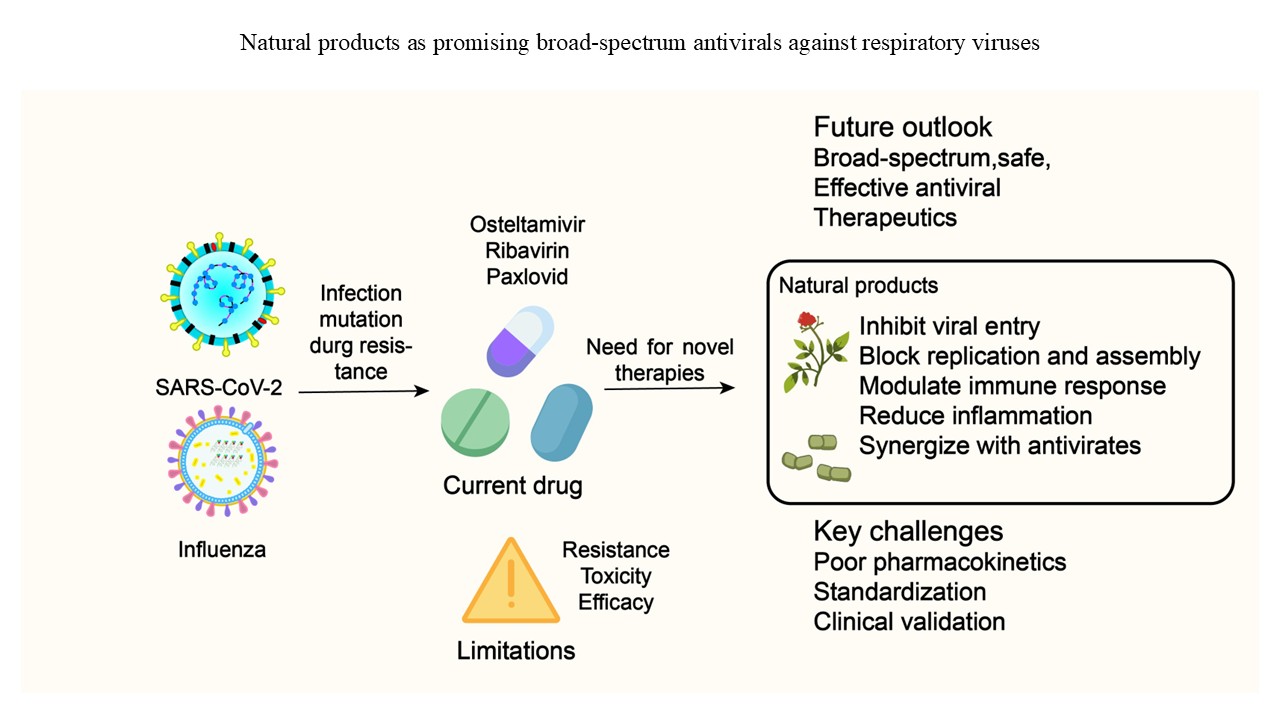
Respiratory viruses—including influenza, severe acute respiratory syndrome coronavirus 2, and respiratory syncytial virus—remain major global health challenges, contributing to substantial morbidity, mortality, and socioeconomic burden. Although vaccines and antiviral agents, such as oseltamivir, ribavirin, and Paxlovid (nirmatrelvir/ritonavir), have advanced disease management, their effectiveness is often compromised by the rapid mutation of viruses, the emergence of drug-resistant strains, and adverse toxicities. These limitations underscore the urgent need for novel therapeutic strategies. Natural products have attracted growing attention as promising antiviral candidates due to their remarkable structural diversity, multi-target mechanisms, and generally favorable safety profiles. They can inhibit viral entry, replication, and assembly while simultaneously modulating host immune and inflammatory responses. In addition, natural compounds may act synergistically with existing antivirals, enhancing efficacy and reducing the risk of resistance. Despite ongoing challenges in pharmacokinetics, standardization, and clinical validation, natural products represent a compelling frontier for the development of broad-spectrum, safe, and effective antiviral therapeutics.
- Collaborators GBDI. Mortality, morbidity, and hospitalisations due to influenza lower respiratory tract infections, 2017: An analysis for the global burden of disease study 2017. Lancet Respir Med. 2019;7(1):69-89. doi: 10.1016/S2213-2600(18)30496-X
- Soudani S, Mafi A, Al Mayahi Z, et al. A systematic review of influenza epidemiology and surveillance in the Eastern Mediterranean and North African region. Infect Dis Ther. 2022;11(1):15-52. doi: 10.1007/s40121-021-00534-3
- Qiao H, Deng X, Qiu L, et al. SARS-CoV-2 induces blood-brain barrier and choroid plexus barrier impairments and vascular inflammation in mice. J Med Virol. 2024;96(5):e29671. doi: 10.1002/jmv.29671
- Zaraket H, Saito R, Suzuki Y, et al. Genetic makeup of amantadine-resistant and oseltamivir-resistant human influenza A/H1N1 viruses. J Clin Microbiol. 2010;48(4):1085-1092. doi: 10.1128/JCM.01532-09
- Whitley RJ, Monto AS. Resistance of influenza virus to antiviral medications. Clin Infect Dis. 2020;71(4):1092-1094. doi: 10.1093/cid/ciz911
- Thorlund K, Awad T, Boivin G, Thabane L. Systematic review of influenza resistance to the neuraminidase inhibitors. BMC Infect Dis. 2011;11:134. doi: 10.1186/1471-2334-11-134
- Khan MT, Ather A, Thompson KD, Gambari R. Extracts and molecules from medicinal plants against herpes simplex viruses. Antiviral Res. 2005;67(2):107-119. doi: 10.1016/j.antiviral.2005.05.002
- Centers for Disease Control and Prevention. Antiviral Agents for the Treatment and Chemoprophylaxis of Influenza; 2011. Available from: https://www.cdc.gov/flu/hcp/antivirals/ antiviral-adverse-events.html [Last accessed on 2025 Dec 25].
- Muller MP, Dresser L, Raboud J, et al. Adverse events associated with high-dose ribavirin: Evidence from the Toronto outbreak of severe acute respiratory syndrome. Pharmacotherapy. 2007;27(4):494-503. doi: 10.1592/phco.27.4.494
- Krammer F, Smith GJD, Fouchier RAM, et al. Influenza. Nat Rev Dis Primers. 2018;4(1):3. doi: 10.1038/s41572-018-0002-y
- Bouvier NM, Palese P. The biology of influenza viruses. Vaccine. 2008;26(Suppl 4):D49-D53. doi: 10.1016/j.vaccine.2008.07.039
- Skehel JJ, Wiley DC. Receptor binding and membrane fusion in virus entry: the influenza hemagglutinin. Annu Rev Biochem. 2000;69:531-569. doi: 10.1146/annurev.biochem.69.1.531
- Moscona A. Neuraminidase inhibitors for influenza. N Engl J Med. 2005;353(13):1363-1373. doi: 10.1056/nejmra050740
- Fodor E, Te Velthuis AJ. Structure and function of the influenza virus transcription and replication machinery. Cold Spring Harb Perspect Med. 2020;10(9):a038398. doi: 10.1101/cshperspect.a038398
- Pang IK, Pillai PS, Iwasaki A. Efficient influenza A virus replication in the respiratory tract requires signals from TLR7 and RIG-I. Proc Natl Acad Sci U S A. 2013;110(34):13910-13915. doi: 10.1073/pnas.1303275110
- Gack MU, Albrecht RA, Urano T, et al. Influenza A virus NS1 targets the ubiquitin ligase TRIM25 to evade recognition by the host viral RNA sensor RIG-I. Cell Host Microbe. 2009;5(5):439-449. doi: 10.1016/j.chom.2009.04.006
- Nemeroff ME, Barabino SM, Li Y, Keller W, Krug RM. Influenza virus NS1 protein interacts with the cellular 30 kDa subunit of CPSF and inhibits 3’end formation of cellular pre-mRNAs. Mol Cell. 1998;1(7):991-1000. doi: 10.1016/s1097-2765(00)80099-4
- Varga ZT, Ramos I, Hai R, et al. The influenza virus protein PB1-F2 inhibits the induction of type I interferon at the level of the MAVS adaptor protein. PLoS Pathog. 2011;7(6):e1002067. doi: 10.1371/journal.ppat.1002067
- Hsu AC. Influenza virus: A master tactician in innate immune evasion and novel therapeutic interventions. Front Immunol. 2018;9:743. doi: 10.3389/fimmu.2018.00743
- Kim H, Webster RG, Webby RJ. Influenza virus: Dealing with a drifting and shifting pathogen. Viral Immunol. 2018;31(2):174-183. doi: 10.1089/vim.2017.0141
- Treanor J. Influenza vaccine--outmaneuvering antigenic shift and drift. N Engl J Med. 2004;350(3):218-220. doi: 10.1056/nejmp038238
- Brant AC, Tian W, Majerciak V, Yang W, Zheng ZM. SARS-CoV-2: From its discovery to genome structure, transcription, and replication. Cell Biosci. 2021;11(1):136. doi: 10.1186/s13578-021-00643-z
- Jackson CB, Farzan M, Chen B, Choe H. Mechanisms of SARS-CoV-2 entry into cells. Nat Rev Mol Cell Biol. 2022;23(1):3-20. doi: 10.1038/s41580-021-00418-x
- Chen A, Lupan AM, Quek RT, et al. A coronaviral pore-replicase complex links RNA synthesis and export from double-membrane vesicles. Sci Adv. 2024;10(45):eadq9580. doi: 10.1126/sciadv.adq9580
- Schubert K, Karousis ED, Jomaa A, et al. SARS-CoV-2 Nsp1 binds the ribosomal mRNA channel to inhibit translation. Nat Struct Mol Biol. 2020;27(10):959-966. doi: 10.1038/s41594-020-0511-8
- Miorin L, Kehrer T, Sanchez-Aparicio MT, et al. SARS-CoV-2 Orf6 hijacks Nup98 to block STAT nuclear import and antagonize interferon signaling. Proc Natl Acad Sci U S A. 2020;117(45):28344-28354. doi: 10.1073/pnas.2016650117
- Jiang HW, Zhang HN, Meng QF, et al. SARS-CoV-2 Orf9b suppresses type I interferon responses by targeting TOM70. Cell Mol Immunol. 2020;17(9):998-1000. doi: 10.1038/s41423-020-0514-8
- Chen Z, John Wherry E. T cell responses in patients with COVID-19. Nat Rev Immunol. 2020;20(9):529-536. doi: 10.1038/s41577-020-0402-6
- Tang Y, Liu J, Zhang D, Xu Z, Ji J, Wen C. Cytokine storm in COVID-19: The current evidence and treatment strategies. Front Immunol. 2020;11:1708. doi: 10.3389/fimmu.2020.01708
- Feng Z, Xu L, Xie Z. Receptors for respiratory syncytial virus infection and host factors regulating the life cycle of respiratory syncytial virus. Front Cell Infect Microbiol. 2022;12:858629. doi: 10.3389/fcimb.2022.858629
- Johnson SM, McNally BA, Ioannidis I, et al. Respiratory syncytial virus uses CX3CR1 as a receptor on primary human airway epithelial cultures. PLoS Pathog. 2015;11(12):e1005318. doi: 10.1371/journal.ppat.1005318
- Cadena-Cruz C, Villarreal Camacho JL, De Avila- Arias M, Hurtado-Gomez L, Rodriguez A, San-Juan- Vergara H. Respiratory syncytial virus entry mechanism in host cells: A general overview. Mol Microbiol. 2023;120(3):341-350. doi: 10.1111/mmi.15133
- Thornhill EM, Verhoeven D. Respiratory syncytial virus’s non-structural proteins: Masters of interference. Front Cell Infect Microbiol. 2020;10:225. doi: 10.3389/fcimb.2020.00225
- Sedeyn K, Schepens B, Saelens X. Respiratory syncytial virus nonstructural proteins 1 and 2: Exceptional disrupters of innate immune responses. PLoS Pathog. 2019;15(10):e1007984. doi: 10.1371/journal.ppat.1007984
- Becker Y. Respiratory syncytial virus (RSV) evades the human adaptive immune system by skewing the Th1/Th2 cytokine balance toward increased levels of Th2 cytokines and IgE, markers of allergy--a review. Virus Genes. 2006;33(2):235-252. doi: 10.1007/s11262-006-0064-x
- Pelaia C, Heffler E, Crimi C, et al. Interleukins 4 and 13 in asthma: Key pathophysiologic cytokines and druggable molecular targets. Front Pharmacol. 2022;13:851940. doi: 10.3389/fphar.2022.851940
- Stasiak AC, Stehle T. Human adenovirus binding to host cell receptors: A structural view. Med Microbiol Immunol. 2020;209(3):325-333. doi: 10.1007/s00430-019-00645-2
- Nestic D, Bozinovic K, Pehar I, Wallace R, Parker AL, Majhen D. The revolving door of adenovirus cell entry: Not all pathways are equal. Pharmaceutics. 2021;13(10):1585. doi: 10.3390/pharmaceutics13101585
- Greber UF, Suomalainen M, Stidwill RP, Boucke K, Ebersold MW, Helenius A. The role of the nuclear pore complex in adenovirus DNA entry. EMBO J. 1997;16(19):5998-6007. doi: 10.1093/emboj/16.19.5998
- King CR, Zhang A, Tessier TM, Gameiro SF, Mymryk JS. Hacking the Cell: Network intrusion and exploitation by adenovirus E1A. mBio. 2018;9(3):e00390-18. doi: 10.1128/mBio.00390-18
- Radke JR, Grigera F, Ucker DS, Cook JL. Adenovirus E1B 19-kilodalton protein modulates innate immunity through apoptotic mimicry. J Virol. 2014;88(5):2658-2669. doi: 10.1128/jvi.02372-13
- Wu Y, Sun Z, Xia L, et al. MHC-I pathway disruption by viruses: insights into immune evasion and vaccine design for animals. Front Immunol. 2025;16:1540159. doi: 10.3389/fimmu.2025.1540159
- McSharry BP, Burgert HG, Owen DP, et al. Adenovirus E3/19K promotes evasion of NK cell recognition by intracellular sequestration of the NKG2D ligands major histocompatibility complex class I chain-related proteins A and B. J Virol. 2008;82(9):4585-4594. doi: 10.1128/JVI.02251-07
- Moscona A. Entry of parainfluenza virus into cells as a target for interrupting childhood respiratory disease. J Clin Invest. 2005;115(7):1688-1698. doi: 10.1172/jci25669
- Tappert MM, Porterfield JZ, Mehta-D’Souza P, Gulati S, Air GM. Quantitative comparison of human parainfluenza virus hemagglutinin-neuraminidase receptor binding and receptor cleavage. J Virol. 2013;87(16):8962-8670. doi: 10.1128/JVI.00739-13
- Marcink TC, Wang T, Des Georges A, Porotto M, Moscona A. Human parainfluenza virus fusion complex glycoproteins imaged in action on authentic viral surfaces. PLoS Pathog. 2020;16(9):e1008883. doi: 10.1371/journal.ppat.1008883
- Yoshizumi M, Kimura H, Okayama Y, et al. Relationships between cytokine profiles and signaling pathways (IkappaB kinase and p38 MAPK) in parainfluenza virus-infected lung fibroblasts. Front Microbiol. 2010;1:124. doi: 10.3389/fmicb.2010.00124
- Aviner R, Frydman J. Proteostasis in viral infection: Unfolding the complex virus-chaperone interplay. Cold Spring Harb Perspect Biol. 2020;12(3):a034090 doi: 10.1101/cshperspect.a034090
- Wu W, Li R, Li X, et al. Quercetin as an antiviral agent inhibits influenza A virus (IAV) entry. Viruses. 2015;8(1):6. doi: 10.3390/v8010006
- Henss L, Auste A, Schurmann C, et al. The green tea catechin epigallocatechin gallate inhibits SARS-CoV-2 infection. J Gen Virol. 2021;102(4):001574. doi: 10.1099/jgv.0.001574
- Pang P, Zheng K, Wu S, et al. Baicalin downregulates RLRs signaling pathway to control influenza A virus infection and improve the prognosis. Evid Based Complement Alternat Med. 2018;2018:4923062. doi: 10.1155/2018/4923062
- Yang JY, Ma YX, Liu Y, Peng XJ, Chen XZ. A comprehensive review of natural flavonoids with anti-SARS-CoV-2 activity. Molecules. 2023;28(6):2735. doi: 10.3390/molecules28062735
- Guo Y, Ma A, Wang X, et al. Research progress on the antiviral activities of natural products and their derivatives: Structure-activity relationships. Front Chem. 2022;10:1005360. doi: 10.3389/fchem.2022.1005360
- Owen L, Laird K, Shivkumar M. Antiviral plant-derived natural products to combat RNA viruses: Targets throughout the viral life cycle. Lett Appl Microbiol. 2022;75(3):476-499. doi: 10.1111/lam.13637
- Li CW, Chao TL, Lai CL, et al. Systematic studies on the anti-SARS-CoV-2 mechanisms of tea polyphenol-related natural products. ACS Omega. 2024;9(22):23984-23997. doi: 10.1021/acsomega.4c02392
- Yang J, Petitjean SJL, Koehler M, et al. Molecular interaction and inhibition of SARS-CoV-2 binding to the ACE2 receptor. Nat Commun. 2020;11(1):4541. doi: 10.1038/s41467-020-18319-6
- Liu J, Bodnar BH, Meng F, et al. Epigallocatechin gallate from green tea effectively blocks infection of SARS-CoV-2 and new variants by inhibiting spike binding to ACE2 receptor. Cell Biosci. 2021;11(1):168. doi: 10.1186/s13578-021-00680-8
- Ohgitani E, Shin-Ya M, Ichitani M, et al. Significant inactivation of SARS-CoV-2 in vitro by a green tea catechin, a catechin-derivative, and black tea galloylated theaflavins. Molecules. 2021;26(12):3572. doi: 10.3390/molecules26123572
- Roy AV, Chan M, Banadyga L, et al. Quercetin inhibits SARS-CoV-2 infection and prevents syncytium formation by cells co-expressing the viral spike protein and human ACE2. Virol J. 2024;21(1):29. doi: 10.1186/s12985-024-02299-w
- Severin C, Rocha de Moura T, Liu Y, Li K, Zheng X, Luo M. The cap-binding site of influenza virus protein PB2 as a drug target. Acta Crystallogr D Struct Biol. 2016;72(Pt 2):245-53. doi: 10.1107/S2059798316000085
- Corona A, Wycisk K, Talarico C, et al. Natural compounds inhibit SARS-CoV-2 nsp13 unwinding and ATPase enzyme activities. ACS Pharmacol Transl Sci. 2022;5(4):226-239. doi: 10.1021/acsptsci.1c00253
- Cheng FJ, Huynh TK, Yang CS, et al. Hesperidin is a potential inhibitor against SARS-CoV-2 infection. Nutrients. 2021;13(8):2800. doi: 10.3390/nu13082800
- Jang M, Park YI, Cha YE, et al. Tea polyphenols EGCG and theaflavin inhibit the activity of SARS‐CoV‐2 3CL‐protease in vitro. Evid Based Complement Altern Med. 2020;2020(1):5630838. doi: 10.1155/2020/5630838
- Kawall A, Lewis DSM, Sharma A, et al. Inhibitory effect of phytochemicals towards SARS-CoV-2 papain like protease (PLpro) proteolytic and deubiquitinase activity. Front Chem. 2022;10:1100460. doi: 10.3389/fchem.2022.1100460
- Chauhan M, Bhardwaj VK, Kumar A, et al. Theaflavin 3-gallate inhibits the main protease (M(pro)) of SARS-CoV-2 and reduces its count in vitro. Sci Rep. 2022;12(1):13146. doi: 10.1038/s41598-022-17558-5
- LeBlanc EV, Colpitts CC. The green tea catechin EGCG provides proof-of-concept for a pan-coronavirus attachment inhibitor. Sci Rep. 2022;12(1):12899. doi: 10.1038/s41598-022-17088-0
- Semper C, Watanabe N, Savchenko A. Structural characterization of nonstructural protein 1 from SARS-CoV-2. iScience. 2021;24(1):101903. doi: 10.1016/j.isci.2020.101903
- Ezeonwumelu IJ, Garcia-Vidal E, Ballana E. JAK-STAT pathway: A novel target to tackle viral infections. Viruses. 2021;13(12):2379. doi: 10.3390/v13122379
- Donelan NR, Dauber B, Wang X, Basler CF, Wolff T, Garcia-Sastre A. The N- and C-terminal domains of the NS1 protein of influenza B virus can independently inhibit IRF-3 and beta interferon promoter activation. J Virol. 2004;78(21):11574-11582. doi: 10.1128/jvi.78.21.11574-11582.2004
- Li R, Wang L. Baicalin inhibits influenza virus A replication via activation of type I IFN signaling by reducing miR146a. Mol Med Rep. 2019;20(6):5041-5049. doi: 10.3892/mmr.2019.10743
- Ehambarampillai D, Wan MLY. A comprehensive review of Schisandra chinensis lignans: Pharmacokinetics, pharmacological mechanisms, and future prospects in disease prevention and treatment. Chin Med. 2025;20(1):47. doi: 10.1186/s13020-025-01096-z
- Rostom B, Karaky R, Kassab I, Sylla-Iyarreta Veitia M. Coumarins derivatives and inflammation: Review of their effects on the inflammatory signaling pathways. Eur J Pharmacol. 2022;922:174867. doi: 10.1016/j.ejphar.2022.174867
- Cwilichowska-Puslecka N, Makowiecka A, Kalinka M, et al. Understanding the long-term interplay of SARS-CoV-2 immune and inflammatory responses with proteases in COVID-19 recovery: A longitudinal study. Front Immunol. 2025;16:1517933. doi: 10.3389/fimmu.2025.1517933
- Huo R, Huang X, Yang Y, Yang Y, Lin J. Potential of resveratrol in the treatment of interstitial lung disease. Front Pharmacol. 2023;14:1139460. doi: 10.3389/fphar.2023.1139460
- Barnes P, Agbo E, Halm-Lai F, et al. Insight into the immunomodulatory and chemotherapeutic mechanisms of paeonol (review). Med Int (Lond). 2025;5(3):24. doi: 10.3892/mi.2025.223
- Ma J, Yan S, Zhao Y, Yan H, Zhang Q, Li X. Blockade of PD-1 and LAG-3 expression on CD8+ T cells promotes the tumoricidal effects of CD8+ T cells. Front Immunol. 2023;14:1265255. doi: 10.3389/fimmu.2023.1265255
- Liu Z, Ying Y. The inhibitory effect of curcumin on virus-induced cytokine storm and its potential use in the associated severe pneumonia. Front Cell Dev Biol. 2020;8:479. doi: 10.3389/fcell.2020.00479
- See WR, Yousefi M, Ooi YS, Prasad VR. A review of virus host factor discovery using CRISPR screening. mBio. 2024;15(11):e0320523. doi: 10.1128/mbio.03205-23
- Zhang S, Mao B, Cui S, et al. Absorption, metabolism, bioactivity, and biotransformation of epigallocatechin gallate. Crit Rev Food Sci Nutr. 2024;64(19):6546-6566. doi: 10.1080/10408398.2023.2170972
- Manach C, Williamson G, Morand C, Scalbert A, Remesy C. Bioavailability and bioefficacy of polyphenols in humans. I. Review of 97 bioavailability studies. Am J Clin Nutr. 2005;81(1 Suppl):230S-242S. doi: 10.1093/ajcn/81.1.230S
- Gokul V, Kothapalli P, Vasanthan M. A comprehensive review on solid lipid nanoparticles as a carrier for oral absorption of phyto-bioactives. Cureus. 2024;16(8):e68339. doi: 10.7759/cureus.68339
- Shaw LH, Lin LC, Tsai TH. HPLC-MS/MS analysis of a traditional Chinese medical formulation of Bu-Yang-Huan- Wu-Tang and its pharmacokinetics after oral administration to rats. PLoS One. 2012;7(8):e43848. doi: 10.1371/journal.pone.0043848
- Xue H, Li P, Bian J, Gao Y, Sang Y, Tan J. Extraction, purification, structure, modification, and biological activity of traditional Chinese medicine polysaccharides: A review. Front Nutr. 2022;9:1005181. doi: 10.3389/fnut.2022.1005181
- Singh R, Singh PK, Kumar R, et al. Multi-omics approach in the identification of potential therapeutic biomolecule for COVID-19. Front Pharmacol. 2021;12:652335. doi: 10.3389/fphar.2021.652335
- Geng P, Zhu H, Zhou W, et al. Baicalin inhibits influenza A virus infection via promotion of M1 macrophage polarization. Front Pharmacol. 2020;11:01298. doi: 10.3389/fphar.2020.01298
- Davis JM, Murphy EA, McClellan JL, Carmichael MD, Gangemi JD. Quercetin reduces susceptibility to influenza infection following stressful exercise. Am J Physiol Regul Integr Comp Physiol. 2008;295(2):R505-R509. doi: 10.1152/ajpregu.90319.2008
- Hu K, Guan WJ, Bi Y, et al. Efficacy and safety of Lianhuaqingwen capsules, a repurposed Chinese herb, in patients with coronavirus disease 2019: A multicenter, prospective, randomized controlled trial. Phytomedicine. 2021;85:153242. doi: 10.1016/j.phymed.2020.153242
- Sun XH, Zhang S, Yang Z, et al. Efficacy and safety of Lianhua Qingwen for patients with COVID-19: A systematic review and meta-analysis. Chin J Integr Med. 2022;28(7):650-660. doi: 10.1007/s11655-022-3578-8
- Wang S, Sun Q, Xu Y, Pei J, Lai L. A transferable deep learning approach to fast screen potential antiviral drugs against SARS-CoV-2. Brief Bioinform. 2021;22(6):bbab211. doi: 10.1093/bib/bbab211
- Ancajas CMF, Oyedele AS, Butt CM, Walker AS. Advances, opportunities, and challenges in methods for interrogating the structure activity relationships of natural products. Nat Prod Rep. 2024;41(10):1543-1578. doi: 10.1039/d4np00009a
- Jumper J, Evans R, Pritzel A, et al. Highly accurate protein structure prediction with AlphaFold. Nature. 2021;596(7873):583-589. doi: 10.1038/s41586-021-03819-2
- Chigozie VU, Ugochukwu CG, Igboji KO, Okoye FB. Application of artificial intelligence in bioprospecting for natural products for biopharmaceutical purposes. BMC Artif Intell. 2025;1(1):4. doi: 10.1186/s44398-025-00004-7
- Zhang HW, Lv C, Zhang LJ, et al. Application of omics- and multi-omics-based techniques for natural product target discovery. Biomed Pharmacother. 2021;141:111833. doi: 10.1016/j.biopha.2021.111833
- Martinez Molina D, Jafari R, Ignatushchenko M, et al. Monitoring drug target engagement in cells and tissues using the cellular thermal shift assay. Science. 2013;341(6141):84-87. doi: 10.1126/science.1233606
- Sadegh S, Skelton J, Anastasi E, et al. Network medicine for disease module identification and drug repurposing with the NeDRex platform. Nat Commun. 2021;12(1):6848. doi: 10.1038/s41467-021-27138-2
- Saldivar-Gonzalez FI, Aldas-Bulos VD, Medina-Franco JL, Plisson F. Natural product drug discovery in the artificial intelligence era. Chem Sci. 2022;13(6):1526-1546. doi: 10.1039/d1sc04471k
- Du P, Fan R, Zhang N, Wu C, Zhang Y. Advances in integrated multi-omics analysis for drug-target identification. Biomolecules. 2024;14(6):69. doi: 10.3390/biom14060692
- Jaffe SR, Strutton B, Levarski Z, Pandhal J, Wright PC. Escherichia coli as a glycoprotein production host: Recent developments and challenges. Curr Opin Biotechnol. 2014;30:205-210. doi: 10.1016/j.copbio.2014.07.006
- Rainha J, Rodrigues JL, Rodrigues LR. De novo biosynthesis of Curcumin in Saccharomyces cerevisiae. ACS Synth Biol. 2024;13(6):1727-1736. doi: 10.1021/acssynbio.4c00059
- Smanski MJ, Zhou H, Claesen J, Shen B, Fischbach MA, Voigt CA. Synthetic biology to access and expand nature’s chemical diversity. Nat Rev Microbiol. 2016;14(3):135-149. doi: 10.1038/nrmicro.2015.24
- Lin D, Jiang S, Zhang A, Wu T, Qian Y, Shao Q. Structural derivatization strategies of natural phenols by semi-synthesis and total-synthesis. Nat Prod Bioprospect. 2022;12(1):8. doi: 10.1007/s13659-022-00331-6
- Tanifuji R, Oguri H. Chemo-enzymatic total synthesis: current approaches toward the integration of chemical and enzymatic transformations. Beilstein J Org Chem. 2024;20:1693-1712. doi: 10.3762/bjoc.20.151
- Cojocaru E, Petris OR, Cojocaru C. Nanoparticle-based drug delivery systems in inhaled therapy: Improving respiratory medicine. Pharmaceuticals (Basel). 2024;17(8):1059. doi: 10.3390/ph17081059
- Clementino AR, Pellegrini G, Banella S, et al. Structure and fate of nanoparticles designed for the nasal delivery of poorly soluble drugs. Mol Pharm. 2021;18(8):3132-3146. doi: 10.1021/acs.molpharmaceut.1c00366
- Huh D, Matthews BD, Mammoto A, Montoya- Zavala M, Hsin HY, Ingber DE. Reconstituting organ-level lung functions on a chip. Science. 2010;328(5986):1662-1668. doi: 10.1126/science.1188302
- Zamprogno P, Wuthrich S, Achenbach S, et al. Second-generation lung-on-a-chip with an array of stretchable alveoli made with a biological membrane. Commun Biol. 2021;4(1):168. doi: 10.1038/s42003-021-01695-0