
Advances in understanding adolescent emotion dysregulation: Mechanisms, risk factors, and interventions

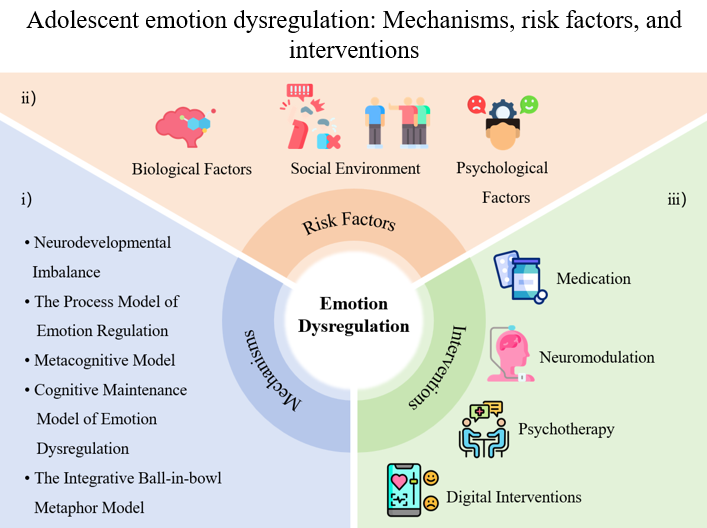
Adolescence is a developmental period associated with increased vulnerability to emotion dysregulation (ED), reflecting interacting neurodevelopmental and psychosocial influences. This review synthesizes current theoretical models, risk factors, and interventions for adolescent ED, with a focus on integrative and transdiagnostic perspectives. The risk factors for ED in adolescents are multifaceted, involving biological factors, psychological factors, and social–environmental factors, all of which form a complex network of causes. Regarding interventions, neuromodulation techniques such as transcranial magnetic stimulation and transcranial direct current stimulation are emerging as effective approaches for targeting biological mechanisms of ED. These technologies can modulate brain activity to improve dysregulated emotional responses. Psychological interventions focus on the social and psychological factors influencing ED, effectively helping adolescents develop adaptive emotion regulation strategies. Additionally, family-based interventions are also critical in addressing the family dynamics that influence emotional regulation.
- Powers A, Casey B. The adolescent brain and the emergence and peak of psychopathology. J Infant Child Adolesc Psychother. 2015;14(1):3-15. doi: 10.1080/15289168.2015.1004889
- Beauchaine TP. Future Directions in Emotion Dysregulation and Youth Psychopathology. J Clin Child Adolesc Psychol. 2015;44(5):875-896. doi: 10.1080/15374416.2015.1038827
- Thompson RA. Emotion dysregulation: A theme in search of definition. Dev Psychopathol. 2019;31(3):805-815. doi: 10.1017/S0954579419000282
- Paulus FW, Ohmann S, Möhler E, Plener P, Popow C. Emotional Dysregulation in Children and Adolescents With Psychiatric Disorders. A Narrative Review. Front Psychiatry. 2021;12:628252. doi: 10.3389/fpsyt.2021.628252
- Cogodi E, Ranieri J, Martelli A, Di Giacomo D. Emotional Dysregulation in Anorexia Nervosa: Scoping Review of Psychological Treatments. Healthcare. 2024;12(14):1388. doi: 10.3390/healthcare12141388
- Gratz KL, Roemer L. Multidimensional Assessment of Emotion Regulation and Dysregulation: Development, Factor Structure, and Initial Validation of the Difficulties in Emotion Regulation Scale. J Psychopathol Behav Assess. 2004;26(1):41-54. doi: 10.1023/B:JOBA.0000007455.08539.94
- Dwyer D, Koutsouleris N. Annual Research Review: Translational machine learning for child and adolescent psychiatry. J Child Psychol Psychiatry. 2022;63(4):421-443. doi: 10.1111/jcpp.13545
- Sloan E, Hall K, Moulding R, Bryce S, Mildred H, Staiger PK. Emotion regulation as a transdiagnostic treatment construct across anxiety, depression, substance, eating and borderline personality disorders: A systematic review. Clin Psychol Rev. 2017;57:141-163. doi: 10.1016/j.cpr.2017.09.002
- Wolff JC, Thompson E, Thomas SA, et al. Emotion dysregulation and non-suicidal self-injury: A systematic review and meta-analysis. Eur Psychiatry. 2019;59:25-36. doi: 10.1016/j.eurpsy.2019.03.004
- Rogante E, Cifrodelli M, Sarubbi S, et al. The Role of Emotion Dysregulation in Understanding Suicide Risk: A Systematic Review of the Literature. Healthcare. 2024;12(2):169. doi: 10.3390/healthcare12020169
- Schwartz-Mette RA, Lawrence HR, Shankman J, Fearey E, Harrington R. Intrapersonal Emotion Regulation Difficulties and Maladaptive Interpersonal Behavior in Adolescence. Res Child Adolesc Psychopathol. 2021;49(6):749-761. doi: 10.1007/s10802-020-00739-z
- Casey BJ, Jones RM, Hare TA. The adolescent brain. Ann N Y Acad Sci. 2008;1124(1):111-126. doi: 10.1196/annals.1440.010
- Ahmed SP, Bittencourt-Hewitt A, Sebastian CL. Neurocognitive bases of emotion regulation development in adolescence. Dev Cogn Neurosci. 2015;15:11-25. doi: 10.1016/j.dcn.2015.07.006
- Skottnik L, Linden DEJ. Mental Imagery and Brain Regulation-New Links Between Psychotherapy and Neuroscience. Front Psychiatry. 2019;10:779. doi: 10.3389/fpsyt.2019.00779
- Giannoulis E, Nousis C, Krokou M, Zikou I, Malogiannis I. Wired for Intensity: The Neuropsychological Dynamics of Borderline Personality Disorders-An Integrative Review. J Clin Med. 2025;14(14):4973. doi: 10.3390/jcm14144973
- Meisel SN, Fosco WD, Hawk LW, Colder CR. Mind the gap: A review and recommendations for statistically evaluating Dual Systems models of adolescent risk behavior. Dev Cogn Neurosci. 2019;39:100681. doi: 10.1016/j.dcn.2019.100681
- Shulman EP, Smith AR, Silva K, et al. The dual systems model: Review, reappraisal, and reaffirmation. Dev Cogn Neurosci. 2016;17:103-117. doi: 10.1016/j.dcn.2015.12.010
- Gross JJ. The emerging field of emotion regulation: An integrative review. Rev Gen Psychol. 1998;2(3):271-299. doi: 10.1037/1089-2680.2.3.271
- Gross JJ. The extended process model of emotion regulation: Elaborations, applications, and future directions. Psychol Inq. 2015;26(1):130-137. doi: 10.1080/1047840X.2015.989751
- Sheppes G, Suri G, Gross JJ. Emotion Regulation and Psychopathology. Annu Rev Clin Psychol. 2015;11(1):379-405. doi: 10.1146/annurev-clinpsy-032814-112739
- Lincoln TM, Schulze L, Renneberg B. The role of emotion regulation in the characterization, development and treatment of psychopathology. Nat Rev Psychol. 2022;1(5):272-286. doi: 10.1038/s44159-022-00040-4
- Williams IA, Levita L, Reuber M. Emotion dysregulation in patients with psychogenic nonepileptic seizures: A systematic review based on the extended process model. Epilepsy Behav. 2018;86:37-48. doi: 10.1016/j.yebeh.2018.06.049
- Ludwig L, Werner D, Lincoln TM. The relevance of cognitive emotion regulation to psychotic symptoms - A systematic review and meta-analysis. Clin Psychol Rev. 2019;72:101746. doi: 10.1016/j.cpr.2019.101746
- Chen MS, Cai Q, Omari D, Sanghvi DE, Lyu S, Bonanno GA. Emotion regulation and mental health across cultures: a systematic review and meta-analysis. Nat Hum Behav. 2025;9(6):1176-1200. doi: 10.1038/s41562-025-02168-8
- Mansueto G, Jarach A, Caselli G, et al. A systematic review of the relationship between generic and specific metacognitive beliefs and emotion dysregulation: A metacognitive model of emotion dysregulation. Clin Psychol Psychother. 2024;31(1):1-842. doi: 10.1002/cpp.2961
- Wells A. Metacognitive therapy for anxiety and depression. New York, NY, USA: Guilford Press; 2009.
- Mansueto G, Marino C, Palmieri S, et al. Difficulties in emotion regulation: The role of repetitive negative thinking and metacognitive beliefs. J Affect Disord. 2022;308:473-483. doi: 10.1016/j.jad.2022.04.086
- Capobianco L, Nordahl H. A brief history of metacognitive therapy: From cognitive science to clinical practice. Cogn Behav Pract. 2023;30(1):45-54. doi: 10.1016/j.cbpra.2021.11.002
- Bosmans G, Braet C, Van Vlierberghe L. Attachment and symptoms of psychopathology: early maladaptive schemas as a cognitive link? Clin Psychol Psychother. 2010;17(5):374-385. doi: 10.1002/cpp.667
- Gaynor K, Gordon O. Cognitive Behavioural Therapy for Mild-to-Moderate Transdiagnostic Emotional Dysregulation. J Contemp Psychother. 2019;49(2):71-77. doi: 10.1007/s10879-018-9393-z
- Nowak U, Wittkamp MF, Clamor A, Lincoln TM. Using the Ball-in-Bowl Metaphor to Outline an Integrative Framework for Understanding Dysregulated Emotion. Front Psychiatry. 2021;12:626698. doi: 10.3389/fpsyt.2021.626698
- Barzman D, Geise C, Lin PI. Review of the genetic basis of emotion dysregulation in children and adolescents. World J Psychiatry. 2015;5(1):112-117. doi: 10.5498/wjp.v5.i1.112
- Xiao Q, Fu Y, Yi X, et al. Altered cortical thickness and emotional dysregulation in adolescents with borderline personality disorder. Eur J Psychotraumatol. 2023;14(1):2163768. doi: 10.1080/20008066.2022.2163768
- Bellato A, Sesso G, Milone A, Masi G, Cortese S. Systematic Review and Meta-Analysis: Altered Autonomic Functioning in Youths With Emotional Dysregulation. J Am Acad Child Adolesc Psychiatry. 2024;63(2):216-230. doi: 10.1016/j.jaac.2023.01.017
- Martel MM. Research review: a new perspective on attention-deficit/hyperactivity disorder: emotion dysregulation and trait models. J Child Psychol Psychiatry. 2009;50(9):1042-1051. doi: 10.1111/j.1469-7610.2009.02105.x
- Malhi GS, Das P, Outhred T, Bell E, Gessler D, Mannie Z. Irritability and mood symptoms in adolescent girls: Trait anxiety and emotion dysregulation as mediators. J Affect Disord. 2021;282:1170-1179. doi: 10.1016/j.jad.2020.12.173
- Gao W, Yan X, Yuan J. Neural correlations between cognitive deficits and emotion regulation strategies: understanding emotion dysregulation in depression from the perspective of cognitive control and cognitive biases. Psychoradiology. 2022;2(3):86-99. doi: 10.1093/psyrad/kkac014
- Joormann J, Quinn ME. Cognitive processes and emotion regulation in depression. Depress Anxiety. 2014;31(4):308-315. doi: 10.1002/da.22264
- Dağdelen F. Decreased Theory of Mind Abilities and Increased Emotional Dysregulation in Adolescents With ASD and ADHD. Alpha Psychiatry. 2021;22(2):100-105. doi: 10.5455/apd.135050
- Yuan Y, Kaiser S, Patel K, Brock P, Parker AJ, Wiggins JL. Emotion Regulation and Neural Connectivity After Frustrative Non-Reward in Adolescents: The Moderating Role of Cognitive Flexibility. Dev Psychobiol. 2025;67(4):e70055. doi: 10.1002/dev.70055
- Goagoses N, Bolz T, Eilts J, et al. Parenting dimensions/styles and emotion dysregulation in childhood and adolescence: a systematic review and Meta-analysis. Curr Psychol. 2023;42(22):18798-18822. doi: 10.1007/s12144-022-03037-7
- Herd T, Brieant A, King-Casas B, Kim-Spoon J. Associations between developmental patterns of negative parenting and emotion regulation development across adolescence. Emotion. 2022;22(2):270-282. doi: 10.1037/emo0000997
- Godleski SA, Eiden RD, Shisler S, Livingston JA. Parent socialization of emotion in a high-risk sample. Dev Psychol. 2020;56(3):489-502. doi: 10.1037/dev0000793
- Bahn GH. From attachment theory to mentalization: historical background and clinical implications. Psychoanalysis. 2013;24:9-20.
- Fonagy P, Gergely G, Jurist EL. Affect regulation, mentalization and the development of the self. London, UK: Routledge; 2018. doi: 10.4324/9780429471643
- Herd T, Kim-Spoon J. A Systematic Review of Associations Between Adverse Peer Experiences and Emotion Regulation in Adolescence. Clin Child Fam Psycho Rev. 2021;24(1):141-163. doi: 10.1007/s10567-020-00337-x
- Goemans A, Viding E, McCrory E. Child Maltreatment, Peer Victimization, and Mental Health: Neurocognitive Perspectives on the Cycle of Victimization. Trauma Violence Abuse. 2023;24(2):530-548. doi: 10.1177/15248380211036393
- Lim L, Rubia K, Lukito S. Common neural correlates of disgust processing in childhood maltreatment and peer victimisation. BJPsych Open. 2024;10(6):e185. doi: 10.1192/bjo.2024.767
- Herd T, Meyer C, Casas B, Kim-Spoon J. Longitudinal associations between changes in peer victimization and emotion dysregulation across adolescence. Emotion. 2024;24(7):1612-1624. doi: 10.1037/emo0001369
- Heumann J, Eisner M, Ribeaud D, Shanahan MJ. Adolescent peer victimization and subsequent cognitive-affective biases in threat attention, reactivity, and interpretation. bioRxiv. Preprint released online July 17, 2025. doi: 10.1101/2025.07.12.664449
- Rosen PJ, Milich R, Harris MJ. Victims of their own cognitions: Implicit social cognitions, emotional distress, and peer victimization. J Appl Dev Psychology. 2007;28(3):211-226. doi: 10.1016/j.appdev.2007.02.001
- Palmier-Claus J, Golby R, Stokes LJ, et al. The relationship between childhood adversity and affective instability across psychiatric disorders: A meta-analysis. Acta Psychiatr Scand. 2025;151(1):33-45. doi: 10.1111/acps.13745
- Gruhn MA, Compas BE. Effects of maltreatment on coping and emotion regulation in childhood and adolescence: A meta-analytic review. Child Abuse Negl. 2020;103:104446. doi: 10.1016/j.chiabu.2020.104446
- Kuo PC, Yao ZF. Amygdala hyperactivation in childhood maltreatment: An ALE-based meta-analysis on emotion-related processing. Neurosci Biobehav Rev. 2025;174:106180. doi: 10.1016/j.neubiorev.2025.106180
- Puetz VB, Viding E, Gerin MI, et al. Investigating patterns of neural response associated with childhood abuse v. childhood neglect. Psychol Med. 2020;50(8):1398-1407. doi: 10.1017/S0033291719001752
- Andersson H, Aspeqvist E, Dahlström Ö, et al. Emotional Dysregulation and Trauma Symptoms Mediate the Relationship Between Childhood Abuse and Nonsuicidal Self-Injury in Adolescents. Front Psychiatry. 2022;13:897081. doi: 10.3389/fpsyt.2022.897081
- Kondi K, Takács M, Kovács-Posta E, et al. Emotion dysregulation in adolescents is normalized by ADHD pharmacological treatment. Bord Pers Disord Emot Dysregul. 2025;12(1):3. doi: 10.1186/s40479-024-00268-x
- Amiri D, Briziarelli L, Tempesta E, Danesh HR, Nadoushan AHJ, Karlsson B. Pharmacological interventions for emotional dysregulation in ADHD: a meta-analysis stratified by sex and ADHD subtypes. Middle East Curr Psychiatry. 2025;32(1):84. doi: 10.1186/s43045-025-00570-6
- Salazar de Pablo G, Pastor Jordá C, Vaquerizo-Serrano J, et al. Systematic Review and Meta-analysis: Efficacy of Pharmacological Interventions for Irritability and Emotional Dysregulation in Autism Spectrum Disorder and Predictors of Response. J Am Acad Child Adolesc Psychiatry. 2023;62(2):151-168. doi: 10.1016/j.jaac.2022.03.033
- Singh MK. Editorial: Weighing Benefits and Risks While Treating Irritability and Emotional Dysregulation in Autism. J Am Acad Child Adolesc Psychiatry. 2023;62(2):123-126. doi: 10.1016/j.jaac.2022.06.004
- Chiappini S, Picutti E, Alessi MC, et al. Efficacy of Noninvasive Brain Stimulation on Borderline Personality Disorder Core Symptoms: A Systematic Review. J Pers Disord. 2022;36(5):505-526. doi: 10.1521/pedi.2022.36.5.505
- Shukla D, Goyal N, Sharma P, Kumar G, Roy C. Adjunctive Deep Transcranial Magnetic Stimulation (dTMS) for Managing Emotional Dysregulation in Children and Adolescents with Externalizing Behavior Disorders: An Open-label Trial. Indian J Psychol Med. 2025:02537176251363142. doi: 10.1177/02537176251363142
- Kang T, Zhao X, Huo X, et al. High-Intensity Transcranial Alternating Current Stimulation for Emotion Regulation and Attentional Bias in Adolescents With Nonsuicidal Self-Injury: A Randomized Clinical Trial. JAMA Netw Open. 2026;9(6):e2617336. doi: 10.1001/jamanetworkopen.2026.17336
- Shen F, Zhou H. Effects of non-invasive brain stimulation on emotion regulation in patients with attention deficit hyperactivity disorder: a systematic review. Front Psychiatry. 2024;15:1483753. doi: 10.3389/fpsyt.2024.1483753
- Waxmonsky JG, Baweja R, Bansal PS, Waschbusch DA. A Review of the Evidence Base for Psychosocial Interventions for the Treatment of Emotion Dysregulation in Children and Adolescents. Child Adolesc Psychiatr Clin N Am. 2021;30(3):573-594. doi: 10.1016/j.chc.2021.04.008
- Saccaro LF, Giff A, De Rossi MM, Piguet C. Interventions targeting emotion regulation: A systematic umbrella review. J Psychiatr Res. 2024;174:263-274. doi: 10.1016/j.jpsychires.2024.04.025
- Perepletchikova F, Nathanson D, Axelrod SR, et al. Randomized Clinical Trial of Dialectical Behavior Therapy for Preadolescent Children With Disruptive Mood Dysregulation Disorder: Feasibility and Outcomes. J Am Acad Child Adolesc Psychiatry. 2017;56(10):832-840. doi: 10.1016/j.jaac.2017.07.789
- Reyes-Ortega MA, Miranda EM, Fresán A, et al. Clinical efficacy of a combined acceptance and commitment therapy, dialectical behavioural therapy, and functional analytic psychotherapy intervention in patients with borderline personality disorder. Psychol Psychother. 2020;93(3):474-489. doi: 10.1111/papt.12240
- Sharma N, Agrawal M, Rushi, Ayyub S, Rai D. Mindfulness-based Interventions for Emotional Dysregulation in Adolescents: A Systematic Review. Ann Neurosci. 2025:33(2):259-267. doi: 10.1177/09727531251355311
- Havighurst SS, Radovini A, Hao B, Kehoe CE. Emotion-focused parenting interventions for prevention and treatment of child and adolescent mental health problems: a review of recent literature. Curr Opin Psychiatry. 2020;33(6):586-601. doi: 10.1097/YCO.0000000000000647
- Vacher C, Goujon A, Romo L, Purper-Ouakil D. Efficacy of psychosocial interventions for children with ADHD and emotion dysregulation: a systematic review. Psychiatry Res. 2020;291:113151. doi: 10.1016/j.psychres.2020.113151
- Diano F, Sica LS, Ponticorvo M. A Systematic Review of Mobile Apps as an Adjunct to Psychological Interventions for Emotion Dysregulation. Int J Environ Res Public Health. 2023;20(2):1431. doi: 10.3390/ijerph20021431
- Kennard BD, Goldstein T, Foxwell AA, et al. As Safe as Possible (ASAP): A Brief App-Supported Inpatient Intervention to Prevent Postdischarge Suicidal Behavior in Hospitalized, Suicidal Adolescents. Am J Psychiatry. 2018;175(9):864-872. doi: 10.1176/appi.ajp.2018.17101151
- Colombo D, Díaz-García A, Fernandez-Álvarez J, Botella C. Virtual reality for the enhancement of emotion regulation. Clin Psychol Psychother. 2021;28(3):519-537. doi: 10.1002/cpp.2618
- Yu M, Bai Y, Li Y. Emo-regulator: An emotion-regulation training system fusing virtual reality and EEG-based neurofeedback. Annu Int Conf IEEE Eng Med Biol Soc. 2023;1-4. doi: 10.1109/EMBC40787.2023.10340975