
Gut–brain axis and fibromyalgia: Neurobiological mechanisms, microbiome composition, psychological comorbidities, and diagnostic approaches

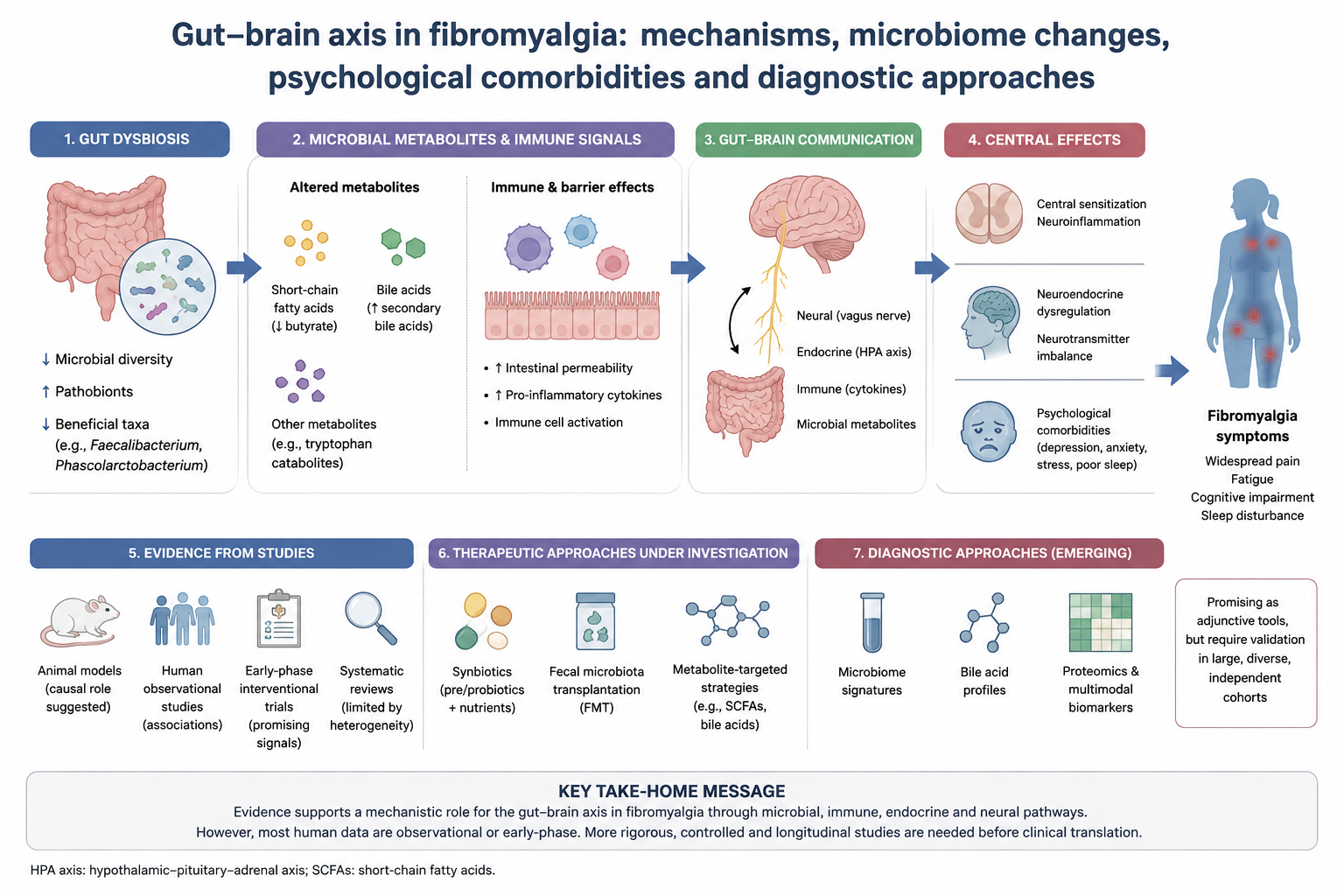
Fibromyalgia is a chronic nociplastic pain syndrome affecting 2–4% of the global population, with marked female predominance, substantial functional impairment, and an incompletely understood pathophysiology. Diagnosis still relies on symptom-based criteria, and treatment options remain limited. Over the past decade, evidence has positioned the gut–brain axis as a key pathway linking intestinal microbiome dysbiosis, altered microbial metabolites, peripheral immune activation, and central nervous system dysfunction. This review synthesizes current findings across four domains: (i) neurobiological mechanisms by which gut-derived signals influence central sensitization, neuroinflammation, neurotransmitter balance, and neuroendocrine function; (ii) microbiome compositional changes and their metabolic consequences, particularly involving short-chain fatty acids and secondary bile acids; (iii) bidirectional relationships between gut dysbiosis and the psychological comorbidities associated with fibromyalgia; and (iv) limitations of current diagnostic criteria and the potential of multimodal biomarker panels. Evidence from translational animal models, human observational studies, and early-phase trials indicates that gut microbiota contribute to pain perception and psychological symptoms through metabolite-mediated immune and neuroendocrine pathways, although the human evidence remains predominantly associative. Fecal microbiota transplantation, synbiotic supplementation, and metabolite-targeted strategies have shown promising therapeutic potential but remain constrained by small sample sizes, methodological heterogeneity, and a lack of placebo-controlled trials. Microbiome signatures, bile acid profiles, and proteomic markers show promise as adjunctive diagnostic tools but require validation in large, diverse cohorts. Although the field presents compelling mechanistic evidence, methodological limitations must be addressed before these findings can be translated into clinical practice. Overall, microbiome-directed therapies and multimodal biomarker panels represent promising strategies for precision management of fibromyalgia but require rigorous clinical validation.
- Pinto AM, Luís M, Geenen R, et al. Neurophysiological and psychosocial mechanisms of fibromyalgia: a comprehensive review and call for an integrative model. Neurosci Biobehav Rev. 2023;151:105235. doi: 10.1016/j.neubiorev.2023.105235
- Cai W, Haddad M, Haddad R, et al. The gut microbiota promotes pain in fibromyalgia. Neuron. 2025;113(13):2161- 2175.e13. doi: 10.1016/j.neuron.2025.03.032
- Kishore MM, Jeyaraman M, Jeyaraman N, et al. Implications of gut microbiome in fibromyalgia: A scoping review. J Orthop Case Rep. 2026;16(4):420-425. doi: 10.13107/jocr.2026.v16.i04.7166
- Dipalma G, Marinelli G, Ferrante L, et al. Modulating the gut microbiota to target neuroinflammation, cognition and mood: a systematic review of human studies with relevance to fibromyalgia. Nutrients. 2025;17(14):2261. doi: 10.3390/nu17142261
- Nhu NT, Chen DYT, Yang YCSH, et al. Associations between brain-gut axis and psychological distress in fibromyalgia: a microbiota and magnetic resonance imaging study. J Pain. 2024;25(4):934-945. doi: 10.1016/j.jpain.2023.10.015
- Palma-Ordóñez A, Moreno-Fernández AM, Ramírez‐ Tejero JA, et al. Implication of intestinal microbiota in the etiopathogenesis of fibromyalgia: a systematic review. Int J Rheum Dis. 2024;27(1):e15021. doi: 10.1111/1756-185x.15021
- Watai K, Taniguchi M, Azuma K, et al. The gut-brain-immune axis in environmental sensitivity illnesses: microbiome-centered narrative review of fibromyalgia syndrome, myalgic encephalomyelitis/chronic fatigue syndrome, and multiple chemical sensitivity. Int J Mol Sci. 2025;26(20):9997. doi: 10.3390/ijms26209997
- Fang H, Hou Q, Zhang W, et al. Fecal microbiota transplantation improves clinical symptoms of fibromyalgia: an open-label, randomized, nonplacebo-controlled study. J Pain. 2024;25(9):104535. doi: 10.1016/j.jpain.2024.104535
- Jakobsson JE, Carlsson H, Erngren I, et al. Microbially produced bile acids are associated with increased IgG autoantibodies and poorer mental wellbeing in fibromyalgia. Sci Rep. 2026;16(1):7735. doi: 10.1038/s41598-026-40781-3
- Martín Pérez SE, Abdel Lah HAL, García NH, et al. Effectiveness of fecal microbiota transplantation in nociplastic pain management: a systematic review. Gastrointest Disord. 2025;7(1):5. doi: 10.3390/gidisord7010005
- Minerbi A, Khoutorsky A, Shir Y. Decoding the connection: unraveling the role of gut microbiome in fibromyalgia. Pain Rep. 2024;10(1):e1224. doi: 10.1097/PR9.0000000000001224
- Lanzara R, Conti C, Zito L, et al. Gut microbiota and psychological distress in fibromyalgia: a systematic review. Biopsychosoc Sci Med. 2026;88(3):287-296. doi: 10.1097/PSY.0000000000001463
- Munipalli B, Allman ME, Chauhan M, et al. Depression: a modifiable risk factor for poor outcomes in fibromyalgia. J Prim Care Community Health. 2022;13:21501319221120738. doi: 10.1177/21501319221120738
- Shtrozberg S, Bazzichi L, Sarzi-Puttini P, et al. Is the gut microbiome of importance in fibromyalgia? A critical review of emerging evidence. Clin Exp Rheumatol. 2025;43(6):1024- 1031. doi: 10.55563/clinexprheumatol/pmajsv
- Wolfe F, Walitt B, Perrot S, et al. Fibromyalgia diagnosis and biased assessment: sex, prevalence and bias. PLoS ONE. 2018;13(9):e0203755. doi: 10.1371/journal.pone.0203755
- Garofalo M, Cristiani CM, Ilari S, et al. Fibromyalgia and irritable bowel syndrome interaction: a possible role for gut microbiota and gut-brain axis. Biomedicines. 2023;11(6):1701. doi: 10.3390/biomedicines11061701
- Tomasello G, Mazzola M, Bosco V, et al. Intestinal dysbiosis and hormonal neuroendocrine secretion in the fibromyalgic patient: relationship and correlations. Biomed Pap Med Fac Univ Palacky Olomouc Czech Repub. 2018;162(4):258-262. doi: 10.5507/BP.2018.051
- Hinchado MD, Quero-Calero CD, Otero E, et al. Synbiotic supplementation improves quality of life and immunoneuroendocrine response in patients with fibromyalgia: influence of codiagnosis with chronic fatigue syndrome. Nutrients. 2023;15(7):1591. doi: 10.3390/nu15071591
- Minerbi A, Gonzalez E, Brereton N, et al. Altered serum bile acid profile in fibromyalgia is associated with specific gut microbiome changes and symptom severity. Pain. 2023;164(2):e66-e76. doi: 10.1097/j.pain.0000000000002694
- Bheemaneni RS, Sakarkar P, Nigam A, et al. Unraveling the association between fibromyalgia and irritable bowel syndrome: a systematic review. Cureus. 2025;17(11):e96801. doi: 10.7759/cureus.96801
- Waterman A, Doumas SA, Fischer M, et al. Uncovering the hidden link between the aberrant intestinal microbiome and fibromyalgia. Gastroenterol Hepatol. 2025;21(2):111-121.