

Zonal variation in commercial function–human activity relationships around North Ring Road Station, Changchun: Evidence from sampled weekday and weekend conditions

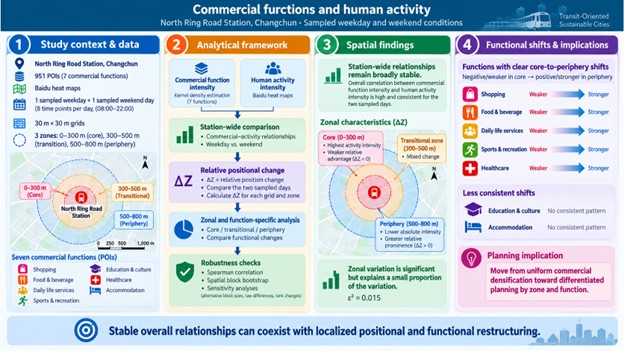
Commercial concentration does not necessarily correspond to observed human activity in metro station areas, and temporal differences may occur through localized changes even when the overall activity structure remains stable. Identifying such internal restructuring is important because aggregate station-wide measures may overlook how specific commercial functions relate differently to human activity across spatial zones. North Ring Road Station in Changchun is examined within 800 m of its two operational entrances. A total of 951 commercial and service points of interest in seven categories are combined with Baidu-derived human activity intensity from one sampled weekday and one sampled weekend day. Data are integrated into 30 m analytical grids and divided into Core (0–300 m), Transitional (300–500 m), and Peripheral (500–800 m) zones. A standardized relative positional change indicator (ΔZ) tracks changes in each grid’s relative position, and functional associations are assessed using Spearman correlations and spatial block bootstrap. The overall commercial function–activity relationship remains broadly similar across the two sampled days, whereas clearer internal differences emerge. Mean ΔZ is −0.085 in the Core Zone and +0.048 in the Peripheral Zone, with a small overall zonal effect (ε2 = 0.015). Shopping, food and beverage, daily life services, sports and recreation, and healthcare show clearer core-to-peripheral shifts in their associations with ΔZ. Because the observations are limited to one sampled weekday and one sampled weekend day, the identified differences reflect the two sampled conditions and should not be generalized to broader weekday–weekend patterns. These findings provide sampled-day evidence of localized functional restructuring within a broadly stable activity pattern and demonstrate the value of zonal and function-specific analysis beyond aggregate station-wide measures.
Abudurexiti, A., Abulikemu, Z., & Keyimu, M. (2025). POI-based assessment of sustainable commercial development: Spatial distribution characteristics and influencing factors of commercial facilities around Urumqi Metro Line 1 stations. Sustainability, 17(12), 5270. https://doi.org/10.3390/su17125270
Bao, W., Gong, A., Zhang, T., Zhao, Y., Li, B., & Chen, S. (2023). Mapping population distribution with high spatiotemporal resolution in Beijing using Baidu Heat Map data. Remote Sensing, 15(2), 458. https://doi.org/10.3390/rs15020458
Benjamini, Y., & Hochberg, Y. (1995). Controlling the false discovery rate: A practical and powerful approach to multiple testing. Journal of the Royal Statistical Society: Series B, 57(1), 289-300. https://doi.org/10.1111/j.2517-6161.1995.tb02031.x
Bertolini, L. (1999). Spatial development patterns and public transport: The application of an analytical model in the Netherlands. Planning Practice & Research, 14(2), 199-210. https://doi.org/10.1080/02697459915724
Bivina, G. R., Gupta, A., & Parida, M. (2020). Walk accessibility to metro stations: An analysis based on meso- or micro-scale built environment factors. Sustainable Cities and Society, 55, 102047. https://doi.org/10.1016/j.scs.2020.102047
Cai, Z. (2026). Urban spatial dynamic modeling in transition: Hybrid, human-centric, and scalable futures. Ambio. https://doi.org/10.1007/s13280-026-02392-0
Cai, Z., Karvonen, A., Cong, C., & Huang, W. (2026). Fine-grained urban land use simulation: Integrating spatial dynamic modeling with a pre-trained vision-language model. Computers, Environment and Urban Systems, 126, 102416. https://doi.org/10.1016/j.compenvurbsys.2026.102416
Calthorpe, P. (1993). The next American metropolis: Ecology, community, and the American dream. Princeton Architectural Press.
Cervero, R., & Kockelman, K. (1997). Travel demand and the 3Ds: Density, diversity, and design. Transportation Research Part D: Transport and Environment, 2(3), 199-219. https://doi.org/10.1016/S1361-9209(97)00009-6
Duan, C., & Chen, Y. (2026). Delineating public life-oriented metro station catchment areas: A framework integrating empirical observation, street view imagery, and machine learning. Cities, 171, 106865. https://doi.org/10.1016/j.cities.2026.106865
Duan, J., Wang, H., Liu, L., & Zhang, J. (2025). The attraction gradient of urban functions: How does functional mix at multiple scales predict urban vitality. Cities, 156, 105516. https://doi.org/10.1016/j.cities.2024.105516
Guo, Z., Luo, K., Yan, Z., Hu, A., Wang, C., Mao, Y., & Niu, S. (2024). Assessment of the street space quality in the metro station areas at different spatial scales and its impact on the urban vitality. Frontiers of Architectural Research, 13(6), 1270-1287. https://doi.org/10.1016/j.foar.2024.06.006
Hillier, B., Penn, A., Hanson, J., Grajewski, T., & Xu, J. (1993). Natural movement: Or, configuration and attraction in urban pedestrian movement. Environment and Planning B: Planning and Design, 20(1), 29-66. https://doi.org/10.1068/b200029
Jacobs, J. (1961). The death and life of great American cities. Random House.
Jiang, Y., Han, Y., Liu, M., & Ye, Y. (2022). Street vitality and built environment features: A data-informed approach from fourteen Chinese cities. Sustainable Cities and Society, 79, 103724. https://doi.org/10.1016/j.scs.2022.103724
Jiang, Y., Huang, Z., Zhou, X., & Chen, X. (2024). Evaluating the impact of urban morphology on urban vitality: An exploratory study using big geo-data. International Journal of Digital Earth, 17(1), 2327571. https://doi.org/10.1080/17538947.2024.2327571
Kruskal, W. H., & Wallis, W. A. (1952). Use of ranks in one-criterion variance analysis. Journal of the American Statistical Association, 47(260), 583-621. https://doi.org/10.1080/01621459.1952.10483441
Lahiri, S. N. (2013). Resampling methods for dependent data. Springer Science & Business Media.
Lahoorpoor, B., & Levinson, D. M. (2020). Catchment if you can: The effect of station entrance and exit locations on accessibility. Journal of Transport Geography, 82, 102556. https://doi.org/10.1016/j.jtrangeo.2019.102556
Miao, Y., & Zhou, J. (2025). Vibrancy of the space around and between metro stations: Life between Stations and its determinants in Hong Kong. Transportation. https://doi.org/10.1007/s11116-025-10710-w
Montgomery, J. (1998). Making a city: Urbanity, vitality and urban design. Journal of Urban Design, 3(1), 93-116. https://doi.org/10.1080/13574809808724418
Moran, P. A. P. (1950). Notes on continuous stochastic phenomena. Biometrika, 37(1–2), 17-23. https://doi.org/10.2307/2332142
Moyano, A., Solís, E., Díaz-Burgos, E., Rodrigo, A., & Coronado, J. M. (2023). Typologies of stations’ catchment areas in metropolitan urban peripheries: From car-oriented to sustainable urban strategies. Land Use Policy, 134, 106903. https://doi.org/10.1016/j.landusepol.2023.106903
Pan, H., & Huang, Y. (2024). TOD typology and station area vibrancy: An interpretable machine learning approach. Transportation Research Part A: Policy and Practice, 186, 104150. https://doi.org/10.1016/j.tra.2024.104150
Peng, J., Hu, Y., Liang, C., Wan, Q., Dai, Q., & Yang, H. (2023). Understanding nonlinear and synergistic effects of the built environment on urban vibrancy in metro station areas. Journal of Engineering and Applied Science, 70, 18. https://doi.org/10.1186/s44147-023-00182-z
Sevtsuk, A. (2014). Location and agglomeration: The distribution of retail and food businesses in dense urban environments. Journal of Planning Education and Research, 34(4), 374-393. https://doi.org/10.1177/0739456X14550401
Shi, P., Xiao, Y., & Zhan, Q. (2020). A study on spatial and temporal aggregation patterns of urban population in Wuhan City based on Baidu Heat Map and POI data. International Review for Spatial Planning and Sustainable Development, 8(3), 101-121. https://doi.org/10.14246/irspsda.8.3_101
Silverman, B. W. (2018). Density estimation for statistics and data analysis. Routledge.
Spearman, C. (1904). The proof and measurement of association between two things. The American Journal of Psychology, 15(1), 72-101. https://doi.org/10.2307/1422689
Sun, X., Hong, L., & Cools, M. (2025). Modeling pedestrian behavior in metro stations with commercial facilities: An attractiveness-based approach. Transportation Research Record: Journal of the Transportation Research Board, 2679(9), 834-846. https://doi.org/10.1177/03611981251340389
Tang, S., & Ta, N. (2022). How the built environment affects the spatiotemporal pattern of urban vitality: A comparison among different urban functional areas. Computational Urban Science, 2, 39. https://doi.org/10.1007/s43762-022-00069-4
Wang, B., Lei, Y., Xue, D., Liu, J., & Wei, C. (2022). Elaborating spatiotemporal associations between the built environment and urban vibrancy: A case of Guangzhou City, China. Chinese Geographical Science, 32(3), 480-492. https://doi.org/10.1007/s11769-022-1272-6
Wang, J., Liu, Y., & Wei, Z. (2025). The impact of the built environment on the spatial vitality of metro station areas and its heterogeneity: A case study of the four central districts of Guangzhou City. Progress in Geography, 44(8), 1664-1677. https://doi.org/10.18306/dlkxjz.2025.08.008
Wu, C., Ye, X., Ren, F., & Du, Q. (2018). Check-in behaviour and spatio-temporal vibrancy: An exploratory analysis in Shenzhen, China. Cities, 77, 104-116. https://doi.org/10.1016/j.cities.2018.01.017
Xia, C., Yeh, A. G. O., & Zhang, A. (2020). Analyzing spatial relationships between urban land use intensity and urban vitality at street block level: A case study of five Chinese megacities. Landscape and Urban Planning, 193, 103669. https://doi.org/10.1016/j.landurbplan.2019.103669
Xu, Y., Mao, W., & Hu, S. (2025). Unveiling the pulse of urban metro stations: A TOD-driven approach to measuring vibrancy using geographically weighted random forest. International Journal of Digital Earth, 18(1), 2524054. https://doi.org/10.1080/17538947.2025.2524054
Yan, C., Gao, Y., & Yang, Y. (2024). Exploring the spatial patterns of accessibility to metro services considering the locations of station entrances/exits. Buildings, 14(11), 3532. https://doi.org/10.3390/buildings14113532
Yue, Y., Zhuang, Y., Yeh, A. G. O., Xie, J.-Y., Ma, C.-L., & Li, Q.-Q. (2017). Measurements of POI-based mixed use and their relationships with neighbourhood vibrancy. International Journal of Geographical Information Science, 31(4), 658-675. https://doi.org/10.1080/13658816.2016.1220561
Zhang, H. (2021). Extracting active population data based on Baidu Heat Maps for transportation planning applications. Urban Transport of China, 19(3), 103-111. https://doi.org/10.13813/j.cn11-5141/u.2021.0306-en