
Youth emigration and population aging in Kosovo: Implications for the sustainability of social policy

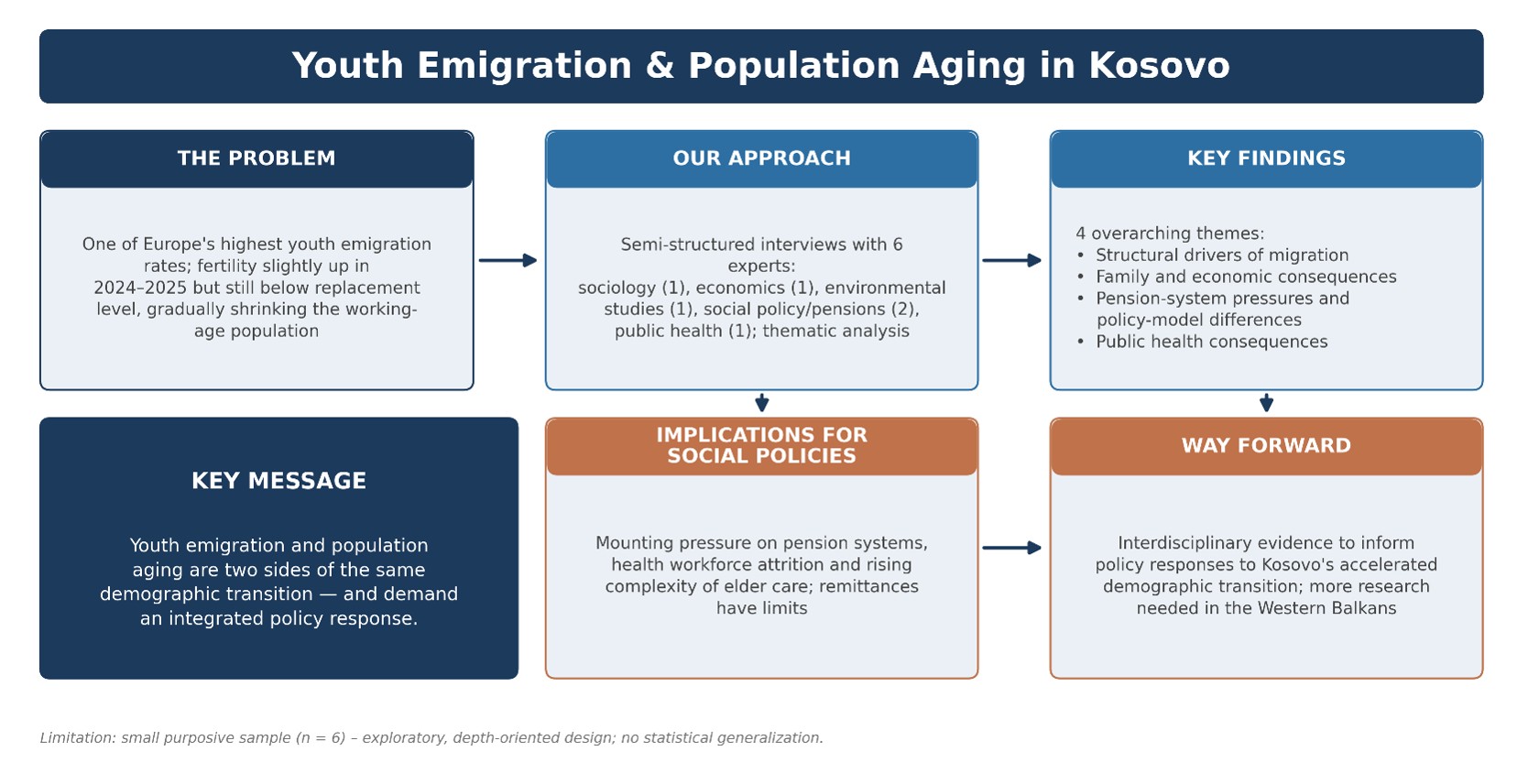
Kosovo is considered to have one of the highest rates of youth emigration in Europe. While fertility rates have seen a slight uptick in 2024–2025, they remain below replacement level, contributing to a gradual contraction of the working-age population. This qualitative study explores expert perspectives on the interlinkages between youth emigration and population aging in Kosovo, as well as the implications of this nexus for social protection, pensions, healthcare, and the labor market. Semi-structured interviews were conducted with six experts representing the fields of sociology, economics, environmental studies, social policy/pensions, and public health. Data were analyzed using thematic analysis. The results identified four overarching themes: (i) migration as a structural, multidimensional phenomenon, encompassing expert consensus on the acceleration of demographic aging; (ii) family and economic consequences for future generations, including human capital loss and the limits of remittances; (iii) mounting pressure on the pension system and expert divergence regarding the most appropriate policy models; and (iv) public health consequences, including health workforce attrition and the rising complexity of elder care. The findings show qualitative convergence with changes in diaspora remittance behavior following visa liberalization, and indicate that, according to one expert, environmental factors play a less prominent role than might be expected. This qualitative study contributes interdisciplinary evidence to inform policy responses to Kosovo’s accelerated demographic transition and addresses the limited empirical research on its implications for social policy in the Western Balkans. The main limitation is the small purposive sample of six experts, which precludes statistical generalization, although it is consistent with the exploratory and depth-oriented aim of the study.
Al-Khudairy, S. I. A. (2024). Theories of migration: Sociological and conceptual dilemmas. European Journal of Sustainable Development, 13(1), 31-47. https://doi.org/10.14207/ejsd.2024.v13n1p31
Ausili, D., Bernasconi, D. P., Rebora, P., Prestini, L., Beretta, G., Ferraioli, L., Cazzaniga, A., Valsecchi, M. G., & Di Mauro, S. (2020). Complexity of nursing care at 24 h from admission predicts in-hospital mortality in medical units: A cohort study. BMC Health Services Research, 20, 181. https://doi.org/10.1186/s12913-020-5038-5
Baliqi, B. (2017). Kosovo’s political economy: Between clientelism and reform. Konrad Adenauer Stiftung.
Băltătescu, S., Strózik, T., Soo, K., Kutsar, D., Strózik, D., & Bacter, C. (2023). Subjective well-being of children left behind by migrant parents in six European countries. Child Indicators Research, 16(5), 1941-1969. https://doi.org/10.1007/s12187-023-10054-w
Behrami, S. (2022). Emigrimet e popullsise - nje mundesi e pashfrytezuar per zhvillim lokal ne Kosove [Population emigration - an unused opportunity for local development in Kosovo]. Institute for Development Policy (INDEP).
Behrami, S., & Bajraktari, F. (2021). Dimensioni demografik i Agjendes 2030 - Perspektivat dhe sfidat e Kosoves [The demographic dimension of Agenda 2030 - Kosovo’s perspectives and challenges]. Prishtine: Institute for Development Policy (INDEP).
Böhme, M. H., Persian, R. & Stöhr, T. (2015). Alone but better off? Adult child migration and health of elderly parents in Moldova. Journal of Health Economics, 39, 211-227. https://doi.org/10.1016/j.jhealeco.2014.09.001
Braun, V., & Clarke, V. (2006). Using thematic analysis in psychology. Qualitative Research in Psychology, 3(2), 77-101. https://doi.org/10.1191/1478088706qp063oa
Carling, J. (2002). Migration in the age of involuntary immobility: Theoretical reflections and Cape Verdean experiences. Journal of Ethnic and Migration Studies, 28(1), 5-42. https://doi.org/10.1080/13691830120103912
Carling, J., & Schewel, K. (2018). Revisiting aspiration and ability in international migration. Journal of Ethnic and Migration Studies, 44(6), 945-963. https://doi.org/10.1080/1369183X.2017.1384146
Central Bank of the Republic of Kosovo. (2024). Financial statistics for other (non-bank) financial institutions and remittances, March 2024. Accessed June 20, 2026. https://bqk-kos.org/financial-statistics-for-other-non-bank-financial-institutions-and-remittances-for-march-2024/?lang=en
Cesare, M., D’Agostino, F., Maurici, M., Zega, M., Zeffiro, V., & Cocchieri, A. (2023). Standardized nursing diagnoses in a surgical hospital setting: A retrospective study based on electronic health data. SAGE Open Nursing, 9, 23779608231158157. https://doi.org/10.1177/23779608231158157
de Haas, H. (2021). A theory of migration: The aspirations-capabilities framework. Comparative Migration Studies, 9, Article 8. https://doi.org/10.1186/s40878-020-00210-4
Epiqendra. (2026, July 4). Kosova po plaket: Deri me 2060 mosha mesatare parashikohet 49 vjec [Kosovo is aging: By 2060 the average age is projected at 49 years]. Accessed July 18, 2026. https://epiqendra.com/kosova-po-plaket-deri-me-2060-mosha-mesatare-parashikohet-49-vjec/
Esping-Andersen, G. (1990). The three worlds of welfare capitalism. Princeton University Press.
Hajdari, L., & Krasniqi, J. (2021). The economic dimension of migration: Kosovo from 2015 to 2020. Humanities and Social Sciences Communications, 8, Article 273. https://doi.org/10.1057/s41599-021-00923-6
INSTAT. (2024). Censusi i Popullsisë dhe Banesave 2023. Instituti i Statistikave, Tiranë. Accessed June 25, 2026. https://www.instat.gov.al/
INSTAT. (2025). Popullsia e Shqipërisë, 1 Janar 2025 [Population of Albania on 1 January 2025]. Accessed June 30, 2026. https://www.instat.gov.al/media/y5diizmw/finale-popullsia-1-janar-2025-dt-12062025.pdf
International Organization for Migration. (2026). World migration report 2026. Accessed June 30, 2026. https://publications.iom.int/books/world-migration-report-2026
Jansen, L., Bernstein, L., & Van Hecke, S. (2024). Navigating brain drain in the Western Balkans. European View, 23(1), 72-79. https://doi.org/10.1177/17816858241242881
Kosovo Agency of Statistics. (2013). Kosovo population projection 2011¨C2061. Accessed June 25, 2026. https://askapi.rks-gov.net/Custom/01a26ac4-bdee-4833-a7af-59f032bc5114.pdf
Kosovo Agency of Statistics. (2024). Regjistrimi i Popullsisë, Ekonomive Familjare dhe Banesave 2024 [2024 Population, Household and Housing Census]. Prishtinë: KAS. Accessed June 30, 2026. https://ask.rks-gov.net/Releases/Details/8429
Law No. 03/L-040 on Local Self-Government. (2008). Official Gazette of the Republic of Kosovo (28). Accessed June 25, 2026. https://gzk.rks-gov.net/ActDocumentDetail.aspx?ActID=2530
Lee, E. S. (1966). A theory of migration. Demography, 3(1), 47-57. https://doi.org/10.2307/2060063
Massey, D. S., Arango, J., Hugo, G., Kouaouci, A., Pellegrino, A., & Taylor, J. E. (1993). Theories of international migration: A review and appraisal. Population and Development Review, 19(3), 431-466. https://doi.org/10.2307/2938462
Ministry of Internal Affairs. (2026). Profili i migrimit 2024 [Migration profile 2024]. Accessed July 18, 2026. https://mpb.rks-gov.net/Uploads/Documents/Pdf/AL/12430/Profili%20i%20Migrimit%202024%20.pdf
Monitor. (2024, August 16). Pas liberalizimit te vizave diaspora dergon me pak para ne Kosove [After visa liberalization, the diaspora sends less money to Kosovo]. Accessed June 25, 2026. https://monitor.al/pas-liberalizimit-te-vizave-diaspora-dergon-me-pak-para-ne-kosove/
Mustafa, A., & Gerovska-Mitev, M. (2022). Social protection expenditure and redistribution in the Western Balkans. Journal of International and Comparative Social Policy, 38(2), 135-152. https://doi.org/10.1017/ics.2022.1
Palinkas, L. A., Horwitz, S. M., Green, C. A., Wisdom, J. P., Duan, N., & Hoagwood, K. (2015). Purposeful sampling for qualitative data collection and analysis in mixed method implementation research. Administration and Policy in Mental Health and Mental Health Services Research, 42(5), 533-544. https://doi.org/10.1007/s10488-013-0528-y
Petersen, W. (1958). A general typology of migration. American Sociological Review, 23(3), 256-266. https://doi.org/10.2307/2089239
Piché, V. (Ed.). (2013). Les theories de la migration. Institut National d’Etudes Demographiques. Accessed June 25, 2026. https://www.ined.fr/fr/publications/editions/manuels/les-theories-de-la-migration
RIINVEST Institute. (2025). Economic developments: Threats from the institutional crisis. Riinvest Institute for Development Research. Accessed July 18, 2026. https://www.riinvestinstitute.org/uploads/files/2025/November/19/Forumi_Ekonomik_2025_-_eng_final1763564698.pdf
Rosińska, A. (2024). Drivers of Migration: Dimensions and Indicators. A Policy-Oriented Literature Review (JRC139459). Publications Office of the European Union. https://doi.org/10.2760/5771973
Smajli, A., Morina, V., Morina, J., Kida, N., Rexhepi, B. R., & Miftari, F. (2025). Socioeconomic and emotional dimensions of retiree welfare in Kosovo: the basic pension and implications for sustainable social policy. International Journal of Sustainable Development and Planning, 20(9), 3647-3672. https://doi.org/10.18280/ijsdp.200903
Van de Kaa, D. J. (1987). Europe’s second demographic transition. Population Bulletin, 42(1), 1-59.
Wang, X. (2026). Discourse, power and paternalism: A critical discourse analysis of EU reports on brain drain in the Western Balkans. Southeast European and Black Sea Studies, Advance online publication. https://doi.org/10.1080/14683857.2025.2611499