

Channel reduction in AdaBoost ensemble models for energy-efficient ambulatory seizure detection

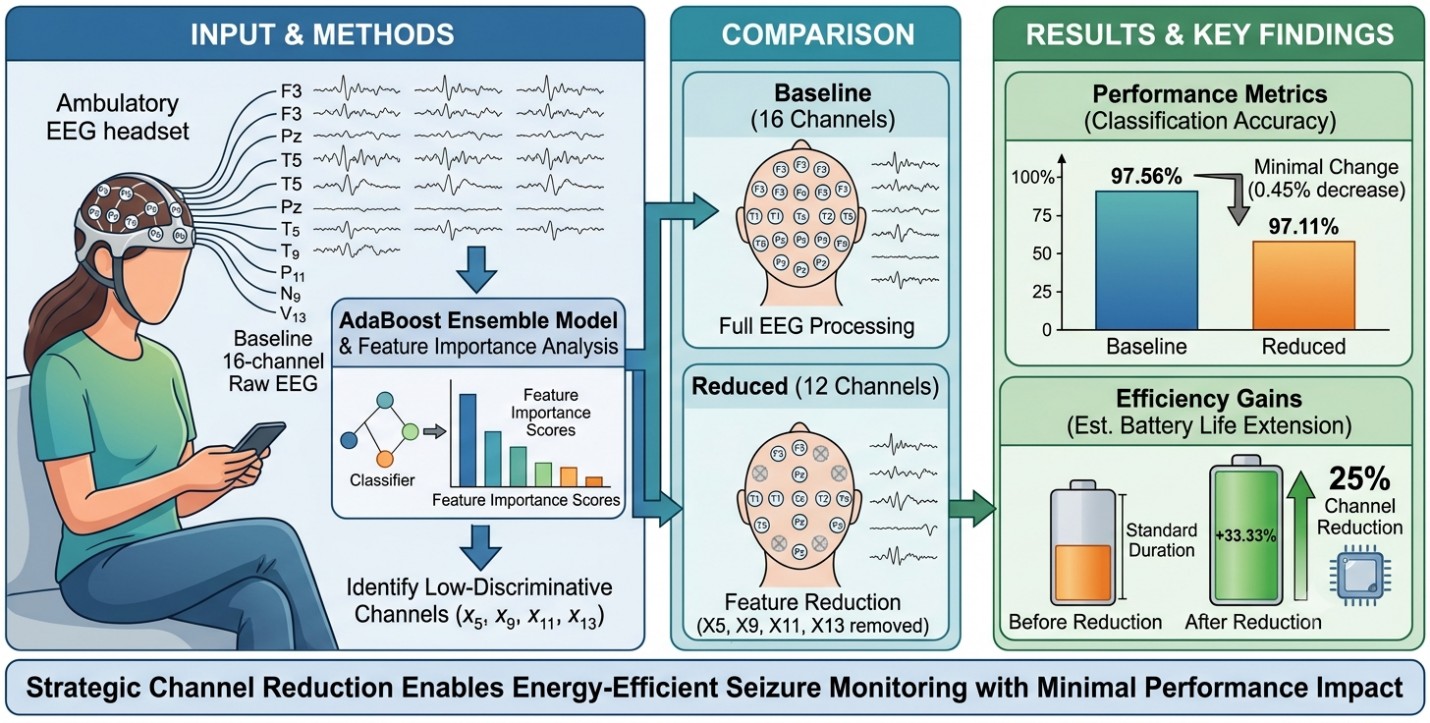
Wearable electroencephalogram (EEG) devices offer promising solutions for continuous seizure monitoring in out-of-hospital settings. However, the adoption of medical-grade wearable devices remains limited by the power consumption demands of edge computing, where each active EEG channel contributes to energy expenditure through signal processing and feature extraction operations. Optimizing algorithms through feature reduction may extend battery life without compromising diagnostic reliability. This study evaluated a feature reduction strategy for a 100-tree AdaBoost ensemble model applied to binary seizure detection using the Bangalore EEG Epilepsy Dataset, comprising recordings from 60 subjects. A patient-aware data partitioning scheme (70/15/15 split) was implemented to ensure complete separation of patient identities across training, validation, and testing subsets. Feature importance scores were extracted from the trained ensemble to identify less discriminative EEG channels, and classification performance was compared between a baseline 16-channel configuration and a reduced 12-channel configuration following removal of the four least important channels. The baseline 16-channel model achieved 97.56% test accuracy, 97.29% sensitivity, 98.50% specificity, and a 2.71% seizure miss rate. Following the removal of channels x5, x9, x11, and x13, the reduced 12-channel model achieved 97.11% test accuracy, 96.71% sensitivity, 98.50% specificity, and a 3.29% seizure miss rate. The 25% reduction in active channels resulted in only a 0.45 percentage-point decrease in accuracy while yielding an estimated 33.33% theoretical extension in battery operating duration. Strategic channel reduction based on feature importance analysis can improve computational efficiency while maintaining comparable seizure detection performance. These findings support the development of energy-efficient, long-term ambulatory EEG monitoring devices that balance diagnostic reliability with extended operational duration.
- World Health Organization. Epilepsy: A Public Health Imperative. World Health Organization; 2019. https://iris.who.int/handle/10665/325293
- World Health Organization. Epilepsy. World Health Organization; 2024. https://www.who.int/news-room/fact-sheets/detail/epilepsy
- Institute for Quality and Efficiency in Health Care (IQWiG). Overview: Epilepsy. In: InformedHealth.org [Internet]. Institute for Quality and Efficiency in Health Care (IQWiG); 2023. https://www.ncbi.nlm.nih.gov/books/NBK343313/
- McWilliam M, Asuncion RMD, Al Khalili Y. Idiopathic (genetic) generalized epilepsy. In: StatPearls [Internet]. StatPearls Publishing; 2024. https://www.ncbi.nlm.nih.gov/books/NBK546611/
- Beniczky S, Trinka E, Wirrell E, et al. A practical guide to the updated seizure classification 2025. Epileptic Disord. 2025;27(6):1087-1104. doi: 10.1002/epd2.70110
- Benbadis SR, Beniczky S, Bertram E, MacIver S, Moshé SL. The role of EEG in patients with suspected epilepsy. Epileptic Disord. 2020;22(2):143-155. doi: 10.1684/epd.2020.1151
- Seneviratne U, Cook M, D’Souza W. Brainwaves beyond diagnosis: Wider applications of electroencephalography in idiopathic generalized epilepsy. Epilepsia. 2021;63(1):22-41. doi: 10.1111/epi.17119
- Schulze-Bonhage A, Bruno E, Brandt A, et al. Diagnostic yield and limitations of in-hospital documentation in patients with epilepsy. Epilepsia. 2022;64(S4). doi: 10.1111/epi.17307
- Tatum WO, Mani J, Jin K, et al. Minimum standards for inpatient long-term video-eeg monitoring: A clinical practice guideline of the international league against epilepsy and international federation of clinical neurophysiology. Clin Neurophysiol. 2022;134:111-128. doi: 10.1016/j.clinph.2021.07.016
- Ambulatory EEG. In: Handbook of Clinical Neurology. Elsevier; 2019:161-170. doi: 10.1016/b978-0-444-64032-1.00010-2
- Hadady L, Robinson T, Bruno E, Richardson MP, Beniczky S. Users’ perspectives and preferences on using wearables in epilepsy: A critical review. Epilepsia. 2025;66(S3):4-13. doi: 10.1111/epi.18280
- Saifutdinova E, Congedo M, Dudysova D, Lhotska L, Koprivova J, Gerla V. An Unsupervised Multichannel Artifact Detection Method for Sleep EEG Based on Riemannian Geometry. Sensors. 2019;19(3):602. doi: 10.3390/s19030602
- Frankel MA, Lehmkuhle MJ, Spitz MC, Newman BJ, Richards SV, Arain AM. Wearable Reduced-Channel EEG System for Remote Seizure Monitoring. Front Neurol. 2021;12. doi: 10.3389/fneur.2021.728484
- Casson A, Yates D, Smith S, Duncan J, Rodriguez-Villegas E. Wearable Electroencephalography. IEEE Eng Med Biol Mag. 2010;29(3):44-56. doi: 10.1109/memb.2010.936545
- Tian F, Yang J, Zhao S, Sawan M. NeuroCARE: A generic neuromorphic edge computing framework for healthcare applications. Front Neurosci. 2023;17. doi: 10.3389/fnins.2023.1093865
- Covi E, Donati L, Liang X, et al. Adaptive extreme edge computing for wearable devices. Front Neurosci. 2021;15. doi: 10.3389/fnins.2021.611300
- Reisinger P, Larochelle J, Abkai C, et al. The impact of EEG preprocessing parameters on ultra-low-power seizure detection. Epilepsia. 2025;66(10):3895-3906. doi: 10.1111/epi.18521
- Zendehbad SA, Razavi AS, Tabrizi N, Sedaghat Z. A systematic review of artificial intelligence techniques based on electroencephalography analysis in the diagnosis of epilepsy disorders: A clinical perspective. Epilepsy Res. 2025;215:107582. doi: 10.1016/j.eplepsyres.2025.107582
- Schapire RE, Singer Y. Improved Boosting Algorithms Using Confidence-rated Predictions. Mach Learn. 1999;37(3):297-336. doi: 10.1023/a:1007614523901
- Ding Y, Zhu H, Chen R, Li R. An Efficient AdaBoost Algorithm with the Multiple Thresholds Classification. Appl Sci. 2022;12(12):5872. doi: 10.3390/app12125872
- Ekpar FE, Njoku FA. Analysis of electroencephalography (EEG) electrode-pair correlations. EJECE. 2023;7(6):6-10. doi: 10.24018/ejece.2023.7.6.571
- Xu Z, Ge H, Huang W, Lu H. Epilepsy detection based on spatiotemporal feature interaction fusion of EEG signals. Front Neurol. 2026;16. doi: 10.3389/fneur.2025.1478718
- Kerr WT, McFarlane KN, Figueiredo Pucci G. The present and future of seizure detection, prediction, and forecasting with machine learning, including the future impact on clinical trials. Front Neurol. 2024;15. doi: 10.3389/fneur.2024.1425490
- Rajput V. BEED: Bangalore EEG epilepsy dataset. Kaggle; 2025. https://www.kaggle.com/datasets/varunrajput/beed-bangalore-eeg-epilepsy-dataset
- Farooq MS, Zulfiqar A, Riaz S. Epileptic seizure detection using machine learning: Taxonomy, opportunities, and challenges. Diagnostics. 2023;13(6):1058. doi: 10.3390/diagnostics13061058
- Sun Y, Ren G, Ren J, Wang Q. High-frequency oscillations detected by electroencephalography as biomarkers to evaluate treatment outcome, mirror pathological severity and predict susceptibility to epilepsy. Acta Epileptol. 2021;3(1). doi: 10.1186/s42494-021-00063-z
- Segovia‐Oropeza M, Rauf EHU, Heide E, Focke NK. Quantitative EEG signatures in patients with and without epilepsy development after a first seizure. Epilepsia Open. 2025;10(2):427-440. doi: 10.1002/epi4.13128
- Fisher RS, Scharfman HE, deCurtis M. How Can We Identify Ictal and Interictal Abnormal Activity? In: Advances in Experimental Medicine and Biology. Springer Netherlands; 2014:3-23. doi: 10.1007/978-94-017-8914-1_1
- Wendling F, Hernandez A, Bellanger JJ, Chauvel P, Bartolomei F. Interictal to ictal transition in human temporal lobe epilepsy: Insights from a computational model of intracerebral EEG. J Clin Neurophysiol. 2005;22(5):343-356.
- Worrell G. High-Frequency Oscillations Recorded on Scalp EEG. Epilepsy Curr. 2012;12(2):57-58. doi: 10.5698/1535-7511-12.2.57
- Arroyo S, Uematsu S. High-Frequency EEG Activity at the Start of Seizures. J Clin Neurophysiol. 1992;9(3):441-448. doi: 10.1097/00004691-199207010-00012
- Asayesh A, Vanhatalo S, Tokariev A. The impact of EEG electrode density on the mapping of cortical activity networks in infants. NeuroImage. 2024;303:120932. doi: 10.1016/j.neuroimage.2024.120932
- National Institute of Neurological Disorders and Stroke. Epilepsy and seizures. 2026. https://www.ninds.nih.gov/health-information/disorders/epilepsy-and-seizures
- Acharya JN, Hani A, Cheek J, Thirumala P, Tsuchida TN. American Clinical Neurophysiology Society Guideline 2: Guidelines for Standard Electrode Position Nomenclature. J Clin Neurophysiol. 2016;33(4):308-311. doi: 10.1097/wnp.0000000000000316
- Fabian D, Ahmed I. Ambulatory ECG Monitoring. In: StatPearls [Internet]. StatPearls Publishing; 2026. https://www.ncbi.nlm.nih.gov/books/NBK597374/
- Al-Hadeethi H, Abdulla S, Diykh M, Green JH. Determinant of Covariance Matrix Model Coupled with AdaBoost Classification Algorithm for EEG Seizure Detection. Diagnostics. 2021;12(1):74. doi: 10.3390/diagnostics12010074
- Brookshire G, Kasper J, Blauch NM, et al. Data leakage in deep learning studies of translational EEG. Front Neurosci. 2024;18. doi: 10.3389/fnins.2024.1373515
- Starcke J, Spadafora J, Spadafora J, Spadafora P, Toma M. The Effect of Data Leakage and Feature Selection on Machine Learning Performance for Early Parkinson’s Disease Detection. Bioengineering. 2025;12(8):845. doi: 10.3390/bioengineering12080845
- Abou-Abbas L, Henni K, Jemal I, Mitiche A, Mezghani N. Patient-independent epileptic seizure detection by stable feature selection. Expert Syst Appl. 2023;232:120585. doi: 10.1016/j.eswa.2023.120585
- Yu J, Zhang L, Cheng D, et al. Ensemble early exit network on human activity recognition using wearable sensors. Comput Netw. 2025;269:111409. doi: 10.1016/j.comnet.2025.111409
- Ferree TC, Luu P, Russell GS, Tucker DM. Scalp electrode impedance, infection risk, and EEG data quality. Clin Neurophysiol. 2001;112(3):536-544. doi: 10.1016/s1388-2457(00)00533-2
- Zhang R, Sui L, Gong J, Cao J. EEG-based real-time diagnostic system with developed dynamic 2TEMD and dynamic ApEn algorithms. Front Physiol. 2023;14. doi: 10.3389/fphys.2023.1165450
- Nasef D, Nasef D, Sawiris V, Weinstein B, Garcia J, Toma M. Integrating artificial intelligence in clinical practice, hospital management, and health policy: literature review. J Hosp Manag Health Policy. 2025;9:20-20. doi: 10.21037/jhmhp-24-138
- Siddiqui MIH, Sakib AH, Akter S, Debnath J, Mahmud MR. Comparative analysis of traditional machine learning vs deep learning for sleep stage classification. Int J Sci Res Arch. 2025;15(1):1778-1789. doi: 10.30574/ijsra.2025.15.1.1159