

Automated assessment of osteopathic manipulative treatment techniques through quantitative video motion analysis: A feasibility study

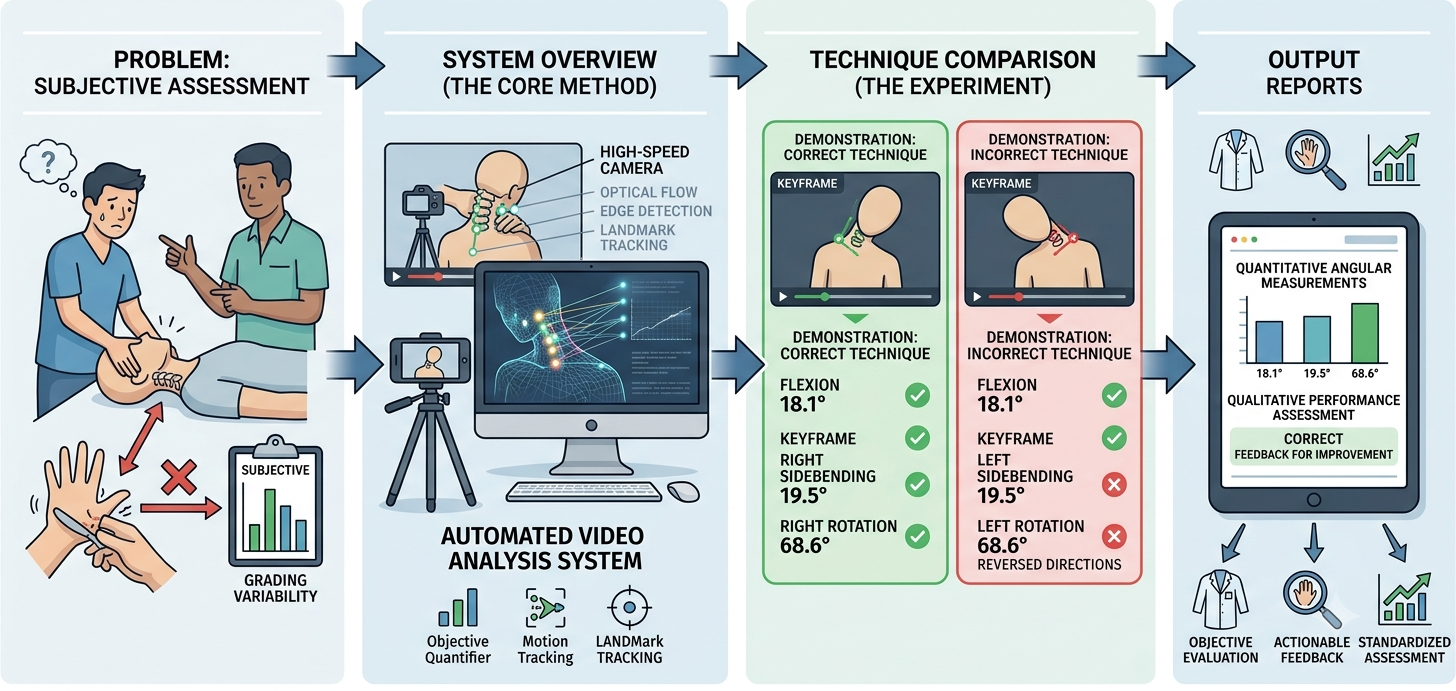
Osteopathic manipulative treatment represents a cornerstone of osteopathic medical education, yet the assessment of student competency in performing these techniques remains largely dependent on subjective instructor evaluation. This limitation introduces variability in grading standards and restricts the provision of actionable, quantitative feedback to learners. The present study introduces a proof-of-concept automated video analysis system designed to objectively evaluate osteopathic manipulative treatment technique execution through quantitative motion parameter analysis. A computational framework was developed incorporating optical flow algorithms, edge detection methods, and landmark tracking to quantify cervical spine motion during counterstrain technique performance. The system analyzes paired demonstration videos representing correct and incorrect technique execution, extracting angular displacement measurements for flexion, sidebending, and rotation movements. Validation testing using anterior cervical counterstrain techniques demonstrated that the automated system successfully distinguished between correct and incorrect performances, with the correct technique achieving all three therapeutic motion parameters (flexion of 18.1 degrees, right sidebending of 19.5 degrees, and right rotation of 68.6 degrees) while the incorrect technique exhibited reversed sidebending and rotation directions. The system generates comprehensive output reports containing both quantitative angular measurements and qualitative performance assessments. These findings establish the technical feasibility of this proof-of-concept automated motion analysis approach rather than a validated diagnostic tool, offering potential future applications in skills laboratory settings, simulation environments, and remote learning contexts where instructor availability may be limited.
- DiGiovanna EL, Amen CJ, Burns DK. An Osteopathic Approach to Diagnosis and Treatment. 4th ed. Philadelphia: Lippincott Williams & Wilkins; 2021.
- Johnson SM, Kurtz ME. Diminished Use of Osteopathic Manipulative Treatment and Its Impact on the Uniqueness of the Osteopathic Profession. Acad Med. 2001;76(8):821-828. doi: 10.1097/00001888-200108000-00016
- Lunghi C, Baroni F, D’Alessandro G, et al. Patient–Practitioner–Environment Synchronization: Four-Step Process for Integrating Interprofessional and Distinctive Competencies in Osteopathic Practice—A Scoping Review with Integrative Hypothesis. Healthcare. 2025;13(7):820. doi: 10.3390/healthcare13070820
- Roberts A, Harris K, Outen B, et al. Osteopathic Manipulative Medicine: A Brief Review of the Hands-On Treatment Approaches and Their Therapeutic Uses. Medicines. 2022;9(5):33. doi: 10.3390/medicines9050033
- Cairney WJ, Dickerman JL, Brannan GD, Dogbey GY. Identification of distinctive characteristics, principles, and practices of the osteopathic physician in the current health care system. Osteopath Fam Physician. 2012;4(4):110-117. doi: 10.1016/j.osfp.2012.03.004
- White C, Xie Y, Bigham J, et al. Osteopathic Manipulative Medicine and Disorders: An Overview of Peer-Reviewed Publications 2018–2022. Cureus. 2024. doi: 10.7759/cureus.62185
- Boulet JR, Sandella JM, Gimpel J, LaBaere R. Assessing fundamental clinical skills of osteopathic medical students. J Osteopath Med. 2025;125(10):469-476. doi: 10.1515/jom-2024-0225
- Cook C, Turney L, Ramirez L, et al. Predictive Factors in Poor Inter-Rater Reliability Among Physical Therapists. J Man Manip Ther. 2002;10(4):200-205. doi: 10.1179/106698102790819102
- Shafian S, Ilaghi M, Shahsavani Y, et al. The feedback dilemma in medical education: insights from medical residents’ perspectives. BMC Med Educ. 2024;24(1). doi: 10.1186/s12909-024-05398-y
- Vieira M, Kögel A, Stroetmann M, et al. Low Inter-rater Reliability of Active Hand Joint Range of Motion Measurements When Assessing Hand Function in a Clinical Setting. Arch Physiother Rehabil. 2026;9(1). doi: 10.26502/fapr0030
- ten Cate O, Regehr G. The Power of Subjectivity in the Assessment of Medical Trainees. Acad Med. 2019;94(3):333-337. doi: 10.1097/acm.0000000000002495
- Rosenberger K, Skinner D, Monk J. Ready for Residency: A Bloomian Analysis of Competency-Based Osteopathic Medical Education. J Osteopath Med. 2017;117(8):529-536. doi: 10.7556/jaoa.2017.103
- Bray NN, Andolsek KM, Edgar L. The Osteopathic Recognition Milestones in the Single Accreditation System for Graduate Medical Education. J Grad Med Educ. 2021;13(2):161-163. doi: 10.4300/jgme-d-21-00214.1
- Herrera-Aliaga E, Estrada LD. Trends and Innovations of Simulation for Twenty First Century Medical Education. Front Public Health. 2022;10. doi: 10.3389/fpubh.2022.619769
- Pottle J. Virtual reality and the transformation of medical education. Future Healthc J. 2019;6(3):181-185. doi: 10.7861/fhj.2019-0036
- Khakpaki A. Advancements in artificial intelligence transforming medical education: a comprehensive overview. Med Educ Online. 2025;30(1). doi: 10.1080/10872981.2025.2542807
- Toofaninejad E, Mirzaei S, Mahdavi Shakib A, et al. Mapping the Landscape: A Systematic Review of Technology Trends in Medical Education and Competency Development. Adv Med Educ Pract. 2025;16:2369-2383. doi: 10.2147/amep.s561949
- Altintas L, Sahiner M. Transforming medical education: the impact of innovations in technology and medical devices. Expert Rev Med Devices. 2024;21(9):797-809. doi: 10.1080/17434440.2024.2400153
- Mawyin-Muñoz CE, Salmerón-Escobar FJ, Hidalgo-Acosta JA. From Virtual Patients to AI-Powered Training: The Evolution of Medical Simulation. BioNatura J. 2024;1(4):12. doi: 10.70099/bj/2024.01.04.7
- Ganni S, Botden SMBI, Chmarra M, et al. A software-based tool for video motion tracking in the surgical skills assessment landscape. Surg Endosc. 2018;32(6):2994-2999. doi: 10.1007/s00464-018-6023-5
- Ganni S, Botden SMBI, Chmarra M, et al. Validation of Motion Tracking Software for Evaluation of Surgical Performance in Laparoscopic Cholecystectomy. J Med Syst. 2020;44(3). doi: 10.1007/s10916-020-1525-9
- Ebina K, Abe T, Hotta K, et al. External validation of a motion capture-based surgical skill assessment system in laparoscopic simulation training environments. Surg Endosc. 2025;39(9):5879-5888. doi: 10.1007/s00464-025-12018-3
- Dick L, Boyle CP, Skipworth RJE, et al. Automated analysis of operative video in surgical training: scoping review. BJS Open. 2024;8(5). doi: 10.1093/bjsopen/zrae124
- Atazadah M, Bourass M, Max SA, et al. Objective Assessment of Surgical Skill Using Artificial Intelligence Hand Tracking in Cardiothoracic Training: A Feasibility Study. Interdiscip CardioVasc Thorac Surg. 2026;41(2). doi: 10.1093/icvts/ivag048
- Perrone KH, Yang S, Mohamadipanah H, et al. Translating motion tracking data into resident feedback: An opportunity for streamlined video coaching. Am J Surg. 2020;219(4):552-556. doi: 10.1016/j.amjsurg.2020.01.032
- Bouzid S, Chaker A, Arsicault M, et al. A Novel Integrated Motion Tracking Device for Objective Laparoscopic Training Assessment: Development and Validation. J Med Devices. 2025;20(1). doi: 10.1115/1.4069906
- Roggio F, Trovato B, Sortino M, Musumeci G. A comprehensive analysis of the machine learning pose estimation models used in human movement and posture analyses: A narrative review. Heliyon. 2024;10(21):e39977. doi: 10.1016/j.heliyon.2024.e39977
- Linsenmeyer M, Ridpath L. Technology use and satisfaction among colleges/schools of osteopathic medical education. J Osteopath Med. 2025;126(3):129-137. doi: 10.1515/jom-2024-0217
- Kovanur Sampath K, McIntyre C, Arumugam A, et al. Beyond “YouTube clips”: a qualitative study of manual therapy educators’ perceptions of 3D technology in MT education. J Man Manip Ther. 2026:1-13. doi: 10.1080/10669817.2026.2629292
- Mitchell AA, Ivimey-Cook ER. Technology-enhanced simulation for healthcare professionals: A meta-analysis. Front Med. 2023;10. doi: 10.3389/fmed.2023.1149048
- Cerritelli F, Chiera M, Abbro M, et al. The Challenges and Perspectives of the Integration Between Virtual and Augmented Reality and Manual Therapies. Front Neurol. 2021;12. doi: 10.3389/fneur.2021.700211
- Dugailly PM, Beyer B, Feipel V. Biomechanics of the upper cervical spine ligaments in axial rotation and flexion-extension: Considerations into the clinical framework. J Craniovert Junct Spine. 2020;11(3):217. doi: 10.4103/jcvjs.jcvjs_78_20
- Ramieri A, Domenicucci M, Miscusi M, Costanzo G. Functional Anatomy and Biomechanics of the Cervical Spine. In: Springer International Publishing. Cham: Springer; 2016. doi: 10.1007/978-3-319-21608-9_2
- Anthwal S, Ganotra D. An overview of optical flow-based approaches for motion segmentation. Imaging Sci J. 2019;67(5):284-294. doi: 10.1080/13682199.2019.1641316
- Farnebäck G. Two-Frame Motion Estimation Based on Polynomial Expansion. In: Lecture Notes in Computer Science. Springer Berlin Heidelberg; 2003:363-370. doi: 10.1007/3-540-45103-x_50
- Aminfar A, Davoodzadeh N, Aguilar G, Princevac M. Application of optical flow algorithms to laser speckle imaging. Microvasc Res. 2019;122:52-59. doi: 10.1016/j.mvr.2018.11.001
- Robitaille MC, Byers JM, Christodoulides JA, Raphael MP. Robust optical flow algorithm for general single cell segmentation. PLoS One. 2022;17(1):e0261763. doi: 10.1371/journal.pone.0261763
- Zhang Q, Yang D, Zhu Y, et al. An optimized optical-flow-based method for quantitative tracking of ultrasound-guided right diaphragm deformation. BMC Med Imaging. 2023;23(1). doi: 10.1186/s12880-023-01066-7
- Holden MS, Xia S, Lia H, et al. Machine learning methods for automated technical skills assessment with instructional feedback in ultrasound-guided interventions. Int J Comput Assist Radiol Surg. 2019;14(11):1993-2003. doi: 10.1007/s11548-019-01977-3
- Yurdal MO, Kıncal RY. Development of a digital peer-feedback tool for clinical skills training: a pilot study with second-year medical students. Sci Rep. 2025;15(1). doi: 10.1038/s41598-025-24650-z
- Chang I, Rivera MJ, Eberman LE. The Effect of Feedback on Manual Therapy Skill Acquisition: A Systematic Review. Athl Train Educ J. 2020;15(3):224-234. doi: 10.4085/150120038
- Trinidad-Fernández M, González-Molina F, Roldán-Jiménez C, et al. New learning technique based on real-time kinematic feedback from an inertial sensor for manual therapy in shoulder joint: a randomised trial. BMC Med Educ. 2024;24(1). doi: 10.1186/s12909-024-05649-y
- Khan SA, Taiyara J, Zary N, Otaki F. Artificial Intelligence in Narrative Feedback Analysis for Competency-Based Medical Education: A Review. In: Studies in Health Technology and Informatics. IOS Press; 2025. doi: 10.3233/shti250637
- Hill M, Peters M, Salvaggio M, et al. Implementation and evaluation of a self-directed learning activity for first-year medical students. Med Educ Online. 2020;25(1). doi: 10.1080/10872981.2020.1717780
- Arja SB, White BA, Fayyaz J, Thompson A. The impact of accreditation on continuous quality improvement process in undergraduate medical education programs: A scoping review. MedEdPublish. 2024;14:13. doi: 10.12688/mep.20142.2
- Norcini JJ, McKinley DW. Assessment methods in medical education. Teach Teach Educ. 2007;23(3):239-250. doi: 10.1016/j.tate.2006.12.021
- El-Hussuna A, Elhadi M, Møgelmose A, et al. Enhancing Surgical Performance Through Automated Video Analysis Utilizing Computer Vision and Machine Learning. Turk J Colorectal Dis. 2025. doi: 10.4274/tjcd.galenos.2025.2025-6-6
- Zsarnoczky-Dulhazi F, Agod S, Szarka S, et al. AI Base Motion Analysis Software for Sport and Physical Therapy Assessment. Rev Bras Med Esporte. 2024;30. doi: 10.1590/1517-8692202430012022_0020i
- Park EO, Chang K, Koduah S. Structured Assessments: Enhancing Success in Early Nursing Education and Student Retention. Nurs Rep. 2025;15(9):335. doi: 10.3390/nursrep15090335
- Wong CK. Strain counterstrain: Current concepts and clinical evidence. Man Ther. 2012;17(1):2-8. doi: 10.1016/j.math.2011.10.001
- Wong CK, Abraham T, Karimi P, et al. Strain counterstrain technique to decrease tender point palpation pain compared to control conditions: A systematic review with meta-analysis. J Bodyw Mov Ther. 2014;18(2):165-173. doi: 10.1016/j.jbmt.2013.09.010
- Koura GM, Elshiwi AM, Selim M, et al. Comparing the Therapeutic Impact of Strain-Counterstrain and Exercise on Low Back Myofascial Pain Syndrome: A Randomized Trial. J Multidiscip Healthc. 2025;18:1-12. doi: 10.2147/jmdh.s499927
- Jones LH. Strain and Counterstrain. Indianapolis: American Academy of Osteopathy; 1981:1-112.
- Piscitelli E, Jose J, Ahmed E, et al. A Feasibility and Acceptability Study of Virtual Reality-Based Training for Thoracic Spine Assessment: First-Year Osteopathic Medical Student Perceptions and Motivational Responses. Eng. 2026;7(8):399. doi: 10.3390/eng7080399