

Artificial intelligence for surgically resectable lung cancer: Toward a multimodal and clinically actionable framework

Lung cancer remains the leading cause of cancer incidence and mortality worldwide, and surgically resectable disease represents a critical window for cure. However, the current care continuum for resectable lung cancer remains limited by heterogeneous risk profiles, empirical decisions, fragmented integration of multi-dimensional information, and insufficient prediction of clinical outcomes. Under these circumstances, artificial intelligence (AI) has emerged as a promising approach for extracting clinically relevant information from complex data. Nevertheless, a synthesis of AI evidence across the full pathway of resectable lung cancer remains lacking, leaving clinicians uncertain about its clinical implementation. To address this gap, we narratively synthesize representative evidence regarding the evolution, technical platforms, and clinical applications of AI in resectable lung cancer, integrating how AI could support preoperative screening and diagnosis, intraoperative decision-making and procedures, as well as postoperative treatment and surveillance. We further discuss the major barriers to clinical translation, including limited external and prospective validation, patient safety, and accountability, followed by future directions. At present, many AI applications remain at an early exploratory stage, and further prospective evaluation is required to establish their clinical utility.
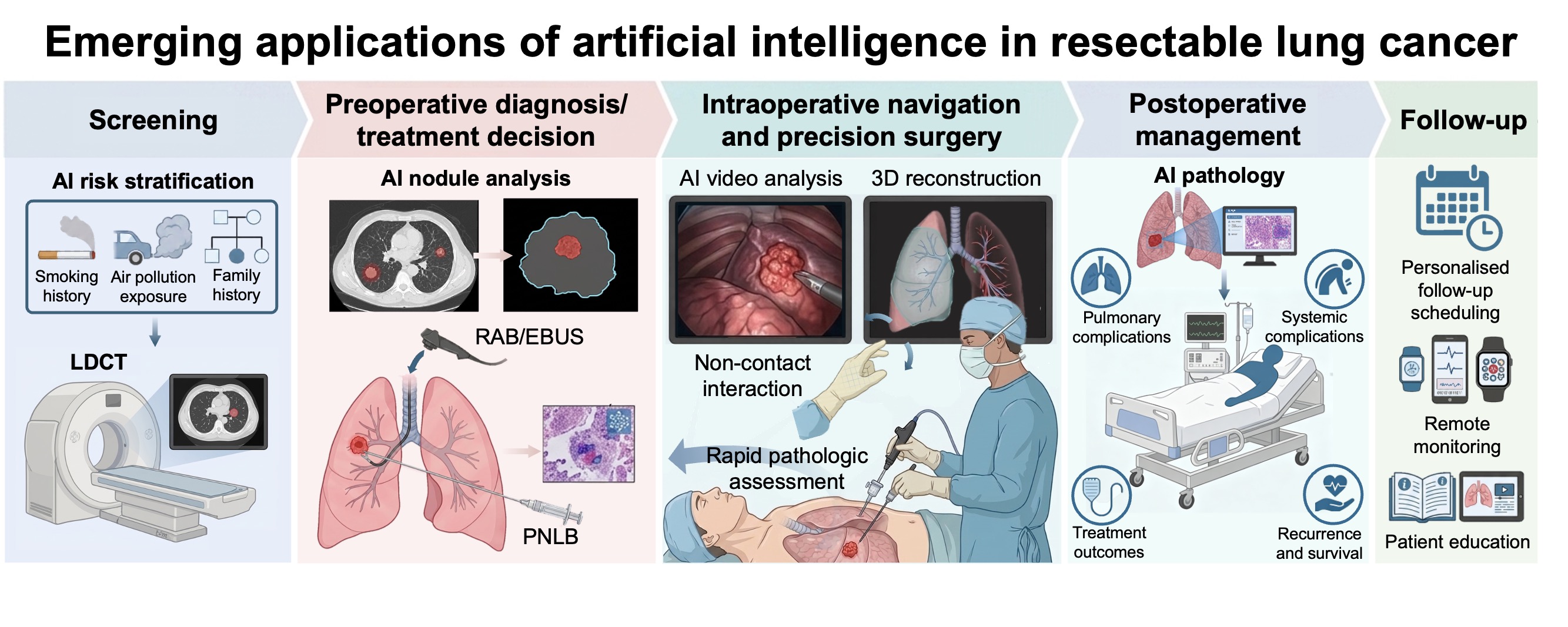
- Scott WJ, Howington J, Feigenberg S, Movsas B, Pisters K. Treatment of non-small cell lung cancer stage I and stage II: ACCP evidence-based clinical practice guidelines (2nd edition). Chest. 2007;132(3 Suppl):234S-242S. doi: 10.1378/chest.07-1378
- Xenophontos E, Giaj Levra N, Durieux V, et al. Definition of resectable stage III non-small cell lung cancer: A systematic review from EORTC lung cancer group. Lung Cancer. 2025;207:108671. doi: 10.1016/j.lungcan.2025.108671
- D’Amours MF, Wu FTH, Theisen-Lauk O, Chan EK, McGuire A, Ho C. Surgically resectable nonsmall cell lung cancer: a contemporary approach. Eur Respir J. 2024;64(2):2400332. doi: 10.1183/13993003.00332-2024
- Shigenobu T, Taniguchi Y, Suzuki T, et al. Surgery versus concurrent chemoradiotherapy for stage III non-small cell lung cancer: a retrospective study with propensity score matching. BMC Cancer. 2025;25(1):121. doi: 10.1186/s12885-025-13550-0
- Yokoi K, Taniguchi T, Usami N, Kawaguchi K, Fukui T, Ishiguro F. Surgical management of locally advanced lung cancer. Gen Thorac Cardiovasc Surg. 2014;62(9):522-530. doi: 10.1007/s11748-014-0425-7
- Gandhi Z, Gurram P, Amgai B, et al. Artificial Intelligence and Lung Cancer: Impact on Improving Patient Outcomes. Cancers. 2023;15(21):5236. doi: 10.3390/cancers15215236
- Spiro SG, Porter JC. Lung cancer--where are we today? Current advances in staging and nonsurgical treatment. Am J Respir Crit Care Med. 2002;166(9):1166-1196. doi: 10.1164/rccm.200202-070SO
- Rami-Porta R, Nishimura KK, Giroux DJ, et al. The International Association for the Study of Lung Cancer Lung Cancer Staging Project: Proposals for Revision of the TNM Stage Groups in the Forthcoming (Ninth) Edition of the TNM Classification for Lung Cancer. J Thorac Oncol. 2024;19(7):1007-1027. doi: 10.1016/j.jtho.2024.02.011
- Liao J, Li X, Gan Y, et al. Artificial intelligence assists precision medicine in cancer treatment. Front Oncol. 2023;12. doi: 10.3389/fonc.2022.998222
- National Academy of Medicine; The Learning Health System Series. Artificial Intelligence in Health Care: The Hope, the Hype, the Promise, the Peril. (Whicher D, Ahmed M, Israni ST, Matheny M, eds.). Washington, D.C., USA: National Academies Press (US); 2023. Accessed March 4, 2026. http://www.ncbi.nlm.nih.gov/books/NBK605955/
- Christie JR, Lang P, Zelko LM, Palma DA, Abdelrazek M, Mattonen SA. Artificial Intelligence in Lung Cancer: Bridging the Gap Between Computational Power and Clinical Decision-Making. Can Assoc Radiol J. 2021;72(1):86-97. doi: 10.1177/0846537120941434
- Le VH, Minh TNT, Kha QH, Le NQK. Deep Learning Radiomics for Survival Prediction in Non-Small-Cell Lung Cancer Patients from CT Images. J Med Syst. 2025;49(1):22. doi: 10.1007/s10916-025-02156-5
- Aleem MU, Khan JA, Younes A, Sabbah BN, Saleh W, Migliore M. Enhancing Thoracic Surgery with AI: A Review of Current Practices and Emerging Trends. Curr Oncol. 2024;31(10):6232-6244. doi: 10.3390/curroncol31100464
- Seastedt KP, Moukheiber D, Mahindre SA, et al. A scoping review of artificial intelligence applications in thoracic surgery. Eur J Cardiothorac Surg. 2022;61(2):239-248. doi: 10.1093/ejcts/ezab422
- Bonci EA, Bandura A, Dooley A, et al. Artificial intelligence in NSCLC management for revolutionizing diagnosis, prognosis, and treatment optimization: A systematic review. Crit Rev Oncol/Hematol. 2025;216:104929. doi: 10.1016/j.critrevonc.2025.104929
- Ijlal A, Mumtaz H, Hassan SM, et al. Bridging surgical oncology and personalized medicine: the role of artificial intelligence and machine learning in thoracic surgery. Ann Med Surg. 2025;87(6):3566. doi: 10.1097/MS9.0000000000003302
- Johnson D, Goodman R, Patrinely J, et al. Assessing the Accuracy and Reliability of AI-Generated Medical Responses: An Evaluation of the Chat-GPT Model. Res Sq. 2023. doi: 10.21203/rs.3.rs-2566942/v1
- Chen ZH, Lin L, Wu CF, Li CF, Xu RH, Sun Y. Artificial intelligence for assisting cancer diagnosis and treatment in the era of precision medicine. Cancer Commun. 2021;41(11):1100-1115. doi: 10.1002/cac2.12215
- Zhang Y, Qian F, Teng J, et al. China lung cancer screening (CLUS) version 2.0 with new techniques implemented: Artificial intelligence, circulating molecular biomarkers and autofluorescence bronchoscopy. Lung Cancer. 2023;181:107262. doi: 10.1016/j.lungcan.2023.107262
- Song J, Hwang EJ, Yoon SH, Kim SY, Chang YC, Goo JM. CT Screening Challenges Amid Rising Threat of Lung Cancer in Individuals Who Have Never Smoked. Radiology. 2026;318(1):e251305. doi: 10.1148/radiol.251305
- Jin Y, Mu W, Shi Y, et al. Development and validation of an integrated system for lung cancer screening and post-screening pulmonary nodules management: a proof-of-concept study (ASCEND-LUNG). eClinicalMedicine. 2024;75:102769. doi: 10.1016/j.eclinm.2024.102769
- Ding Q, Wang C, Zhang Z, et al. An explainable AI approach to surgical and radiotherapy interventions for optimized treatment decision-making in early-stage non-small cell lung cancer. Transl Lung Cancer Res. 2025;14(6):2011-2030. doi: 10.21037/tlcr-2025-152
- Luo Q, Zheng Z, Luo W, Zhu J. Development and external validation of interpretable machine learning models for personalized multiple treatment recommendations in non-small cell lung cancer. Int J Med Inform. 2026;206:106160. doi: 10.1016/j.ijmedinf.2025.106160
- Wu J, Meng H, Zhou L, et al. Habitat radiomics and deep learning fusion nomogram to predict EGFR mutation status in stage I non-small cell lung cancer: a multicenter study. Sci Rep. 2024;14(1):15877. doi: 10.1038/s41598-024-66751-1
- Gillies RJ, Kinahan PE, Hricak H. Radiomics: Images Are More than Pictures, They Are Data. Radiology. 2016;278(2):563-577. doi: 10.1148/radiol.2015151169
- Zhang S, Liu X, Zhou L, et al. Intelligent prognosis evaluation system for stage I-III resected non-small-cell lung cancer patients on CT images: a multi-center study. eClinicalMedicine. 2023;65:102270. doi: 10.1016/j.eclinm.2023.102270
- Edwards FH, Schaefer PS, Cohen AJ, et al. Use of artificial intelligence for the preoperative diagnosis of pulmonary lesions. Ann Thorac Surg. 1989;48(4):556-559. doi: 10.1016/s0003-4975(10)66862-2
- Gurney JW, Swensen SJ. Solitary pulmonary nodules: determining the likelihood of malignancy with neural network analysis. Radiology. 1995;196(3):823-829. doi: 10.1148/radiology.196.3.7644650
- Vesselle H, Turcotte E, Wiens L, Haynor D. Application of a neural network to improve nodal staging accuracy with 18F-FDG PET in non-small cell lung cancer. J Nucl Med. 2003;44(12):1918-1926.
- Jefferson MF, Pendleton N, Lucas SB, Horan MA. Comparison of a genetic algorithm neural network with logistic regression for predicting outcome after surgery for patients with nonsmall cell lung carcinoma. Cancer. 1997;79(7):1338-1342. doi: 10.1002/(sici)1097-0142(19970401)79:7<1338::aid-cncr10>3.0.co;2-0
- Marchevsky AM, Patel S, Wiley KJ, et al. Artificial neural networks and logistic regression as tools for prediction of survival in patients with Stages I and II non-small cell lung cancer. Mod Pathol. 1998;11(7):618-625.
- Esteva H, Marchevsky A, Núñez T, Luna C, Esteva M. Neural networks as a prognostic tool of surgical risk in lung resections. Ann Thorac Surg. 2002;73(5):1576-1581. doi: 10.1016/s0003-4975(02)03418-5
- Kiraly AP, Helferty JP, Hoffman EA, McLennan G, Higgins WE. Three-dimensional path planning for virtual bronchoscopy. IEEE Trans Med Imaging. 2004;23(11):1365-1379. doi: 10.1109/TMI.2004.829332
- Nakamoto M, Aburaya N, Sato Y, et al. Thoracoscopic surgical navigation system for cancer localization in collapsed lung based on estimation of lung deformation. Med Image Comput Comput Assist Interv. 2007;4792:68-76. doi: 10.1007/978-3-540-75759-7_9
- Zhao W, Yang J, Sun Y, et al. 3D Deep Learning from CT Scans Predicts Tumor Invasiveness of Subcentimeter Pulmonary Adenocarcinomas. Cancer Res. 2018;78(24):6881-6889. doi: 10.1158/0008-5472.CAN-18-0696
- Kim H, Goo JM, Lee KH, Kim YT, Park CM. Preoperative CT-based Deep Learning Model for Predicting Disease-Free Survival in Patients with Lung Adenocarcinomas. Radiology. 2020;296(1):216-224. doi: 10.1148/radiol.2020192764
- Kalchiem-Dekel O, Connolly JG, Lin IH, et al. Shape-Sensing Robotic-Assisted Bronchoscopy in the Diagnosis of Pulmonary Parenchymal Lesions. Chest. 2022;161(2):572-582. doi: 10.1016/j.chest.2021.07.2169
- Asfahan S, Elhence P, Dutt N, Niwas Jalandra R, Chauhan NK. Digital-Rapid On-site Examination in Endobronchial Ultrasound-Guided Transbronchial Needle Aspiration (DEBUT): a proof of concept study for the application of artificial intelligence in the bronchoscopy suite. Eur Respir J. 2021;58(4):2100915. doi: 10.1183/13993003.00915-2021
- Liu N, Han G, Gu Q, Zhang Y, Chen M. A new era of precision diagnosis and treatment for lung cancer: artificial intelligence-driven multimodal data integration and clinical applications. Cell Death Dis. 2026;17:534. doi: 10.1038/s41419-026-08769-z
- Zabaleta J, Aguinagalde B, Lopez I, et al. Utility of Artificial Intelligence for Decision Making in Thoracic Multidisciplinary Tumor Boards. J Clin Med. 2025;14(2). doi: 10.3390/jcm14020399
- Kim S, Jang S, Kim B, et al. Automated Pathologic TN Classification Prediction and Rationale Generation From Lung Cancer Surgical Pathology Reports Using a Large Language Model Fine-Tuned With Chain-of-Thought: Algorithm Development and Validation Study. JMIR Med Inform. 2024;12(1):e67056. doi: 10.2196/67056
- Troian M, Lovadina S, Ravasin A, et al. An Assessment of ChatGPT’s Responses to Common Patient Questions About Lung Cancer Surgery: A Preliminary Clinical Evaluation of Accuracy and Relevance. J Clin Med. 2025;14(5):1676. doi: 10.3390/jcm14051676
- Swanson K, Wu E, Zhang A, Alizadeh AA, Zou J. From patterns to patients: Advances in clinical machine learning for cancer diagnosis, prognosis, and treatment. Cell. 2023;186(8):1772-1791. doi: 10.1016/j.cell.2023.01.035
- Breiman L. Random Forests. Mach Learn. 2001;45(1):5-32. doi: 10.1023/A:1010933404324
- Chen T, Guestrin C. XGBoost: A Scalable Tree Boosting System. In: Proceedings of the 22nd ACM SIGKDD International Conference on Knowledge Discovery and Data Mining. New York, NY, USA: Association for Computing Machinery (ACM); 2016:785-794. doi: 10.1145/2939672.2939785
- Ke G, Meng Q, Finley T, et al. LightGBM: A Highly Efficient Gradient Boosting Decision Tree. In: Guyon I, Luxburg UV, Bengio S, et al., eds. Advances in Neural Information Processing Systems 30 (Nips 2017). Vol 30. Red Hook, NY, USA: Curran Associates: 2017.
- Cortes C, Vapnik V. Support-vector networks. Mach Learn. 1995;20(3):273-297. doi: 10.1007/BF00994018
- Tibshirani R. Regression Shrinkage and Selection Via the Lasso. R Stat Soc J Ser B: Methodol. 1996;58(1):267-288. doi: 10.1111/j.2517-6161.1996.tb02080.x
- Zou H, Hastie T. Regularization and Variable Selection Via the Elastic Net. J R Stat Soc Ser B Stat Methodol. 2005;67(2):301-320. doi: 10.1111/j.1467-9868.2005.00503.x
- Lundberg SM, Erion G, Chen H, et al. From Local Explanations to Global Understanding with Explainable AI for Trees. Nat Mach Intell. 2020;2(1):56-67. doi: 10.1038/s42256-019-0138-9
- Hosny A, Parmar C, Coroller TP, et al. Deep learning for lung cancer prognostication: A retrospective multi-cohort radiomics study. PLoS Med. 2018;15(11):e1002711. doi: 10.1371/journal.pmed.1002711
- Kim G, Moon S, Choi JH. Deep Learning with Multimodal Integration for Predicting Recurrence in Patients with Non-Small Cell Lung Cancer. Sensors. 2022;22(17):6594. doi: 10.3390/s22176594
- Li X, Zhang S, Luo X, et al. Accuracy and efficiency of an artificial intelligence-based pulmonary broncho-vascular three-dimensional reconstruction system supporting thoracic surgery: retrospective and prospective validation study. eBioMedicine. 2023;87:104422. doi: 10.1016/j.ebiom.2022.104422
- Liang H, Yan Z, Zhang Y, et al. LungSurg: A Generative AI System for Segmentation and Phase Classification in Thoracoscopic Lobectomy. MedComm. 2026;7(2):e70613. doi: 10.1002/mco2.70613
- Chen Z, Li Y, Nie C, Cai H, Xu Y, Yuan Z. Fast and accurate lung cancer subtype classication and localization based on Intraoperative frozen sections of lung adenocarcinoma. Biomed Phys Eng Express. 2025;11(4):045014. doi: 10.1088/2057-1976/ade157
- He K, Zhang X, Ren S, Sun J. Deep Residual Learning for Image Recognition. arXiv. 2015. doi: 10.48550/arXiv.1512.03385
- Ronneberger O, Fischer P, Brox T. U-Net: Convolutional Networks for Biomedical Image Segmentation. In: Navab N, Hornegger J, Wells WM, Frangi AF, eds. Medical Image Computing and Computer-Assisted Intervention – MICCAI 2015. Cham, Switzerland: Springer International Publishing; 2015:234-241. doi: 10.1007/978-3-319-24574-4_28
- Bai S, Kolter JZ, Koltun V. An Empirical Evaluation of Generic Convolutional and Recurrent Networks for Sequence Modeling. arXiv. 2018. doi: 10.48550/arXiv.1803.01271
- Dosovitskiy A, Beyer L, Kolesnikov A, et al. An Image is Worth 16x16 Words: Transformers for Image Recognition at Scale. arXiv. 2020. doi: 10.48550/arXiv.2010.11929
- Umirzakova S, Baltayev J, Mardieva S, Muksimova S. Lightweight adaptive AI for novel real-time facial expression recognition. Knowl-Based Syst. 2026;339:115589. doi: 10.1016/j.knosys.2026.115589
- Esteva A, Robicquet A, Ramsundar B, et al. A guide to deep learning in healthcare. Nat Med. 2019;25(1):24-29. doi: 10.1038/s41591-018-0316-z
- Nardone V, Marmorino F, Germani MM, et al. The Role of Artificial Intelligence on Tumor Boards: Perspectives from Surgeons, Medical Oncologists and Radiation Oncologists. Curr Oncol. 2024;31(9):4984-5007. doi: 10.3390/curroncol31090369
- Shen C, Huang Y, Wang B, Ye X, Jiang J. The impact of nurse-led, AI-assisted perioperative health education on psychological status and quality of life in patients undergoing lung cancer surgery. Front Psychol. 2025;16. doi: 10.3389/fpsyg.2025.1702256
- Vaswani A, Shazeer N, Parmar N, et al. Attention Is All You Need. arXiv. 2023. doi: 10.48550/arXiv.1706.03762
- Zhang S, Dong L, Li X, et al. Instruction Tuning for Large Language Models: A Survey. arXiv. 2023. doi: 10.48550/arXiv.2308.10792
- Lewis P, Perez E, Piktus A, et al. Retrieval-Augmented Generation for Knowledge-Intensive NLP Tasks. arXiv. 2021. doi: 10.48550/arXiv.2005.11401
- OpenAI, Achiam J, Adler S, et al. GPT-4 Technical Report. arXiv. 2023. doi: 10.48550/arXiv.2303.08774
- Milletari F, Navab N, Ahmadi SA. V-Net: Fully Convolutional Neural Networks for Volumetric Medical Image Segmentation. arXiv. 2016. doi: 10.48550/arXiv.1606.04797
- Ilse M, Tomczak JM, Welling M. Attention-based Deep Multiple Instance Learning. arXiv. 2018. doi: 10.48550/arXiv.1802.04712
- Gadermayr M, Tschuchnig M. Multiple instance learning for digital pathology: A review of the state-of-the-art, limitations & future potential. Comput Med Imaging Graph. 2024;112:102337. doi: 10.1016/j.compmedimag.2024.102337
- Argelaguet R, Velten B, Arnol D, et al. Multi‐Omics Factor Analysis—a framework for unsupervised integration of multi‐omics data sets. Mol Syst Biol. 2018;14(6):MSB178124. doi: 10.15252/msb.20178124
- Ballard JL, Wang Z, Li W, Shen L, Long Q. Deep learning-based approaches for multi-omics data integration and analysis. BioData Mining. 2024;17(1):38. doi: 10.1186/s13040-024-00391-z
- Grinsztajn L, Oyallon E, Varoquaux G. Why do tree-based models still outperform deep learning on tabular data? arXiv. 2022. doi: 10.48550/arXiv.2207.08815
- Caruana R, Lou Y, Gehrke J, Koch P, Sturm M, Elhadad N. Intelligible Models for HealthCare: Predicting Pneumonia Risk and Hospital 30-day Readmission. In: Proceedings of the 21th ACM SIGKDD International Conference on Knowledge Discovery and Data Mining. KDD ’15. New York, NY, USA: Association for Computing Machinery; 2015:1721-1730. doi: 10.1145/2783258.2788613
- Redmon J, Divvala S, Girshick R, Farhadi A. You Only Look Once: Unified, Real-Time Object Detection. In: Proceedings of the 2016 IEEE Conference on Computer Vision and Pattern Recognition (CVPR). Piscataway, NJ, USA: IEEE Computer Society; 2016:779-788. doi: 10.1109/CVPR.2016.91
- He K, Gkioxari G, Dollár P, Girshick R. Mask R-CNN. arXiv. 2018. doi: 10.48550/arXiv.1703.06870
- Twinanda AP, Shehata S, Mutter D, Marescaux J, de Mathelin M, Padoy N. EndoNet: A Deep Architecture for Recognition Tasks on Laparoscopic Videos. arXiv. 2016. doi: 10.48550/arXiv.1602.03012
- Yengera G, Mutter D, Marescaux J, Padoy N. Less is More: Surgical Phase Recognition with Less Annotations through Self-Supervised Pre-training of CNN-LSTM Networks. arXiv. 2018. doi: 10.48550/arXiv.1805.08569
- Maintz JB, Viergever MA. A survey of medical image registration. Med Image Anal. 1998;2(1):1-36. doi: 10.1016/s1361-8415(01)80026-8
- Devlin J, Chang MW, Lee K, Toutanova K. BERT: Pre-training of Deep Bidirectional Transformers for Language Understanding. arXiv. 2019. doi: 10.48550/arXiv.1810.04805
- Kakinuma R, Muramatsu Y, Asamura H, et al. Low-dose CT lung cancer screening in never-smokers and smokers: results of an eight-year observational study. Transl Lung Cancer Res. 2020;9(1):10-22. doi: 10.21037/tlcr.2020.01.13
- Kang HR, Cho JY, Lee SH, et al. Role of Low-Dose Computerized Tomography in Lung Cancer Screening among Never-Smokers. J Thorac Oncol. 2019;14(3):436-444. doi: 10.1016/j.jtho.2018.11.002
- Pelosof L, Ahn C, Gao A, et al. Proportion of Never-Smoker Non-Small Cell Lung Cancer Patients at Three Diverse Institutions. J Natl Cancer Inst. 2017;109(7):djw295. doi: 10.1093/jnci/djw295
- LoPiccolo J, Gusev A, Christiani DC, Jänne PA. Lung cancer in patients who have never smoked - an emerging disease. Nat Rev Clin Oncol. 2024;21(2):121-146. doi: 10.1038/s41571-023-00844-0
- Hill W, Lim EL, Weeden CE, et al. Lung adenocarcinoma promotion by air pollutants. Nature. 2023;616(7955):159-167. doi: 10.1038/s41586-023-05874-3
- Myers R, Brauer M, Dummer T, et al. High-Ambient Air Pollution Exposure Among Never Smokers Versus Ever Smokers With Lung Cancer. J Thorac Oncol. 2021;16(11):1850-1858. doi: 10.1016/j.jtho.2021.06.015
- Huang Y, Zhu M, Ji M, et al. Air Pollution, Genetic Factors, and the Risk of Lung Cancer: A Prospective Study in the UK Biobank. Am J Respir Crit Care Med. 2021;204(7):817-825. doi: 10.1164/rccm.202011-4063OC
- Kim SH, Hwang WJ, Cho JS, Kang DR. Attributable risk of lung cancer deaths due to indoor radon exposure. Ann Occup Environ Med. 2016;28(1):8. doi: 10.1186/s40557-016-0093-4
- Cheng ES, Egger S, Hughes S, et al. Systematic review and meta-analysis of residential radon and lung cancer in never-smokers. Eur Respir Rev. 2021;30(159):200230. doi: 10.1183/16000617.0230-2020
- Ang L, Chan CPY, Yau WP, Seow WJ. Association between family history of lung cancer and lung cancer risk: a systematic review and meta-analysis. Lung Cancer. 2020;148:129-137. doi: 10.1016/j.lungcan.2020.08.012
- Chang GC, Chiu CH, Yu CJ, et al. Low-dose CT screening among never-smokers with or without a family history of lung cancer in Taiwan: a prospective cohort study. Lancet Respir Med. 2024;12(2):141-152. doi: 10.1016/S2213-2600(23)00338-7
- Wang CL, Hsu KH, Chang YH, et al. Low-Dose Computed Tomography Screening in Relatives With a Family History of Lung Cancer. J Thorac Oncol. 2023;18(11):1492-1503. doi: 10.1016/j.jtho.2023.06.018
- Lee JY, Choi SH, Kim H, Goo JM, Yoon SH. Low-Dose CT Screening in East Asian Women Who Have Never Smoked: Association between Family History of Lung Cancer and Ground-Glass Nodule Prevalence and Growth. Radiology. 2024;313(3):e241286. doi: 10.1148/radiol.241286
- Shi J, Shiraishi K, Choi J, et al. Genome-wide association study of lung adenocarcinoma in East Asia and comparison with a European population. Nat Commun. 2023;14(1):3043. doi: 10.1038/s41467-023-38196-z
- Kim J, Park YS, Kim JH, et al. Predicting Lung Cancer in Korean Never-Smokers With Polygenic Risk Scores. Genet Epidemiol. 2025;49(1):e22586. doi: 10.1002/gepi.22586
- Wang F, Tan F, Shen S, et al. Risk-stratified Approach for Never- and Ever-Smokers in Lung Cancer Screening: A Prospective Cohort Study in China. Am J Respir Crit Care Med. 2023;207(1):77-88. doi: 10.1164/rccm.202204-0727OC
- Ma Z, Lv J, Zhu M, et al. Lung cancer risk score for ever and never smokers in China. Cancer Commun. 2023;43(8):877-895. doi: 10.1002/cac2.12463
- Tammemägi MC, Church TR, Hocking WG, et al. Evaluation of the lung cancer risks at which to screen ever- and never-smokers: screening rules applied to the PLCO and NLST cohorts. PLoS Med. 2014;11(12):e1001764. doi: 10.1371/journal.pmed.1001764
- Yuan X, Li X, Wang C, et al. Hallmarks of lung cancer driven by inhalable particulate matter: From cell-intrinsic oncogenic traits to microenvironment remodeling. Innovation. 2026:101347. doi: 10.1016/j.xinn.2026.101347
- Guo LW, Lyu ZY, Meng QC, et al. Construction and Validation of a Lung Cancer Risk Prediction Model for Non-Smokers in China. Front Oncol. 2022;11:766939. doi: 10.3389/fonc.2021.766939
- Chien LH, Chen CH, Chen TY, et al. Predicting Lung Cancer Occurrence in Never-Smoking Females in Asia: TNSF-SQ, a Prediction Model. Cancer Epidemiol Biomark Prev. 2020;29(2):452-459. doi: 10.1158/1055-9965.EPI-19-1221
- Wu X, Wen CP, Ye Y, et al. Personalized Risk Assessment in Never, Light, and Heavy Smokers in a prospective cohort in Taiwan. Sci Rep. 2016;6(1):36482. doi: 10.1038/srep36482
- Warkentin MT, Lam S, Hung RJ. Determinants of impaired lung function and lung cancer prediction among never-smokers in the UK Biobank cohort. eBioMedicine. 2019;47:58-64. doi: 10.1016/j.ebiom.2019.08.058
- Chabon JJ, Hamilton EG, Kurtz DM, et al. Integrating genomic features for non-invasive early lung cancer detection. Nature. 2020;580(7802):245-251. doi: 10.1038/s41586-020-2140-0
- Cristiano S, Leal A, Phallen J, et al. Genome-wide cell-free DNA fragmentation in patients with cancer. Nature. 2019;570(7761):385-389. doi: 10.1038/s41586-019-1272-6
- Hanna GB, Boshier PR, Markar SR, Romano A. Accuracy and Methodologic Challenges of Volatile Organic Compound-Based Exhaled Breath Tests for Cancer Diagnosis: A Systematic Review and Meta-analysis. JAMA Oncol. 2019;5(1):e182815. doi: 10.1001/jamaoncol.2018.2815
- Horváth I, Barnes PJ, Loukides S, et al. A European Respiratory Society technical standard: exhaled biomarkers in lung disease. Eur Respir J. 2017;49(4):1600965. doi: 10.1183/13993003.00965-2016
- Keogh RJ, Riches JC. The Use of Breath Analysis in the Management of Lung Cancer: Is It Ready for Primetime? Curr Oncol. 2022;29(10):7355-7378. doi: 10.3390/curroncol29100578
- Raimundo BS, Leitão PM, Vinhas M, et al. Breath Insights: Advancing Lung Cancer Early-Stage Detection Through AI Algorithms in Non-Invasive VOC Profiling Trials. Cancers. 2025;17(10):1685. doi: 10.3390/cancers17101685
- Chou H, Godbeer L, Ball ML. Establishing breath as a biomarker platform-take home messages from the Breath Biopsy Conference 2023. J Breath Res. 2024;18(3):030401. doi: 10.1088/1752-7163/ad3fdf
- Astaraki M, Yang G, Zakko Y, Toma-Dasu I, Smedby Ö, Wang C. A Comparative Study of Radiomics and Deep-Learning Based Methods for Pulmonary Nodule Malignancy Prediction in Low Dose CT Images. Front Oncol. 2021;11:737368. doi: 10.3389/fonc.2021.737368
- Baldwin DR, Gustafson J, Pickup L, et al. External validation of a convolutional neural network artificial intelligence tool to predict malignancy in pulmonary nodules. Thorax. 2020;75(4):306-312. doi: 10.1136/thoraxjnl-2019-214104
- Massion PP, Antic S, Ather S, et al. Assessing the Accuracy of a Deep Learning Method to Risk Stratify Indeterminate Pulmonary Nodules. Am J Respir Crit Care Med. 2020;202(2):241-249. doi: 10.1164/rccm.201903-0505OC
- Heuvelmans MA, van Ooijen PMA, Ather S, et al. Lung cancer prediction by Deep Learning to identify benign lung nodules. Lung Cancer. 2021;154:1-4. doi: 10.1016/j.lungcan.2021.01.027
- Kim RY, Yee C, Zeb S, et al. Clinical utility of an artificial intelligence radiomics-based tool for risk stratification of pulmonary nodules. JNCI Cancer Spectr. 2024;8(5):pkae086. doi: 10.1093/jncics/pkae086
- Ardila D, Kiraly AP, Bharadwaj S, et al. End-to-end lung cancer screening with three-dimensional deep learning on low-dose chest computed tomography. Nat Med. 2019;25(6):954-961. doi: 10.1038/s41591-019-0447-x
- Lancaster HL, Zheng S, Aleshina OO, et al. Outstanding negative prediction performance of solid pulmonary nodule volume AI for ultra-LDCT baseline lung cancer screening risk stratification. Lung Cancer. 2022;165:133-140. doi: 10.1016/j.lungcan.2022.01.002
- Simon J, Mikhael P, Graur A, et al. Significance of Image Reconstruction Parameters for Future Lung Cancer Risk Prediction Using Low-Dose Chest Computed Tomography and the Open-Access Sybil Algorithm. Invest Radiol. 2025;60(5):311-318. doi: 10.1097/RLI.0000000000001131
- Shi Q, Liao Y, Li J, Huang H. An Interpretable Deep Learning Framework for Preoperative Classification of Lung Adenocarcinoma on CT Scans: Advancing Surgical Decision Support. Ann Ital Chir. 2025;96(9):1206-1217. doi: 10.62713/aic.4239
- Li TZ, Xu K, Krishnan A, et al. Performance of Lung Cancer Prediction Models for Screening-detected, Incidental, and Biopsied Pulmonary Nodules. Radiol Artif Intell. 2025;7(2):e230506. doi: 10.1148/ryai.230506
- Nam JG, Park S, Hwang EJ, et al. Development and Validation of Deep Learning–based Automatic Detection Algorithm for Malignant Pulmonary Nodules on Chest Radiographs. Radiology. 2019;290(1):218-228. doi: 10.1148/radiol.2018180237
- Jiang L, Zhou Y, Miao W, et al. Artificial intelligence-assisted quantitative CT parameters in predicting the degree of risk of solitary pulmonary nodules. Ann Med. 2024;56(1):2405075. doi: 10.1080/07853890.2024.2405075
- Long D, Zuo Z, Zhou H, et al. Preoperative Ternary Classification of Pulmonary Ground-Glass Nodules (AIS/MIA/IAC): ResNet-10 Outperforms Radiomics and Clinicoradiographic Models in Multicenter Study. Technol Cancer Res Treat. 2026;25:15330338261423265. doi: 10.1177/15330338261423265
- Garabinovic Z, Savic M, Colic N, et al. Artificial Intelligence as a Diagnostic Tool in Preoperative Surgical Planning for Early Non-Small Cell Lung Cancer: A Single-Center Experience. J Clin Med. 2025;14(21):7609. doi: 10.3390/jcm14217609
- Zuo Z, Fan X, Zeng Y, Qi W, Liu W, Zhang J. Multiperspective tumor heterogeneity metrics for preoperative prediction of IASLC grading in clinical stage IA lung adenocarcinomas: A multicenter study. Comput Methods Programs Biomed. 2026;274:109137. doi: 10.1016/j.cmpb.2025.109137
- Chen H, Kim AW, Hsin M, et al. The 2023 American Association for Thoracic Surgery (AATS) Expert Consensus Document: Management of subsolid lung nodules. J Thorac Cardiovasc Surg. 2024;168(3):631-647.e11. doi: 10.1016/j.jtcvs.2024.02.026
- Cardillo G, Petersen RH, Ricciardi S, et al. European guidelines for the surgical management of pure ground-glass opacities and part-solid nodules: Task Force of the European Association of Cardio-Thoracic Surgery and the European Society of Thoracic Surgeons. Eur J Cardiothorac Surg. 2023;64(4):ezad222. doi: 10.1093/ejcts/ezad222
- Erdogdu E, Öksüz İ, Duman S, et al. Machine learning-based prediction of N2 lymph node metastasis in non-small cell lung cancer. BMC Pulm Med. 2025;25(1):454. doi: 10.1186/s12890-025-03921-5
- Bi T, Qiang M, Duan X, et al. Machine learning-driven PET-CT and clinical pathology model for predicting mediastinal lymph node metastasis in non-small cell lung cancer: a retrospective cohort study. PeerJ. 2026;14:e20788. doi: 10.7717/peerj.20788
- Wdowiak A, Rogasch JMM, Baumgärtner GL, et al. Independent Validation of a Machine Learning Classifier for Predicting Mediastinal Lymph Node Metastases in Non-Small Cell Lung Cancer Using Routinely Obtainable [18F]FDG-PET/CT Parameters. Curr Oncol. 2025;32(12):679. doi: 10.3390/curroncol32120679
- De Leyn P, Dooms C, Kuzdzal J, et al. Revised ESTS guidelines for preoperative mediastinal lymph node staging for non-small-cell lung cancer. Eur J Cardiothorac Surg. 2014;45(5):787-798. doi: 10.1093/ejcts/ezu028
- Wang Z, Kong L, Li B, et al. Predicting spread through air space of lung adenocarcinoma based on deep learning and machine learning models. J Cardiothorac Surg. 2025;20(1):336. doi: 10.1186/s13019-025-03568-7
- Eguchi T, Kameda K, Lu S, et al. Lobectomy Is Associated with Better Outcomes than Sublobar Resection in Spread Through Air Spaces (STAS)–Positive T1 Lung Adenocarcinoma: A Propensity Score–Matched Analysis. J Thorac Oncol. 2019;14(1):87-98. doi: 10.1016/j.jtho.2018.09.005
- Bao T, Li X, Deng Y, et al. Comparing radiomics, deep learning, and fusion models for predicting occult pleural dissemination in patients with non-small cell lung cancer: a retrospective multicenter study. BMC Cancer. 2025;25(1):1670. doi: 10.1186/s12885-025-15121-9
- Li S, Zhang S, Huang M, Ma Y, Yang Y. Management of occult malignant pleural disease firstly detected at thoracotomy for non-small cell lung cancer patients. J Thorac Dis. 2017;9(10):3851-3858. doi: 10.21037/jtd.2017.09.112
- Cao X, Lv Z, Li Y, et al. Non-invasive prediction of invasive lung adenocarcinoma and high-risk histopathological characteristics in resectable early-stage adenocarcinoma by [18F]FDG PET/CT radiomics-based machine learning models: a prospective cohort study. Int J Surg. 2026;112(1):935-947. doi: 10.1097/JS9.0000000000003464
- Ye M, Tong L, Zheng X, et al. A Classifier for Improving Early Lung Cancer Diagnosis Incorporating Artificial Intelligence and Liquid Biopsy. Front Oncol. 2022;12:853801. doi: 10.3389/fonc.2022.853801
- He J, Wang B, Tao J, et al. Accurate classification of pulmonary nodules by a combined model of clinical, imaging, and cell-free DNA methylation biomarkers: a model development and external validation study. Lancet Digit Health. 2023;5(10):e647-e656. doi: 10.1016/S2589-7500(23)00125-5
- Xu S, Luo J, Tang W, et al. Detecting pulmonary malignancy against benign nodules using noninvasive cell-free DNA fragmentomics assay. ESMO Open. 2024;9(8):103595. doi: 10.1016/j.esmoop.2024.103595
- Fernandez-Bussy S, Chandra NC, Koratala A, et al. Robotic-assisted bronchoscopy: a narrative review of systems. J Thorac Dis. 2024;16(8):5422-5434. doi: 10.21037/jtd-24-456
- Gruionu LG, Udriștoiu AL, Iacob AV, et al. Feasibility of a lung airway navigation system using fiber-Bragg shape sensing and artificial intelligence for early diagnosis of lung cancer. PLoS ONE. 2022;17(12):e0277938. doi: 10.1371/journal.pone.0277938
- Abdelghani R, Espinoza D, Uribe JP, et al. Cone-beam computed tomography-guided shape-sensing robotic bronchoscopy vs. electromagnetic navigation bronchoscopy for pulmonary nodules. J Thorac Dis. 2024;16(9):5529. doi: 10.21037/jtd-24-178
- Cumbo-Nacheli G, Velagapudi RK, Enter M, Egan JPI, Conci D. Robotic-assisted Bronchoscopy and Cone-beam CT: A Retrospective Series. J Bronchol Interv Pulmonol. 2022;29(4):303-306. doi: 10.1097/LBR.0000000000000860
- Ravikumar N, Ho E, Wagh A, Murgu S. Advanced Imaging for Robotic Bronchoscopy: A Review. Diagnostics. 2023;13(5):990. doi: 10.3390/diagnostics13050990
- Saghaie T, Williamson JP, Phillips M, et al. First-in-human use of a new robotic electromagnetic navigation bronchoscopic platform with integrated Tool-in-Lesion Tomosynthesis (TiLT) technology for peripheral pulmonary lesions: The FRONTIER study. Respirology. 2024;29(11):969-975. doi: 10.1111/resp.14778
- Paez R, Lentz RJ, Salmon C, et al. Robotic versus Electromagnetic bronchoscopy for pulmonary LesIon AssessmeNT: the RELIANT pragmatic randomized trial. Trials. 2024;25(1):66. doi: 10.1186/s13063-023-07863-3
- Leonard KM, Low SW, Echanique CS, et al. Diagnostic Yield vs Diagnostic Accuracy for Peripheral Lung Biopsy Evaluation: Evidence Supporting a Future Pragmatic End Point. CHEST. 2024;165(6):1555-1562. doi: 10.1016/j.chest.2023.12.024
- Li X, Bai J, Zhou X, Wang T, Zhang Y, Hu Y. Diagnostic performance and safety for robotic-assisted bronchoscopy in pulmonary nodules: a systematic review and meta-analysis. Int J Surg. 2025;111(6):4020-4032. doi: 10.1097/JS9.0000000000002423
- Prado RMG, Cicenia J, Almeida FA. Robotic-Assisted Bronchoscopy: A Comprehensive Review of System Functions and Analysis of Outcome Data. Diagnostics. 2024;14(4):399. doi: 10.3390/diagnostics14040399
- Yoo JY, Kang SY, Park JS, et al. Deep learning for anatomical interpretation of video bronchoscopy images. Sci Rep. 2021;11(1):23765. doi: 10.1038/s41598-021-03219-6
- Ishiwata T, Yasufuku K. Artificial intelligence in interventional pulmonology. Curr Opin Pulm Med. 2024;30(1):92-98. doi: 10.1097/MCP.0000000000001024
- Cold KM, Agbontaen K, Nielsen AO, Andersen CS, Singh S, Konge L. Artificial intelligence for automatic and objective assessment of competencies in flexible bronchoscopy. J Thorac Dis. 2024;16(9):5718-5726. doi: 10.21037/jtd-24-841
- Agbontaen KO, Cold KM, Woods D, et al. Artificial Intelligence-Guided Bronchoscopy is Superior to Human Expert Instruction for the Performance of Critical-Care Physicians: A Randomized Controlled Trial. Crit Care Med. 2025;53(5):e1105-e1115. doi: 10.1097/CCM.0000000000006629
- Cold KM, Agbontaen K, Nielsen AO, Andersen CS, Singh S, Konge L. Artificial intelligence improves bronchoscopy performance: a randomised crossover trial. ERJ Open Res. 2025;11(1):00395-02024. doi: 10.1183/23120541.00395-2024
- Cold KM, Xie S, Nielsen AO, Clementsen PF, Konge L. Artificial Intelligence Improves Novices’ Bronchoscopy Performance: A Randomized Controlled Trial in a Simulated Setting. Chest. 2024;165(2):405-413. doi: 10.1016/j.chest.2023.08.015
- Detterbeck FC, Asamura H, Rami-Porta R, Rusch VW. The Only Constant Is Change: Introducing the International Association for the Study of Lung Cancer Proposals for the Ninth Edition of TNM Stage Classification of Thoracic Tumors. J Thorac Oncol. 2023;18(10):1258-1260. doi: 10.1016/j.jtho.2023.08.012
- Zhi X, Li J, Chen J, et al. Automatic Image Selection Model Based on Machine Learning for Endobronchial Ultrasound Strain Elastography Videos. Front Oncol. 2021;11. doi: 10.3389/fonc.2021.673775
- Patel YS, Gatti AA, Farrokhyar F, Xie F, Hanna WC. Artificial Intelligence Algorithm Can Predict Lymph Node Malignancy from Endobronchial Ultrasound Transbronchial Needle Aspiration Images for Non-Small Cell Lung Cancer. Respiration. 2024;103(12):741-751. doi: 10.1159/000541365
- Ito Y, Nakajima T, Inage T, et al. Prediction of Nodal Metastasis in Lung Cancer Using Deep Learning of Endobronchial Ultrasound Images. Cancers. 2022;14(14):3334. doi: 10.3390/cancers14143334
- Xu M, Chen J, Li J, et al. Automatic Representative Frame Selection and Intrathoracic Lymph Node Diagnosis With Endobronchial Ultrasound Elastography Videos. IEEE J Biomed Health Inform. 2023;27(1):29-40. doi: 10.1109/JBHI.2022.3152625
- Li J, Zhi X, Chen J, et al. Deep learning with convex probe endobronchial ultrasound multimodal imaging: A validated tool for automated intrathoracic lymph nodes diagnosis. Endosc Ultrasound 2021;10(5):361. doi: 10.4103/EUS-D-20-00207
- Ramsuchit B, MacDonald N, Johnston M, Escalon J, Herrera L. Efficacy of Single-Anesthesia Bronchoscopy and Resection Using the Shape-Sensing Robotic Navigational Platform. Innovations. 2025;20(4):375-382. doi: 10.1177/15569845251344598
- Brownlee AR, Perez C, Weiser L, et al. 1121 Shape-sensing Robotic-assisted Bronchoscopic Biopsies: Diagnostic Yield and Surgical Implications. Ann Thorac Surg. 2025;120(5):928-936. doi: 10.1016/j.athoracsur.2025.03.043
- Damaraju V, Gupta N, Saini M, et al. The utility of WhatsApp-based off-site evaluation for rapid cytology of EBUS-TBNA samples. Cytopathology. 2023;34(1):43-47. doi: 10.1111/cyt.13188
- Sehgal IS, Dhooria S, Aggarwal AN, Agarwal R. Impact of Rapid On-Site Cytological Evaluation (ROSE) on the Diagnostic Yield of Transbronchial Needle Aspiration During Mediastinal Lymph Node Sampling: Systematic Review and Meta-Analysis. Chest. 2018;153(4):929-938. doi: 10.1016/j.chest.2017.11.004
- Gong W, Vaishnani DK, Jin XC, et al. Evaluation of an enhanced ResNet-18 classification model for rapid On-site diagnosis in respiratory cytology. BMC Cancer. 2025;25(1):10. doi: 10.1186/s12885-024-13402-3
- Yan S, Li Y, Pan L, Jiang H, Gong L, Jin F. The application of artificial intelligence for Rapid On-Site Evaluation during flexible bronchoscopy. Front Oncol. 2024;14. doi: 10.3389/fonc.2024.1360831
- Teramoto A, Tsukamoto T, Kiriyama Y, Fujita H. Automated Classification of Lung Cancer Types from Cytological Images Using Deep Convolutional Neural Networks. Biomed Res Int. 2017;2017:4067832. doi: 10.1155/2017/4067832
- Chen CC, Lu SC, Chang YK, et al. Diagnostic performance of rapid on-site evaluation during bronchoscopy for lung cancer: A comprehensive meta-analysis. Cancer Cytopathol. 2025;133(1):e22908. doi: 10.1002/cncy.22908
- Ai D, Hu Q, Chao YC, et al. Artificial intelligence-based rapid on-site cytopathological evaluation for bronchoscopy examinations. Intell-Based Med. 2022;6:100069. doi: 10.1016/j.ibmed.2022.100069
- Tondo P, Palmiotti GA, D’Alagni G, et al. Reliability of Rapid On-Site Evaluation Achieved by Remote Sharing Systems (E-ROSE) and AI Algorithms (AI-ROSE) Compared With the Gold Standard in the Diagnosis of Lung Cancer. Respirology. 2025;30(12):1184-1191. doi: 10.1111/resp.70104
- Nemeh CN, Podder S, Mueller J, Wagh AA. Use of the Vangogh System to Assess for Intra-operative Tissue Adequacy: Initial Experience. Am J Respir Crit Care Med. 2025;211(Supplement_1):A2723-A2723. doi: 10.1164/ajrccm.2025.211.Abstracts.A2723
- Chandragiri PS, Tayal A, Mittal S, et al. Utility and safety of endobronchial ultrasound-guided transbronchial mediastinal cryobiopsy (EBUS-TMC): A systematic review and meta-analysis. Lung India. 2024;41(4):288-298. doi: 10.4103/lungindia.lungindia_606_23
- Lachkar S, Faur Q, Marguet F, et al. Assessment of endobronchial ultrasound-guided bronchoscopy (EBUS) intranodal forceps biopsy added to EBUS 19-gauge transbronchial needle aspiration: A blinded pathology panel analysis. Thoracic Cancer. 2023;14(22):2149-2157. doi: 10.1111/1759-7714.15000
- van Huizen LMG, Blokker M, Daniels JMA, et al. Rapid On-Site Histology of Lung and Pleural Biopsies Using Higher Harmonic Generation Microscopy and Artificial Intelligence Analysis. Mod Pathol. 2025;38(1):100633. doi: 10.1016/j.modpat.2024.100633
- Ying F, Bao Y, Ma X, Tan Y, Li S. Pathomics-based machine learning models for optimizing LungPro navigational bronchoscopy in peripheral lung lesion diagnosis: a retrospective study. BioMed Eng OnLine. 2025;24(1):107. doi: 10.1186/s12938-025-01440-2
- Ishiwata T, Gregor A, Inage T, Yasufuku K. Bronchoscopic navigation and tissue diagnosis. Gen Thorac Cardiovasc Surg. 2020;68(7):672-678. doi: 10.1007/s11748-019-01241-0
- Yang S, Hua Z, Chen Y, et al. Machine learning predicts severe adverse events and salvage success of CT-guided lung biopsy after nondiagnostic transbronchial lung biopsy. Eur Radiol. 2026;36(3):2037-2051. doi: 10.1007/s00330-025-12000-6
- Roller C, Ittermann T, Syperek A, et al. Hitting the Bull’s AI: Artificial Intelligence-derived Imaging Features and their Association with Outcomes in CT-guided Lung Biopsy, a Retrospective Study. Eur J Radiol. 2026;195:112642. doi: 10.1016/j.ejrad.2025.112642
- Xu D, Liu M, Li FJ, et al. [Application of a novel robot-assisted navigation system in CT-guided percutaneous lung biopsy]. Zhonghua Jie He He Hu Xi Za Zhi. 2026;49(2):166-171. doi: 10.3760/cma.j.cn112147-20250704-00374
- Diaz-Hernandez MM, Ramirez-Nava G, Chairez I. Target Tissue Identification Based on Image Processing for Regulating Automatic Robotic Lung Biopsy Sampler: Onsite Phantom Validation. Sensors. 2026;26(5):1723. doi: 10.3390/s26051723
- Gao H, Shao J, Li Q, et al. Real-Time In Vivo Cellular-Level Imaging During Puncture. Adv Sci. 2026;13(14):e15110. doi: 10.1002/advs.202515110
- Ye G, Wu G, Qi Y, et al. Non-invasive multimodal CT deep learning biomarker to predict pathological complete response of non-small cell lung cancer following neoadjuvant immunochemotherapy: a multicenter study. J Immunother Cancer. 2024;12(9):e009348. doi: 10.1136/jitc-2024-009348
- Ye G, Wei Z, Han C, et al. AI-derived longitudinal and multi-dimensional CT classifier for non-small cell lung cancer to optimize neoadjuvant chemoimmunotherapy decision: a multicentre retrospective study. eClinicalMedicine. 2025;89. doi: 10.1016/j.eclinm.2025.103551
- She Y, He B, Wang F, et al. Deep learning for predicting major pathological response to neoadjuvant chemoimmunotherapy in non-small cell lung cancer: A multicentre study. eBioMedicine. 2022;86:104364. doi: 10.1016/j.ebiom.2022.104364
- Yang J, Cai X, Dai X, Xie C. Assessing the performance of ChatGPT-4 and ChatGPT-4o in lung cancer diagnoses. J Transl Med. 2025;23(1):346. doi: 10.1186/s12967-025-06337-1
- Chaudhuri V, Brunelli A, Tcherveniakov P, Chaudhuri N. Benchmarking Large Language Models Using a Best Evidence Topic Report in a Patient With Early Non-Small Cell Lung Cancer. Interdiscip CardioVasc Thorac Surg. 2026;41(2):ivag038. doi: 10.1093/icvts/ivag038
- Zhang Y, Yang D, Shi Y, Liu Y. Performance of Large Language Models in Lung Cancer Clinical Decision-Making: A Comparative Analysis Based on DeepSeek, Grok, and GPT. Cureus. 2025;17(12). doi: 10.7759/cureus.99026
- Herbst RS, Morgensztern D, Boshoff C. The biology and management of non-small cell lung cancer. Nature. 2018;553(7689):446-454. doi: 10.1038/nature25183
- Tsuboi M, Herbst RS, John T, et al. Overall Survival with Osimertinib in Resected EGFR-Mutated NSCLC. N Engl J Med. 2023;389(2):137-147. doi: 10.1056/NEJMoa2304594
- Jiang Y, Lin Y, Fu W, et al. The impact of adjuvant EGFR-TKIs and 14-gene molecular assay on stage I non-small cell lung cancer with sensitive EGFR mutations. eClinicalMedicine. 2023;64:102205. doi: 10.1016/j.eclinm.2023.102205
- Lee JM, McNamee CJ, Toloza E, et al. Neoadjuvant Targeted Therapy in Resectable NSCLC: Current and Future Perspectives. J Thorac Oncol. 2023;18(11):1458-1477. doi: 10.1016/j.jtho.2023.07.006
- Mok TSK, Wu YL, Kudaba I, et al. Pembrolizumab versus chemotherapy for previously untreated, PD-L1-expressing, locally advanced or metastatic non-small-cell lung cancer (KEYNOTE-042): a randomised, open-label, controlled, phase 3 trial. Lancet. 2019;393(10183):1819-1830. doi: 10.1016/S0140-6736(18)32409-7
- Reck M, Rodríguez-Abreu D, Robinson AG, et al. Pembrolizumab versus Chemotherapy for PD-L1-Positive Non-Small-Cell Lung Cancer. N Engl J Med. 2016;375(19):1823-1833. doi: 10.1056/NEJMoa1606774
- Zhou Q, Dong J, He J, et al. The Society for Translational Medicine: indications and methods of percutaneous transthoracic needle biopsy for diagnosis of lung cancer. J Thorac Dis. 2018;10(9):5538-5544. doi: 10.21037/jtd.2018.09.28
- Sun W, Yuan X, Tian Y, et al. Non-invasive approaches to monitor EGFR-TKI treatment in non-small-cell lung cancer. J Hematol Oncol. 2015;8(1):95. doi: 10.1186/s13045-015-0193-6
- Marquette CH, Boutros J, Benzaquen J, et al. Circulating tumour cells as a potential biomarker for lung cancer screening: a prospective cohort study. Lancet Respir Med. 2020;8(7):709-716. doi: 10.1016/S2213-2600(20)30081-3
- Nam CH, Koh J, Ock CY, et al. Temporal evolution of programmed death-ligand 1 expression in patients with non-small cell lung cancer. Korean J Intern Med. 2021;36(4):975-984. doi: 10.3904/kjim.2020.178
- Zhou G, Xu S, Liu X, et al. Relationship between the image characteristics of artificial intelligence and EGFR gene mutation in lung adenocarcinoma. Front Genet. 2023;13:1090180. doi: 10.3389/fgene.2022.1090180
- Chen L, Liu K, Zhao X, Shen H, Zhao K, Zhu W. Habitat Imaging-Based 18F-FDG PET/CT Radiomics for the Preoperative Discrimination of Non-small Cell Lung Cancer and Benign Inflammatory Diseases. Front Oncol. 2021;11:759897. doi: 10.3389/fonc.2021.759897
- Mu W, Jiang L, Shi Y, et al. Non-invasive measurement of PD-L1 status and prediction of immunotherapy response using deep learning of PET/CT images. J Immunother Cancer. 2021;9(6):e002118. doi: 10.1136/jitc-2020-002118
- Da-Ano R, Andrade-Miranda G, Tankyevych O, Visvikis D, Conze PH, Rest CCL. Automated PD-L1 status prediction in lung cancer with multi-modal PET/CT fusion. Sci Rep. 2024;14(1):16720. doi: 10.1038/s41598-024-66487-y
- Wang C, Ma J, Shao J, et al. Predicting EGFR and PD-L1 Status in NSCLC Patients Using Multitask AI System Based on CT Images. Front Immunol. 2022;13:813072. doi: 10.3389/fimmu.2022.813072
- Chen X, Dai C, Peng M, et al. Artificial intelligence driven 3D reconstruction for enhanced lung surgery planning. Nat Commun. 2025;16(1):4086. doi: 10.1038/s41467-025-59200-8
- Yagis E, Aslani S, Jain Y, et al. Deep Learning for 3D Vascular Segmentation in Phase Contrast Tomography. Res Sq. 2024. doi: 10.21203/rs.3.rs-4613439/v1
- Miao Y, Yu Q, Zhang Z, Zhang K. Artificial Intelligence-Driven Three-Dimensional Reconstruction in Lung Cancer Surgery: Current Status and Future Perspectives. ANZ J Surg. 2026;5:1101-1108. doi: 10.1111/ans.70534
- Atmakuru A, Chakraborty S, Faust O, et al. Deep learning in radiology for lung cancer diagnostics: A systematic review of classification, segmentation, and predictive modeling techniques. Expert Syst Appl. 2024;255:124665. doi: 10.1016/j.eswa.2024.124665
- Mank QJ, Thabit A, Maat APWM, et al. Artificial intelligence-based pulmonary vessel segmentation: an opportunity for automated three-dimensional planning of lung segmentectomy. Interdiscip CardioVasc Thorac Surg. 2025;40(5):ivaf101. doi: 10.1093/icvts/ivaf101
- Laven IEWG, Oosterhoff VPS, Franssen AJPM, et al. Evaluating three-dimensional lung reconstructions for thoracoscopic lung resections using open-source software: a pilot study. Transl Lung Cancer Res. 2024;13(7):1595-1608. doi: 10.21037/tlcr-24-134
- Zheng Z, Ren M, Li B, et al. Application Value of Artificial Intelligence-assisted Three-dimensional Reconstruction in Planning Thoracoscopic Segmentectomy. Chin J Lung Cancer 2023;26(7):515-522. doi: 10.3779/j.issn.1009-3419.2023.102.28
- Chen X, Xu H, Qi Q, et al. AI-based chest CT semantic segmentation algorithm enables semi-automated lung cancer surgery planning by recognizing anatomical variants of pulmonary vessels. Front Oncol. 2022;12:1021084. doi: 10.3389/fonc.2022.1021084
- Nakazawa S, Hanawa R, Nagashima T, Shimizu K, Yajima T, Shirabe K. Segmentectomy Guided by 3-Dimensional Images Reconstructed From Nonenhanced Computed Tomographic Data. Ann Thorac Surg. 2021;111(4):e301-e304. doi: 10.1016/j.athoracsur.2020.07.098
- Fukuta K, Shimada Y, Nagamatu Y, et al. Accuracy of artificial intelligence-based simulation for assessing lung vessels and volume using unenhanced computed tomography. Eur J Cardiothorac Surg. 2025;67(3):ezae449. doi: 10.1093/ejcts/ezae449
- Chen X, Wang Z, Qi Q, et al. A fully automated noncontrast CT 3-D reconstruction algorithm enabled accurate anatomical demonstration for lung segmentectomy. Thoracic Cancer. 2022;13(6):795-803. doi: 10.1111/1759-7714.14322
- Qiu B, Ji Y, Zhang F, et al. Outcomes and experience of anatomical partial lobectomy. J Thorac Cardiovasc Surg. 2022;164(3):637-647.e1. doi: 10.1016/j.jtcvs.2021.11.044
- Jiang Y, Lin Y, Mo L, et al. Real-time non-invasive localization in sub-lobar resection for small pulmonary nodules: a noninferiority randomized clinical trial. Lung Cancer. 2025;207:108724. doi: 10.1016/j.lungcan.2025.108724
- Gao J, Chen X, Zheng Y, et al. Largest dimension of ground-glass nodule-like lung cancer: Comparison of computed tomography imaging and resected pathological specimens. J Cancer Res Ther. 2025;21(2):409-416. doi: 10.4103/jcrt.jcrt_102_25
- Wang X, Wang Q, Zhang X, et al. Application of three-dimensional (3D) reconstruction in the treatment of video-assisted thoracoscopic complex segmentectomy of the lower lung lobe: A retrospective study. Front Surg. 2022;9:968199. doi: 10.3389/fsurg.2022.968199
- Sang C, Zhu Y, Wang Y, et al. Application of AI versus Mimics software for three-dimensional reconstruction in thoracoscopic anatomic segmentectomy: A retrospective cohort study. Chin J Clin Thorac Cardiovasc Surg. 2025;32(03):313-321. Accessed July 28, 2026. https://wprim.whocc.org.cn/admin/article/articleDetail?WPRIMID=1089810&articleId=1138012
- He H, Wang P, Zhou H, et al. The advantages of preoperative 3D reconstruction over 2D-CT in thoracoscopic segmentectomy. Updates Surg. 2024;76(8):2875-2883. doi: 10.1007/s13304-024-01965-6
- Chen Y, Zhang J, Chen Q, et al. Three-dimensional printing technology for localised thoracoscopic segmental resection for lung cancer: a quasi-randomised clinical trial. World J Surg Oncol. 2020;18(1):223. doi: 10.1186/s12957-020-01998-2
- Hojski A, Hassan M, Mallaev M, Tsvetkov N, Gahl B, Lardinois D. Planning thoracoscopic segmentectomies with 3-dimensional reconstruction software improves outcomes. Interdiscip Cardiovasc Thorac Surg. 2025;40(4):ivaf043. doi: 10.1093/icvts/ivaf043
- Luo X, Wang Z, Kang W, Gou Y, Zhang H. Short-term efficacy evaluation of artificial intelligence-based three-dimensional reconstruction of chest CT in segmentectomy: a propensity score-matched study. Front Oncol. 2025;15. doi: 10.3389/fonc.2025.1712040
- Cusumano G, Calabrese G, Gallina FT, et al. Technical Innovations and Complex Cases in Robotic Surgery for Lung Cancer: A Narrative Review. Curr Oncol. 2025;32(5):244. doi: 10.3390/curroncol32050244
- Nishino M, Ujiie H, Ito M, et al. Refining Surgical Standards: The Role of Robotic-Assisted Segmentectomy in Early-Stage Non-Small-Cell Lung Cancer. Cancers. 2025;17(24):3988. doi: 10.3390/cancers17243988
- Liu Y, Zhang S, Liu C, Sun L, Yan M. Three-dimensional reconstruction facilitates thoracoscopic anatomical partial lobectomy by an inexperienced surgeon: a single-institution retrospective review. J Thorac Dis. 2021;13(10):5986-5995. doi: 10.21037/jtd-21-1578
- Liu X, Zhao Y, Xuan Y, et al. Three-dimensional printing in the preoperative planning of thoracoscopic pulmonary segmentectomy. Transl Lung Cancer Res. 2019;8(6):929-937. doi: 10.21037/tlcr.2019.11.27
- Vervoorn MT, Wulfse M, Mohamed Hoesein FAA, Stellingwerf M, van der Kaaij NP, de Heer LM. Application of three-dimensional computed tomography imaging and reconstructive techniques in lung surgery: A mini-review. Front Surg. 2022;9:1079857. doi: 10.3389/fsurg.2022.1079857
- Li Z, Li R, Liu L, et al. The utility and feasibility of three-dimensional reconstruction in surgical planning for multiple pulmonary nodules: a prospective self-controlled study. Transl Lung Cancer Res. 2025;14(1):194-208. doi: 10.21037/tlcr-24-849
- Yoon SH, Park S, Kang CH, Park IK, Goo JM, Kim YT. Personalized 3D-Printed Model for Informed Consent for Stage I Lung Cancer: A Randomized Pilot Trial. Semin Thorac Cardiovasc Surg. 2019;31(2):316-318. doi: 10.1053/j.semtcvs.2018.10.017
- Laven IEWG, Franssen AJPM, Roozendaal LM van, et al. Advancements in 3D lung models for minimally invasive lung cancer surgery: from static to real-time dynamic modeling. Transl Lung Cancer Res. 2025;14(8). doi: 10.21037/tlcr-2025-460
- Petrella F, Rizzo SMR, Rampinelli C, et al. Assessment of pulmonary vascular anatomy: comparing augmented reality by holograms versus standard CT images/reconstructions using surgical findings as reference standard. Eur Radiol Exp. 2024;8(1):57. doi: 10.1186/s41747-024-00458-w
- Li C, Song J, Yan R, et al. Non-contact artificial intelligence-assisted intraoperative 3D navigation technology prospective application study in lung cancer surgery. J Thorac Dis. 2025;17(11):9610-9621. doi: 10.21037/jtd-2025-1136
- Ikram A, Liu Y. Real Time Hand Gesture Recognition Using Leap Motion Controller Based on CNN-SVM Architechture. In: Proceedings of the 2021 IEEE 7th International Conference on Virtual Reality (ICVR). Piscataway, NJ, USA: IEEE; 2021:5-9. doi: 10.1109/ICVR51878.2021.9483844
- Uba J, Jurewicz KA. A review on development approaches for 3D gestural embodied human-computer interaction systems. Appl Ergon. 2024;121:104359. doi: 10.1016/j.apergo.2024.104359
- Salvador RA, Naval P. Towards a Feasible Hand Gesture Recognition System as Sterile Non-contact Interface in the Operating Room with 3D Convolutional Neural Network. Informatica. 2022;46(1). doi: 10.31449/inf.v46i1.3442
- Kostic Z, Dumas C, Pratt S, Beyer J. Exploring Mid-Air Hand Interaction in Data Visualization. IEEE Trans Vis Comput Graph. 2024;30(9):6347-6364. doi: 10.1109/TVCG.2023.3332647
- Maekawa H, Nakao M, Mineura K, Chen-Yoshikawa TF, Matsuda T. Model-based registration for pneumothorax deformation analysis using intraoperative cone-beam CT images. Annu Int Conf IEEE Eng Med Biol Soc. 2020:5818-5821. doi: 10.1109/EMBC44109.2020.9176729
- Tokuno J, Chen-Yoshikawa TF, Nakao M, Matsuda T, Date H. Resection Process Map: A novel dynamic simulation system for pulmonary resection. J Thorac Cardiovasc Surg. 2020;159(3):1130-1138. doi: 10.1016/j.jtcvs.2019.07.136
- Özgür E, Koo B, Le Roy B, Buc E, Bartoli A. Preoperative liver registration for augmented monocular laparoscopy using backward-forward biomechanical simulation. Int J Comput Assist Radiol Surg. 2018;13(10):1629-1640. doi: 10.1007/s11548-018-1842-3
- Oya T, Kadomatsu Y, Chen-Yoshikawa TF, Nakao M. 2D/3D deformable registration for endoscopic camera images using self-supervised offline learning of intraoperative pneumothorax deformation. Comput Med Imaging Graph. 2024;116:102418. doi: 10.1016/j.compmedimag.2024.102418
- Suliburk JW, Buck QM, Pirko CJ, et al. Analysis of Human Performance Deficiencies Associated With Surgical Adverse Events. JAMA Netw Open. 2019;2(7):e198067. doi: 10.1001/jamanetworkopen.2019.8067
- Ichinose J, Kobayashi N, Fukata K, et al. Accuracy of thoracic nerves recognition for surgical support system using artificial intelligence. Sci Rep. 2024;14(1):18329. doi: 10.1038/s41598-024-69405-4
- Ishikawa Y, Sugino T, Okubo K, Nakajima Y. Detecting the location of lung cancer on thoracoscopic images using deep convolutional neural networks. Surg Today. 2023;53(12):1380-1387. doi: 10.1007/s00595-023-02708-7
- Travis WD, Brambilla E, Rami-Porta R, et al. Visceral pleural invasion: pathologic criteria and use of elastic stains: proposal for the 7th edition of the TNM classification for lung cancer. J Thorac Oncol. 2008;3(12):1384-1390. doi: 10.1097/JTO.0b013e31818e0d9f
- Rami-Porta R, Bolejack V, Crowley J, et al. The IASLC Lung Cancer Staging Project: Proposals for the Revisions of the T Descriptors in the Forthcoming Eighth Edition of the TNM Classification for Lung Cancer. J Thorac Oncol. 2015;10(7):990-1003. doi: 10.1097/JTO.0000000000000559
- Takizawa H, Kondo K, Kawakita N, et al. Autofluorescence for the diagnosis of visceral pleural invasion in non-small-cell lung cancer. Eur J Cardiothorac Surg. 2018;53(5):987-992. doi: 10.1093/ejcts/ezx419
- Shimada Y, Ojima T, Takaoka Y, et al. Prediction of visceral pleural invasion of clinical stage I lung adenocarcinoma using thoracoscopic images and deep learning. Surg Today. 2024;54(6):540-550. doi: 10.1007/s00595-023-02756-z
- Wu Y, Xu H, Cheng X, et al. Development and Validation of an Artificial Intelligence Surgical Video Analysis Model for Predicting Visceral Pleural Invasion in Lung Cancer Surgery: A Multicenter Study. Ann Surg Oncol. 2026;33(4):3138-3150. doi: 10.1245/s10434-025-18863-9
- Selvaraju RR, Cogswell M, Das A, Vedantam R, Parikh D, Batra D. Grad-CAM: Visual Explanations From Deep Networks via Gradient-Based Localization. In: Proceedings of the IEEE International Conference on Computer Vision (ICCV). Piscataway, NJ, USA: IEEE Computer Society; 2017:618-626. Accessed March 1, 2026. https://openaccess.thecvf.com/content_iccv_2017/html/Selvaraju_Grad-CAM_Visual_Explanations_ICCV_2017_paper.html
- Liu HC, Lin MH, Chang WC, Zeng RC, Wang YM, Sun CW. Rapid On-Site AI-Assisted Grading for Lung Surgery Based on Optical Coherence Tomography. Cancers. 2023;15(22):5388. doi: 10.3390/cancers15225388
- Qian S, Yang L, Meng J, et al. Intraoperative biopsy imaging of lung cancer risk. Commun Med. 2026;6(1). doi: 10.1038/s43856-026-01406-y
- Qiu X, Hu S, Dong S, Sun H, Lee HS. Construction of an automated machine learning-based predictive model for postoperative pulmonary complications risk in non-small cell lung cancer patients undergoing thoracoscopic surgery. PLoS ONE. 2025;20(9):e0333413. doi: 10.1371/journal.pone.0333413
- Zhou CM, Xue Q, Li H, Yang JJ, Zhu Y. A predictive model for post-thoracoscopic surgery pulmonary complications based on the PBNN algorithm. Sci Rep. 2024;14(1):7035. doi: 10.1038/s41598-024-57700-z
- Zheng W, Tang B, Xue Y, et al. Prediction of pulmonary complications post-lobectomy or -sub-lobectomy in lung cancer using artificial intelligence-estimated lung function indexes based on preoperative chest computed tomography. Quant Imaging Med Surg. 2025;15(8):7131-7145. doi: 10.21037/qims-24-1487
- Wang F, Qian Z, Chen J, Hu J, Wu Z. Application of machine learning to develop and validate a pain risk prediction model for patients with non-small cell lung cancer after video-assisted thoracoscopic surgery: A single-center retrospective study. Medicine. 2026;105(2):e47025. doi: 10.1097/MD.0000000000047025
- Chen R, Ma X, Liu M, et al. Machine learning-based prediction model for intraoperative hypothermia risk in thoracoscopic lobectomy patients: A SHAP analysis. Medicine. 2025;104(35):e44202. doi: 10.1097/MD.0000000000044202
- Giesa N, Sekutowicz M, Rubarth K, et al. Applying a transformer architecture to intraoperative temporal dynamics improves the prediction of postoperative delirium. Commun Med. 2024;4(1):251. doi: 10.1038/s43856-024-00681-x
- Zhu Y, Liang R, Yang JJ, Zhou CM. Predicting postoperative delirium after lung cancer resection: the utility of synthetic data and LIME algorithm for model interpretation. Sci Rep. 2026;16(1):4109. doi: 10.1038/s41598-025-24848-1
- Gómez-Hernández MT, Forcada C, Varela G, et al. Operating time: an independent and modifiable risk factor for short-term complications after video-thoracoscopic pulmonary lobectomy. Eur J Cardiothorac Surg. 2022;62(6):ezac503. doi: 10.1093/ejcts/ezac503
- Wang Y, Xie S, Liu J, et al. Predicting postoperative complications after pneumonectomy using machine learning: a 10-year study. Ann Med. 2025;57(1):2487636. doi: 10.1080/07853890.2025.2487636
- Durand X, Hédou J, Bellan G, et al. Predicthor: AI-Powered Predictive Risk Model for 30-Day Mortality and 30-Day Complications in Patients Undergoing Thoracic Surgery for Lung Cancer. Ann Surg Open. 2025;6(2):e578. doi: 10.1097/AS9.0000000000000578
- Işık GÖ, Özçıbık OS, Yıldırım T, et al. Can artificial intelligence models predict hospital stays following non-small cell lung carcinoma surgery? Kardiochirurgia I Torakochirurgia Pol/Pol J Thorac Cardiovasc Surg. 2025;22(3):163-168. doi: 10.5114/kitp.2025.155014
- Tou S, Matsumoto K, Hashinokuchi A, et al. Identifying Key Variances in Clinical Pathways Associated With Prolonged Hospital Stays Using Machine Learning and ePath Real-World Data: Model Development and Validation Study. JMIR Med Inform. 2025;13(1):e71617. doi: 10.2196/71617
- Cadel L, Guilcher SJT, Kokorelias KM, et al. Initiatives for improving delayed discharge from a hospital setting: a scoping review. BMJ Open. 2021;11(2):e044291. doi: 10.1136/bmjopen-2020-044291
- Wu X, Lan M, Tang L, et al. Interpretable Machine Learning Model for Predicting Prolonged Postoperative Length of Stay in Lung Cancer Patients Undergoing Day Surgery: A Retrospective Cohort Study. J Craniofac Surg. 2026;37(3-4):534-539. doi: 10.1097/SCS.0000000000012152
- Su XE, Lin CL, Wang HG, et al. Development and Validation of a Machine Learning-Based Predictive Model for Postoperative Frailty in Patients with Non-Small Cell Lung Cancer and Its Relation to Early Recovery. Ann Surg Oncol. 2025;32(8):5936-5947. doi: 10.1245/s10434-025-17353-2
- Augustin M, Lyons K, Kim H, Kim DG, Kim Y. AI Prognostication in Nonsmall Cell Lung Cancer: A Systematic Review. Am J Clin Oncol. 2026;49(2):89-103. doi: 10.1097/COC.0000000000001238
- Yang Y, He H, Yu C, Sardari Nia P. Artificial Intelligence Models to Predict Recurrence Risk Prediction in Early-Stage Non-Small Cell Lung Cancer: A Systematic Review. Eur J Cardiothorac Surg. 2026;68(2). doi: 10.1093/ejcts/ezag072
- Guo X, Xu T, Luo Y, et al. Comparative study on predicting postoperative distant metastasis of lung cancer based on machine learning models. Sci Rep. 2026;16(1):6468. doi: 10.1038/s41598-026-37113-w
- Lunardi F, Ferro A, Vedovelli L, et al. Pathologic assessment of resected stage III non-small cell lung cancer after neoadjuvant chemotherapy: identification of additional prognostic factors. Histopathology. 2026;88(3):710-728. doi: 10.1111/his.70025
- Li Y, Chai X, Yang M, et al. Accurate prediction of disease-free and overall survival in non-small cell lung cancer using patient-level multimodal weakly supervised learning. npj Precis Onc. 2025;9(1):197. doi: 10.1038/s41698-025-00981-y
- Jeon JH, Lee J, Park JS, et al. Impact of Quantitatively Assessed Interstitial Lung Abnormalities on Long-Term Outcomes After Lung Cancer Surgery. J Clin Med. 2025;14(16):5640. doi: 10.3390/jcm14165640
- Christie JR, Romine P, Eddy K, et al. Thorax-encompassing multi-modality PET/CT deep learning model for resected lung cancer prognostication: A retrospective, multicenter study. Med Phys. 2025;52(6):4390-4402. doi: 10.1002/mp.17862
- Yuan W, Huang Q, Yan X, et al. Prognostic Significance of the Controlling Nutritional Status Score in Non-Small Cell Lung Cancer Patients Undergoing Neoadjuvant Therapy: Development of a Predictive Nomogram. Eur J Cardiothorac Surg. 2025;67(12):ezaf436. doi: 10.1093/ejcts/ezaf436
- Jung HA, Lee D, Park B, et al. Deep-Learning Model for Real-Time Prediction of Recurrence in Early-Stage Non-Small Cell Lung Cancer: A Multimodal Approach (RADAR CARE Study). JCO Precis Oncol. 2025;9:e2500172. doi: 10.1200/PO-25-00172
- Lin GY, Chen RN, Wu S, et al. Development and validation of a machine learning model to predict early recurrence after surgery in NSCLC patients. Sci Rep. 2025;15(1):41952. doi: 10.1038/s41598-025-25775-x
- Wang Y, Xiang YB, Chen XW, et al. PRIME: an interpretable artificial intelligence model based on liquid biopsy improves prediction of progression risk in non-small cell lung cancer. Military Med Res. 2026;12(1):94. doi: 10.1186/s40779-025-00679-z
- Li Y, Jiang G, Wu W, et al. Multi-omics integrated circulating cell-free DNA genomic signatures enhanced the diagnostic performance of early-stage lung cancer and postoperative minimal residual disease. eBioMedicine. 2023;91:104553. doi: 10.1016/j.ebiom.2023.104553
- Chen K, He Y, Wang W, Yuan X, Carbone DP, Yang F. Development of new techniques and clinical applications of liquid biopsy in lung cancer management. Sci Bull. 2024;69(10):1556-1568. doi: 10.1016/j.scib.2024.03.062
- Westeel V, Foucher P, Scherpereel A, et al. Chest CT scan plus x-ray versus chest x-ray for the follow-up of completely resected non-small-cell lung cancer (IFCT-0302): a multicentre, open-label, randomised, phase 3 trial. Lancet Oncol. 2022;23(9):1180-1188. doi: 10.1016/S1470-2045(22)00451-X
- Hoeijmakers F, Schreurs WH, Comans EFI, et al. The TNM System Is Not Adequate to Guide Lung Cancer Multidisciplinary Teams in Treatment Decisions in the Precision Oncology Era. J Thorac Oncol. 2022;17(11):1250-1254. doi: 10.1016/j.jtho.2022.08.006
- Abbosh C, Birkbak NJ, Swanton C. Early stage NSCLC - challenges to implementing ctDNA-based screening and MRD detection. Nat Rev Clin Oncol. 2018;15(9):577-586. doi: 10.1038/s41571-018-0058-3
- Jaiswal S, Fontanillas P, Flannick J, et al. Age-related clonal hematopoiesis associated with adverse outcomes. N Engl J Med. 2014;371(26):2488-2498. doi: 10.1056/NEJMoa1408617
- Wang R, Zheng J, Guo W, et al. Integrating a Multimodal Digital Device for Continuous Perioperative Monitoring in Patients With Lung Cancer Undergoing Thoracic Surgery: Development and Usability Study. JMIR mHealth uHealth. 2025;13(1):e69512. doi: 10.2196/69512
- Dai W, Wang Y, Liao J, et al. Electronic Patient-Reported Outcome-Based Symptom Management Versus Usual Care After Lung Cancer Surgery: Long-Term Results of a Multicenter, Randomized, Controlled Trial. J Clin Oncol. 2024;42(18):2126-2131. doi: 10.1200/jco.23.01854
- Dai W, Feng W, Zhang Y, et al. Patient-Reported Outcome-Based Symptom Management Versus Usual Care After Lung Cancer Surgery: A Multicenter Randomized Controlled Trial. J Clin Oncol. 2022;40(9):988-996. doi: 10.1200/jco.21.01344
- Beqari J, Powell JR, Hurd J, et al. A Pilot Study Using Machine-learning Algorithms and Wearable Technology for the Early Detection of Postoperative Complications After Cardiothoracic Surgery. Ann Surg. 2025;281(3):514. doi: 10.1097/SLA.0000000000006263
- Nelson DB, Mehran RJ, Mena GE, et al. Enhanced recovery after surgery improves postdischarge recovery after pulmonary lobectomy. J Thorac Cardiovasc Surg. 2023;165(5):1731-1740.e5. doi: 10.1016/j.jtcvs.2022.09.064
- Yang HL, Hung CH, Huang YT, et al. The effectiveness of the AI-based RehabLung mobile rehabilitation system on cardiopulmonary function and user satisfaction in lung cancer patients undergoing thoracic surgery: a protocol for a two-arm randomized clinical trial. Ther Adv Respir Dis. 2026;20. doi: 10.1177/17534666261427319
- Li M, Zhang H, Xia C, et al. Application Practice of AI Empowering Post-discharge Specialized Disease Management in Postoperative Rehabilitation of the Lung Cancer Patients Undergoing Surgery. Chin J Lung Cancer. 2025;28(3):176-182. doi: 10.3779/j.issn.1009-3419.2025.102.11
- Yang X, Xiao Y, Liu D, et al. Cross language transformation of free text into structured lobectomy surgical records from a multi center study. Sci Rep. 2025;15(1):15417. doi: 10.1038/s41598-025-97500-7
- Sivarajkumar S, Edupuganti S, Lazris D, et al. Extraction of Treatments and Responses From Non–Small Cell Lung Cancer Clinical Notes Using Natural Language Processing. JCO Clin Cancer Inform. 2026;(10):e2500138. doi: 10.1200/CCI-25-00138
- World Health Organization. Ethics and governance of artificial intelligence for health: guidance on large multi-modal models. Geneva, Switzerland: World Health Organization; 2024. Accessed July 28, 2026. https://www.who.int/publications/i/item/9789240084759
- Haltaufderheide J, Ranisch R. The ethics of ChatGPT in medicine and healthcare: a systematic review on Large Language Models (LLMs). NPJ Digit Med. 2024;7(1):183. doi: 10.1038/s41746-024-01157-x
- Jung KH. Large Language Models in Medicine: Clinical Applications, Technical Challenges, and Ethical Considerations. Healthc Inform Res. 2025;31(2):114-124. doi: 10.4258/hir.2025.31.2.114
- Busch F, Hoffmann L, Rueger C, et al. Current applications and challenges in large language models for patient care: a systematic review. Commun Med. 2025;5(1):26. doi: 10.1038/s43856-024-00717-2
- Tam TYC, Sivarajkumar S, Kapoor S, et al. A framework for human evaluation of large language models in healthcare derived from literature review. npj Digit Med. 2024;7(1):258. doi: 10.1038/s41746-024-01258-7
- Akçay O, Öztürk Ö, Acar T, Gürsoy S. Accuracy and Reliability of ChatGPT in Answering Patient Questions About Lung Cancer and Its Surgery: An Expert Panel Evaluation by Thoracic Surgeons. J Canc Educ. 2026;41:477-482. doi: 10.1007/s13187-025-02682-3
- Abbaker N, Minervini F, Guttadauro A, Solli P, Cioffi U, Scarci M. The future of artificial intelligence in thoracic surgery for non-small cell lung cancer treatment a narrative review. Front Oncol. 2024;14:1347464. doi: 10.3389/fonc.2024.1347464
- Chang L, Li H, Wu W, et al. Applications of artificial intelligence in non–small cell lung cancer: from precision diagnosis to personalized prognosis and therapy. J Transl Med. 2025;24(1):108. doi: 10.1186/s12967-025-07591-z
- Holmes JH, Beinlich J, Boland MR, et al. Why Is the Electronic Health Record So Challenging for Research and Clinical Care? Methods Inf Med. 2021;60(1-02):32-48. doi: 10.1055/s-0041-1731784
- Kavian JA, Wilkey HL, Patel PA, Boyd CJ. Harvesting the Power of Artificial Intelligence for Surgery: Uses, Implications, and Ethical Considerations. Am Surg. 2023;89(12):5102-5104. doi: 10.1177/00031348231175454
- Bashir U, Kawa B, Siddique M, et al. Non-invasive classification of non-small cell lung cancer: a comparison between random forest models utilising radiomic and semantic features. Br J Radiol. 2019;92(1099). doi: 10.1259/bjr.20190159
- Collins GS, Moons KGM, Dhiman P, et al. TRIPOD+AI statement: updated guidance for reporting clinical prediction models that use regression or machine learning methods. BMJ. 2024;385:e078378. doi: 10.1136/bmj-2023-078378
- Wilkinson MD, Dumontier M, Aalbersberg IJJ, et al. The FAIR Guiding Principles for scientific data management and stewardship. Sci Data. 2016;3(1):160018. doi: 10.1038/sdata.2016.18
- Vasey B, Nagendran M, Campbell B, et al. Reporting guideline for the early-stage clinical evaluation of decision support systems driven by artificial intelligence: DECIDE-AI. Nat Med. 2022;28(5):924-933. doi: 10.1038/s41591-022-01772-9
- Fung MC. Beyond the hype: navigating the real-world applications of artificial intelligence (AI) in healthcare. Med Rev. 2026;6(1):14-34. doi: 10.1515/mr-2025-0074
- Weiner EB, Dankwa-Mullan I, Nelson WA, Hassanpour S, Kuo PC. Ethical challenges and evolving strategies in the integration of artificial intelligence into clinical practice. PLoS Digit Health. 2025;4(4):e0000810. doi: 10.1371/journal.pdig.0000810
- Trentz C, Engelbart J, Semprini J, et al. Evaluating machine learning model bias and racial disparities in non-small cell lung cancer using SEER registry data. Health Care Manag Sci. 2024;27(4):631-649. doi: 10.1007/s10729-024-09691-6
- Yin Y, Gao Y, Yi H, et al. Racial/ethnic disparities in non-small cell lung cancer mortality in the USA, 2000–2020: a population-based study. QJM. 2026:hcag011. doi: 10.1093/qjmed/hcag011
- Hwang TJ, Kesselheim AS, Vokinger KN. Lifecycle Regulation of Artificial Intelligence- and Machine Learning-Based Software Devices in Medicine. JAMA. 2019;322(23):2285-2286. doi: 10.1001/jama.2019.16842
- Cruz Rivera S, Liu X, Chan AW, et al. Guidelines for clinical trial protocols for interventions involving artificial intelligence: the SPIRIT-AI extension. Nat Med. 2020;26(9):1351-1363. doi: 10.1038/s41591-020-1037-7
- Liu X, Cruz Rivera S, Moher D, et al. Reporting guidelines for clinical trial reports for interventions involving artificial intelligence: the CONSORT-AI extension. Nat Med. 2020;26(9):1364-1374. doi: 10.1038/s41591-020-1034-x
- Lekadir K, Frangi AF, Porras AR, et al. FUTURE-AI: international consensus guideline for trustworthy and deployable artificial intelligence in healthcare. BMJ. 2025;388:e081554. doi: 10.1136/bmj-2024-081554
- Saad MB, Showkatian E, Verma V, et al. Causal AI-based clinical and radiomic analysis for optimizing patient selection in combined immunotherapy and SABR in early-stage NSCLC: a secondary analysis of the phase II I-SABR trial. J Immunother Cancer. 2025;13(10):e013074. doi: 10.1136/jitc-2025-013074
- Leivaditis V, Maniatopoulos AA, Lausberg H, et al. Artificial Intelligence in Thoracic Surgery: A Review Bridging Innovation and Clinical Practice for the Next Generation of Surgical Care. J Clin Med. 2025;14(8):2729. doi: 10.3390/jcm14082729