
Baicalein-loaded biomimetic PLGA nanoparticles for ferroptosis-targeted neuroprotection in cerebral ischemia–reperfusion injury

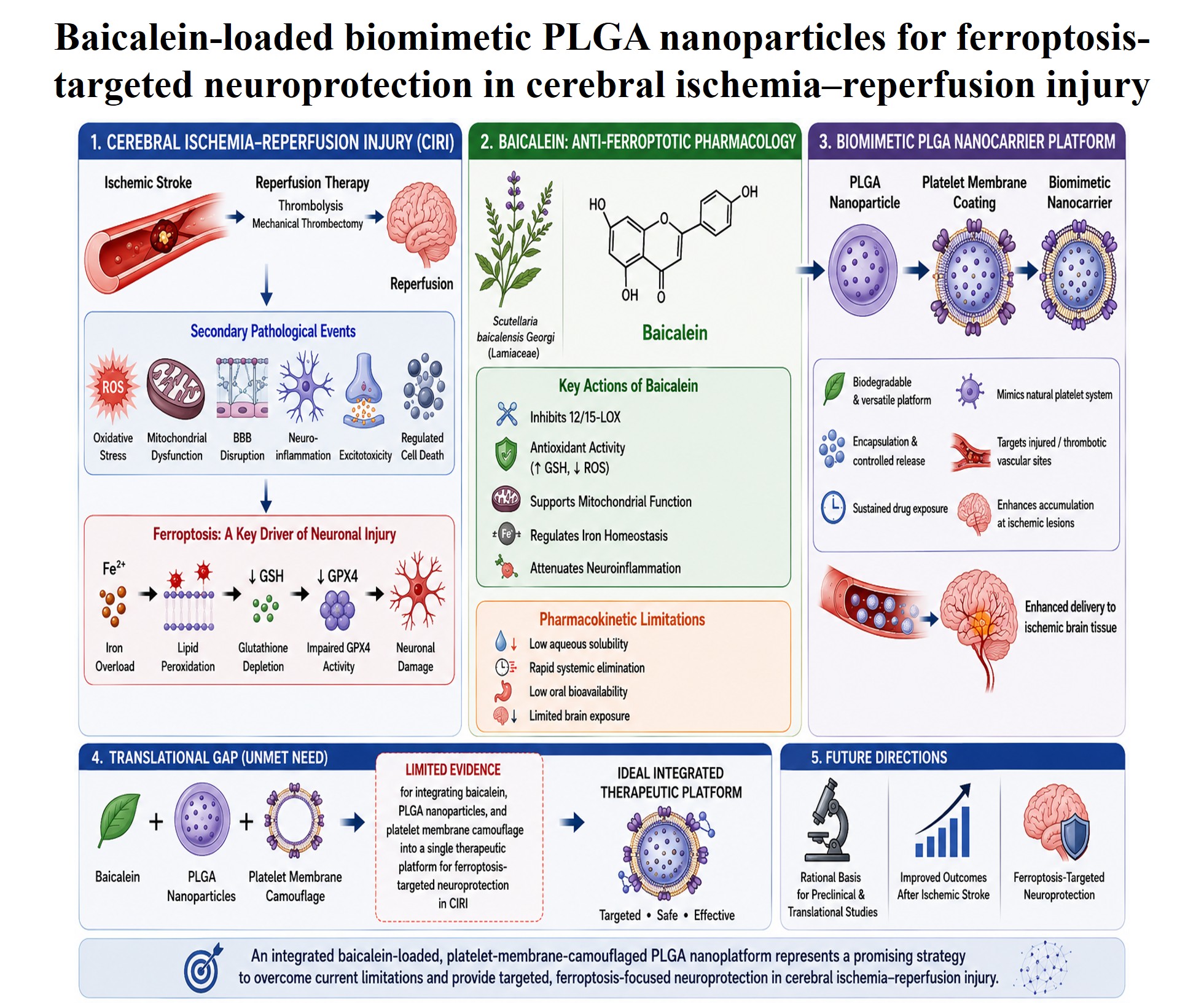
Cerebral ischemia–reperfusion injury (CIRI) contributes to secondary neurological injury following ischemic stroke, with ferroptosis increasingly recognized as an important mechanism involving iron dysregulation, lipid peroxidation, impaired glutathione-dependent antioxidant defenses, and mitochondrial dysfunction. This review summarizes the molecular mechanisms of ferroptosis in CIRI, evaluates evidence regarding baicalein, a bioactive flavonoid from Scutellaria baicalensis Georgi, and examines biomimetic nanocarrier strategies for ischemic stroke. A structured literature search was conducted in PubMed, Scopus, and Web of Science for publications from January 2015 to January 2026, focusing on CIRI and ferroptosis; baicalein and cerebral ischemia/neuroprotection; baicalein and ferroptosis; and poly(lactic-co-glycolic acid) (PLGA)-based and biomimetic nanocarrier strategies. The literature indicates that ferroptosis is closely associated with oxidative stress, iron dysregulation, impaired antioxidant defense, lipid peroxidation, mitochondrial dysfunction, and neuroinflammation in CIRI. Experimental evidence suggests that baicalein may modulate ferroptosis-related pathways, including those involving glutathione peroxidase 4 (GPX4) and acyl-CoA synthetase long-chain family member 4 (ACSL4), while also influencing oxidative and inflammatory responses. PLGA-based and biomimetic nanocarriers may improve the delivery of neuroprotective compounds, and platelet membrane camouflage may provide additional biomimetic properties relevant to targeted delivery. However, direct evidence integrating baicalein, PLGA-based delivery, and platelet membrane camouflage into a single ferroptosis-targeted platform for CIRI remains limited. This proposed integration represents a hypothesis-driven direction for future preclinical research. Further studies are needed to establish mechanistic validity, optimize delivery characteristics, evaluate pharmacokinetics and biosafety, and determine therapeutic efficacy in clinically relevant models.
- Tuo QZ, Lei P. Ferroptosis in ischemic stroke: Animal models and mechanisms. Zool Res. 2024;45(6):1235–1248. doi: 10.24272/j.issn.2095-8137.2024.239
- She R, Liu D, Liao J, Wang G, Ge J, Mei Z. Mitochondrial dysfunctions induce PANoptosis and ferroptosis in cerebral ischemia/reperfusion injury: from pathology to therapeutic potential. Front Cell Neurosci. 2023;17:1191629. doi: 10.3389/fncel.2023.1191629
- Li M, Meng Z, Yu S, et al. Baicalein ameliorates cerebral ischemia-reperfusion injury by inhibiting ferroptosis via regulating GPX4/ACSL4/ACSL3 axis. Chem Biol Interact. 2022;366:110137. doi: 10.1016/j.cbi.2022.110137
- Ye Z, Zhang F, Wang P, et al. Baicalein relieves brain injury via inhibiting ferroptosis and endoplasmic reticulum stress in a rat model of cardiac arrest. Shock. 2023;59(3):434–441. doi: 10.1097/SHK.0000000000002058
- Su Y, Huang B, Liu D, Yu L, Chen Y. Cell‐Membrane‐Camouflaged Biomimetic Nanomedicines for Cerebral Ischemia‐Reperfusion Injury Treatment. Adv Healthc Mater. 2026;15(4):e02936. doi: 10.1002/adhm.202502936
- Shi C, Li T, Zhang B. Platelet Membrane-Camouflaged Biomimetic Drug Delivery Systems for Ischemia-Reperfusion Injury: Targeted Therapeutic Strategies. Physiol Res. 2025;74(4):551–562. doi: 10.33549/physiolres.935585
- Long Z, Zhu Y, Zhao H, Liao S, Liu C. Ferroptosis in ischemic stroke: mechanisms, pathological implications, and therapeutic strategies. Front Neurosci. 2025;19:1623485. doi: 10.3389/fnins.2025.1623485
- Bi X, He M, Cao W, et al. Molecularly self-assembled nanoplatforms for targeted ROS-scavenging and neuroinflammation alleviation in acute ischemic stroke. Materials Today Bio. 2026;38:103247. doi: 10.1016/j.mtbio.2026.103247
- He Y, Qu M, Yu L, et al. Nanomaterial-based drug delivery systems for ischemic stroke: from blood-brain barrier crossing to neuroprotection. Int J Nanomedicine. 2026;21:588499. doi: 10.2147/IJN.S588499
- Yuan Y, Men W, Shan X, et al. Baicalein exerts neuroprotective effect against ischaemic/reperfusion injury via alteration of NF-κB and LOX and AMPK/Nrf2 pathway. Inflammopharmacology. 2020;28(5):1327–1341. doi: 10.1007/s10787-020-00714-6
- Xie Y, Song X, Sun X, et al. Identification of baicalein as a ferroptosis inhibitor by natural product library screening. Biochem Biophys Res Commun. 2016;473(4):775–780. doi: 10.1016/j.bbrc.2016.03.052
- Wang P, Di X, Li F, et al. Platelet membrane-coated HGF-PLGA nanoparticles promote therapeutic angiogenesis and tissue perfusion recovery in ischemic hindlimbs. ACS Appl Bio Mater. 2025;8(1):399–409. doi: 10.1021/acsabm.4c01373
- Li X, Li S, Ma C, Li T, Yang L. Preparation of baicalin-loaded ligand-modified nanoparticles for nose-to-brain delivery for neuroprotection in cerebral ischemia. Drug Deliv. 2022;29(1):1282–1298. doi: 10.1080/10717544.2022.2064564
- Wu Y, Feng H, Gao L, et al. Functionalized biomimetic nanoparticles are delivered from the nose to the brain for the synergistic targeted treatment of cerebral ischemia/reperfusion injury. Regen Biomater. 2025;12:rbaf063. doi: 10.1093/rb/rbaf063
- Page MJ, McKenzie JE, Bossuyt PM, et al. Updating guidance for reporting systematic reviews: development of the PRISMA 2020 statement. J Clin Epidemiol. 2021;134:103–112. doi: 10.1016/j.jclinepi.2021.02.003
- van Leyen K, Kim HY, Lee SR, Jin G, Arai K, Lo EH. Baicalein and 12/15-lipoxygenase in the ischemic brain. Stroke. 2006;37(12):3014-3018. doi: 10.1161/01.STR.0000249004.25444.a5
- Hoyos-Ceballos GP, Ruozi B, Ottonelli I, et al. PLGA-PEG-ANG-2 Nanoparticles for Blood-Brain Barrier Crossing: Proof-of-Concept Study. Pharmaceutics. 2020;12(1):72. doi: 10.3390/pharmaceutics12010072
- Liu Z, Xia Q, Ma D, et al. Biomimetic nanoparticles in ischemic stroke therapy. Discov Nano. 2023;18(1):40. doi: 10.1186/s11671-023-03824-6
- Zhang M, Liu Q, Meng H, et al. Ischemia-reperfusion injury: molecular mechanisms and therapeutic targets. Signal Transduct Target Ther. 2024;9(1):12. doi: 10.1038/s41392-023-01688-x
- Guo S, Liu R, Cheng S, Liu X, Wu J. Mechanisms and Therapeutic Targets of Ischemia–Reperfusion Injury in Stroke: A Narrative Review Focusing on Blood–Brain Barrier Dysfunction. Brain Sci. 2026;16(5):469. doi: 10.3390/brainsci16050469
- Kumar Saini S, Singh D. Mitochondrial mechanisms in cerebral ischemia-reperfusion injury: Unravelling the intricacies. Mitochondrion. 2024;77:101883. doi: 10.1016/j.mito.2024.101883
- Shadman J, Haghi-Aminjan H, Alipour MR, Panahpour H. The neuroprotective mechanisms of kaempferol in experimental ischemic stroke: a preclinical systematic review. Mol Neurobiol. 2025;62(8):9527-9544. doi: 10.1007/s12035-025-04848-y
- Zhou Y, Luo B, Shang T, Wei Z, Zou W. Cerebral ischemia-reperfusion injury: unraveling the mitophagy-oxidative stress axis for neuroprotective strategies. Int J Mol Sci. 2026;27(5):2448. doi: 10.3390/ijms27052448
- Fang S, Huang W, Qu X, Chai W. The mitochondria as a potential therapeutic target in cerebral I/R injury. Front Neurosci. 2025;18:1500647. doi: 10.3389/fnins.2024.1500647
- Duan M, Xu Y, Li Y, Feng H, Chen Y. Targeting brain-peripheral immune responses for secondary brain injury after ischemic and hemorrhagic stroke. J Neuroinflammation. 2024;21(1):102. doi: 10.1186/s12974-024-03101-y
- Zhang Y, Yang H, Hou S, Xia Y, Wang YQ. Influence of the brain-gut axis on neuroinflammation in cerebral ischemia-reperfusion injury. Int J Mol Med. 2024;53(3):30. doi: 10.3892/ijmm.2024.5354
- Tian X, Li X, Pan M, Yang LZ, Li Y, Fang W. Progress of Ferroptosis in Ischemic Stroke and Therapeutic Targets. Cell Mol Neurobiol. 2024;44(1):25. doi: 10.1007/s10571-024-01457-6
- Chai Z, Zheng J, Shen J. Mechanism of ferroptosis regulating ischemic stroke and pharmacologically inhibiting ferroptosis in treatment of ischemic stroke. CNS Neurosci Ther. 2024;30(7):e14865. doi: 10.1111/cns.14865
- Sandra Monserrat BP, Carlos Alfredo SI, Rosina ST, Alejandra F, Diana BO, Perla D M. Targeting Ferroptosis and Necroptosis to Treat Stroke. Neurochem Res. 2026;51(2):135. doi: 10.1007/s11064-026-04751-5
- Gao L, Peng L, Wang J, Zhang JH, Xia Y. Mitochondrial stress: a key role of neuroinflammation in stroke. J Neuroinflammation. 2024;21(1):44. doi: 10.1186/s12974-024-03033-7
- He Y, Wang J, Ying C, et al. The interplay between ferroptosis and inflammation: therapeutic implications for cerebral ischemia-reperfusion. Front Immunol. 2024;15:1482386. doi: 10.3389/fimmu.2024.1482386
- Candelario-Jalil E, Paul S. Impact of aging and comorbidities on ischemic stroke outcomes in preclinical animal models: a translational perspective. Exp Neurol. 2021;335:113494. doi: 10.1016/j.expneurol.2020.113494
- Shi C, Xu M, Li Y, et al. Stroke-Related Animal Models: Methodologies, Applications, and Translational Perspectives. JoVE. 2026;(231). doi: 10.3791/70147
- Ruscu M, Glavan D, Surugiu R, et al. Pharmacological and stem cell therapy of stroke in animal models: Do they accurately reflect the response of humans? Exp Neurol. 2024;376:114753. doi: 10.1016/j.expneurol.2024.114753
- Singh D, Wasan H, Reeta KH. Preclinical Stroke Research and Translational Failure: A Bird’s Eye View on Preventable Variables. Cell Mol Neurobiol. 2022;42(7):2003–2017. doi: 10.1007/s10571-021-01083-6
- Hu X, Bao Y, Li M, Zhang W, Chen C. The role of ferroptosis and its mechanism in ischemic stroke. Exp Neurol. 2024;372:114630. doi: 10.1016/j.expneurol.2023.114630
- Tian L, Liu Q, Guo H, Zang H, Li Y. Fighting ischemia-reperfusion injury: focusing on mitochondria-derived ferroptosis. Mitochondrion. 2024;79:101974. doi: 10.1016/j.mito.2024.101974
- Liu C, Wang G, Han W, Tian Q, Li M. Ferroptosis: a potential therapeutic target for stroke. Neural Regen Res. 2024;19(5):988-997. doi: 10.4103/1673-5374.385284
- Shi Z, Zhang C, Xie T, et al. Molecular mechanisms and therapeutic strategies of GPX4 regulation in acute kidney injury. Pharmacol Rep. 2026;78(1):218–235. doi: 10.1007/s43440-025-00777-8
- Wei C. The role of glutathione peroxidase 4 in neuronal ferroptosis and its therapeutic potential in ischemic and hemorrhagic stroke. Brain Res Bull. 2024;217:111065. doi: 10.1016/j.brainresbull.2024.111065
- Conrad M. Ferroptosis: when metabolism meets cell death. Physiol Rev. 2024;105(2):651–706. doi: 10.1152/physrev.00031.2024
- Cao C, Tao YG, Shi Y. The role of ubiquitination in regulating ferroptosis. Prog Biochem Biophys. 2024;51(6):1269–1283. (In Chinese). doi: 10.16476/j.pibb.2023.0400
- Pang Q, Zheng L, Ren Z, et al. Mechanism of Ferroptosis and Its Relationships with Other Types of Programmed Cell Death: Insights for Potential Therapeutic Benefits in Traumatic Brain Injury. Oxid Med Cell Longev. 2022;2022:1274550. doi: 10.1155/2022/1274550
- Wang J, Lv C, Wei X, Li F. Molecular mechanisms and therapeutic strategies for ferroptosis and cuproptosis in ischemic stroke. Brain Behav Immun Health. 2024;40:100837. doi: 10.1016/j.bbih.2024.100837
- Du B, Deng Z, Chen K, et al. Iron promotes both ferroptosis and necroptosis in the early stage of reperfusion in ischemic stroke. Genes Dis. 2024;11(6):101262. doi: 10.1016/j.gendis.2024.101262
- Liu W, Liu L, Li H, et al. Targeted pathophysiological treatment of ischemic stroke using nanoparticle-based drug delivery system. J Nanobiotechnology. 2024;22(1):499. doi: 10.1186/s12951-024-02772-2
- Peng B, Mohammed FS, Tang X, Liu J, Sheth KN, Zhou J. Nanotechnology approaches to drug delivery for the treatment of ischemic stroke. Bioact Mater. 2025;43:145-161. doi: 10.1016/j.bioactmat.2024.09.016
- Zhang W, Liu Y, Liao Y, Zhu C, Zou Z. GPX4, ferroptosis, and diseases. Biomed Pharmacother. 2024;174:116512. doi: 10.1016/j.biopha.2024.116512
- Liu Y, Lu S, Wu LL, Yang L, Yang L, Wang J. The diversified role of mitochondria in ferroptosis in cancer. Cell Death Dis. 2023;14(8):519. doi: 10.1038/s41419-023-06045-y
- Battaglia AM, Chirillo R, Aversa I, Sacco A, Costanzo F, Biamonte F. Ferroptosis and cancer: mitochondria meet the “iron maiden” cell death. Cells. 2020;9(6):1505. doi: 10.3390/cells9061505
- Otasevic V, Vucetic M, Grigorov I, Martinovic V, Stancic A. Ferroptosis in different pathological contexts seen through the eyes of mitochondria. Oxid Med Cell Longev. 2021;2021:5537330. doi: 10.1155/2021/5537330
- Bucarey JL, Casas M, Espinosa A. Mitochondrial iron handling and lipid peroxidation as drivers of ferroptosis. Int J Mol Sci. 2026;27(5):2232. doi: 10.3390/ijms27052232
- Strazdauskas A, Trumbeckaite S, Jakstas V, Kamarauskaite J, Ivanauskas L, Baniene R. Ischemia in vivo induces cardiolipin oxidation in rat kidney mitochondria. Biology (Basel). 2022;11(4):541. doi: 10.3390/biology11040541
- Díaz-Quintana A, Pérez-Mejías G, Guerra-Castellano A, De la Rosa MA, Díaz-Moreno I. Wheel and deal in the mitochondrial inner membranes: the tale of cytochrome c and cardiolipin. Oxid Med Cell Longev. 2020;2020:6813405. doi: 10.1155/2020/6813405
- Basak B, Holzbaur ELF. Mitophagy in neurons: mechanisms regulating mitochondrial turnover and neuronal homeostasis. J Mol Biol. 2025;437(18):169161. doi: 10.1016/j.jmb.2025.169161
- Zhong R, Yang H, Li X, Wang F, Zhai L, Gao J. Mitochondria-Mediated Mechanisms of Ferroptosis in Neurological Diseases. Neurochem Res. 2025;50(6):354. doi: 10.1007/s11064-025-04605-6
- Marmolejo-Garza A, Krabbendam IE, Luu MDA, et al. Negative modulation of mitochondrial calcium uniporter complex protects neurons against ferroptosis. Cell Death Dis. 2023;14(11):772. doi: 10.1038/s41419-023-06290-1
- Oppermann S, Mertins B, Meissner L, et al. Interaction between BID and VDAC1 is required for mitochondrial demise and cell death in neurons. Preprint. Posted online September 14, 2021. bioRxiv. doi: 10.1101/2021.09.14.460262
- Zhou X, Tang X, Li T, et al. Inhibition of VDAC1 Rescues Aβ1-42-Induced Mitochondrial Dysfunction and Ferroptosis via Activation of AMPK and Wnt/β-Catenin Pathways. Mediators Inflamm. 2023;2023(1):6739691. doi: 10.1155/2023/6739691
- Teferi N, Challa M, Woodiwiss T, Allen B, Petronek M. Mitochondrial dysfunction, iron accumulation, and ferroptosis in Parkinson’s disease. Redox Exp Med. 2023;2023(1):e230004. doi: 10.1530/REM-23-0004
- Fang XL, Ding SY, Du XZ, Wang JH, Li XL. Ferroptosis—a novel mechanism with multifaceted actions on stroke. Front Neurol. 2022;13:881809. doi: 10.3389/fneur.2022.881809
- Gowtham A, Chauhan C, Rahi V, Kaundal RK. An update on the role of ferroptosis in ischemic stroke: from molecular pathways to neuroprotection. Expert Opin Ther Targets. 2024;28(12):1149–1175. doi: 10.1080/14728222.2024.2446319
- Tohid MD, Singh S, Kumar H, Singh T. GPX4 ferroptosis, rheumatoid arthritis, lipid peroxidation, biomarkers, iron metabolism, Therapeutics. Pan-African J Health Psychol Sci. 2026;2(2). doi: 10.64261/4jcc2h05
- Yi Y, Zhu X, Jia P, Cai W, Liu L. Nature’s answer to ferroptosis: how bioactive compounds rewire oxidative stress circuits in cerebral ischemia. Int Immunopharmacol. 2025;163:115250. doi: 10.1016/j.intimp.2025.115250
- Zhang J, Li S, Huang L, Jiang X. Polyphenolic metabolites in Scutellaria baicalensis as potential candidate agents for the treatment of ischemic stroke. Front Pharmacol. 2025;16:1700164. doi: 10.3389/fphar.2025.1700164
- Yuan D, Xu W, Raza F, et al. Baicalein Long-Circulating Liposomes Improve Histological and Functional Outcomes After Traumatic Brain Injury. Adv Pharmacol Pharm Sci. 2024;2024(1):2869332. doi: 10.1155/adpp/2869332
- Tajbakhsh A, Hosseinpour-Soleimani F, Abedi M, Hashempur MH, Negahdaripour M. Modulation of neuroinflammation in poststroke rehabilitation: the role of 12/15-lipoxygenase inhibition and baicalein. Stroke. 2025;56(4):1092-1103. doi: 10.1161/STROKEAHA.124.049048
- Karatas H, Cakir-Aktas C. 12/15 lipoxygenase as a therapeutic target in brain disorders. Noro Psikiyatr Ars. 2019;56(4):288-291. doi: 10.29399/npa.23646
- Wang X, Shao Q, Gao Y. The emerging role of 12/15-lipoxygenase in ischemic stroke. Brain Res Bull. 2025;221:111194. doi: 10.1016/j.brainresbull.2025.111194
- He P, Qiao R, Liu C, Zhang W, Li H, He F. Neuroprotective mechanisms of baicalin in ischemia stroke. ACS Chem Neurosci. 2025;16(11):1978-1995. doi: 10.1021/acschemneuro.4c00842
- Song C, Tang S, Huang Y, Xie G, Tang J. Targeting Ferroptosis for Cerebral Neuroprotection in Ischemic Stroke: Pathophysiological Insights. Int J Gen Med. 2026;19:605531. doi: 10.2147/ijgm.s605531
- Fang C, Liu X, Zhang F, Song T. Baicalein inhibits cerebral ischemia-reperfusion injury through SIRT6-mediated FOXA2 deacetylation to promote SLC7A11 expression. eNeuro. 2024;11(10):ENEURO.0174-24.2024. doi: 10.1523/ENEURO.0174-24.2024
- Pan L, Cho KS, Yi I, To CH, Chen DF, Do CW. Baicalein, baicalin, and wogonin: protective effects against ischemia-induced neurodegeneration in the brain and retina. Oxid Med Cell Longev. 2021;2021:8377362. doi: 10.1155/2021/8377362
- Nakadate K, Ito N, Kawakami K, Yamazaki N. Anti-inflammatory actions of plant-derived compounds and prevention of chronic diseases: from molecular mechanisms to applications. Int J Mol Sci. 2025;26(11):5206. doi: 10.3390/ijms26115206
- Xiang Y, Long Y, Yang Q, et al. Pharmacokinetics, pharmacodynamics and toxicity of baicalin liposome on cerebral ischemia reperfusion injury rats via intranasal administration. Brain Res. 2020;1726:146503. doi: 10.1016/j.brainres.2019.146503
- Huang Q, Zhang H, Chen S, Wang Y, Zhou J. Ferroptosis in central nervous system injuries: molecular mechanisms, diagnostic approaches, and therapeutic strategies. Front Cell Neurosci. 2025;19:1593963. doi: 10.3389/fncel.2025.1593963
- Wang T, Zeng J, Zhang J, Sun X, Jiang C. Ferroptosis in neurovascular unit of ischemic stroke: multidimensional regulatory mechanisms and targeted interventions. Front Biosci (Landmark Ed). 2025;30(11):40737. doi: 10.31083/FBL40737
- Yang M, Liu B, Chen B, Shen Y, Liu G. Cerebral ischemia-reperfusion injury: mechanisms and promising therapies. Front Pharmacol. 2025;16:1613464. doi: 10.3389/fphar.2025.1613464
- Song C, Liu Z, Tang J, Huang Y. Ferroptosis in cerebral ischemia/reperfusion injury: mechanistic drivers and therapeutic frontiers. Neuropsychiatr Dis Treat. 2026;22:580170. doi: 10.2147/NDT.S580170
- Ashok A, Andrabi SS, Mansoor S, Kuang Y, Kwon BK, Labhasetwar V. Antioxidant therapy in oxidative stress-induced neurodegenerative diseases: role of nanoparticle-based drug delivery systems in clinical translation. Antioxidants (Basel). 2022;11(2):408. doi: 10.3390/antiox11020408
- Zielińska A, Szalata M, Gorczyński A, et al. Cancer nanopharmaceuticals: physicochemical characterization and in vitro/in vivo applications. Cancers (Basel). 2021;13(8):1896. doi: 10.3390/cancers13081896
- Singh S, Singha P. Effect of modifications in poly(lactide-co-glycolide) (PLGA) on drug release and degradation characteristics: a mini review. Curr Drug Deliv. 2021;18(10):1378-1390. doi: 10.2174/1567201818666210510165938
- Chavan YR, Tambe SM, Jain DD, Khairnar SV, Amin PD. Redefining the importance of polylactide-co-glycolide acid (PLGA) in drug delivery. Annales Pharmaceutiques Françaises. 2022;80(5):603-616. doi: 10.1016/j.pharma.2021.11.009
- Narmani A, Jahedi R, Bakhshian-Dehkordi E, et al. Biomedical applications of PLGA nanoparticles in nanomedicine: advances in drug delivery systems and cancer therapy. Expert Opin Drug Deliv. 2023;20(7):937-954. doi: 10.1080/17425247.2023.2223941
- Swider E, Koshkina O, Tel J, Cruz LJ, de Vries IJM, Srinivas M. Customizing poly(lactic-co-glycolic acid) particles for biomedical applications. Acta Biomater. 2018;73:38-51. doi: 10.1016/j.actbio.2018.04.006
- Duan WL, Wang XJ, Ma YP, et al. Therapeutic strategies targeting the NLRP3-mediated inflammatory response and pyroptosis in cerebral ischemia/reperfusion injury (Review). Mol Med Rep. 2024;29(3):46. doi: 10.3892/mmr.2024.13170
- Sharma N, Chauhan V, Singh S, et al. A spotlight on PLGA-based nanoparticles: pioneering a new era in the therapeutics of cardiovascular disorders. Curr Pharm Des. 2025;31(41):3267-3284. doi: 10.2174/0113816128361869250409171305
- Chhetri P. PLGA-Based nanocarriers in drug delivery: Advances in block copolymer engineering, hybrid platforms, and clinical translation. Nanomedicine: Nanotechnology, Biology and Medicine. 2026;72:102896. doi: 10.1016/j.nano.2025.102896
- Liu H, Su YY, Jiang XC, Gao JQ. Cell membrane-coated nanoparticles: a novel multifunctional biomimetic drug delivery system. Drug Deliv Transl Res. 2023;13(3):716–37. doi: 10.1007/s13346-022-01252-0
- Chen L, Hong W, Ren W, Xu T, Qian Z, He Z. Recent progress in targeted delivery vectors based on biomimetic nanoparticles. Signal Transduct Target Ther. 2021;6:225. doi: 10.1038/s41392-021-00631-2
- Wang Y, Xu J, Yan W, Zhang S, Luo C, Wang Y. Nanotechnology-donated ischemic stroke therapeutics: evolving strategies from the basic to the cutting-edge. Theranostics. 2026;16(6):3173-3205. doi: 10.7150/thno.127504
- Fu B, Chen D, Wang G, Hu H, Zhao M. Strategies for Nanomaterials to Circumvent the Mononuclear Phagocyte System. Adv Healthcare Materials. 2026;15(22):e71135. doi: 10.1002/adhm.71135
- Gheibihayat SM, Jaafari MR, Hatamipour M, Sahebkar A. Improvement of the pharmacokinetic characteristics of liposomal doxorubicin using CD47 biomimickry. J Pharm Pharmacol. 2021;73(2):169-177. doi: 10.1093/jpp/rgaa005
- Puricelli C, Boggio E, Gigliotti CL, et al. Platelets, protean cells with all-around functions and multifaceted pharmacological applications. Int J Mol Sci. 2023;24(5):4565. doi: 10.3390/ijms24054565
- He Y, Qu M, Yu L, et al. Blood–Brain Barrier: Structure, Function, Diseases, and Drug Delivery Systems. MedComm. 2026;7(4):e70712. doi: 10.1002/mco2.70712
- Li Y, Wu C, Yang R, et al. Application and development of cell membrane functionalized biomimetic nanoparticles in the treatment of acute ischemic stroke. Int J Mol Sci. 2024;25(15):8539. doi: 10.3390/ijms25158539
- Cheng F, Wang J, Sun F, et al. Membrane-camouflaged biomimetic nanoparticles for effective ischemic stroke therapeutics? A comprehensive review of the literature. Int J Nanomedicine. 2025;20:15461-15477. doi: 10.2147/IJN.S563061
- Safdar A, Wang P, Muhaymin A, Nie G, Li S. From bench to bedside: platelet biomimetic nanoparticles as a promising carriers for personalized drug delivery. J Control Release. 2024;373:128-144. doi: 10.1016/j.jconrel.2024.07.013
- Chen X, Liu Y, Zou J, et al. Cell membrane-camouflaged nanomedicines for enhanced thrombolysis and blood-brain barrier penetration in ischemic stroke therapy. Int J Pharm X. 2025;10:100404. doi: 10.1016/j.ijpx.2025.100404
- Kuriakose D, Xiao Z. Pathophysiology and treatment of stroke: present status and future perspectives. Int J Mol Sci. 2020;21(20):7609. doi: 10.3390/ijms21207609
- Hao C, Sha M, Ye Y, Wang C. Cell membrane-derived nanovehicles for targeted therapy of ischemic stroke: from construction to application. Pharmaceutics. 2024;16(1):6. doi: 10.3390/pharmaceutics16010006
- Qi M, Sun Y, Zhao Z, et al. Cell membrane-coated nanoparticles: a biomimetic strategy for effective treatment of ischemic stroke. J Drug Deliv Sci Technol. 2025;108:106966. doi: 10.1016/j.jddst.2025.106966
- Delgado-Martín S, Martínez-Ruiz A. The role of ferroptosis as a regulator of oxidative stress in the pathogenesis of ischemic stroke. FEBS Lett. 2024;598(17):2160-2173. doi: 10.1002/1873-3468.14894
- Inogés M, Arboix A, García-Eroles L, Sánchez-López MJ. Gender Predicts Differences in Acute Ischemic Cardioembolic Stroke Profile: Emphasis on Woman-Specific Clinical Data and Early Outcome—The Experience of Sagrat Cor Hospital of Barcelona Stroke Registry. Medicina. 2024;60(1):101. doi: 10.3390/medicina60010101