
Lactiplantibacillus plantarum mitigates aluminum chloride-induced neurotoxicity in Wistar rats

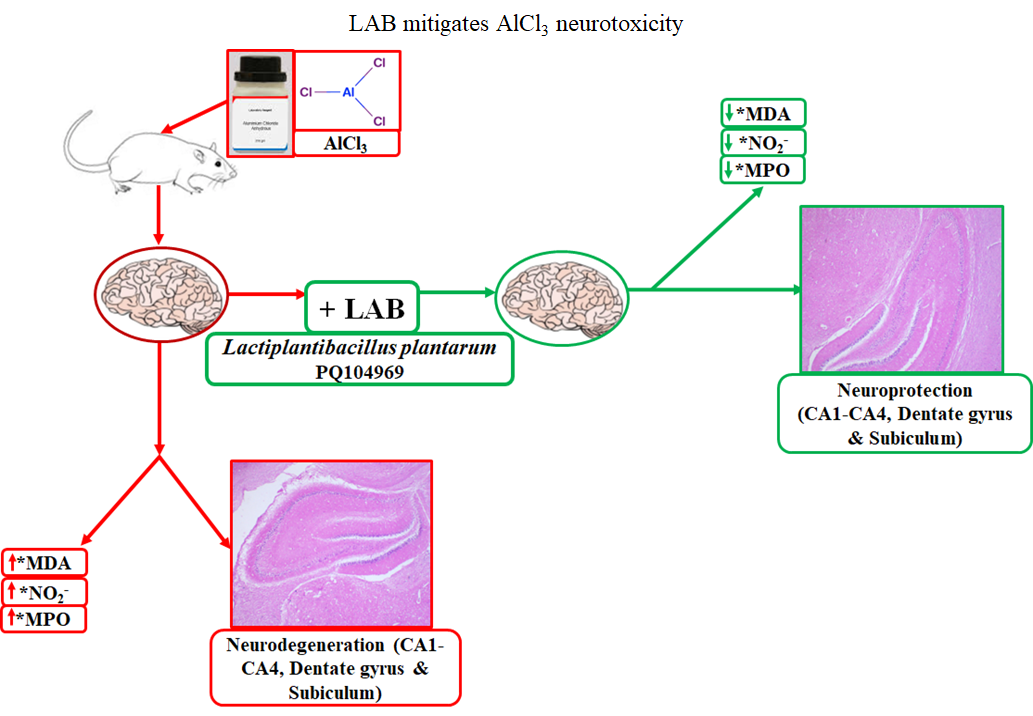
Aluminum chloride (AlCl3) has been associated with neurological disorders. This study assesses the potential neuroprotective effects of Lactiplantibacillus plantarum PQ104969 in alleviating AlCl3-induced neurotoxicity in Wistar rats, with emphasis on the hippocampus. Thirty male Wistar rats were divided into six groups (n = 5/group): Group A received normal saline (control group), Groups B and C received 0.5 and 1.0 mL, respectively, of lactic acid bacteria (LAB; L. plantarum PQ104969; 1×10⁸ CFU/mL), Group D received 200 mg/kg AlCl3 (neurotoxicity group), and Groups E and F received 200 mg/kg AlCl3 and treated with 0.5 and 1.0 mL LAB, respectively. The brain tissues of all groups were harvested after 21 days of treatment and analyzed for their malondialdehyde (MDA), myeloperoxidase (MPO), protein, nitrite, nitrate, and total protein concentration using standard biochemical methods. Tissue histology of the hippocampus was performed using hematoxylin and eosin staining techniques. AlCl3 caused extensive neurodegeneration, which improved with LAB administration. Groups E and F showed significantly lower levels of MDA, MPO, nitrite, and nitrate concentrations compared to Group D, except for the nitrate level in Group F. The total protein concentrations were consistent across all groups. Histological examination showed that AlCl3 induced neurodegenerative changes in the hippocampus, while LAB introduction following AlCl3 administration attenuated the observed pathological damages and preserved the neuronal architecture. These findings suggest that L. plantarum PQ104969 possesses negative dose-dependent neuroprotective effects against AlCl3-induced neurotoxicity, offering a promising therapeutic approach for inflammation-induced neurotoxicity.
- Shaw CA, Tomljenovic L. Aluminum in the central nervous system (CNS): Toxicity in humans and animals, vaccine adjuvants, and autoimmunity. Immunol Res. 2013;56(2-3):304-316. doi: 10.1007/s12026-013-8403-1
- Lukiw WJ, Kruck TP, Percy ME, et al. Aluminum in neurological disease - a 36 year multicenter study. J Alzheimers Dise Parkinsonism. 2019;8(6):457. doi: 10.4172/2161-0460.1000457
- Kumar V, Gill KD. Aluminium neurotoxicity: Neurobehavioural and oxidative aspects. Arch Toxicol. 2009;83(11):965-978. doi: 10.1007/s00204-009-0455-6
- Simpson DS, Oliver PL. ROS generation in microglia: Understanding oxidative stress and inflammation in neurodegenerative disease. Antioxidants (Basel). 2020;9(8):743. doi: 10.3390/antiox9080743
- Bondy SC. Prolonged exposure to low levels of aluminium leads to changes associated with brain aging and neurodegeneration. Toxicology. 2014;315:1-7. doi: 10.1016/j.tox.2013.10.008
- Maksoud HA, Said AM, Abdeldaiem MA, Hassan MA. Aluminium chloride induced inflammatory process in rat’s brain. Scholars Int J Biochem. 2020;3(10):1-4. doi: 10.36348/sijb.2020.v03i10.00X
- Zhu X, Hao W, Liu Z, et al. Aluminium induces neuroinflammation via P2X7 receptor activating NLRP3 inflammasome pathway. Ecotoxicol Environ Saf. 2023;249:114373. doi: 10.1016/j.ecoenv.2022.114373
- Huat TJ, Camats-Perna J, Newcombe EA, Valmas N, Kitazawa M, Medeiros R. Metal toxicity links to Alzheimer’s disease and neuroinflammation. J Mol Biol. 2019;431:1843-1868. doi: 10.1016/j.jmb.2019.01.018
- Cheng XJ, Gu JX, Pang YP, et al. Tacrine-hydrogen sulfide donor hybrid ameliorates cognitive impairment in the aluminium chloride mouse model of Alzheimer’s disease. ACS Chem Neurosci. 2019;10(8):3500-3509. doi: 10.1021/acschemneuro.9b00120
- Antonelli M, Kushner I. It’s time to redefine inflammation. FASEB J. 2017;31(5):1787-1791. doi: 10.1096/fj.201601326R
- Mariotti A. A primer on inflammation. Compend Contin Educ Dent. 2004;25(7):7-15.
- Cavaliere G, Traina G. Neuroinflammation in the brain and role of intestinal microbiota: An overview of the players. J Integr Neurosci. 2023;22(6):148. doi: 10.31083/j.jin2206148
- Heneka MT, Kummer MP, Latz E. Innate immune activation in neurodegenerative disease. Nat Rev Immunol. 2014;14(7):463-477. doi: 10.1038/nri3705
- Kwon HS, Koh SH. Neuroinflammation in neurodegenerative disorders: The roles of microglia and astrocytes. Transl Neurodegener. 2020;9:42. doi: 10.1186/s40035-020-00221-2
- Gorji A. Neuroinflammation: The pathogenic mechanism of neurological disorders. Int J Mol Sci. 2022;23(10):5744. doi: 10.3390/ijms23105744
- Hooper LV, Littman DR, Macpherson AJ. Interactions between the microbiota and the immune system. Science. 2012;336(6086):1268-1273. doi: 10.1126/science.122349
- Braniste V, Al-Asmakh M, Kowal C, et al. The gut microbiota influences blood-brain barrier permeability in mice. Sci Transl Med. 2014;6(263):158-158. doi: 10.1126/scitranslmed.3009759
- Kamsan N, Mohammad NR. The Prevalence of Lactic Acid Bacteria as Probiotic in Malaysian Fermented Food Products: A Review. Virtual. Paper Presented at Inaugural Symposium of Research and Innovation for Food; 2021. p. 54-57. Available from: https://ir.uitm.edu.my/id/eprint/57210
- Abd Mutalib N, Syed Mohamad SA, Jusril NA, Hasbullah NI, Mohd Amin MC, Ismail NH. Lactic acid bacteria (LAB) and neuroprotection, what is new? An up-to-date systematic review. Pharmaceuticals (Basel). 2023;16(5):712. doi: 10.3390/ph16050712
- Bhatia R, Sharma S, Bhadada SK, Bishnoi M, Kondepudi KK. Lactic acid bacterial supplementation ameliorated the lipopolysaccharide-induced gut inflammation and dysbiosis in mice. Front Microbiol. 2022;13:930928. doi: 10.3389/fmicb.2022.930928
- Shukla PK, Meena AS, Rao R. Prevention and mitigation of alcohol-induced neuroinflammation by Lactobacillus plantarum by an EGF receptor-dependent mechanism. Nutr Neurosci. 2022;25(4):871-883. doi: 10.1080/1028415X.2020.1819105
- Wu Y, Wang Y, Hu A, et al. Lactobacillus plantarum-derived postbiotics prevent Salmonella-induced neurological dysfunctions by modulating gut-brain axis in mice. Front Nutr. 2022;9:946096. doi: 10.3389/fnut.2022.94609
- Bamigbade BO, Oladejo BO, Omayone TP. Assessment of lactic acid bacteria treatments on some biochemical indices associated with ulcerative colitis induced in wistar rats. Niger J Microbiol. 2024;38(2):7243-7249.
- National Research Council. Guide to the Care and Use of Laboratory Animals. 8th ed.: Washington, DC: The National Academies Press; 2011. p. 246.
- Akinrinade ID, Memudu AE, Ogundele OM. Fluoride and aluminium disturb neuronal morphology, transport functions, cholinesterase, lysosomal and cell cycle activities. Pathophysiology. 2015;22(2):105-115. doi: 10.1016/j.pathophys.2015.03.001
- Ahmed GA, Khalil SK, Abbas L, et al. ATR-IR and EPR spectroscopy for detecting the alterations in cortical synaptosomes induced by aluminium stress. Spectrochim Acta Part A Mol Biomol Spectrosc. 2020;228:117535. doi: 10.1016/j.saa.2019.117535
- Chiroma SM, Moklas, MA, Taib CN, Baharuldin MT, Amon Z. D-galactose and aluminium chloride induced rat model with cognitive impairments. Biomed Pharmacother. 2018;103:1602-1608. doi: 10.1016/j.biopha.2018.04.152
- Avwioro G. Histochemical uses of haematoxylin-a review. JPCS. 2011;1(5):24-34.
- Varshney R, Kale RK. Effects of calmodulin antagonists on radiation-induced lipid peroxidation in microsomes. Int J Radiat Biol. 1990;58(5):733-743. doi: 10.1080/09553009014552121
- Adam-Vizi V, Seregi M. Receptor independent stimulatory effect of noradrenaline on Na,K-ATPase in rat brain homogenate. Role of Lipid Peroxidation. Biochem Pharmacol. 1982;31:2231-2236. doi: 10.1016/0006-2952(82)90106-x
- Ignarro LJ, Byrns RE, Buga GM, Wood KS. Endothelium-derived relaxing factor from pulmonary artery and vein possesses pharmacologic and chemical properties identical to those of nitric oxide radical. Circ Res. 1987;61(6):866-879. doi: 10.1161/01.res.61.6.866
- Granger DL, Taintor RR, Boockvar KS, Hibbs JB Jr. Measurement of nitrate and nitrite in biological samples using nitrate reductase and Griess reaction. Methods Enzymol. 1996;268:142-151. doi: 10.1016/s0076-6879(96)68016-1
- Kim Y, Yoon S, Kim SJ, Kim JS, Cheong JW, Min YH. Myeloperoxidase expression in acute myeloid leukemia helps identifying patients to benefit from transplant. Yonsei Med J. 2012;53(3):530-536. doi: 10.3349/ymj.2012.53.3.530
- Cataldo DA, Maroon M, Schrader LE, Youngs VL. Rapid colorimetric determination of nitrate in plant tissue by nitration of salicylic acid. Commun Soil Sci Plant Anal. 1975;6(1):71-80. doi: 10.1080/00103627509366547
- Gornal AC, Bardawill CJ, David MM. Determination of serum proteins by means of the biuret reaction. J Biol Chem. 1949;177(2):751-766.
- Ransohoff RM, Brown MA. Innate immunity in the central nervous system. J Clin Invest. 2012;122(4):1164-1171. doi: 10.1172/JCI58644
- Subhramanyam CS, Wang C, Hu Q, Dheen ST. Microglia-mediated neuroinflammation in neurodegenerative diseases. Semin Cell Dev Biol. 2019;94:112-120. doi: 10.1016/j.semcdb.2019.05.004
- Ransohoff RM, Cardona AE. The myeloid cells of the central nervous system parenchyma. Nature. 2010;468(7321):253-262. doi: 10.1038/nature09615
- Winiarska-Mieczan A, Kwiecień M, Jachimowicz- Rogowska K, Donaldson J, Tomaszewska E, Baranowska- Wójcik E. Anti-inflammatory, antioxidant, and neuroprotective effects of polyphenols-polyphenols as an element of diet therapy in depressive disorders. Int J Mol Sci. 2023;24(3):2258. doi: 10.3390/ijms24032258
- Walton JR. Functional impairment in aged rats chronically exposed to human range dietary aluminum equivalents. Neurotoxicology. 2009;30(2):182-193. doi: 10.1016/j.neuro.2008.11.012
- Soheili M, Alinaghipour A, Salami M. Good bacteria, oxidative stress and neurological disorders: Possible therapeutical considerations. Life Sci. 2022;301:120605. doi: 10.1016/j.lfs.2022.120605
- Hoffmann A, Pfeil J, Mueller AK, et al. MRI of iron oxide nanoparticles and myeloperoxidase activity links inflammation to brain edema in experimental cerebral malaria. Radiology. 2019;290(2):359-367. doi: 10.1148/radiol.2018181051
- Davies MJ, Hawkins CL. The role of myeloperoxidase in biomolecule modification, chronic inflammation, and disease. Antioxid Redox Signal. 2020;32(13):957-981. doi: 10.1089/ars.2020.8030
- Li B, He Y, Ma J, et al. Mild cognitive impairment has similar alterations as Alzheimer’s disease in gut microbiota. Alzheimers Dementia. 2019;15(10):1357-1366. doi: 10.1016/j.jalz.2019.07.002
- Exley C, Mamutse G, Korchazhkina O, et al. Elevated urinary excretion of aluminium and iron in multiple sclerosis. Mult Scler. 2006;12(5):533-540. doi: 10.1177/1352458506071323
- Lavasani S, Dzhambazov B, Nouri M, et al. A novel probiotic mixture exerts a therapeutic effect on experimental autoimmune encephalomyelitis mediated by IL-10- producing regulatory T cells. PLoS One. 2010;5(2):e9009. doi: 10.1371/journal.pone.0009009
- Fatima N, Tabassum A. Effect of Salvia officinalis on neuromodulating and oxidative stress status in brain of male albino Wistar rats intoxicated with aluminium. ACTA Pharma Sci. 2020;58(3):277. doi: 10.23893/1307-2080.APS.05816
- Sun W, Zhu J, Qin G, et al. Lonicera japonica polysaccharides alleviate D-galactose-induced oxidative stress and restore gut microbiota in icr mice. Int J Biol Macromol. 2023;245:125517. doi: 10.1016/j.ijbiomac.2023.125517
- Omayone TP, Ogaji IP. Methyl jasmonate ameliorates liver oxidative stress associated with acetic acid-induced ulcerative colitis in wistar rats. J Biomed Biosens. 2023;3(2):19-28. doi: 10.58613/jbb322
- Attia H, Albuhayri S, Alaraidh S, et al. Biotin, coenzyme Q10, and their combination ameliorate aluminium chloride‐induced Alzheimer’s disease via attenuating neuroinflammation and improving brain insulin signaling. J Biochem Mol Toxicol. 2020;34(9):22519. doi: 10.1002/jbt.22519
- Dey M, Singh RK. Chronic oral exposure of aluminum chloride in rat modulates molecular and functional neurotoxic markers relevant to Alzheimer’s disease. Toxicol Mech Methods. 2022;32(8):616-627. doi: 10.1080/15376516.2022.2058898
- Bondy SC. The neurotoxicity of environmental aluminium is still an issue. Neurotoxicology. 2010;31(5):575-581. doi: 10.1016/j.neuro.2010.05.009
- Exley C. Why industry propaganda and political interference cannot disguise the inevitable role played by human exposure to aluminum in neurodegenerative diseases, including Alzheimer’s disease. Front Neurol. 2014;5:212. doi: 10.3389/fneur.2014.00212
- Abd-Elghaffar SK, El-Sokkary GH, Sharkawy AA. Aluminum-induced neurotoxicity and oxidative damage in rabbits: Protective effect of melatonin. Neuroendocrinol Lett. 2005;26(5):609-616.
- Hu J, Li Y, Pakpour S, et al. Dose effects of orally administered Spirulina suspension on colonic microbiota in healthy mice. Front Cell Infect Microbiol. 2019;9:243. doi: 10.3389/fcimb.2019.00243
- Bonfili L, Cecarini V, Berardi S, et al. Microbiota modulation counteracts Alzheimer’s disease progression influencing neuronal proteolysis and gut hormones plasma levels. Sci Rep. 2017;7(1):2426. doi: 10.1038/s41598-017-02587-2
- Athari Nik Azm S, Djazayeri A, Safa M, et al. Lactobacilli and bifidobacteria ameliorate memory and learning deficits and oxidative stress in β-amyloid (1–42) injected rats. Appl Physiol Nutr Metab. 2018;43(7):718-726. doi: 10.1139/apnm-2017-0648
- Ahmed MA, El Morsy EM, Ahmed AA. Neuroprotective effects of antioxidants against aluminum-induced neurotoxicity in rats. NeuroToxicology. 2021;83:61-71. doi: 10.3390/ph15081008
- Shahani L, Rathore N, Patel T. Aluminium-induced neurotoxicity: A review. Bull Env Pharmacol Life Sci. 2020;9(3):63-71.
- Zhao Y, Dang M, Zhang W, et al. Neuroprotective effects of Syringic acid against aluminium chloride induced oxidative stress mediated neuroinflammation in rat model of Alzheimer’s disease. J Funct Foods. 2020;71:104009. doi: 10.1016/j.jff.2020.104009
- Huang HJ, Chen JL, Liao JF, et al. Lactobacillus plantarum PS128 prevents cognitive dysfunction in Alzheimer’s disease mice by modulating propionic acid levels, glycogen synthase kinase 3 beta activity, and gliosis. BMC Complement Med Ther. 2021;21(1):259. doi: 10.1186/s12906-021-03426-8
- Choi J, Hur TY, Lee KW. Neuroprotective properties of Lactobacillus plantarum in Alzheimer’s disease mouse model: Attenuation of neuroinflammation and amyloid-beta. Nutrients. 2020;12(11):3252.