
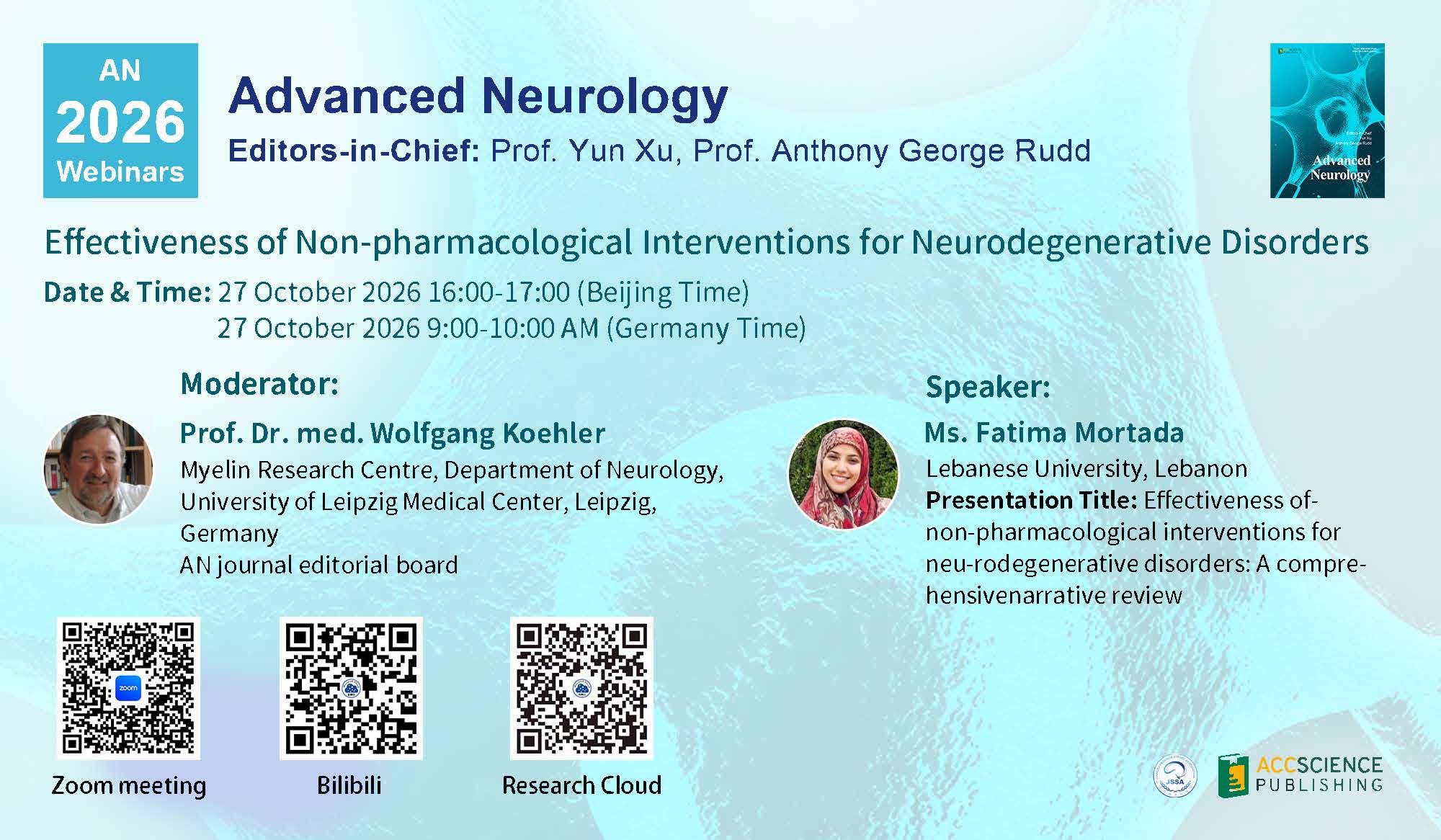
Theme: Effectiveness of Non-pharmacological Interventions for Neurodegenerative Disorders
Date & Time:
27 October 2026 16:00-17:00 (Beijing Time)
27 October 2026 9:00-10:00 AM (Germany Time)
Zoom Meeting: https://frontai-hk.zoom.us/j/97652922026?pwd=8FpZZpSnfJRhf9repax0qdKdylSkbi.1
Conference Information
- Conference Topic: Efficacy of Non-Pharmacological Interventions for Neurodegenerative Diseases
- Format: Online Seminar (Free Registration)
- Time:
- 16:00 – 17:00, 27 October 2026 (Beijing Time)
- 09:00 – 10:00 AM, 27 October 2026 (Germany Time)
- Access: Zoom Online Meeting Meeting ID: 976 5292 2026 Passcode: 407259
- Agenda
| Time | Session | Speaker |
| 16:00–16:10 | Introduction to the Journal and Speakers | Prof. Dr. med. Wolfgang Koehler |
| 16:10–16:40 | Efficacy of Non-Pharmacological Interventions for Neurodegenerative Diseases |
Prof. Dr. med. Wolfgang Koehler Ms. Fatima Mortada |
| 16:40–16:55 | Q&A Session | Ms. Fatima Mortada |
| 16:55–17:00 | Closing Remarks |
Prof. Dr. med. Wolfgang Koehler |
Seminar Background
Against the backdrop of accelerating global population ageing, the incidence of neurodegenerative diseases such as Alzheimer’s disease and Parkinson’s disease continues to rise, emerging as a major public health challenge worldwide. These diseases progressively impair patients’ cognitive and motor functions, severely compromising the quality of life among older adults, while imposing a heavy burden on family caregivers and public healthcare systems.
Current clinical practice relies primarily on symptomatic pharmacotherapy. Nevertheless, conventional treatments can only partially alleviate symptoms and fail to effectively halt or reverse the neurodegenerative process. They are also limited by notable adverse effects and narrow applicability, making long-term, systematic disease management difficult to achieve. Accordingly, safe, non-invasive, implementable and sustainable non-pharmacological intervention strategies have become a cutting-edge research focus in the prevention and control of neurodegenerative diseases and brain health.
Multiple international evidence-based studies have confirmed that diversified lifestyle interventions, including scientific dietary patterns, regular physical activity, high-quality sleep, stress regulation, cognitive training and social engagement, can effectively suppress neuroinflammation, reduce oxidative stress, improve neuroplasticity and mitigate neuronal damage. Such interventions play a pivotal role in delaying brain ageing, preventing cognitive decline and slowing disease progression, serving as an important complement to pharmacotherapy.
The core findings to be presented at this seminar originate from an authoritative international systematic review. This study comprehensively summarises the mechanisms of action and clinical efficacy of various non-pharmacological interventions, systematically compares the advantages and drawbacks of pharmacological versus non-pharmacological approaches, and precisely analyses the existing limitations and future breakthrough directions of current intervention protocols. Boasting a robust theoretical framework and sufficient evidence base, it carries high scientific value and clinical guiding significance.
Thanks to its forward-looking academic perspectives and solid research conclusions, this study has been cited in an authoritative paper by Professor Xu Yun, Editor-in-Chief of ALZHEIMERS RESEARCH & THERAPY, a Q1 top journal with an impact factor of 8.9. This fully demonstrates its high recognition and academic influence in the international field of neurology.
To align with cutting-edge international research, advance the clinical translation of non-pharmacological intervention techniques, and improve the full-cycle prevention and management system for neurodegenerative diseases, this academic seminar has invited the corresponding author of this paper to deliver a special presentation. The conference will conduct in-depth analysis of the core mechanisms, practical essentials and research trends of multimodal non-pharmacological interventions. It aims to help practitioners update diagnostic and therapeutic concepts, broaden research horizons, and further promote high-quality development of brain health and neurological rehabilitation in China.