

Insight into the bactericidal mechanisms of g-C3N4-based metal and metallic-compound junctions: A review

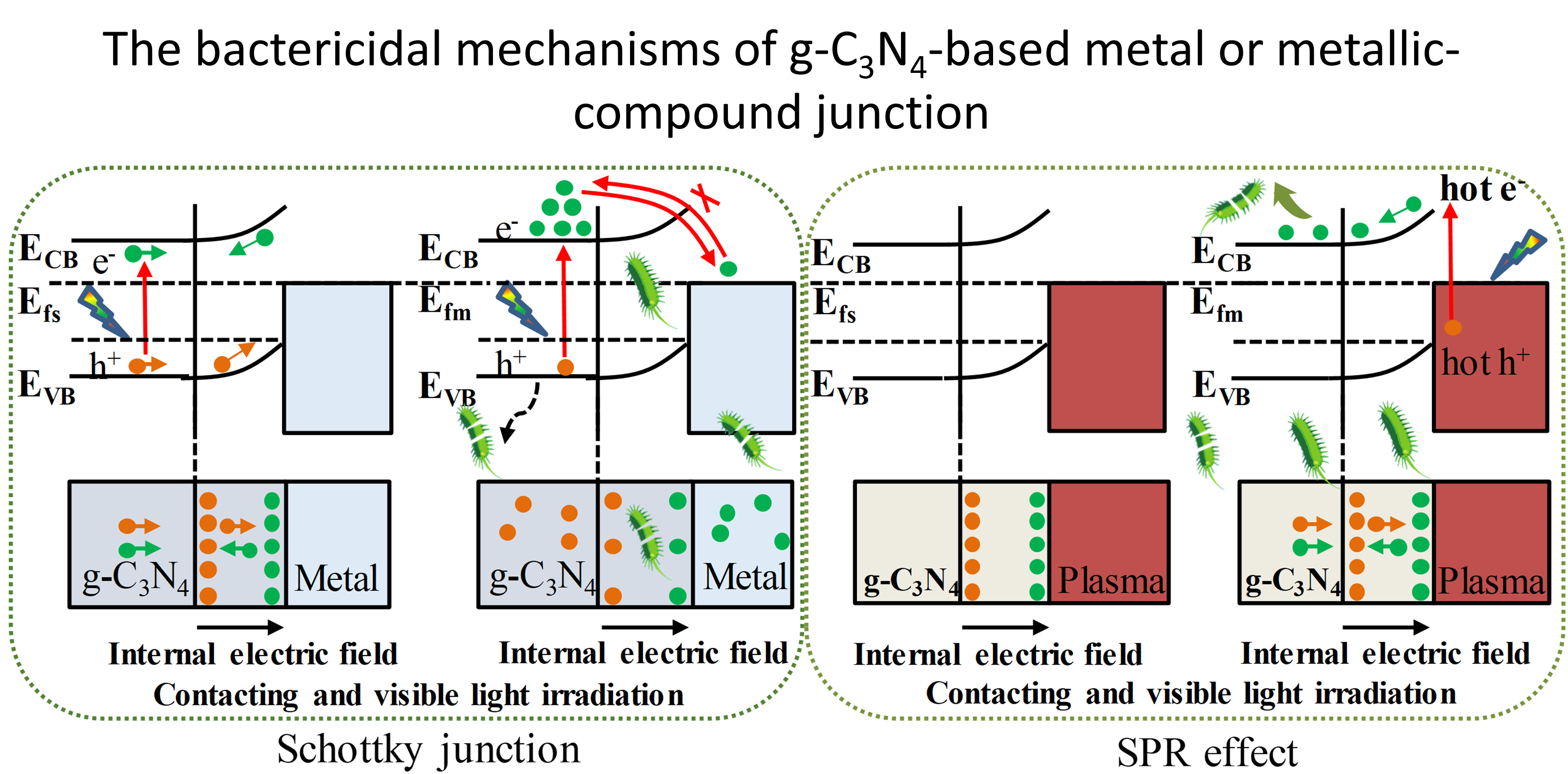
The use of sunlight to inactivate bacteria through photocatalysis is crucial for a sustainable future. Bactericidal performance is closely related to the charge dynamics of semiconductors. Among various semiconductors, graphitic carbon nitride (g-C3N4) has emerged as an attractive candidate for photocatalytic sterilization due to its chemical stability and versatility as a platform for constructing composites. However, the visible-light absorption and charge-separation performance of pristine g-C3N4 are insufficient, which limits further improvement in its bactericidal performance. Constructing g-C3N4-based metal or metallic-compound junctions has been shown to improve charge dynamics, including the introduction of plasma with surface plasmon resonance effect to photocatalysis and the construction of g-C3N4-based Schottky junctions. In this review, we first outline the basic principles of photocatalytic sterilization and then discuss the close relationship between bactericidal performance and the energy-band structure of semiconductors. We next summarize the factors limiting the performance of pristine g-C3N4, review common strategies for improving its bactericidal activity, and explain the underlying mechanisms. Finally, we discuss the remaining challenges and potential strategies to improve the practical applicability of g-C3N4-based metal and metallic-compound junctions.
- Chen H, Gao S, Huang G, Chen Q, Gao Y, Bi J. Built-in electric field mediated S-scheme charge migration in COF/ In2S3 heterojunction for boosting H2O2 photosynthesis and sterilization. Appl Catal B Environ. 2023;343:123545. doi: 10.1016/j.apcatb.2023.123545
- Matsunaga T, Tomoda R, Nakajima T, Wake H. Photoelectrochemical sterilization of microbial cells by semiconductor powders. FEMS Microbiol Lett. 1985;29(1- 2):211-214. doi: 10.1111/j.1574-6968.1985.tb00864.x
- Li R, Chen T, Pan X. Metal–organic-framework-based materials for antimicrobial applications. ACS Nano. 2021;15(3):3808-3848. doi: 10.1021/acsnano.0c09617
- Meng L, Zhao C, Zhang X, et al. Piezo-photocatalytic synergetic for H2O2 generation via dual-pathway over Z-scheme ZIF-L/g-C3N4 heterojunction. Nano Energy. 2024;128:109795. doi: 10.1016/j.nanoen.2024.109795
- Song J, Li C, Zhang X, Ma P, Zheng K. Hydrogen Peroxide Production with Photocatalysts Based on Carbon Nitride: Evaluation Criteria, Reaction Mechanism, Improvement Scheme, and Development Opportunity. ACS Catal. 2025;15(11):9058-9088. doi: 10.1021/acscatal.5c01609
- Qian X, Li W, Wang X et al. Multifunctional roles of ionic microenvironments in the preparation, modification, and application of g‐C3N4. Adv Funct Mater. 2025;35(11):2416946. doi: 10.1002/adfm.202416946
- Zhou T, Deng J, Chu Y, et al. Breaking the activity-selectivity trade-off through engineered scalable production of sulfur vacancy-rich pyrite for zero-oxidant targeted enrofloxacin removal. Appl Catal B Environ. 2025;381:125892. doi: 10.1016/j.apcatb.2025.125892
- Xiao T, Diao P. Quantifying localized surface plasmon resonance induced enhancement on metal@ Cu2O composites for photoelectrochemical water splitting. Adv Mater. 2025;37(28):2501069. doi: 10.1002/adma.202501069
- Ruan X, Ding C, Leng J et al. Decoupling of Carrier Pathways in Au/Cu‐Zn3In2S6 Through Bulk Hole Trapping and Surface Hot Electron Accumulation Enhances Photocatalytic Hydrogen Peroxide Production. Adv Mater. 2025;37(44):e11422. doi: 10.1002/adma.202511422
- Ding Y, Yang G, Zheng S et al. Advanced photocatalytic disinfection mechanisms and their challenges. J Environ Manag. 2024;366:121875. doi: 10.1016/j.jenvman.2024.121875
- Ding Y, Wang C, Pei L et al. Emerging heterostructured C 3 N 4 photocatalysts for photocatalytic environmental pollutant elimination and sterilization. Inorg Chem Front. 2023;10(13):3756-3780. doi: 10.1039/D3QI00657C
- Zeng J, Li Z, Jiang H, Wang X. Progress on photocatalytic semiconductor hybrids for bacterial inactivation. Mater Horiz. 2021;8(11):2964-3008. doi: 10.1039/D1MH00773D
- She P, Li S, Li X, Rao H, Men X, Qin JS. Photocatalytic antibacterial agents based on inorganic semiconductor nanomaterials: a review. Nanoscale. 2024;16(10):4961-4973. doi: 10.1039/D3NR06531F
- Zhang X, Zhang S, Mathivanan K et al. Research progress and prospects in antifouling performance of photocatalytic sterilization: A review. J Mater Sci Technol. 2025;208:189- 201. doi: 10.1016/j.jmst.2024.04.052
- Cong S, Zhou S, You J, Wang L, Wang X. Directionally Designed Double Z‐Scheme Heterojunction: BiOBr and Carbon Dots‐Reduced TiO2− x for Targeted Photocarriers Separation in Photocatalytic Sterilization. Small. 2025;21(37):e05905. doi: 10.1002/smll.20 2505905
- Ren X, Feng M, Mao M et al. Cyanobacteria for environmental, energy and biomedical application: a review. Environ Chem Lett. 2025;23(2):491-515. doi: 10.1007/s10311-024-01814-3
- Lu H, Zou F, Liu X, et al. Z-scheme g-C3N4/α-FOD heterojunction-assisted persulfate activation for degradation of tetracycline hydrochloride under visible light: Insights into mechanism. Chem Eng J. 2023;479:147224. doi: 10.1016/j.cej.2023.147224
- Liu X, Xiang T, Liu J, et al. AG single atoms boosting water dissociation on CU nanowires for efficient H * ‐Mediated nitrate reduction at Ultra‐Low concentrations with ammonia recovery. Adv Funct Mater. 2025;36(15). doi: 10.1002/adfm.202521402
- Wu Q, Zheng G, Li L, Wang L. Enhancing Peroxidase‐Like activity and photothermal property of Copper Single‐Atom nanozyme via a cascade competition strategy. Adv Funct Mater. 2025;35(22). doi: 10.1002/adfm.202422588
- Jiang Z, Yue Q, Guo C, Lin H. Z-scheme CuBi2O4/ carbon dots nanoflowers heterojunction to enhance solar photocatalytic sterilization. Carbon. 2025;241:120395. doi: 10.1016/j.carbon.2025.120395
- Jiang X, Hu J, Qin Y, et al. Novel dual bactericidal mechanism of TiO2 ‘solution’ during photocatalytic sterilization. Appl Surf Sci. 2025;688:162409. doi: 10.1016/j.apsusc.2025.162409
- Yang YL, Wang CY, Wang NB et al. Ohmic-junction of Ag cluster decorated BiO2-x with strong built-in electric field enables efficient photocatalytic sterilization: DFT and mechanism insights. Rare Met. 2025;44(11):8680-8690. doi: 10.1007/s12598-025-03405-9
- Qiu L, Zhang Y, Wu B, et al. State-selective engineering in luminescent metal-organic frameworks: Ligand-to-ligand charge transfer activates superior photocatalytic sterilization in Wei River. J Hazard Mater.2025;500:140448. doi: 10.1016/j.jhazmat.2025.140448
- Fan Y, Liu J, Han X. Important contributions of in-situ produced H2O2 during photocatalytic sterilization of air by self-doped Bi2.15WO6. Sep Purif Technol. 2025;363:132052. doi: 10.1016/j.seppur.2025.132052
- Ren J, Luo X, Gao J, Fang X, An X, Chen Y. Rapid preparation of porous composite hydrogels developed via an activation-induced strategy for efficient solar steam generation and photocatalytic sterilization. Sep Purif Technol. 2025;382:136152. doi: 10.1016/j.seppur.2025.136152
- Wang W, Yu Y, An T, et al. Visible-Light-Driven Photocatalytic Inactivation of E. coli K-12 by Bismuth Vanadate Nanotubes: Bactericidal Performance and Mechanism. Environ Sci Technol. 2012;46(8):4599-4606. doi: 10.1021/es2042977
- Qian G, Deng R, Liu X, et al. Achieving high carrier mobility of FE‐ZNO and CU‐ZNO laminated homo‐junction nanofilm for rapid and highly effective photocatalytic sterilization. Small. 2025;21(35):e2503536. doi: 10.1002/smll.202503536
- Sun H, Li G, Nie X, et al. Systematic approach to In-Depth understanding of photoelectrocatalytic bacterial inactivation mechanisms by tracking the decomposed building blocks. Environ Sci Technol. 2014;48(16):9412-9419. doi: 10.1021/es502471h
- Wang F, Li M, Zhang Z, et al. Dopamine-perylene diimide polymer with a donor–acceptor structure enhance interfacial electric field for improved H2O2 photosynthesis. Appl Catal B Environ. 2025;366:125057. doi: 10.1016/j.apcatb.2025.125057
- Ren X, Mao M, Feng M, Peng T, Long X, Yang F. Fate, abundance and ecological risks of microcystins in aquatic environment: The implication of microplastics. Water Res. 2024;251:121121. doi: 10.1016/j.watres.2024.121121
- Zhou X, Zhou Y, Zhao S, et al. Precise MO‐FE Dual‐Atom coordination regulates the selective generation of Non‐Free radicals in peroxymoncosulfate activation. Adv Funct Mater. 2025;36(2). doi: 10.1002/adfm.202513232
- Li Y, Zhang X, Hou W, et al. Tailoring hole-trapping heterojunctions via carbon quantum dot for efficient photocatalytic urea synthesis. Appl Catal B Environ. 2025;380:125758. doi: 10.1016/j.apcatb.2025.125758
- Sha H, Li J, Wang L, Nong H, Wang G, Zeng T. Preparation of phosphorus-modified biochar for the immobilization of heavy metals in typical lead-zinc contaminated mining soil: Performance, mechanism and microbial community. Environ Res. 2022;218:114769. doi: 10.1016/j.envres.2022.114769
- Zhao Y, Yang D, Yu C, Yan H. A review on photocatalytic CO2 reduction of g-C3N4 and g-C3N4-based photocatalysts modified by CQDs. J Environ Chem Eng. 2025;13(2):115348. doi: 10.1016/j.jece.2025.115348
- Shen C, Sun K, Yang Y, Liu C, Liu Y, Wang X. Photoreductive elimination of heavy metal ions and radionuclides by g-C3N4-based materials: A review. Sep Purif Technol. 2025;363:132023. doi: 10.1016/j.seppur.2025.132023
- Huang B, Xu K, Zhao Y et al. Review of the versatility and application potentials of g-C3N4-Based S-Scheme heterojunctions in photocatalytic antibiotic degradation. Molecules. 2025;30(6):1240. doi: 10.3390/molecules30061240
- Rao J, Cheng Z, Lv H et al. Structure design of g-C3N4 based photocatalysis and its application in water splitting: A review. Diam Relat Mater. 2025;157:112478. doi: 10.1016/j.diamond.2025.112478
- Hayat A, Sohail M, Ajmal Z, et al. Advances/Scope and prospects of g-C3N4 derived fascinating photocatalyst as a leading route towards solar energy adaption. J Clean Prod. 2024;438:140568. doi: 10.1016/j.jclepro.2024.140568
- Lu Y, Hu X, Tang L, et al. Effect of CuO/ZnO/FTO electrode properties on the performance of a photo-microbial fuel cell sensor for the detection of heavy metals. Chemosphere. 2022;302:134779. doi: 10.1016/j.chemosphere.2022.134779
- Tang R, Zeng H, Feng C et al. C‐TiO2/PCN S‐scheme heterojunction with enhanced n→ π* electronic excitation for promoted piezo‐photocatalytic effect. Small. 2023;19(18):2207636. doi: 10.1002/smll.202207636
- Li S, Wang J, Cai X, et al. From amorphous to ordered: Ammonia-mediated structural evolution in melon-based carbon nitride photocatalyst. Appl Catal B Environ. 2025;381:125807. doi: 10.1016/j.apcatb.2025.125807
- Sun J, Wang G. Achieving near infrared photodegradation by the synergistic effect of Z‐Scheme heterojunction and antenna of rare Earth single atoms. Small. 2025;21(10):e2412148. doi: 10.1002/smll.202412148
- Zhang M, Zhang Y, Tang L, et al. Ultrathin Bi2WO6 nanosheets loaded g-C3N4 quantum dots: A direct Z-scheme photocatalyst with enhanced photocatalytic activity towards degradation of organic pollutants under wide spectrum light irradiation. J Colloid Interface Sci. 2019;539:654-664. doi: 10.1016/j.jcis.2018.12.112
- Ong WJ, Tan LL, Ng YH, Yong ST, Chai SP. Graphitic carbon nitride (g-C3N4)-based photocatalysts for artificial photosynthesis and environmental remediation: are we a step closer to achieving sustainability? Chem Rev. 2016;116(12):7159-7329. doi: 10.1021/acs.chemrev.6b00075
- Mamun AA, Chowdhury AH, Billah A, et al. Advancing Transition Metal Oxide Photoelectrodes for Efficient Solar‐ Driven Hydrogen Generation: Strategies and Insights. Adv Energy Mater. 2025;15(32). doi: 10.1002/aenm.202501766
- Fu B, Pan Y, Zhao P, et al. “Edge in-situ heterogeneous” BiOI based on defect engineering and non-noble metal deposition: Boosting visible-light photocatalytic sterilization. Chem Eng J. 2024;491:152071. doi: 10.1016/j.cej.2024.152071
- Liu X, Zhou Y, Yin H, Li X, Duan J. Synergistic Application of PEC-OPECT-CL Multimodal Biosensing and Photocatalytic Sterilization Based on Hollow Tubular Bi12O17Cl2/In2O3 Z-Scheme Heterojunction for Vibrio parahaemolyticus. J Hazard Mater. 2025:140831. doi: 10.1016/j.jhazmat.2025.140831
- Tan J, Dai Z, Zhou K, Zhang L, Zhou X, Tan Y. Ultrasensitive Screening of Endocrine-Disrupting Chemicals Using a Surface Plasmon Resonance Biosensor with Polarization- Compensated Laser Heterodyne Feedback. Anal Chem. 2023;95(22):8687-8695. doi: 10.1021/acs.analchem.3c01292
- Li B, Li B, Han Y, et al. Rational design of porphyrin-based ionophores for enhanced perchlorate selectivity in ion selective electrodes: application to fireworks wastewater analysis. Energy Amp Environ Nexus 2025;1(1):0. doi: 10.48130/een-0025-0007
- Zhou C, Yu H, Yang M, Dong XT, Yang Y. CdS/BiOBr Photocatalysts Modified with Monocrystalline Cd Quantum Dots for Sterilization and Degradation of Organic Dyes and Antibiotics. ACS Appl Nano Mater. 2025;8(25):12828-12839. doi: 10.1021/acsanm.5c00732
- Zhang Y, Wang C, Yin R, et al. AgNPs as efficient co-catalysts significantly improve the photocatalytic and antibacterial activities of NaTaO3 nanofilms. Mater Sci Semicond Processing. 2023;166:107738. doi: 10.1016/j.mssp.2023.107738
- Wang F, Zhan S, Zhou F et al. In-situ synthesis of Bi0 on 3D-3D-shaped (BiO) 2CO3 surface for photocatalytic inactivation: Metal self-doping mechanism. J Environ Chem Eng. 2022;10(3):107576. doi: 10.1016/j.jece.2022.107576
- Zhang C, Song Y, He Q, Wang F, Zhan S, Zhou F. H2O2- assisted photocatalysis induced by SPR of BiQDs anchored on BiVO4 for the production of hydroxyl radicals in seawater. J Environ Chem Eng. 2021;9(5):105973. doi: 10.1016/j.jece.2021.105973
- Wang F, Zhou F, Zhan S, et al. Morphology modulation and performance optimization of nanopetal-based Ag-modified Bi2O2CO3 as an inactivating photocatalytic material. Environ Res. 2021;198:111256. doi: 10.1016/j.envres.2021.111256
- Sun L, Li W, Lv G, Wang W, Chen S. Strategy for reducing the carriers transfer antagonistic effect between heterojunction and plasmonic effect and weakening photocorrosion of Cu2O for excellent photocatalytic bacteriostasis. J Colloid Interface Sci. 2022;630(Pt A):556-572. doi: 10.1016/j.jcis.2022.10.016
- Yuan M, Xue J, Li J, Ma S, Wang M. PCN-222/Ag2O-Ag p-n heterojunction modified fabric as recyclable photocatalytic platform for boosting bacteria inactivation and organic pollutant degradation. Colloids Surf A Physicochem Eng Asp. 2022;656:130474. doi: 10.1016/j.colsurfa.2022.130474
- Xiao W, Huang Z, Tang Y, Li Y, Situ W, Song X. Effect of nano-Ag proportion on the structure of Ag– TiO2–Bi2WO6 photocatalyst and its antibacterial property on Escherichia coli. Opt Mater. 2023;137:113539. doi: 10.1016/j.optmat.2023.113539
- Qin Y, Guo Y, Liang Z, et al. Au nanorods decorated TiO2 nanobelts with enhanced full solar spectrum photocatalytic antibacterial activity and the sterilization file cabinet application. Chin Chem Lett. 2020;32(4):1523-1526. doi: 10.1016/j.cclet.2020.10.020
- Pulliam JR. Lower infection rates after introduction of a photocatalytic surface coating. Am J Infect Control. 2014;43(2):180-181. doi: 10.1016/j.ajic.2014.10.023
- Zhang M, Zhang Y, Zhang Y, et al. Synergetic utilization of 3D materials merits and unidirectional electrons transfer of Schottky junction for optimizing optical absorption and charge kinetics. Appl Catal B Environ. 2021;295:120278. doi: 10.1016/j.apcatb.2021.120278
- Li D, Wen Q, Gao C et al. Schottky Junction and D–A1– A2 System Dual Regulation of Graphite‐Phase Carbon Nitride for Piezo‐Photocatalytic H2O2 Production. Small. 2025;21(25):2500797. doi: 10.1002/smll.202500797
- Guo H, Niu HY, Wang WJ, et al. Schottky barrier height mediated Ti3C2 MXene based heterostructure for rapid photocatalytic water disinfection: Antibacterial efficiency and reaction mechanism. Sep Purif Technol. 2023;312:123412. doi: 10.1016/j.seppur.2023.123412
- Tahir B, Alraeesi A, Tahir M. Bimetallic Au–Co-assisted exfoliated g-C3N4 nanosheets with dual sites for plasmon-induced photocatalytic solar H2 production. Int J Hydrog Energy. 2025;136:1061-1072. doi: 10.1016/j.ijhydene.2025.04.304
- Bai S, Jiang J, Zhang Q, Xiong Y. Steering charge kinetics in photocatalysis: intersection of materials syntheses, characterization techniques and theoretical simulations. Chem Soc Rev. 2015;44(10):2893-939. doi: 10.1039/C5CS00064E
- He S, Huang J, Goodsell JL, Angerhofer A, Wei WD. Plasmonic Nickel–TiO2 heterostructures for visible‐light‐driven photochemical reactions. Angew Chem Int Ed. 2019;58(18):6038-6041. doi: 10.1002/anie.201901987
- Naldoni A, Guler U, Wang Z, et al. Broadband Hot‐Electron Collection for Solar Water Splitting with Plasmonic Titanium Nitride. Adv Opt Mater. 2017;5(15). doi: 10.1002/adom.201601031
- Macchia E, Di Franco C, Scandurra C, et al. Plasmonic Single‐Molecule affinity detection at 10 −20 molar. Adv Mater. 2025;37(9):e2418610. doi: 10.1002/adma.202418610
- Tong F, Liang X, Bao X, Zheng Z. Photocatalysis on hybrid plasmonic nanomaterials: From catalytic mechanism study at Single-Particle Level to materials design. ACS Catal. 2024;14(15):11425-11446. doi: 10.1021/acscatal.4c03566
- Yan T, Su M, Wang Z, Zhang J. Second near‐infrared plasmonic nanomaterials for photoacoustic imaging and photothermal therapy. Small. 2023;19(30):2300539. doi: 10.1002/smll.202300539
- Xu X, Dutta A, Khurgin J, Wei A, Shalaev VM, Boltasseva A. TiN@ TiO2 core–shell nanoparticles as plasmon‐enhanced photosensitizers: the role of hot electron Injection. Laser Photonics Rev. 2020;14(5):1900376. doi: 10.1002/lpor.202070031
- Koya AN, Zhu X, Ohannesian N et al. Nanoporous metals: From plasmonic properties to applications in enhanced spectroscopy and photocatalysis. ACS Nano. 2021;15(4):6038-6060. doi: 10.1021/acsnano.0c10945
- Wang M, Chen D, Lu J. Recent advances in the construction of structurally diverse catalysts for enhanced photocatalytic CO2 reduction. Sep Purif Technol. 2024;343:126917. doi: 10.1016/j.seppur.2024.126917
- Han C, Quan Q, Chen HM, Sun Y, Xu Y. Progressive Design of Plasmonic Metal–Semiconductor Ensemble toward Regulated Charge Flow and Improved Vis–NIR‐Driven Solar‐to‐Chemical Conversion. Small. 2017;13(14). doi: 10.1002/smll.201602947
- Zhang M, Tang L, Duan A et al. Adjusting charge kinetics of conjugated polymers via integration of LSPR effect with homojunction. Chem Eng J. 2022;452:139068. doi: 10.1016/j.cej.2022.139068
75. Zhang L, Ding N, Lou L et al. Localized surface plasmon resonance enhanced photocatalytic hydrogen evolution via Pt@ Au NRs/C3N4 nanotubes under visible‐light irradiation. Adv Funct Mater. 2019;29(3):1806774. doi: 10.1002/adfm.201806774