

Trends and hotspots in tetracycline removal research over the last 20 years: A bibliometric analysis

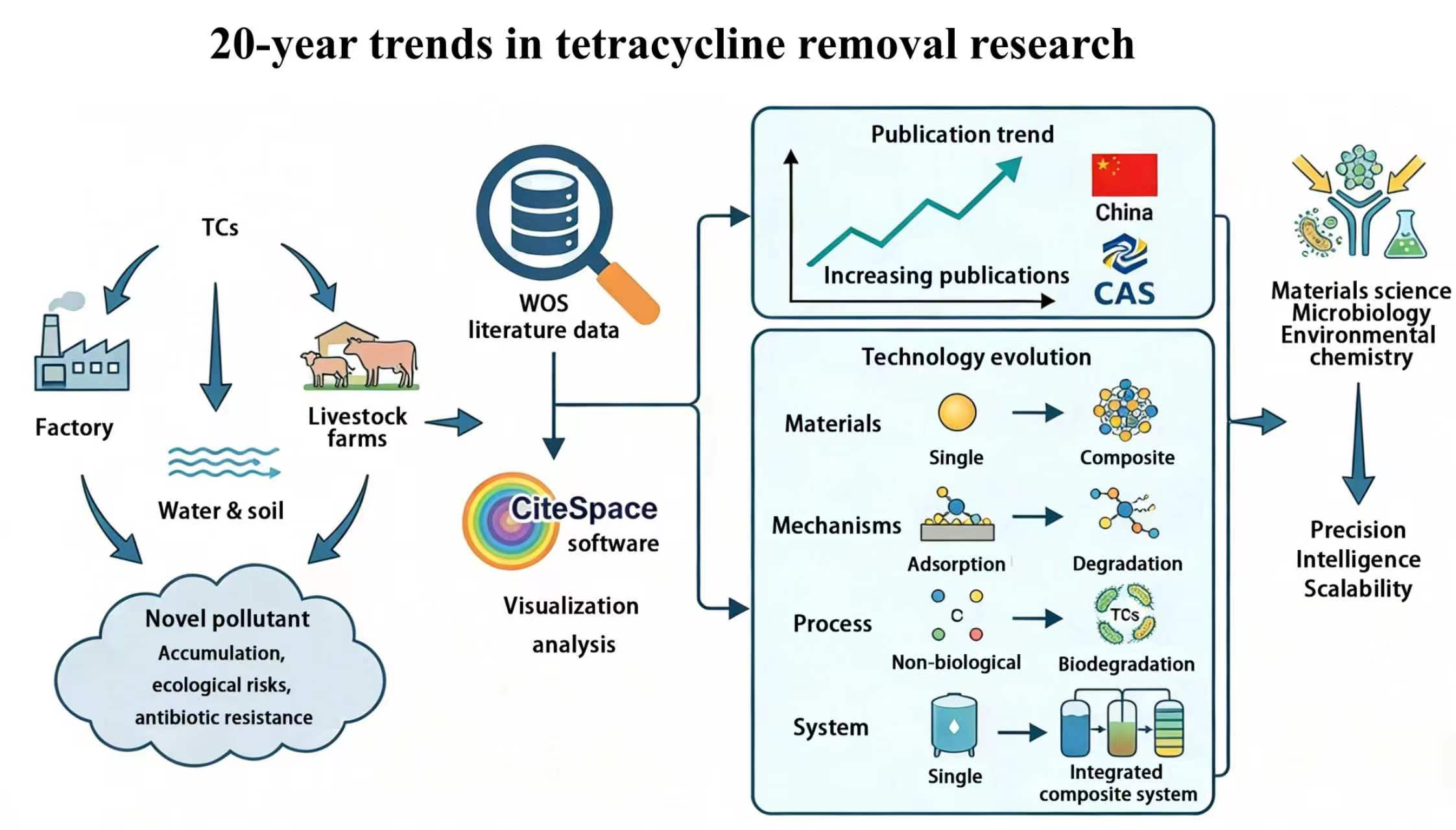
Tetracyclines are a novel pollutant that has become a significant environmental contaminant due to their widespread use and poor biodegradability, leading to their accumulation in ecosystems and posing potential hazards. Concerns over the ecological risks and antibiotic resistance associated with these antibiotics have prompted research into removal technologies. In recent years, various techniques have emerged, with both single and combined technologies demonstrating excellent performance in removing tetracyclines from different environments. This study uses the CiteSpace bibliometric software, in conjunction with literature data obtained from the Web of Science (WoS) database, to conduct a visual analysis of publication volume, author groups, publishing institutions, clustering of high-frequency keywords, and co-citation patterns in research into the removal of tetracyclines. The results demonstrated an overall upward trend in the number of publications from 2004 to 2024. China leads in publication volume, with the Chinese Academy of Sciences dominating the top 10 institutions in the WoS rankings. Keyword co-occurrence network analysis and literature co-citation analysis revealed an evolution of removal technologies from single materials to composite materials, from simple adsorption to functionalized degradation, from non-biological removal to biodegradation, and from single technologies to integrated composite systems. Looking ahead, as materials science, microbiology, environmental chemistry, and other disciplines continue to converge, tetracycline removal technologies are poised to advance toward precision, intelligence, and scalability. This evolution will provide stronger support for addressing tetracycline pollution worldwide.
- Granados-Chinchilla F, Rodríguez C. Tetracyclines in food and feedingstuffs: From regulation to analytical methods, bacterial resistance, and environmental and health implications. J Anal Methods Chem. 2017;2017:1315497. doi: 10.1155/2017/1315497
- Vinayagam R, Varadavenkatesan T, Selvaraj R. Tetracycline adsorption research (2015–2025): A bibliometric analysis of trends, challenges, and future directions. Results Eng. 2025;27:106383. doi: 10.1016/j.rineng.2025.106383
- Ghadami F, Valian M, Atoof F, et al. Response surface methodology for optimization of operational parameters to remove tetracycline from contaminated water by new magnetic Ho2MoO6/Fe2O3 nano adsorbent. Results Eng. 2024;21:101746. doi: 10.1016/j.rineng.2023.101746
- Ahmadijokani F, Molavi H, Tajahmadi S, et al. Coordination chemistry of metal–organic frameworks: Detection, adsorption, and photodegradation of tetracycline antibiotics and beyond. Coord Chem Rev. 2022;464:214562. doi: 10.1016/j.ccr.2022.214562
- Wei YH, Li MX, Xiong YS, et al. Rose-inspired salt-responsive hierarchical microbead via in-situ growth of layered double hydroxide plates onto rosin-derived resin for efficient tetracycline removal: Ingenious design, advanced molecular simulations, and rethinking adsorption mass transfer. Sep Purif Technol. 2025;363:131952. doi: 10.1016/j.seppur.2025.131952
- Balakrishnan A, Chinthala M, Polagani RK, Vo DVN. Removal of tetracycline from wastewater using g-C3N4 based photocatalysts: A review. Environ Res. 2023;216:114660. doi: 10.1016/j.envres.2022.114660
- Xu L, Zhang H, Xiong P, Zhu Q, Liao C, Jiang G. Occurrence, fate, and risk assessment of typical tetracycline antibiotics in the aquatic environment: A review. Sci Total Environ. 2021;753:141975. doi: 10.1016/j.scitotenv.2020.141975
- Zhou LJ, Wang WX, Lv YJ, Mao ZG, Chen C, Wu QL. Tissue concentrations, trophic transfer and human risks of antibiotics in freshwater food web in Lake Taihu, China. Ecotoxicol Environ Saf. 2020;197:110626. doi: 10.1016/j.ecoenv.2020.110626
- Shang AH, Ye J, Chen DH, et al. Physiological effects of tetracycline antibiotic pollutants on non-target aquatic Microcystis aeruginosa. J Environ Sci Health B. 2015;50(11):809-818. doi: 10.1080/03601234.2015.1058100
- Xia C, Huang H, Liang D, et al. Adsorption of tetracycline hydrochloride on layered double hydroxide loaded carbon nanotubes and site energy distribution analysis. Chem Eng J. 2022;443:136398. doi: 10.1016/j.cej.2022.136398
- Ivantsova NA, Kuzin EN, Kuznetsov VV, et al. Advanced electrochemical treatment of tetracycline-contaminated water using Pt/Ti electrodes. RSC Adv. 2025;15(27):21785-21793. doi: 10.1039/d5ra02632f
- Kabanov MA, Ivantsova NA, Kuzin EN, Murzina ED, Korobov AY. Evaluation of the influence of drug complex formation on the efficiency of water conditioning with reagents for tetracycline. Pharm Chem J. 2022;55(11):1245-1249. doi: 10.1007/s11094-022-02565-7
- Chen F, Yang Q, Li X, et al. Hierarchical assembly of graphene-bridged Ag3PO4/Ag/BiVO4 (040) Z-scheme photocatalyst: An efficient, sustainable and heterogeneous catalyst with enhanced visible-light photoactivity towards tetracycline degradation under visible light irradiation. Appl Catal B: Environ. 2017;200:330-342. doi: 10.1016/j.apcatb.2016.07.021
- Yin K, Wang J, Tian X, et al. Effect of biochar-derived dissolved organic matter on tetracycline sorption by KMnO4-modified biochar. Chem Eng J. 2023;474:145872. doi: 10.1016/j.cej.2023.145872
- Li Z, Wang M, Jin C, et al. Synthesis of novel Co3O4 hierarchical porous nanosheets via corn stem and MOF-Co templates for efficient oxytetracycline degradation by peroxymonosulfate activation. Chem Eng J. 2020;392:123789. doi: 10.1016/j.cej.2019.123789
- Wang H, Liao B, Lu T, Ai Y, Liu G. Enhanced visible-light photocatalytic degradation of tetracycline by a novel hollow BiOCl@CeO2 heterostructured microspheres: Structural characterization and reaction mechanism. J Hazard Mater. 2020;385:121552. doi: 10.1016/j.jhazmat.2019.121552
- Wang J, Zhi D, Zhou H, He X, Zhang D. Evaluating tetracycline degradation pathway and intermediate toxicity during the electrochemical oxidation over a Ti/Ti4O7 anode. Water Res. 2018;137:324-334. doi: 10.1016/j.watres.2018.03.030
- Wei J, Wang Z, Zhao C, Sun S, Xu J, Zhao Y. Effect of GR24 concentrations on tetracycline and nutrient removal from biogas slurry by different microalgae-based technologies. Bioresour Technol. 2023;369:128400. doi: 10.1016/j.biortech.2022.128400
- Wang S, Zhou J, Zhang Y, et al. Biochar assisted cultivation of Chlorella protothecoides for adsorption of tetracycline and electrochemical study on self-cultured Chlorella protothecoides. Bioresour Technol. 2023;389:129810. doi: 10.1016/j.biortech.2023.129810
- Zhao Y, Gu X, Gao S, Geng J, Wang X. Adsorption of tetracycline (TC) onto montmorillonite: Cations and humic acid effects. Geoderma. 2012;183-184:12-18. doi: 10.1016/j.geoderma.2012.03.004
- Turku I, Sainio T, Paatero E. Thermodynamics of tetracycline adsorption on silica. Environ Chem Lett. 2007;5(4):225-228. doi: 10.1007/s10311-007-0106-1
- Zhang L, Song X, Liu X, Yang L, Pan F, Lv J. Studies on the removal of tetracycline by multi-walled carbon nanotubes. Chem Eng J. 2011;178:26-33. doi: 10.1016/j.cej.2011.09.127
- Gao Y, Li Y, Zhang L, et al. Adsorption and removal of tetracycline antibiotics from aqueous solution by graphene oxide. J Colloid Interface Sci. 2012;368(1):540-546. doi: 10.1016/j.jcis.2011.11.015
- Tran TVH, Lee BK. Great improvement on tetracycline removal using ZnO rod-activated carbon fiber composite prepared with a facile microwave method. J Hazard Mater. 2017;324:329-339. doi: 10.1016/j.jhazmat.2016.10.066
- Yin Z, Xia D, Shen M, et al. Tetracycline degradation by Klebsiella sp. strain TR5: Proposed degradation pathway and possible genes involved. Chemosphere. 2020;253:126729. doi: 10.1016/j.chemosphere.2020.126729
- Abdul Nasir Khan M, Kwame Klu P, Wang C, et al. Metal-organic framework-derived hollow Co3O4/carbon as efficient catalyst for peroxymonosulfate activation. Chem Eng J. 2019;363:234-246. doi: 10.1016/j.cej.2019.01.129
- Huang D, Zhang Q, Zhang C, et al. Mn doped magnetic biochar as persulfate activator for the degradation of tetracycline. Chem Eng J. 2020;391:123532. doi: 10.1016/j.cej.2019.123532
- Chen X, Xu X, Cui J, et al. Visible-light driven degradation of tetracycline hydrochloride and 2,4-dichlorophenol by film-like N-carbon@N-ZnO catalyst with three-dimensional interconnected nanofibrous structure. J Hazard Mater. 2020;392:122331. doi: 10.1016/j.jhazmat.2020.122331
- Wang D, Jia F, Wang H, et al. Simultaneously efficient adsorption and photocatalytic degradation of tetracycline by Fe-based MOFs. J Colloid Interface Sci. 2018;519:273-284. doi: 10.1016/j.jcis.2018.02.067
- Li X, Wang Y, Wang B, Huang J, Deng S, Yu G. Combination of ozonation and electrolysis process to enhance elimination of thirty structurally diverse pharmaceuticals in aqueous solution. J Hazard Mater. 2019;368:281-291. doi: 10.1016/j.jhazmat.2019.01.062
- Ahmad F, Zhu D, Sun J. Environmental fate of tetracycline antibiotics: degradation pathway mechanisms, challenges, and perspectives. Environ Sci Eur. 2021;33(1):64. doi: 10.1186/s12302-021-00505-y
- Liao X, Zou R, Li B, Tong T, Xie S, Yuan B. Biodegradation of chlortetracycline by acclimated microbiota. Process Saf Environ Prot. 2017;109:11-17. doi: 10.1016/j.psep.2017.03.015
- Yang CW, Liu C, Chang BV. Biodegradation of Amoxicillin, Tetracyclines and sulfonamides in wastewater sludge. Water. 2020;12(8):2147. doi: 10.3390/w12082147
- Prado N, Ochoa J, Amrane A. Biodegradation by activated sludge and toxicity of tetracycline into a semi-industrial membrane bioreactor. Bioresour Technol. 2009;100(15):3769-3774. doi: 10.1016/j.biortech.2008.11.039
- Suda T, Hata T, Kawai S, Okamura H, Nishida T. Treatment of tetracycline antibiotics by laccase in the presence of 1-hydroxybenzotriazole. Bioresour Technol. 2012;103(1):498-501. doi: 10.1016/j.biortech.2011.10.041
- Guo Q, Yao P. Bibliometric review of carbon peak with CiteSpace: evolution, trends, and framework. Environ Sci Pollut Res. 2024;31(9):13592-13608. doi: 10.1007/s11356-024-32008-7
- Chen C. CiteSpace II: Detecting and visualizing emerging trends and transient patterns in scientific literature. J Am Soc Inf Sci Technol. 2006;57(3):359-377. doi: 10.1002/asi.20317
- Wang H, Yuan X, Wu Y, et al. In situ synthesis of In2S3@ MIL-125(Ti) core–shell microparticle for the removal of tetracycline from wastewater by integrated adsorption and visible-light-driven photocatalysis. Appl Catal B: Environ. 2016;186:19-29. doi: 10.1016/j.apcatb.2015.12.041
- Wang Y, Zhang H, Chen L. Ultrasound enhanced catalytic ozonation of tetracycline in a rectangular air-lift reactor. Catal Today. 2011;175(1):283-292. doi: 10.1016/j.cattod.2011.06.001
- Wang Y, Zhang H, Zhang J, et al. Degradation of tetracycline in aqueous media by ozonation in an internal loop-lift reactor. J Hazard Mater. 2011;192(1):35-43. doi: 10.1016/j.jhazmat.2011.04.086
- Khan MH, Bae H, Jung JY. Tetracycline degradation by ozonation in the aqueous phase: Proposed degradation intermediates and pathway. J Hazard Mater. 2010;181(1):659-665. doi: 10.1016/j.jhazmat.2010.05.063
- Zhang Y, Lu J, Wang X, et al. Phenol degradation by TiO2 photocatalysts combined with different pulsed discharge systems. J Colloid Interface Sci. 2013;409:104-111. doi: 10.1016/j.jcis.2013.07.064
- Zhang Y, Xin Q, Cong Y, Wang Q, Jiang B. Application of TiO2 nanotubes with pulsed plasma for phenol degradation. Chem Eng J. 2013;215-216:261-268. doi: 10.1016/j.cej.2012.11.045
- Guo S, Yang W, You L, Li J, Chen J, Zhou K. Simultaneous reduction of Cr(VI) and degradation of tetracycline hydrochloride by a novel iron-modified rectorite composite through heterogeneous photo-Fenton processes. Chem Eng J. 2020;393:124758. doi: 10.1016/j.cej.2020.124758
- Wang Y, Chen Y, Lu S, Guo X. Development and trends of constructed wetland substrates over the past 30 years: a literature visualization analysis based on CiteSpace. Environ Sci Pollut Res. 2024;31(10):14537-14552. doi: 10.1007/s11356-024-32139-x
- Zhang L, Lin Y, Zhou S, Qin Q. Evolution and trends of new energy vehicle policy research hotspots: an analysis based on a Citespace knowledge graph. Environ Sci Pollut Res. 2024;31(5):7728-7750. doi: 10.1007/s11356-023-31485-6
- Du C, Li Z. Bibliometric analysis and systematic review of fluoride-containing wastewater treatment: Development, hotspots and future perspectives. J Environ Manage. 2024;370:122564. doi: 10.1016/j.jenvman.2024.122564
- Eddy NO, Oladede J, Eze IS, Garg R, Garg R, Paktin H. Synthesis and characterization of CaO nanoparticles from periwinkle shells for the treatment of tetracycline-contaminated water by adsorption and photocatalyzed degradation. Results Eng. 2024;24:103374. doi: 10.1016/j.rineng.2024.103374
- Yan L, Song X, Miao J, Ma Y, Zhao T, Yin M. Removal of tetracycline from water by adsorption with biochar: A review. J Water Process Eng. 2024;60:105215. doi: 10.1016/j.jwpe.2024.105215
- Wang J, Wang M, Kang J, et al. The promoted tetracycline visible-light-driven photocatalytic degradation efficiency of g-C3N4/FeWO4 Z-scheme heterojunction with peroxymonosulfate assisting and mechanism. Sep Purif Technol. 2022;296:121440. doi: 10.1016/j.seppur.2022.121440
- Li X, Wang J, Xia L, Cheng R, Chen J, Shang J. Peroxymonosulfate activation by nitrogen-doped herb residue biochar for the degradation of tetracycline. J Environ Manage. 2023;328:117028. doi: 10.1016/j.jenvman.2022.117028
- Jiang W, Cai Y, Liu D, Shi Q, Wang Q. Adsorption properties and mechanism of Suaeda biochar and modified materials for tetracycline. Environ Res. 2023;235:116549. doi: 10.1016/j.envres.2023.116549
- Lian Z, Wu T, Zhang X, Cai S, Xiong Y, Yang R. Synergistic degradation of tetracycline from Mo2C/MoOx films mediated peroxymonosulfate activation and visible-light triggered photocatalysis. Chem Eng J. 2023;469:143774. doi: 10.1016/j.cej.2023.143774
- Fang Q, Liu N, Gu Y, et al. Mechanism exploration in tetracycline degradation by Ni-Fe layered double hydroxide-biochar/peroxymonosulfate system: Nonradical-dominated oxidation process. Sep Purif Technol. 2024;335:126122. doi: 10.1016/j.seppur.2023.126122
- Caço AI, Varanda F, Pratas de Melo MJ, Dias AMA, Dohrn R, Marrucho IM. Solubility of antibiotics in different solvents. Part II. Non-hydrochloride forms of tetracycline and ciprofloxacin. Ind Eng Chem Res. 2008;47(21):8083-8089. doi: 10.1021/ie8003495
- Liu P, Liu WJ, Jiang H, Chen JJ, Li WW, Yu HQ. Modification of bio-char derived from fast pyrolysis of biomass and its application in removal of tetracycline from aqueous solution. Bioresour Technol. 2012;121:235-240. doi: 10.1016/j.biortech.2012.06.085
- Peiris C, Gunatilake SR, Mlsna TE, Mohan D, Vithanage M. Biochar based removal of antibiotic sulfonamides and tetracyclines in aquatic environments: A critical review. Bioresour Technol. 2017;246:150-159. doi: 10.1016/j.biortech.2017.07.150
- Jang HM, Yoo S, Choi YK, Park S, Kan E. Adsorption isotherm, kinetic modeling and mechanism of tetracycline on Pinus taeda-derived activated biochar. Bioresour Technol. 2018;259:24-31. doi: 10.1016/j.biortech.2018.03.013
- Ma J, Zhou B, Zhang H, Zhang W, Wang Z. Activated municipal wasted sludge biochar supported by nanoscale Fe/ Cu composites for tetracycline removal from water. Chem Eng Res Des. 2019;149:209-219. doi: 10.1016/j.cherd.2019.07.013
- Zhao W, Li J, Dai B, et al. Simultaneous removal of tetracycline and Cr(VI) by a novel three-dimensional AgI/ BiVO4 p-n junction photocatalyst and insight into the photocatalytic mechanism. Chem Eng J. 2019;369:716-725. doi: 10.1016/j.cej.2019.03.115
- Yang Q, Wu P, Liu J, et al. Batch interaction of emerging tetracycline contaminant with novel phosphoric acid activated corn straw porous carbon: Adsorption rate and nature of mechanism. Environ Res. 2020;181:108899. doi: 10.1016/j.envres.2019.108899
- Mao H, Yang H, Xu Z, et al. Responses of submerged macrophytes to different particle size microplastics and tetracycline co-pollutants at the community and population level. J Hazard Mater. 2024;464:132994. doi: 10.1016/j.jhazmat.2023.132994
- Zhang K, Liu F, Zhang H, et al. Trends in phytoremediation of heavy metals-contaminated soils: A Web of Science and CiteSpace bibliometric analysis. Chemosphere. 2024;352:141293. doi: 10.1016/j.chemosphere.2024.141293
- Chen M, Zhao T, Ma J, et al. Magnetic carbon material treatment of tetracycline-containing wastewater in a membrane capacitive deionization-coupled peroxymonosulfate oxidation system. ACS ES&T Water. 2025;5(8):4769-4781. doi: 10.1021/acsestwater.5c00461
- Chen L, Wang Y, Cheng S, et al. Nitrogen defects/boron dopants engineered tubular carbon nitride for efficient tetracycline hydrochloride photodegradation and hydrogen evolution. Appl Catal B: Environ. 2022;303:120932. doi: 10.1016/j.apcatb.2021.120932
- Qi H, Wang C, Shen L, et al. α-NiS/g-C3N4 nanocomposites for photocatalytic hydrogen evolution and degradation of tetracycline hydrochloride. Catalysts. 2023;13(6):983. doi: 10.3390/catal13060983
- Cao J, Lai L, Lai B, Yao G, Chen X, Song L. Degradation of tetracycline by peroxymonosulfate activated with zero-valent iron: Performance, intermediates, toxicity and mechanism. Chem Eng J. 2019;364:45-56. doi: 10.1016/j.cej.2019.01.113
- Huo X, Zhou P, Zhang J, et al. N, S-doped porous carbons for persulfate activation to remove tetracycline: Nonradical mechanism. J Hazard Mater. 2020;391:122055. doi: 10.1016/j.jhazmat.2020.122055
- Li J, Liang X, Zhou W, Liu B, Yang Z, Yang Q. Nitrogen-doped iron-manganese porous carbon particle electrodes for electrocatalytic degradation of tetracycline: Interfacial reaction mechanisms. Sep Purif Technol. 2025;354:129382. doi: 10.1016/j.seppur.2024.129382
- Chang PH, Li Z, Jean JS, Jiang WT, Wang CJ, Lin KH. Adsorption of tetracycline on 2:1 layered non-swelling clay mineral illite. Appl Clay Sci. 2012;67-68:158-163. doi: 10.1016/j.clay.2011.11.004
- Acosta R, Fierro V, Martinez de Yuso A, Nabarlatz D, Celzard A. Tetracycline adsorption onto activated carbons produced by KOH activation of tyre pyrolysis char. Chemosphere. 2016;149:168-176. doi: 10.1016/j.chemosphere.2016.01.093
- Peng X, Cao J, Xie B, Duan M, Zhao J. Evaluation of degradation behavior over tetracycline hydrochloride by microbial electrochemical technology: Performance, kinetics, and microbial communities. Ecotoxicol Environ Saf. 2020;188:109869. doi: 10.1016/j.ecoenv.2019.109869
- Kim SC, Carlson K. Quantification of human and veterinary antibiotics in water and sediment using SPE/LC/MS/ MS. Anal Bioanal Chem. 2007;387(4):1301-1315. doi: 10.1007/s00216-006-0613-0
- Wu S, Hu H, Lin Y, Zhang J, Hu YH. Visible light photocatalytic degradation of tetracycline over TiO2. Chem Eng J. 2020;382:122842. doi: 10.1016/j.cej.2019.122842
- Shen L, An Z, Jian X, Li M, Zhang B, Guo LH. Synergistic removal of tetracycline in water with highly stable lac immobilized on magnetic metal-organic framework. J Environ Sci. 2025;154:536-549. doi: 10.1016/j.jes.2024.07.023
- Nie Y, Zhao C, Zhou Z, Kong Y, Ma J. Hydrochloric acid-modified fungi-microalgae biochar for adsorption of tetracycline hydrochloride: Performance and mechanism. Bioresour Technol. 2023;383:129224. doi: 10.1016/j.biortech.2023.129224
- Li N, Zhou L, Jin X, Owens G, Chen Z. Simultaneous removal of tetracycline and oxytetracycline antibiotics from wastewater using a ZIF-8 metal organic-framework. J Hazard Mater. 2019;366:563-572. doi: 10.1016/j.jhazmat.2018.12.047
- Scaria J, Anupama KV, Nidheesh PV. Tetracyclines in the environment: An overview on the occurrence, fate, toxicity, detection, removal methods, and sludge management. Sci Total Environ. 2021;771:145291. doi: 10.1016/j.scitotenv.2021.145291
- Zhang Y, Zhou J, Chen X, Wang L, Cai W. Coupling of heterogeneous advanced oxidation processes and photocatalysis in efficient degradation of tetracycline hydrochloride by Fe-based MOFs: Synergistic effect and degradation pathway. Chem Eng J. 2019;369:745-757. doi: 10.1016/j.cej.2019.03.108
- Xie Z, Feng Y, Wang F, et al. Construction of carbon dots modified MoO3/g-C3N4 Z-scheme photocatalyst with enhanced visible-light photocatalytic activity for the degradation of tetracycline. Appl Catal B: Environ. 2018;229:96-104. doi: 10.1016/j.apcatb.2018.02.011
- Zhang P, Li Y, Cao Y, Han L. Characteristics of tetracycline adsorption by cow manure biochar prepared at different pyrolysis temperatures. Bioresour Technol. 2019;285:121348. doi: 10.1016/j.biortech.2019.121348
- Zeng Z, Ye S, Wu H, et al. Research on the sustainable efficacy of g-MoS2 decorated biochar nanocomposites for removing tetracycline hydrochloride from antibiotic-polluted aqueous solution. Sci Total Environ. 2019;648:206-217. doi: 10.1016/j.scitotenv.2018.08.108
- Xiong W, Zeng G, Yang Z, et al. Adsorption of tetracycline antibiotics from aqueous solutions on nanocomposite multi-walled carbon nanotube functionalized MIL-53 (Fe) as new adsorbent. Sci Total Environ. 2018;627:235-244. doi: 10.1016/j.scitotenv.2018.01.249
- Wang H, Wu Y, Yuan X, et al. Clay-inspired MXene-based electrochemical devices and photo-electrocatalyst: state-of-the-art progresses and challenges. Adv Mater. 2017;1704561. doi: 10.1002/adma.201704561
- Kulshrestha P, Giese RF, Aga DS. Investigating the molecular interactions of oxytetracycline in clay and organic matter: Insights on factors affecting its mobility in soil. Environ Sci Technol. 2004;38(15):4097-4105. doi: 10.1021/es034856q
- Fernández C, Alonso C, Babín MM, Pro J, Carbonell G, Tarazona JV. Ecotoxicological assessment of doxycycline in aged pig manure using multispecies soil systems. Sci Total Environ. 2004;323(1):63-69. doi: 10.1016/j.scitotenv.2003.10.015
- Li B, Zhang T. Biodegradation and adsorption of antibiotics in the activated sludge process. Environ Sci Technol. 2010;44(9):3468-3473. doi: 10.1021/es903490h
- Oturan N, Wu J, Zhang H, Sharma VK, Oturan MA. Electrocatalytic destruction of the antibiotic tetracycline in aqueous medium by electrochemical advanced oxidation processes: Effect of electrode materials. Appl Catal B: Environ. 2013;140-141:92-97. doi: 10.1016/j.apcatb.2013.03.035
- Liu H, Pu C, Yu X, Sun Y, Chen J. Removal of tetracyclines, sulfonamides, and quinolones by industrial-scale composting and anaerobic digestion processes. Environ Sci Pollut Res. 2018;25(36):35835-35844. doi: 10.1007/s11356-018-1487-3