

Decision-making study on sewer overflow pollution in mountainous cities based on the Stormwater Management Model

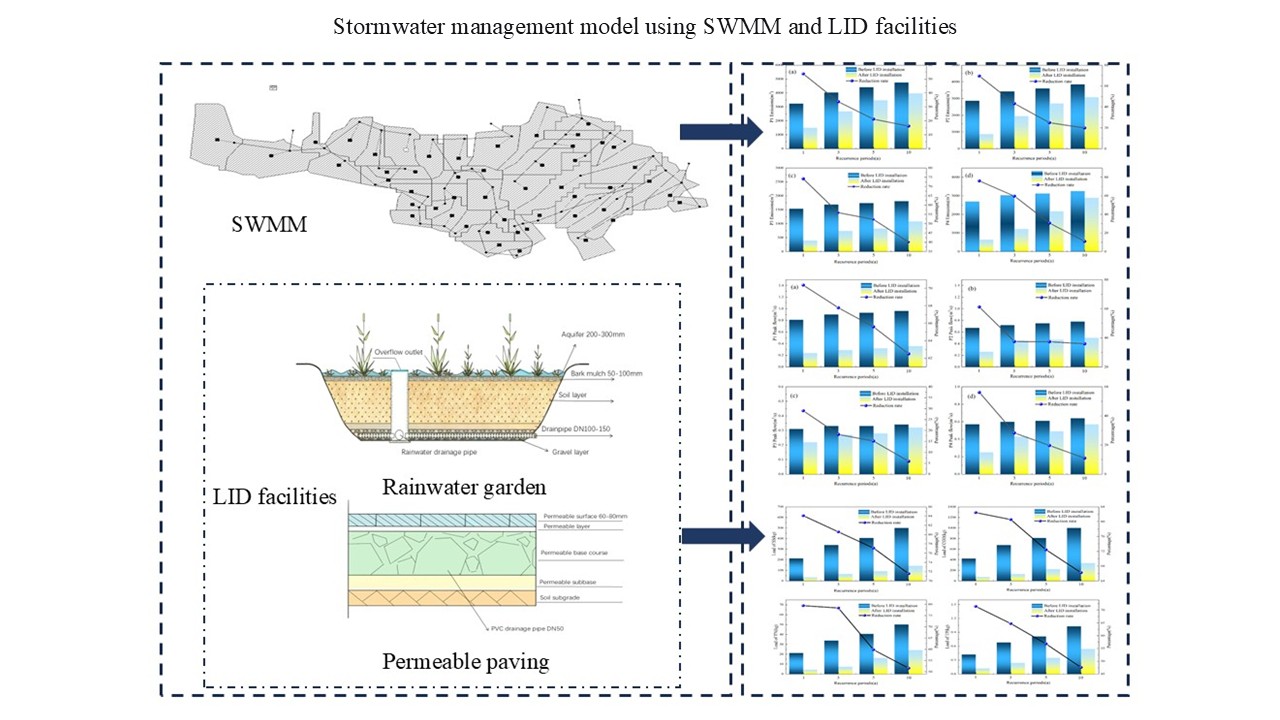
The urban area of Wanzhou District in Chongqing frequently experiences flooding and sewage overflow pollution due to its steep topography, frequent and intense short-duration rainstorms, and inadequate drainage capacity. To address these issues, this study integrated sponge city concepts with low-impact development (LID) measures to establish a stormwater management framework for the Guoben Road catchment area. Hydrometeorological and drainage data were obtained from local monitoring stations. Utilizing high-resolution remote sensing imagery and a 30 m-resolution digital elevation model, 50 sub-catchments were delineated in ArcGIS. Based on regional soil information and national sponge city design guidelines, a Stormwater Management Model employing the Horton infiltration method was constructed. This model simulated runoff and sewer network performance under Chicago design storm conditions with return periods of 1, 3, 5, and 10 years. Results indicate that LID facilities (permeable pavements and rain gardens) substantially reduced runoff generation and enhanced drainage system efficiency. Across the four rainfall scenarios, the total decrease in runoff volume ranged from 69.3% to 79.3%, with runoff coefficients falling from 0.51–0.61 to 0.10–0.19. The decrease in outfall discharge ranged from 11.0% to 76.1%, with peak flow reduced by up to 70.4%, most notably during the 1-year return-period event. Mitigation effects diminished during higher-return-period storms, attributed to limited LID storage capacity and rapid soil saturation, which reduced infiltration and detention capabilities during intense rainfall events. Overall, this integrated LID scheme effectively enhanced infiltration capacity within the mountainous urban catchment, reduced peak flows, and alleviated sewer network overloading. This study provides technical support for stormwater risk management, sewage overflow pollution control, and sponge city planning in Wanzhou District, Chongqing, and other cities with similar topographic and hydrological characteristics.
- McGrane SJ. Impacts of urbanisation on hydrological and water quality dynamics, and urban water management: A review. Hydrol Sci J. 2016;61(13):2295-2311. doi: 10.1080/02626667.2015.1128084
- Wang Z, Qi F, Liu L, Chen M, Sun D, Nan J. How do urban rainfall-runoff pollution control technologies develop in China? A systematic review based on bibliometric analysis and literature summary. Sci Total Environ. 2021;789:148045. doi: 10.1016/j.scitotenv.2021.148045
- Cao J, Sun Q, Zhao D, et al. A critical review of the appearance of black-odorous waterbodies in China and treatment methods. J Hazard Mater. 2019;385:121511. doi: 10.1016/j.jhazmat.2019.121511
- Yin D, Chen Y, Jia H, et al. Sponge city practice in China: A review of construction, assessment, operational and maintenance. J Clean Prod. 2021;280:124963. doi: 10.1016/j.jclepro.2020.124963
- Kamali M, Delkash M, Tajrishy M. Evaluation of permeable pavement responses to urban surface runoff. J Environ Manag. 2017;187:43-53. doi: 10.1016/j.jenvman.2016.11.027
- Zhu L, Ma J, Wang C, Defilla S, Yan Z. Sensitivity analysis of coastal cities to effects of rainstorm and flood disasters. Environ Monit Assess. 2024;196(4):386. doi: 10.1007/s10661-024-12516-2
- Cojoc L, De Castro-Català N, De Guzmán I, et al. Pollutants in urban runoff: Scientific evidence on toxicity and impacts on freshwater ecosystems. Chemosphere. 2024;369:143806. doi: 10.1016/j.chemosphere.2024.143806
- Ferreira CSS, Kalantari Z, Seifollahi-Aghmiuni S, et al. Rainfall-runoff-erosion processes in Urban areas. In: Rodrigo-Comino J, editor. Precipitation. Ch. 21. Netherlands: Elsevier; 2021. p. 481-498.
- Zhang D, Mei C, Ding X, et al. Impacts of rainstorm characteristics on runoff quantity and quality control performance considering integrated green infrastructures. Sustainability. 2022;14(18):11284. doi: 10.3390/su141811284
- Lv C, Wang X, Ling M, Xu W, Yan D. Effects of precipitation concentration and human activities on city runoff changes. Water Resour Manage. 2023;37(13):5023-5036. doi: 10.1007/s11269-023-03593-y
- Rezaei AR, Ismail ZB, Niksokhan MH, et al. Investigating the effective factors influencing surface runoff generation in urban catchments - a review. Desalination Water Treat. 2019;164:276-292. doi: 10.5004/dwt.2019.24359
- Ma T, Kim JS, Jun C, Moon YI, Moon H. Optimizing urban flood management: Enhancing Urban drainage system efficiency under extreme rainfall events. J Hydroinform. 2024;26(11):2704-2719. doi: 10.2166/hydro.2024.067
- Zhou H, Chi Y. Optimized Scheduling of Fixed and Mobile Pumps for Urban Drainage Under Extreme Rainfall. In: 2025 8th International Conference on Advanced Algorithms and Control Engineering (ICAACE); 2025. p. 1751-1755.
- Barco J, Wong Kenneth M, Stenstrom Michael K. Automatic calibration of the U.S. EPA SWMM model for a large Urban catchment. J Hydraulic Eng. 2008;134(4):466-474. doi: 10.1061/(ASCE)0733-9429(2008)134:4(466)
- Zakizadeh F, Moghaddam Nia A, Salajegheh A, Sañudo- Fontaneda LA, Alamdari N. Efficient Urban runoff quantity and quality modelling using SWMM model and field data in an Urban watershed of tehran metropolis. Sustainability. 2022;14(3):1086. doi: 10.3390/su14031086
- Kim J, Lee J, Song Y, Han H, Joo J. Modeling the runoff reduction effect of low impact development installations in an industrial area, South Korea. Water. 2018;10(8):987. doi: 10.3390/w10080967
- De Vleeschauwer K, Weustenraad J, Nolf C, et al. Green-blue water in the city: Quantification of impact of source control versus end-of-pipe solutions on sewer and river floods. Water Sci Technol. 2014;70(11):1825-1837. doi: 10.2166/wst.2014.306
- Autixier L, Mailhot A, Bolduc S, et al. Evaluating rain gardens as a method to reduce the impact of sewer overflows in sources of drinking water. Sci Total Environ. 2014;499:238-247. doi: 10.1016/j.scitotenv.2014.08.030
- Xu YS, Shen SL, Lai Y, Zhou AN. Design of sponge city: Lessons learnt from an ancient drainage system in Ganzhou, China. J Hydrol. 2018;563:900-908. doi: 10.1016/j.jhydrol.2018.06.075
- Yang M, Sang YF, Sivakumar B, Ka Shun Chan F, Pan X. Challenges in urban stormwater management in Chinese cities: A hydrologic perspective. J Hydrol. 2020;591:125314. doi: 10.1016/j.jhydrol.2020.125314
- Fu L. Advancing Rainwater Harvesting Systems to Help Mitigate the Urban Flooding Problems in China. United States: University of Georgia; 2018.
- Fengyun S. Urban non-point source pollution: Research progress. Chin J Ecol. 2013;32:492-500.
- Wang Y, Qiao J, Hu Y, Zhang Q, Han X, Li C. Risk assessment of non-point source pollution based on the minimum cumulative resistance model: A case study of shenyang, China. Land. 2025;14(1):88. doi: 10.3390/land14010088
- Wang Z, Fu RZ, Wang D, Zhang X, Lai X. Coupling Simulation of Non-Point Source Pollution and 2-D Water Quality in Nanhe River. In: IOP Conference Series: Earth and Environmental Science; 2021. p. 787.
- Niazi M, Nietch C, Maghrebi M, et al. Storm water management model: Performance review and gap analysis. J Sustain Water Built Environ. 2017;3(2):10.1061/JSWBAY.0000817. doi: 10.1061/JSWBAY.0000817
- Zhang X, Qiao W, Huang J, Li H, Wang X. Impact and analysis of urban water system connectivity project on regional water environment based on storm water management model (SWMM). J Clean Prod. 2023;423:138840. doi: 10.1016/j.jclepro.2023.138840
- Yang M, Zhang Y, Pan X. Improving the Horton infiltration equation by considering soil moisture variation. J Hydrol. 2020;586:124864. doi: 10.1016/j.jhydrol.2020.124864
- Annisa B. Penerapan model horton untuk kuantifikasi laju infiltrasi: Application of the horton model for quantification of infiltration rate. J SAINTIS. 2018;18(1):95-102. doi: 10.25299/saintis.2018.vol18(1).3198
- Yue M, Gao X. A comparative study of infiltration methods based on the SWMM model: Application of horton and green-ampt models in drainage system design in Northeast China. Int J Eng Adv. 2025;2(1):25-31. doi: 10.71222/rry5ks79
- Ni T, Zhang X, Leng P, Pelling M, Xu J. Comprehensive benefits evaluation of low impact development using scenario analysis and fuzzy decision approach. Sci Rep. 2025;15(1):2227. doi: 10.1038/s41598-025-85763-z
- Chowdhury MS. Modelling hydrological factors from DEM using GIS. MethodsX. 2023;10:102062. doi: 10.1016/j.mex.2023.102062
- Bajjali W. Watershed Delineation. In: ArcGIS Pro and ArcGIS Online. Springer Textbooks in Earth Sciences, Geography and Environment. Switzerland: Springer, Cham; 2023.
- Su X, Shao W, Liu J, Jiang Y, Wang K. Dynamic assessment of the impact of flood disaster on economy and population under extreme rainstorm events. Remote Sens. 2021;13(19):3924. doi: 10.3390/rs13193924
- Farina A, Di Nardo A, Gargano R, Van Der Werf JA, Greco R. A simplified approach for the hydrological simulation of urban drainage systems with SWMM. J Hydrol. 2023;623:129757. doi: 10.1016/j.jhydrol.2023.129757
- Fortunato A, Oliveri E, Mazzola MR. Selection of the optimal design rainfall return period of Urban drainage systems. Procedia Eng. 2014;89:742-749. doi: 10.1016/j.proeng.2014.11.502
- Ahiablame LM, Engel BA, Chaubey I. Effectiveness of low impact development practices: Literature review and suggestions for future research. Water Air Soil Pollut. 2012;223(7):4253-4273. doi: 10.1007/s11270-012-1189-2
- Liu T, Lawluvy Y, Shi Y, Yap PS. Low impact development (LID) practices: A review on recent developments, challenges and prospects. Water Air Soil Pollut. 2021;232(9):344. doi: 10.1007/s11270-021-05262-5
- Jia H, Wang Z, Zhen X, Clar M, Yu SL. China’s sponge city construction: A discussion on technical approaches. Front Environ Sci Eng. 2017;11(4):18. doi: 10.1007/s11783-017-0984-9
- Hu M, Zhang X, Siu YL, et al. Flood mitigation by permeable pavements in Chinese sponge city construction. Water. 2018;10(2):172. doi: 10.3390/w10020172
- Guan X, Wang J, Xiao F. Sponge city strategy and application of pavement materials in sponge city. J Clean Prod. 2021;303:127022. doi: 10.1016/j.jclepro.2021.127022
- Sharma R, Malaviya P. Management of stormwater pollution using green infrastructure: The role of rain gardens. Wires Water. 2021;8(2):e1507. doi: 10.1002/wat2.1507
- Wang M, Zhuang JA, Sun C, et al. The application of rain gardens in Urban environments: A bibliometric review. Land. 2024;13(10):1702. doi: 10.3390/land13101702
- Mooers EW, Jamieson RC, Hayward JL, Drage J, Lake CB. Low-impact development effects on aquifer recharge using coupled surface and groundwater models. J Hydrol Eng. 2018;23(9):04018040. doi: 10.1061/(ASCE)HE.1943-5584.0001682
- Job C. A review of low-impact development factors affecting managed aquifer recharge. Groundwater. 2022;60(5):619-627. doi: 10.1111/gwat.13207
- Nazarpour S, Gnecco I, Palla A. Evaluating the effectiveness of bioretention cells for Urban stormwater management: A systematic review. Water. 2023;15(5):913. doi: 10.3390/w15050913
- Zhu Z, Chen X. Evaluating the effects of low impact development practices on Urban flooding under different rainfall intensities. Water. 2017;9(7):548. doi: 10.3390/w9070548
- Garbanzos S, Maniquiz-Redillas M. Modeling the hydrologic performance and cost-effectiveness of LID in a residential park area using a decentralized design approach. Hydrology. 2022;9(4):62. doi: 10.3390/hydrology9040062
- Fan G, Lin R, Wei Z, Xiao Y, Shangguan H, Song Y. Effects of low impact development on the stormwater runoff and pollution control. Sci Total Environ. 2022;805:150404. doi: 10.1016/j.scitotenv.2021.150404
- Liu BK, Armitage NP. The link between permeable interlocking concrete pavement (PICP) design and nutrient removal. Water. 2020;12(6):1714. doi: 10.3390/w12061714
- Sui X, Van De Ven FHM. The influence of low impact development (LID) on basin runoff in a half-urbanized catchment: A case study in San Antonio, Texas. J Hydrol. 2023;616:128793. doi: 10.1016/j.jhydrol.2022.128793
- Hou X, Qin L, Xue X, et al. A city-scale fully controlled system for stormwater management: Consideration of flooding, non-point source pollution and sewer overflow pollution. J Hydrol. 2021;603:127155. doi: 10.1016/j.jhydrol.2021.127155
- Barreira AP, Jacinto G. Clustered patterns of household water consumption in Portuguese municipalities: Do regional location and population trajectory matter? Utilities Policy. 2025;93:101887. doi: 10.1016/j.jup.2025.101887
- Kapanski AA, Klyuev RV, Brigida VS, Hruntovich NV. Temporal segmentation of urban water consumption patterns based on non-parametric density clustering. Technologies. 2025;13(10):449. doi: 10.3390/technologies13100449