
Influence of laser power and hatch spacing on the mechanical properties of AlSi10Mg processed by selective laser melting

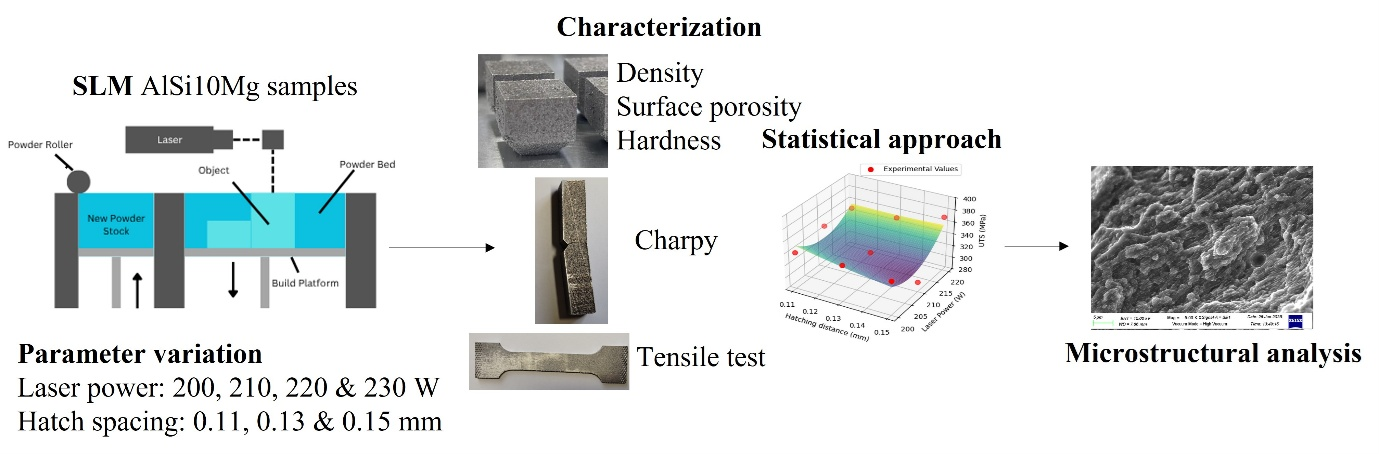
Selective laser melting (SLM) of AlSi10Mg is widely used for lightweight engineering applications, but the combined effects of key process parameters on densification, microstructure, and mechanical performance remain incompletely understood. This study systematically investigated the combined effects of laser power (200–230 W) and hatch spacing (0.11–0.15 mm) on the densification, mechanical behavior, and microstructural characteristics of AlSi10Mg components fabricated by SLM. A statistically rigorous approach based on two-way ANOVA and ordinary least squares regression was employed to quantify the individual and interactive influence of process parameters on relative density, surface porosity, hardness, Charpy impact energy, and tensile properties. The results show that laser power is the dominant parameter affecting densification and impact energy, whereas hatch spacing exhibits no statistically significant influence within the investigated range. Maximum relative densities above 99.7% were achieved at low laser powers (200–210 W), while hardness increased with increasing power, reaching approximately 140 HV at 230 W. The highest impact energy was obtained at an intermediate laser power of 210 W, indicating a favorable intermediate energy input under the tested conditions. Tensile testing revealed that the highest ultimate tensile strength was achieved at 220 W with a hatch spacing of 0.15 mm, despite slightly lower density and hardness values compared to other samples. Microstructural and fractographic analyses demonstrate that tensile performance is strongly governed by solidification morphology and defect distribution rather than density alone. This systematic, statistically supported evaluation advances the understanding of process–property relationships in SLM AlSi10Mg and provides practical guidance for parameter optimization in engineering applications.
- Klenam DEP, McBagonluri F, Asumadu TK, Osei ED, Mornah D, Soboyejo WO. Additive manufacturing: shaping the future of the manufacturing industry – overview of trends, challenges and opportunities. Appl Eng Sci. 2025;22:100224. doi: 10.1016/j.apples.2025.100224
- Mohanavel V, Ashraff Ali KS, Ranganathan K, Allen Jeffrey J, Ravikumar MM, Rajkumar S. The roles and applications of additive manufacturing in the aerospace and automobile sector. Mater Today Proc. 2021;47:405-409.doi: 10.1016/j.matpr.2021.04.596
- Chowdhury S, Yadaiah N, Prakash C, Dixit S, Gupta LR, Buddhi D. Laser powder bed fusion: a state-of-the-art review of the technology, materials, properties & defects, and numerical modelling. J Mater Res Technol. 2022;20:2109- 2172. doi: 10.1016/j.jmrt.2022.07.121
- Spears TG, Gold SA. In-process sensing in selective laser melting (SLM) additive manufacturing. Integr Mater Manuf Innov. 2016;5(1):16-40. doi: 10.1186/s40192-016-0045-4
- Dejene ND, Lemu HG. Current Status and Challenges of Powder Bed Fusion-Based Metal Additive Manufacturing: Literature Review. Metals. 2023;13(2):424. doi: 10.3390/met13020424
- Majeed A, Lv J, Zhang Y, Shamim K, Qureshi ME, Zafar F. An investigation into the influence of processing parameters on the surface quality of AlSi10Mg parts by SLM process. In: 2019 16th International Bhurban Conference on Applied Sciences and Technology (IBCAST). IEEE; 2019:143-147. doi: 10.1109/ibcast.2019.8667175
- Trevisan F, Calignano F, Lorusso M, Lombardi M, Fino P, Manfredi D. On the Selective Laser Melting (SLM) of the AlSi10Mg Alloy: Process, Microstructure, and Mechanical Properties. Materials. 2017;10(1):76. doi: 10.3390/ma10010076
- Romano S. Quality control of AlSi10Mg produced by SLM_ Metallography versus CT scans for critical defect size assessment. Addit Manuf. 2019;28:394-405. doi: 10.1016/j.addma.2019.05.017
- Praneeth J, Venkatesh S, Sivarama Krishna L. Process parameters influence on mechanical properties of AlSi10Mg by SLM. Mater Today Proc. 2023. doi: 10.1016/j.matpr.2022.12.222
- Campanelli SL, Contuzzi N, Posa P, Angelastro A. Printability and Microstructure of Selective Laser Melting of WC/Co/Cr Powder. Materials. 2019;12(15):2397. doi: 10.3390/ma12152397
- Tolosa I, Garciandía F, Zubiri F, Zapirain F, Esnaola A. Study of mechanical properties of AISI 316 stainless steel processed by “selective laser melting”, following different manufacturing strategies. Int J Adv Manuf Technol. 2010;51(5-8):639-647. doi: 10.1007/s00170-010-2631-5
- Maamoun AH, Xue YF, Elbestawi MA, Veldhuis SC. The Effect of Selective Laser Melting Process Parameters on the Microstructure and Mechanical Properties of Al6061 and AlSi10Mg Alloys. Materials. 2018;12(1):12. doi: 10.3390/ma12010012
- Kempen K. Mechanical Properties of AlSi10Mg Produced by Selective Laser Melting. Phys Procedia. 2012;39:439-446. doi: 10.1016/j.phpro.2012.10.059
- Roth CC, Tancogne-Dejean T, Mohr D. Plasticity and fracture of cast and SLM AlSi10Mg: High-throughput testing and modeling. Addit Manuf. 2021;43:101998. doi: 10.1016/j.addma.2021.101998
- Snopiński P, Woźniak A, Pagáč M. Microstructural Evolution, Hardness, and Strengthening Mechanisms in SLM AlSi10Mg Alloy Subjected to Equal-Channel Angular Pressing (ECAP). Materials. 2021;14(24):7598. doi: 10.3390/ma14247598
- Read N, Wang W, Essa K, Attallah MM. Selective laser melting of AlSi10Mg alloy: Process optimisation and mechanical properties development. Mater Des. 2015;65:417-424. doi: 10.1016/j.matdes.2014.09.044
- Maamoun AH, Elbestawi M, Dosbaeva GK, Veldhuis SC. Thermal post-processing of AlSi10Mg parts produced by Selective Laser Melting using recycled powder. Addit Manuf. 2018;21:234-247. doi: 10.1016/j.addma.2018.03.014
- Aboulkhair NT, Simonelli M, Parry L, Ashcroft I, Tuck C, Hague R. 3D printing of Aluminium alloys: Additive Manufacturing of Aluminium alloys using selective laser melting. Prog Mater Sci. 2019;106:100578. doi: 10.1016/j.pmatsci.2019.100578
- GmbH MMS. m4p material solutions|metals for printing. Published online 2023. Available from: https://www. metals4printing.com [Last accessed on February 28, 2026]
- Chen Z, Wei Z, Wei P, et al. Experimental Research on Selective Laser Melting AlSi10Mg Alloys: Process, Densification and Performance. J Mater Eng Perform. 2017;26(12):5897-5905. doi: 10.1007/s11665-017-3044-5
- Chawla K, Talabi SI, Rodriguez B, et al. Benchmarking image processing techniques for porosity measurement in polymer additive manufacturing: Review and experimental analysis. Compos Part B Eng. 2025;307:112857. doi: 10.1016/j.compositesb.2025.112857
- Pyka G, Kerckhofs G, Schrooten J, Wevers M. The effect of spatial micro-CT image resolution and surface complexity on the morphological 3D analysis of open porous structures. Mater Charact. 2014;87:104-115. doi: 10.1016/j.matchar.2013.11.004
- Cai X, Malcolm AA, Wong BS, Fan Z. Measurement and characterization of porosity in aluminium selective laser melting parts using X-ray CT. Virtual Phys Prototyp. 2015;10(4):195-206. doi: 10.1080/17452759.2015.1112412
- Ghio E, Cerri E. Work Hardening of Heat-Treated AlSi10Mg Alloy Manufactured by Selective Laser Melting: Effects of Layer Thickness and Hatch Spacing. Materials. 2021;14(17):4901. doi: 10.3390/ma14174901
- Li X, Liu Y, Tan C, Zou Y. Porosity formation mechanisms, microstructure evolution and mechanical performance of AlMgScZr alloy fabricated by laser powder bed fusion: Effect of hatch distance. J Manuf Process. 2023;94:107-119. doi: 10.1016/j.jmapro.2023.03.047
- Arvieu C, Galy C, Le Guen E, Lacoste E. Relative Density of SLM-Produced Aluminum Alloy Parts: Interpretation of Results. JMMP. 2020;4(3):83. doi: 10.3390/jmmp4030083
- Weingarten C, Buchbinder D, Pirch N, Meiners W, Wissenbach K, Poprawe R. Formation and reduction of hydrogen porosity during selective laser melting of AlSi10Mg. J Mater Process Technol. 2015;221:112-120. doi: 10.1016/j.jmatprotec.2015.02.013
- Aboulkhair NT, Everitt NM, Ashcroft I, Tuck C. Reducing porosity in AlSi10Mg parts processed by selective laser melting. Addit Manuf. 2014;1-4:77-86. doi: 10.1016/j.addma.2014.08.001
- Zhou L, Mehta A, Schulz E, McWilliams B, Cho K, Sohn Y. Microstructure, precipitates and hardness of selectively laser melted AlSi10Mg alloy before and after heat treatment. Mater Charact. 2018;143:5-17. doi: 10.1016/j.matchar.2018.04.022
- Měsíček J, Čegan T, Ma QP, et al. Effect of artificial aging on the strength, hardness, and residual stress of SLM AlSi10Mg parts prepared from the recycled powder. Mater Sci Eng A. 2022;855:143900. doi: 10.1016/j.msea.2022.143900
- Wang L zhi, Wang S, Hong X. Pulsed SLM-manufactured AlSi10Mg alloy: Mechanical properties and microstructural effects of designed laser energy densities. J Manuf Process. 2018;35:492-499. doi: 10.1016/j.jmapro.2018.09.007
- Yasa E, Deckers J, Kruth JP, Rombouts M, Luyten J. Charpy impact testing of metallic selective laser melting parts. Virtual Phys Prototyp. 2010;5(2):89-98. doi: 10.1080/17452751003703894
- Girelli L, Giovagnoli M, Tocci M, et al. Evaluation of the impact behaviour of AlSi10Mg alloy produced using laser additive manufacturing. Mater Sci Eng A. 2019;748:38-51. doi: 10.1016/j.msea.2019.01.078
- Maconachie T, Leary M, Zhang J, Lu G, Faruque O, Brandt M. Effect of build orientation on the quasi-static and dynamic response of SLM AlSi10Mg. Mater Sci Eng A. 2020;788:139445. doi: 10.1016/j.msea.2020.139445
- Gong J, Wei K, Liu M, Song W, Li X, Zeng X. Microstructure and mechanical properties of AlSi10Mg alloy built by laser powder bed fusion/direct energy deposition hybrid laser additive manufacturing. Addit Manuf. 2022;59:103160. doi: 10.1016/j.addma.2022.103160
- Bai S, Perevoshchikova N, Sha Y, Wu X. The Effects of Selective Laser Melting Process Parameters on Relative Density of the AlSi10Mg Parts and Suitable Procedures of the Archimedes Method. Appl Sci. 2019;9(3):583. doi: 10.3390/app9030583
- Majeed A, Zhang Y, Lv J, Peng T, Atta Z, Ahmed A. Investigation of T4 and T6 heat treatment influences on relative density and porosity of AlSi10Mg alloy components manufactured by SLM. Comput Ind Eng. 2020;139:106194. doi: 10.1016/j.cie.2019.106194
- Serjouei A, Libura T, Brodecki A, et al. Strength-hardness relationship for AlSi10Mg alloy produced by laser powder bed fusion: An experimental study. Mater Sci Eng A. 2022;861:144345. doi: 10.1016/j.msea.2022.144345
- Gao C, Wu W, Shi J, Xiao Z, Akbarzadeh AH. Simultaneous enhancement of strength, ductility, and hardness of TiN/ AlSi10Mg nanocomposites via selective laser melting. Addit Manuf. 2020;34:101378. doi: 10.1016/j.addma.2020.101378
- Rosenthal I, Shneck R, Stern A. Heat treatment effect on the mechanical properties and fracture mechanism in AlSi10Mg fabricated by additive manufacturing selective laser melting process. Mater Sci Eng A. 2018;729:310-322. doi: 10.1016/j.msea.2018.05.074
- Tradowsky U, White J, Ward RM, Read N, Reimers W, Attallah MM. Selective laser melting of AlSi10Mg: Influence of post-processing on the microstructural and tensile properties development. Mater Des. 2016;105:212-222. doi: 10.1016/j.matdes.2016.05.066
- Larrosa NO, Wang W, Read N, et al. Linking microstructure and processing defects to mechanical properties of selectively laser melted AlSi10Mg alloy. Theor Appl Fract Mech. 2018;98:123-133. doi: 10.1016/j.tafmec.2018.09.011
- Patakham U, Palasay A, Wila P, Tongsri R. MPB characteristics and Si morphologies on mechanical properties and fracture behavior of SLM AlSi10Mg. Mater Sci Eng A. 2021;821:141602. doi: 10.1016/j.msea.2021.141602