

A hybrid CNN–SVM framework with variational quantum confidence calibration for brain tumor detection from MRI images

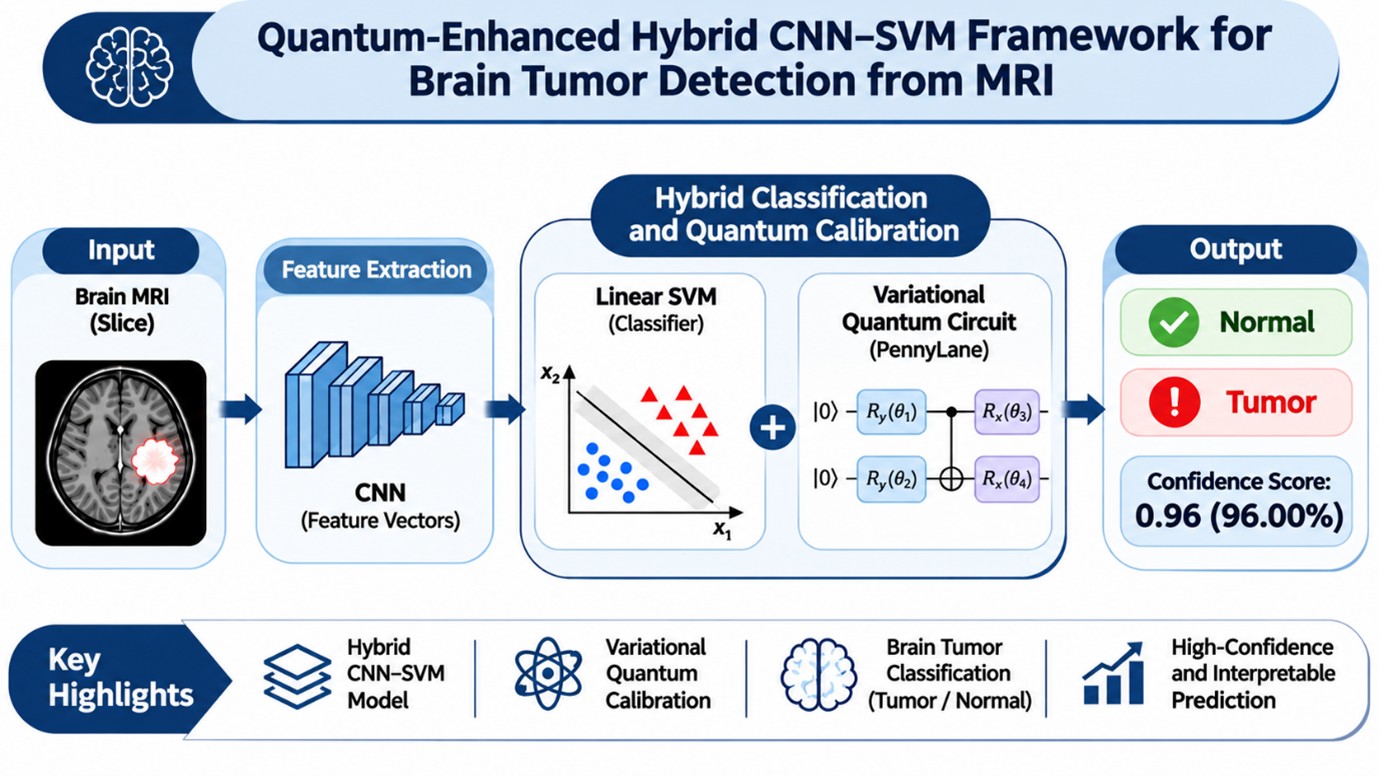
Background: Brain tumor detection through automated analysis of magnetic resonance imaging (MRI) images with classical deep learning has been shown to produce highly accurate results; however, such models often give overconfident outputs. This problem stems from unreliable confidence measures in these models. Aim: To develop a hybrid quantum-classical diagnostic pipeline that combines robust visual classification with explicit, calibrated prediction-confidence estimation for brain tumor detection. Methods: A modular framework was engineered integrating a convolutional neural network (CNN) for extracting visual features from normalized 224 × 224 MRI images, a linear support vector machine (SVM) to establish robust binary decision boundaries, and a variational quantum circuit (VQC) developed in PennyLane to map the SVM decision scores into normalized confidence scores. Comprehensive evaluation included classification metrics, expected calibration error, reliability analysis, and component-wise ablation studies. Results: Recalculated test set evaluation directly from the confusion matrix yielded an accuracy of 96.97% (582/600), a precision of 97.97% (289/295), a recall of 96.01% (289/301), and an F1-score of 96.98%. Incorporating the VQC provided distinct confidence separations between correct (mean = 0.92) and incorrect (mean = 0.72) classifications, outperforming standard Softmax and conventional Platt scaling in calibration alignment. Conclusion: Integrating a lightweight VQC component into a traditional CNN–SVM structure enables accurate brain tumor classification alongside dependable confidence estimation without imposing significant computational or simulation overhead. Relevance for patients: This framework enhances diagnostic safety by flagging highly uncertain predictions for senior clinical review, reducing misdiagnosis risks, and boosting patient trust in automated neuro-oncological tools.
- Dehkordi AA, Hashemi M, Neshat M, Mirjalili A, Sadiq AS. Brain Tumor Detection and Classification Using a New Evolutionary Convolutional Neural Network. SSRN J. Published online 2022. doi: 10.2139/ssrn.4292650
- Mozumder AN, Haque MR, Sifat FH, Mahmud KR, Al Azad AK, Kibria MG. A deep learning approach for brain tumor detection using magnetic resonance imaging. Int J Electr Comput Eng. 2023;13(1):1039-1047. doi: 10.11591/ijece.v13i1.pp1039-1047
- Wong Y, Su ELM, Yeong CF, Holderbaum W, Yang C, Ramzan M. Brain tumor classification using MRI images and deep learning techniques. PLoS ONE. 2025;20(5):e0322624. doi: 10.1371/journal.pone.0322624
- Salama WM, Shokry A. A novel framework for brain tumor detection based on convolutional variational generative models. Multimed Tools Appl. 2022;81(12):16441-16454. doi: 10.1007/s11042-022-12362-9
- Kolla M, Mishra RK, Zahoor ul Huq S, Vijayalata Y, Gopalachari MV, Siddiquee KNA. CNN-based brain tumor detection model using local binary pattern and multilayered SVM classifier. Comput Intell Neurosci. 2022;2022:9015778. doi: 10.1155/2022/9015778
- Biswas A, Islam MS. A hybrid deep CNN-SVM approach for brain tumor classification. J Inf Syst Eng Bus Intell. 2023;9(1):1-15. doi: 10.20473/jisebi.9.1.1-15
- Yonar A. A swarm intelligence-driven hybrid framework for brain tumor classification with enhanced deep features. Sci Rep. 2025;15(1):37543. doi: 10.1038/s41598-025-23820-3
- Ticku A, Sangwan V, Balani S, et al. Advancing neuroimaging with quantum convolutional neural networks for brain tumor detection. Int J Inf Technol. 2025;17(9):5759-5766. doi: 10.1007/s41870-025-02401-7
- Shinde SS, Pande A. High-performance computing-based brain tumor detection using parallel quantum dilated convolutional neural network. NMR Biomed. 2025;38(6):e5311. doi: 10.1002/nbm.70035
- Nugraha SP, Alfajri AI, Sumaryada T, Tai DT, Tamam N, Sulieman A, Yani S. Application of quantum convolutional neural networks for MRI-based brain tumor detection and classification. arXiv. 2025. doi: 10.48550/arXiv.2509.02582
- Özger F, Pacal I, Sökmen D. Cutting edge deep learning models for brain tumor classification. Gazi Univ J Sci. 2026;39(1):394-413. doi: 10.35378/gujs.1684696
- Guo C, Pleiss G, Sun Y, Weinberger KQ. On calibration of modern neural networks. In: Proceedings of the 34th International Conference on Machine Learning (ICML). 2017;70:1321-1330.
- Minderer M, Djolonga J, Romijnders R, et al. Revisiting the calibration of modern neural networks. Adv Neural Inf Process Syst. 2021;34:15682-15694.
- Selvaraju RR, Cogswell M, Das A, Vedantam R, Parikh D, Batra D. Grad-CAM: visual explanations from deep networks via gradient-based localization. In: Proceedings of the IEEE International Conference on Computer Vision (ICCV). 2017:618-626. doi: 10.1109/ICCV.2017.74
- Lundberg SM, Lee SI. A unified approach to interpreting model predictions. Adv Neural Inf Process Syst. 2017;30:4765-4774.
- Cheng S. Brain MRI images for brain tumor detection. Kaggle Dataset. Published 2020. Accessed July 20, 2026. https://www.kaggle.com/datasets/ahmedhamada0/brain-tumor-detection/data