

Can hydrogen-rich water increase nitrite and nitric oxide in patients with central obesity?

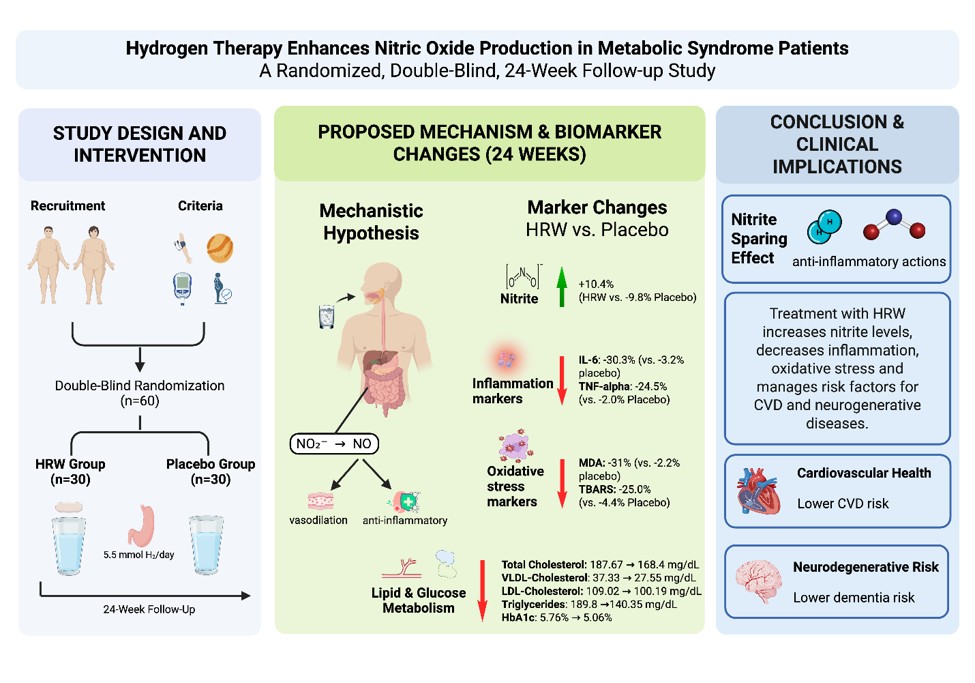
Background: Inflammation and oxidative stress play important roles in the pathophysiology of cardiovascular diseases. Hydrogen therapy, due to its antioxidant activity, has become a supplementary treatment. Objective: This study aims to investigate whether hydrogen-rich water (HRW) affects nitrite levels, a precursor of nitric oxide. Methods: Of 71 patients who volunteered, only 60 were selected due to the presence of metabolic syndrome and were randomly divided into either an intervention (HRW; n = 30) or placebo group (n = 30) using a computer-generated random number sequence, with participants blinded to the intervention. The participants consumed one tablet three times daily with 250–500 mL of water, and drank the entire solution immediately after complete dissolution on an empty stomach. Results: A significant increase in nitrite levels (8.2% vs. −1.5%, p < 0.001) was observed in the HRW group compared with the control group at the end of the 24-week follow-up, , with a modest decrease in the control group (0.66 ± 0.15 vs. 0.64 ± 0.14, p > 0.05). Thiobarbituric acid-reactive substances, malondialdehyde, and diene conjugate levels, as well as cytokine levels (tumor necrosis factor α and interleukin-6), did not differ significantly at baseline. However, after 12 and 24 weeks, all these biomarkers showed a significant decline in the HRW group, but not in the control group. Conclusion: Treatment with HRW may cause a possible increase in nitrite levels and decrease markers of inflammation and oxidative stress. It is likely that another possible mechanism of benefit from hydrogen therapy may be through an increase in nitrite levels. Relevance for patients: Hydrogen therapy may help protect against cardiovascular diseases.
- Palaniappan LP, Allen NB, Almarzooq ZI, et al. 2026 Heart Disease and Stroke Statistics: A Report of US and Global Data From the American Heart Association. Circulation. 2026;153(9). doi: 10.1161/cir.0000000000001412
- Wadhera RK, Dhruva SS, Bikdeli B, et al. Cardiovascular Statistics in the United States, 2026. JACC. 2026;87(9):1094-1134. doi: 10.1016/j.jacc.2025.12.027
- Guo X, Ma L. Inflammation in coronary artery disease-clinical implications of novel HDL-cholesterol–related inflammatory parameters as predictors. Coron Artery Dis. 2022;34(1):66-77. doi: 10.1097/mca.0000000000001198
- Singh RB, Fedacko J, Smail MA, Elkilany G, Mahajan S. View Point: Is Vulnerable Atherosclerotic Plaque the Target for Prevention of Cardiovascular Events and Deaths? World Heart J. 2024;16(1):1-6.
- Björkegren JL, Lusis AJ. Atherosclerosis: Recent developments. Cell. 2022;185:1630-1645. doi: 10.1016/j.cell.2022.04.004
- Chiorescu RM, Mocan M, Inceu AI, Buda AP, Blendea D, Vlaicu SI. Vulnerable Atherosclerotic Plaque: Is There a Molecular Signature? Int J Mol Sci. 2022;23(21):13638. doi: 10.3390/ijms232113638
- Stefanadis C, Antoniou C, Tsiachris D, Pietri P. Coronary Atherosclerotic Vulnerable Plaque: Current Perspectives. JAHA. 2017;6(3). doi: 10.1161/jaha.117.005543
- Hafiane A. Vulnerable plaque, characteristics, detection, and potential therapies. J Cardiovasc Dev Dis. 2019; 6(3):26. doi: 10.3390/jcdd6030026
- Chen Y, Wei Y, Tang W. The role of hydrogen in the prevention and treatment of coronary atherosclerotic heart disease. Eur J Pharmacol. 2024;972:176586. doi: 10.1016/j.ejphar.2024.176586
- Singh RB, Alwazeer D, Ucarer E. Effect of molecular hydrogen as a nutrient on the inflammatory index of diet, with reference to health promotion and disease prevention. MOJ Public Health. 2026;15(1):24‒26
- Singh RB, Sumbalova Z, Fatima G, et al. Effects of Molecular Hydrogen in the Pathophysiology and Management of Cardiovascular and Metabolic Diseases. Rev Cardiovasc Med. 2024;25(1). doi: 10.31083/j.rcm2501033
- Mojto V, Singh RB, Gvozdjakova A, Pella D, Fedacko J, Pella D. Molecular Hydrogen: A New Approach for the Management of Cardiovascular Diseases. World Heart J. 2018;10:83-93.
- Ji H, Sun H, Zhang Y et al. Effectiveness and safety of hydrogen inhalation therapy as an additional treatment for hypertension in real-world practice: a retrospective, observational study in China. Front Cardiovasc Med. 2024;11. doi: 10.3389/fcvm.2024.1391282
- Sugai K, Tamura T, Sano M, et al. Daily inhalation of hydrogen gas has a blood pressure-lowering effect in a rat model of hypertension. Sci Rep. 2020;10(1). doi: 10.1038/s41598-020-77349-8
- Singh RB, Tarnava A, Fedacko J, Fatima G, Rupee S, Sumbalova Z. Effects of Molecular Hydrogen in the Pathophysiology and Management of Metabolic and Non-communicable Diseases. In: Advances in Biochemistry in Health and Disease. Springer Nature Switzerland; 2024:287-317. doi: 10.1007/978-3-031-47375-3_18
- Membrino V, Di Paolo A, Di Crescenzo T, Cecati M, Alia S, Vignini A. Effects of Animal-Based and Plant-Based Nitrates and Nitrites on Human Health: Beyond Nitric Oxide Production. Biomolecules. 2025;15(2):236. doi: 10.3390/biom15020236
- Jonvik KL, Nyakayiru J, Pinckaers PJ, Senden JM, van Loon LJ, Verdijk LB. Nitrate-Rich Vegetables Increase Plasma Nitrate and Nitrite Concentrations and Lower Blood Pressure in Healthy Adults. J. Nutr. 2016;146(5):986-993. doi: 10.3945/jn.116.229807
- Divakaran S, Loscalzo J. The Role of Nitroglycerin and Other Nitrogen Oxides in Cardiovascular Therapeutics. J Am Coll Cardiol. 2017;70(19):2393-2410. doi: 10.1016/j.jacc.2017.09.1064
- Pandey S, Jangra R, Ahlawat K, et al. Selective generation of nitrate and nitrite in plasma activated water and its physicochemical parameters analysis. Phys Lett A. 2023;474:128832. doi: 10.1016/j.physleta.2023.128832128832.
- LeBaron TW, Singh RB, Fatima, et al. The Effects of 24-Week, High-Concentration Hydrogen-Rich Water on Body Composition, Blood Lipid Profiles and Inflammation Biomarkers in Men and Women with Metabolic Syndrome: A Randomized Controlled Trial. Diabetes Metab Syndr Obes Targets Ther. 2020;13:889–896. doi: 10.2147/dmso.s240122
- Tian Y, Zhang Y, Wang Y, et al. Hydrogen, a Novel Therapeutic Molecule, Regulates Oxidative Stress, Inflammation, and Apoptosis. Front Physiol. 2021;12. doi: 10.3389/fphys.2021.789507
- Lu KC, Shen MC, Wang RL, Chen WW, Chiu SH, Kao YH, et al. Using oral molecular hydrogen supplements to combat microinflammation in humans: a pilot observational study. Int J Med Sci. 2024;21(12):2390-2401. doi: 10.7150/ijms.101114
- Tan X, Shen F, Dong WL, Yang Y, Chen G. The role of hydrogen in Alzheimer’s disease. Med Gas Res. 2019;8(4):176-180. doi: 10.4103/2045-9912.248270.
- Alwazeer D, Liu FFC, Wu XY, LeBaron TWCombating oxidative stress and inflammation in COVID‐19 by molecular hydrogen therapy: mechanisms and perspectives. Oxidative Med. Cell. Longev. 2021;2021(1). doi: 10.1155/2021/5513868
- Yıldız F, LeBaron TW, Alwazeer D. A comprehensive review of molecular hydrogen as a novel nutrition therapy in relieving oxidative stress and diseases: Mechanisms and perspectives. Biochem Biophys Rep. 2025;41:101933.doi: 10.1016/j.bbrep.2025.101933
- Han XC, Ye ZH, Hu HJ, Sun Q, Fan DF. Hydrogen exerts neuroprotective effects by inhibiting oxidative stress in experimental diabetic peripheral neuropathy rats. Med Gas Res. 2023;13(2):72-77. doi: 10.4103/2045-9912.345171
- Cheng P, Wang Y, Cai C, et al. Molecular hydrogen positively regulates nitrate uptake and seed size by targeting nitrate reductase. Plant Physiol. 2023;193(4):2734-2749. doi: 10.1093/plphys/kiad474
- Shinbo T, Kokubo K, Sato Y, et al. Breathing nitric oxide plus hydrogen gas reduces ischemia-reperfusion injury and nitrotyrosine production in murine heart. Am J Physiol-Heart Circ Physiol. 2013;305(4):H542-H550. doi: 10.1152/ajpheart.00844.2012
- Liu H, Liang X, Wang D, et al. Combination Therapy With Nitric Oxide and Molecular Hydrogen in a Murine Model of Acute Lung Injury. Shock. 2015;43(5):504-511. doi: 10.1097/shk.0000000000000316
- Kuropatkina T, Atiakshin D, Sychev F, et al. Hydrogen Inhalation Reduces Lung Inflammation and Blood Pressure in the Experimental Model of Pulmonary Hypertension in Rats. Biomedicines. 2023;11(12):3141. doi: 10.3390/biomedicines11123141
- Pozdnyakova DD, Baranova IA, Selemir VD, Chuchalin AG. Combination therapy with medical gases (nitric oxide and molecular hydrogen): safety assessment. Pulʹmonologiâ. 2024;34(1):42-49. doi: 10.18093/0869-0189-2024-34-1-42-49
- Wang L, Lu D, Wang X, Wang Z, Li W, Chen G. The effects of nitric oxide in Alzheimer’s disease. Med Gas Res. 2023;14(4):186-191. doi: 10.4103/2045-9912.38593
- He J, Liu F, Xu T, et al. The role of hydrogen therapy in Alzheimer’s disease management: Insights into mechanisms, administration routes, and future challenges. Biomed Pharmacother. 2023;168:115807. doi: 10.1016/j.biopha.2023.115807
- Ono H, Nishijima Y, Ohta S. Therapeutic Inhalation of Hydrogen Gas for Alzheimer’s Disease Patients and Subsequent Long-Term Follow-Up as a Disease-Modifying Treatment: An Open Label Pilot Study. Pharmaceuticals. 2023;16(3):434. doi: 10.3390/ph16030434.
- Mirzababaei A, Mahmoodi M, Keshtkar A, et al. The interaction between dietary nitrates/nitrites intake and gut microbial metabolites on metabolic syndrome: a cross-sectional study. Front Public Health. 2024;12. doi: 10.3389/fpubh.2024.1398460
- Mirzababaei A, Mahmoodi M, Abaj F, et al. The association of dietary nitrates/nitrites intake and the gut microbial metabolite trimethylamine N-oxide and kynurenine in adults: a population-based study. Front Nutr. 2024;11. doi: 10.3389/fnut.2024.1346074