

The three-month referral threshold as an independent prognostic marker of cancer-specific survival in advanced oncological disease

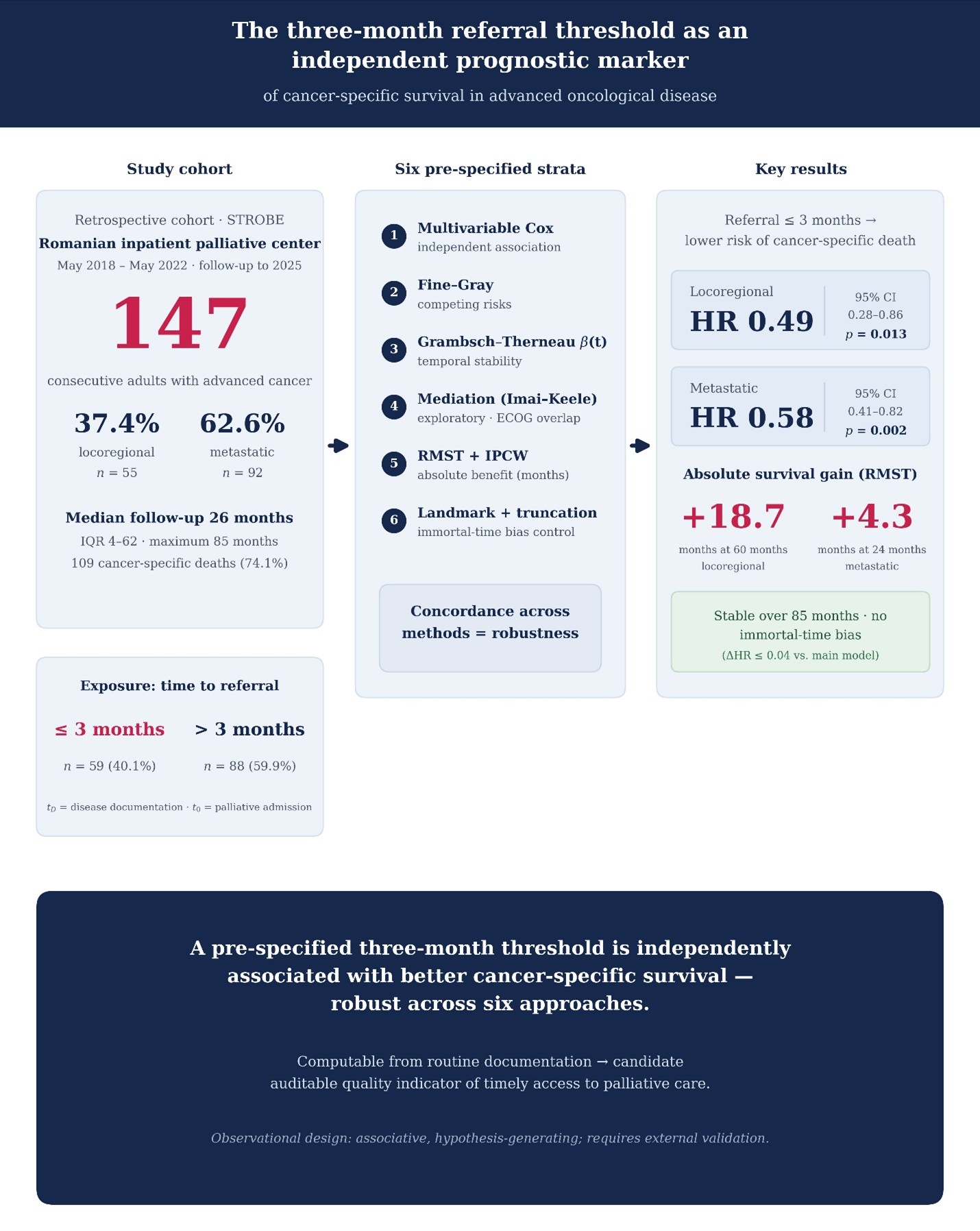
Background: Guidelines recommend the early integration of palliative care in advanced cancer; however, “earliness” remains heterogeneously defined, with no temporal consensus, and timing studies are vulnerable to immortal-time bias and do not model competing risks. Objective: To evaluate a pre-specified three-month threshold as a prognostic marker of cancer-specific survival (CSS) and as a potential auditable indicator of timely access to palliative care. Methods: A retrospective observational cohort study of 147 consecutive adults with advanced locoregional or metastatic cancer, admitted to a Romanian palliative care center (2018–2022; median follow-up 26 months), was conducted. The six-stratum analytical framework comprised multivariable Cox regression, Fine–Gray models, Grambsch–Therneau coefficients, Imai–Keele–Tingley mediation, restricted mean survival time (RMST) with inverse probability of censoring weighting, and validation through landmark and left-truncation analyses. Results: Fifty-nine patients (40.1%) were referred within the first three months. Referral within three months was independently associated with a reduced risk of cancer-specific death in locoregional disease (adjusted hazard ratio [HR], 0.49; 95% confidence interval, 0.28–0.86) and metastatic disease (HR, 0.58). Fine–Gray models confirmed the association (subdistribution HR 0.52). The RMST benefit was + 18.7 months (locoregional) and + 4.3 months (metastatic), persisting across landmark and truncation analyses. Conclusion: The three-month threshold is independently associated with significantly better CSS and is robust across six analytical approaches. As the design is observational, the findings remain associative and hypothesis-generating. Relevance for patients: The proportion of patients referred within the first three months can be computed from routine documentation and, subject to external validation, could serve as an auditable indicator of access to palliative care.
- Sanders JJ, Temin S, Ghoshal A, et al. Palliative care for patients with cancer: ASCO guideline update. J Clin Oncol. 2024;42(19):2336-2357. doi: 10.1200/JCO.24.00542
- Haroen H, Maulana S, Harun H, et al. The benefits of early palliative care on psychological well-being, functional status, and health-related quality of life among cancer patients and their caregivers: a systematic review and meta-analysis. BMC Palliat Care. 2025;24(1):117. doi: 10.1186/s12904-025-01737-y
- Lundeby T, Hjermstad MJ, Aass N, Kaasa S. Integration of palliative care in oncology – the intersection of cultures and perspectives of oncology and palliative care. Ecancermedicalscience. 2022;16:1376. doi: 10.3332/ecancer.2022.1376
- Petrillo LA, Jones KF, El-Jawahri A, Sanders J, Greer JA, Temel JS. Why and how to integrate early palliative care into cutting-edge personalized cancer care. Am Soc Clin Oncol Educ Book. 2024;44:e100038. doi: 10.1200/EDBK_100038
- Crawford GB, Dzierżanowski T, Hauser K, et al. Care of the adult cancer patient at the end of life: ESMO Clinical Practice Guidelines. ESMO Open. 2021;6(4):100225. doi: 10.1016/j.esmoop.2021.100225
- Temel JS, Jackson VA, El-Jawahri A, et al. Stepped palliative care for patients with advanced lung cancer: a randomized clinical trial. JAMA. 2024;332(6):471-481. doi: 10.1001/jama.2024.10398
- Greer JA, Temel JS, El-Jawahri A, et al. Telehealth vs in-person early palliative care for patients with advanced lung cancer: a multisite randomized clinical trial. JAMA. 2024;332(14):1153-1164. doi: 10.1001/jama.2024.13964
- Adenis A, Da Silva A, Ben Abdelghani M, et al. Early palliative care and overall survival in patients with metastatic upper gastrointestinal cancers (EPIC): a multicentre, open-label, randomised controlled phase 3 trial. eClinicalMedicine. 2024;74:102470. doi: 10.1016/j.eclinm.2024.102470
- Kaasa S, Loge JH, Aapro M, et al. Integration of oncology and palliative care: a Lancet Oncology Commission. Lancet Oncol. 2018;19(11):e588-e653. doi: 10.1016/S1470-2045(18)30415-7
- Hernán MA, Sauer BC, Hernández-Díaz S, Platt R, Shrier I. Specifying a target trial prevents immortal time bias and other self-inflicted injuries in observational analyses. J Clin Epidemiol. 2016;79:70-75. doi: 10.1016/j.jclinepi.2016.04.014
- Mathew C, Hsu AT, Prentice M, et al. Economic evaluations of palliative care models: a systematic review. Palliat Med. 2020;34(1):69-82. doi: 10.1177/0269216319875906
- Conlon MS, Caswell JM, Santi SA, et al. Access to palliative care for cancer patients living in a northern and rural environment in Ontario, Canada: the effects of geographic region and rurality on end-of-life care in a population-based decedent cancer cohort. Clin Med Insights Oncol. 2019;13:1179554919829500. doi: 10.1177/1179554919829500
- Hui D, Hannon BL, Zimmermann C, Bruera E. Improving patient and caregiver outcomes in oncology: team-based, timely, and targeted palliative care. CA Cancer J Clin. 2018;68(5):356-376. doi: 10.3322/caac.21490
- Quinn KL, Stukel TA, Campos E, et al. Regional collaborative home-based palliative care and health care outcomes among adults with heart failure. CMAJ. 2022;194(37):E1274-E1282. doi: 10.1503/cmaj.220784
- Sleeman KE, Gomes B, de Brito M, Shamieh O, Harding R. The burden of serious health-related suffering among cancer decedents: global projections study to 2060. Palliat Med. 2021;35(1):231-235. doi: 10.1177/0269216320957561
- Hausner D, Tricou C, Mathews J, et al. Timing of palliative care referral before and after evidence from trials supporting early palliative care. Oncologist. 2021;26(4):332-340. doi: 10.1002/onco.13625.
- Creangă-Murariu I, Froicu EM, Scripcariu DV, et al. Timing matters: a systematic review of early versus delayed palliative care in advanced cancer. Cancers. 2025;17(15):2598. doi: 10.3390/cancers17152598
- Hui D, Bruera E. The Edmonton Symptom Assessment System 25 years later: past, present, and future developments. J Pain Symptom Manage. 2017;53(3):630-643. doi: 10.1016/j.jpainsymman.2016.10.370
- Hui D, Paiva CE, Del Fabbro EG, et al. Prognostication in advanced cancer: update and directions for future research. Support Care Cancer. 2019;27(6):1973-1984. doi: 10.1007/s00520-019-04727-y.
- Vanbutsele G, Pardon K, Van Belle S, et al. Effect of early and systematic integration of palliative care in patients with advanced cancer: a randomised controlled trial. Lancet Oncol. 2018;19(3):394-404. doi: 10.1016/S1470-2045(18)30060-3
- Arias-Casais N, Garralda E, Sánchez-Cárdenas MA, Rhee JY, Centeno C. Evaluating the integration of palliative care in national health systems: an indicator rating process with EAPC task force members to measure advanced palliative care development. BMC Palliat Care. 2021;20(1):36. doi: 10.1186/s12904-021-00728-z
- Coppini V, Ferraris G, Ferrari MV, et al. Patients’ perspectives on cancer care disparities in Central and Eastern European countries: experiencing taboos, misinformation and barriers in the healthcare system. Front Oncol. 2024;14:1420178. doi: 10.3389/fonc.2024.1420178
- Hoerger M, Greer JA, Jackson VA, et al. Defining the elements of early palliative care that are associated with patient-reported outcomes and the delivery of end-of-life care. J Clin Oncol. 2018;36(11):1096-1102. doi: 10.1200/JCO.2017.75.6676
- Sullivan DR, Chan B, Lapidus JA, et al. Association of early palliative care use with survival and place of death among patients with advanced lung cancer. JAMA Oncol. 2019;5(12):1702-1709. doi: 10.1001/jamaoncol.2019.3105
- Pop RS, Cojan-Minzat BO, Ursu CP, Ursu Ș, Puia A. Decrease in primary caregivers’ quality of life during the care of a relative with palliative care needs: a prospective longitudinal study. Cancers. 2024;16(21):3570. doi: 10.3390/cancers16213570
- Austin PC, Steyerberg EW, Putter H. Fine-Gray subdistribution hazard models to simultaneously estimate the absolute risk of different event types: cumulative total failure probability may exceed 1. Stat Med. 2021;40(19):4200-4212. doi: 10.1002/sim.9023
- Tyrer F, Bhaskaran K, Rutherford MJ. Immortal time bias for life-long conditions in retrospective observational studies using electronic health records. BMC Med Res Methodol. 2022;22(1):86. doi: 10.1186/s12874-022-01581-1
- Buranupakorn T, Thangsuk P, Patumanond J, Phinyo P. Emulation of a target trial to evaluate the causal effect of palliative care consultation on the survival time of patients with hepatocellular carcinoma. Cancers. 2021;13(5):992. doi: 10.3390/cancers13050992
- von Elm E, Altman DG, Egger M, Pocock SJ, Gøtzsche PC, Vandenbroucke JP. The Strengthening the Reporting of Observational Studies in Epidemiology (STROBE) statement: guidelines for reporting observational studies. Int J Surg. 2014;12(12):1495-1499. doi: 10.1016/j.ijsu.2014.07.013
- Austin PC, Fine JP. Practical recommendations for reporting Fine–Gray model analyses for competing risk data. Stat Med. 2017;36(27):4391-4400. doi: 10.1002/sim.7501
- Bonneville EF, Beyersmann J, Keogh RH, et al. Multiple imputation of missing covariates when using the Fine–Gray model. Stat Med. 2025;44(15-17):e70166. doi: 10.1002/sim.70166
- Qin X, Yang F. Simulation-based sensitivity analysis for causal mediation studies. Psychol Methods. 2022;27(6):1000-1013. doi: 10.1037/met0000340
- Imai K, Keele L, Tingley D. A general approach to causal mediation analysis. Psychol Methods. 2010;15(4):309-334. doi: 10.1037/a0020761
- Horiguchi M, Tian L, Uno H. On assessing survival benefit of immunotherapy using long-term restricted mean survival time. Stat Med. 2023;42(8):1139-1155. doi: 10.1002/sim.9662
- Averbuch I, Bareket-Samish A, Goldstein DA, et al. Challenges in interpreting survival metrics in clinical trials: the utility of restricted mean survival analyses. Int J Radiat Oncol Biol Phys. 2025;122(2):224-233. doi: 10.1016/j.ijrobp.2025.02.006
- Crowley F, Sheng T, Zeng L, et al. Patient factors associated with early vs late referral to supportive oncology. JCO Oncol Pract. 2024;20(10 suppl):202. doi: 10.1200/OP.2024.20.10_suppl.202.
- Zhong Y, Schaubel DE. Restricted mean survival time as a function of restriction time. Biometrics. 2022;78(1):192-201. doi: 10.1111/biom.13414
- Mosoiu D, Mitrea N, Dumitrescu M. Palliative care in Romania. J Pain Symptom Manage. 2018;55(2):S67-S76. doi: 10.1016/j.jpainsymman.2017.03.036