
Comparative phytochemical profiling, antioxidant activity, and subacute toxicity assessment of infusion and decoction extracts of pumpkin seeds

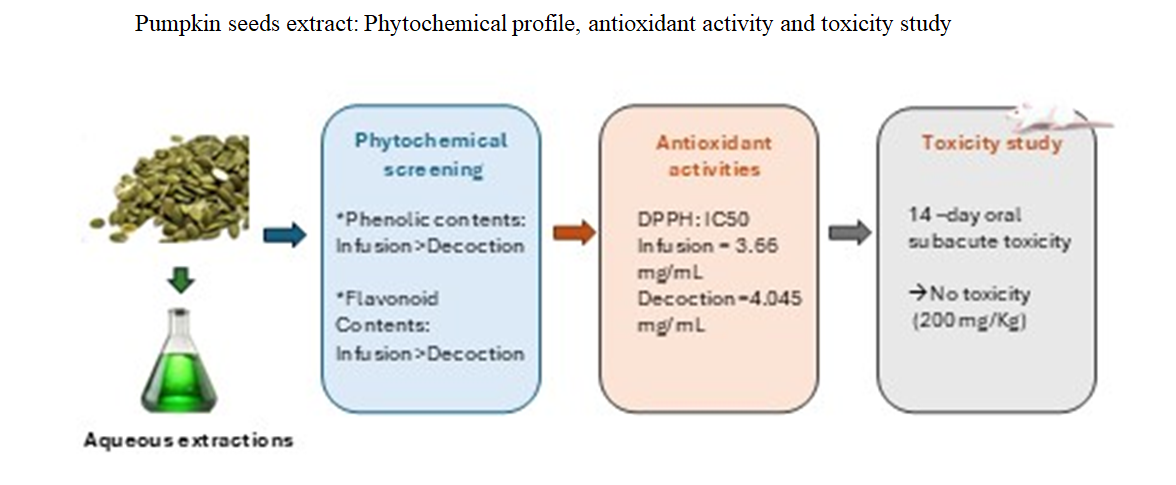
Pumpkin (Cucurbita maxima) seeds are rich in bioactive compounds, including phenolics and flavonoids, which contribute to their antioxidant properties. Traditional consumption often involves aqueous preparations, such as infusions and decoctions; however, comparative evaluations of their phytochemical content, antioxidant activity, and safety remain limited. This study compares the phytochemical profiles and antioxidant activities of pumpkin seed infusions and decoctions and evaluates their subacute oral toxicity over 14 days in rats. Pumpkin seed infusion and decoction extracts were prepared using traditional aqueous extraction methods. Total phenolic and flavonoid contents were quantified using the Folin–Ciocalteu and aluminum chloride assays. Antioxidant activity was evaluated using the 2,2-diphenyl-1-picrylhydrazyl radical scavenging method. Subacute oral toxicity was assessed in Wistar rats following daily oral administration of 200 mg/kg for 14 days. Phytochemical screening revealed that the infusion contained higher total phenolic content (7.5 ± 0.032 mg gallic acid equivalents/g dry extract) and total flavonoid content (2.72 ± 0.0018 mg quercetin equivalents/g dry extract) compared with the decoction (6.5 ± 0.026 mg gallic acid equivalents/g dry extract and 2.53 ± 0.0014 mg quercetin equivalents/g dry extract, respectively). Accordingly, the infusion exhibited higher antioxidant activity (IC50 = 3.66 ± 0.03 mg/mL) than the decoction (IC50 = 4.045 ± 0.02 mg/mL). No mortality or adverse clinical signs were observed in treated animals, indicating an absence of subacute toxicity at the tested dose. These findings support the traditional use of pumpkin seeds and demonstrate that their aqueous preparations, particularly infusion, exhibit antioxidant activity with a favorable safety profile. Overall, pumpkin seeds represent a promising source of bioactive compounds.
- Šamec D, Loizzo MR, Gortzi O, Çankaya İT, Tundis R, Suntar İ, et al. The potential of pumpkin seed oil as a functional food—A comprehensive review of chemical composition, health benefits, and safety. Comp Rev Food Sci Food Safe. 2022;21(5):4422‑4446. doi: 10.1111/1541-4337.13013
- Wal A, Singh MR, Gupta A, Rathore S, Rout RR, Wal P. Pumpkin seeds (Cucurbita spp.) as a nutraceutical used in various lifestyle disorders. Nat Prod J. 2024;14(1):118-137. doi: 10.2174/2210315513666230516120756
- Gavril RN, Stoica F, Lipșa FD, Constantin OE, Stănciuc N, Aprodu I, et al. Pumpkin and pumpkin by-products: A comprehensive overview of phytochemicals, extraction, health benefits, and food applications. Foods. 2024;13(17):2694. doi: 10.3390/foods13172694
- Krimer-Malešević V. Phenolic acids in pumpkin seed (Cucurbita pepo L.). In: Nuts and seeds in health and disease prevention. Amsterdam, The Netherlands: Elsevier. 2011:925-932. doi: 10.1016/B978-0-12-375688-6.10109-4
- Hu T, Zhou L, Kong F, et al. Effects of extraction strategies on yield, physicochemical and antioxidant properties of pumpkin seed oil. Foods 2023;12(18):3351. doi: 10.3390/foods12183351
- Andjelkovic M, Van Camp J, Trawka A, Verhé R. Phenolic compounds and some quality parameters of pumpkin seed oil. Euro J Lipid Sci Technol. 2010;112(2):208‑217. doi: 10.1002/ejlt.200900021
- Peiretti PG, Meineri G, Gai F, Longato E, Amarowicz R. Antioxidative activities and phenolic compounds of pumpkin (Cucurbita pepo) seeds and amaranth (Amaranthus caudatus) grain extracts. Nat Prod Res. 2017;31(18):2178‑2182. doi: 10.1080/14786419.2017.1278597
- Sun S, Yu Y, Jo Y, et al. Impact of extraction techniques on phytochemical composition and bioactivity of natural product mixtures. Front Pharmacol. 2025;16. doi: 10.3389/fphar.2025.1615338
- Antony A, Farid M. Effect of temperatures on polyphenols during extraction. Appl Sci. 2022;12(4):2107. doi: 10.3390/app12042107
- Alamgir ANM. Herbal Drugs: Their Collection, Preservation, and Preparation; Evaluation, Quality Control, and Standardization of Herbal Drugs. In: Progress in Drug Research. Berlin/Heidelberg, Germany: Springer International Publishing; 2017:453-495. doi: 10.1007/978-3-319-63862-1_10
- Castro-López C, Ventura-Sobrevilla JM, González Hernández MD, et al. Impact of extraction techniques on antioxidant capacities and phytochemical composition of polyphenol-rich extracts. Food Chem. 2017;237:1139‑1148. doi: 10.1016/j.foodchem.2017.06.032
- Osadebe PO, Okoye FBC, Uzor PF, et al. Phytochemical analysis, hepatoprotective and antioxidant activity of Alchornea cordifolia methanol leaf extract on carbon tetrachlorideinduced hepatic damage in rats. Asian Pac J Trop Med. 2012;5(4):289-293. doi: 10.1016/S1995-7645(12)60041-8
- Oyetayo FL, Akomolafe SF, Osesanmi TJ. Effect of dietary inclusion of pumpkin (Cucurbita pepo L.) seed on nephrotoxicity occasioned by cisplatin in experimental rats. J Food Biochem. 2020;44(10):e13439. doi: 10.1111/jfbc.13439
- de Queiroz-Neto A, Mataqueiro MI, Santana AE, Alessi AC. Toxicologic evaluation of acute and subacute oral administration of Cucurbita maxima seed extracts to rats and swine. J Ethnopharmacol. 1994;43(1):45‑51. doi: 10.1016/0378-8741(94)90115-5
- Cruz RCB, Meurer CD, Silva EJ, Schaefer C, Santos ARS, Bella Cruz A, et al. Toxicity Evaluation of Cucurbita maxima. Seed Extract in Mice. Pharm Biol. 2006;44(4):301‑303. doi: 10.1080/13880200600715886
- El-Adawy TA, Taha KM. Characteristics and composition of different seed oils and flours. Food Chem. 2001;74(1):47‑54. doi: 10.1016/S0308-8146(00)00337-X
- Stevenson DG, Eller FJ, Wang L, Jane JL, Wang T, Inglett GE. Oil and Tocopherol Content and Composition of Pumpkin Seed Oil in 12 Cultivars. J Agric Food Chem. 2007;55(10):4005‑4013. doi: 10.1021/jf0706979
- Altaf A, Sharma H, Dar AH, Dash KK, Pandey VK, Manzoor M. Phytochemical Potential and Biological Activity of Pumpkin: A Review. Food Safety and Health. 2025;3(2):188‑201. doi: 10.1002/fsh3.70001
- Peng, M., Lu, D., Liu, J., Jiang, B., Chen, J. Effect of roasting on the antioxidant activity, phenolic composition, and nutritional quality of pumpkin (Cucurbita pepo L.) seeds. Front Nutr. 2021;8. doi: 10.3389/fnut.2021.647354
- Potočnik T, Cizej MR, Košir IJ. Influence of seed roasting on pumpkin seed oil tocopherols, phenolics and antiradical activity. J Food Compos Anal. 2018;69:7‑12. doi: 10.1016/j.jfca.2018.01.020
- Sławińska N, Olas B. Effect of thermal processing on the antioxidant activity of oilseeds used in bakery products: A systematic review. Ind Crops Prod. 2025;233:121459. doi: 10.1016/j.indcrop.2025.121459
- Hagos M, Chandravanshi BS, Redi-Abshiro M, Yaya EE. Determination of total phenolic, total flavonoid, ascorbic acid contents and antioxidant activity of pumpkin flesh, peel and seeds. Bull Chem Soc Ethiop. 2023;37(5):1093-1108. doi: 10.4314/bcse.v37i5.3
- Chung WY, Jadhav S, Hsu PK, Kuan CM. Evaluation of acute and sub-chronic toxicity of bitter melon seed extract in Wistar rats. Toxicol Rep. 2022;9:1024‑1034. doi: 10.1016/j.toxrep.2022.04.024
- Syed QA. Nutritional and Therapeutic Importance of the Pumpkin Seeds. BJSTR. 2019;21(2). doi: 10.26717/bjstr.2019.21.003586
- Akomolafe SF, Akinjiyan MO, Asogwa NT, Elekofehinti OO. Evaluation of the protective effects of raw and roasted pumpkin (Cucurbita pepo L.) seed-supplemented diets on cisplatin-induced cardiotoxicity in rats. J Mol Histol. 2025;56(3):157. doi: 10.1007/s10735-025-10432-4