
Evaluation of the nephroprotective potential of chrysin against pentadecafluorooctanoic acid-induced kidney dysfunction in male Wistar rats

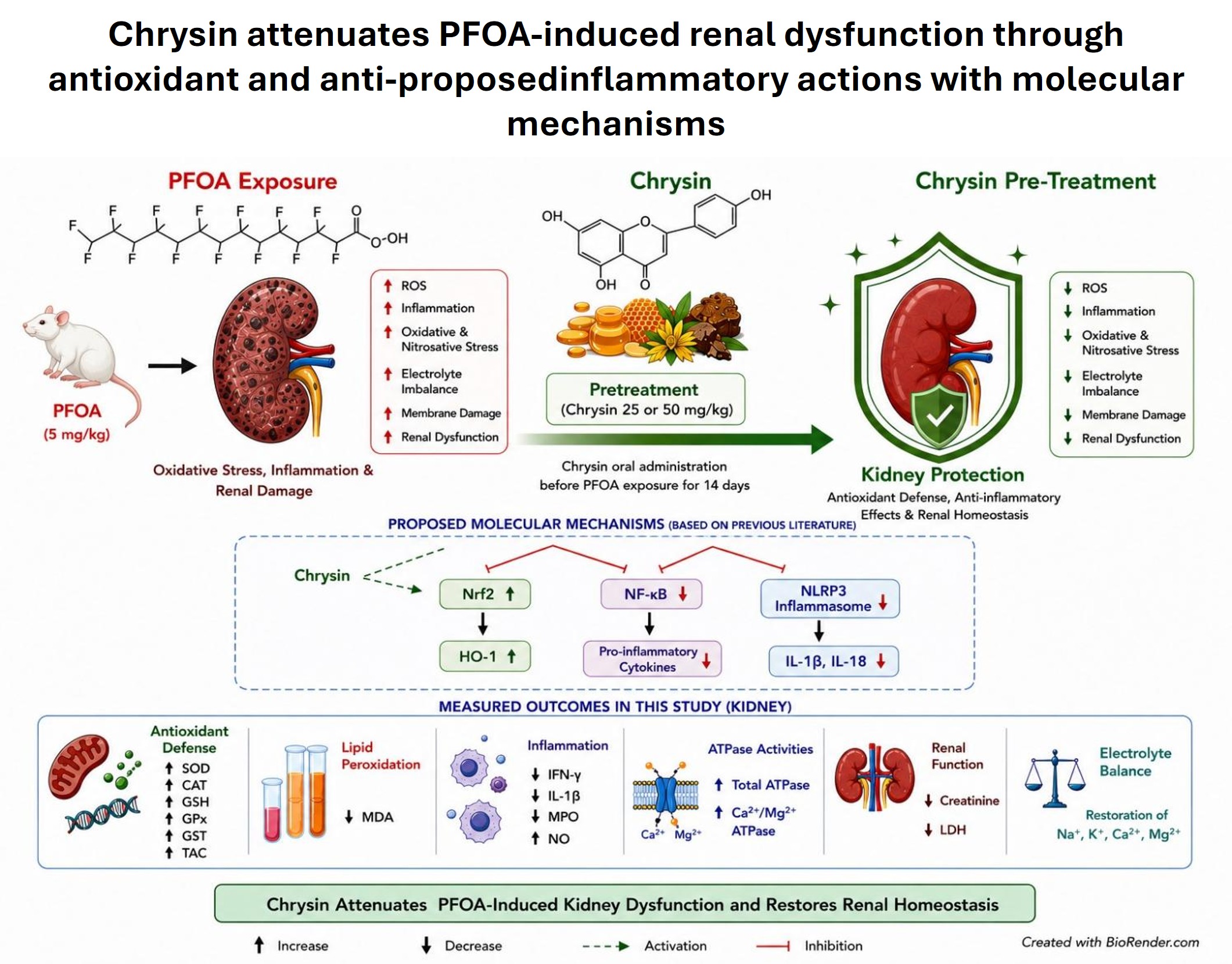
Pentadecafluorooctanoic acid (PFOA) is a highly persistent environmental contaminant known for its bioaccumulative nature and ability to cause adverse renal effects. Prolonged exposure to PFOA has been associated with oxidative stress, inflammation, and membrane dysfunction, which collectively contribute to renal impairment. This study investigates the nephroprotective effects of chrysin, a naturally occurring flavonoid with potent antioxidant and anti-inflammatory properties, against PFOA-induced kidney toxicity in male Wistar rats. Twenty-five rats were divided into five groups (n = 5 per group): (i) control (20% dimethyl sulfoxide), (ii) PFOA-only (5 mg/kg), (iii) 25 mg/kg chrysin + 5 mg/kg PFOA, (iv) 50 mg/kg chrysin + 5 mg/kg PFOA, and (v) 50 mg/kg chrysin-only. All treatments were administered orally for 14 consecutive days. Exposure to PFOA resulted in a significant (p < 0.05) elevation in serum creatinine, lactate dehydrogenase, and electrolyte imbalances, accompanied by reduced antioxidant enzyme activities, elevated oxidative stress markers, increased inflammatory cytokines, and disrupted ATPase activity. Chrysin pre-treatment at both 25 and 50 mg/kg markedly attenuated these toxic effects in a dose-dependent manner. It restored antioxidant defenses, normalized biochemical indices, improved electrolyte balance, and suppressed inflammation, thereby preserving renal function. These findings suggest that chrysin confers significant nephroprotective effects against PFOA-induced renal injury by mitigating oxidative stress, inflammation, and ion transport disruption, supporting its therapeutic potential as a promising nephroprotective agent for protecting against environmentally induced kidney injury.
- Mohamed HK, Mobasher MA, Ebiya RA, et al. Anti-inflammatory, anti-apoptotic, and antioxidant roles of honey, royal jelly, and propolis in suppressing nephrotoxicity induced by doxorubicin in male albino rats. Antioxidants. 2022;11(5):1029. doi: 10.3390/antiox11051029
- Pingili RB, Pawar AK, Challa SR, et al. A comprehensive review on hepatoprotective and nephroprotective activities of chrysin against various drugs and toxic agents. Chem-Biol Interact. 2019;308:51-60. doi: 10.1016/j.cbi.2019.05.010
- Samarghandian S, Farkhondeh T, Azimi-Nezhad M. Protective Effects of Chrysin Against Drugs and Toxic Agents. Dose-Response. 2017;15(2):155932581771178. doi: 10.1177/1559325817711782
- Ujah GA, Ofutet EO, Ukam CIO, et al. Protective effect of tert-butylhydroquinone against cisplatin-induced hepatorenal injury via modulating oxidative stress, inflammation, and apoptosis. Arch Physiol Biochem. 2024;130(6):951-961. doi: 10.1080/13813455.2024.2376812
- Zhang X, Qian J, Wei B, et al. Flavonoids as modulators of Nrf2 signaling pathway in alleviating cisplatin-induced organ toxicity. Yangtze Med. 2025;09(01):52–77. doi: 10.4236/ym.2025.91006
- Ali BH, Adham SA, Al Za’abi M, et al. Ameliorative effect of chrysin on adenine-induced chronic kidney disease in rats. PloS ONE. 2015;10(4):e0125285. doi: 10.1371/journal.pone.0125285
- Chen M, Li J, Liu X, et al. Chrysin prevents lipopolysaccharide-induced acute lung injury in mice by suppressing the IRE1α/TXNIP/NLRP3 pathway. Pulm Pharmacol Ther. 2021;68:102018. doi: 10.1016/j.pupt.2021.102018
- Nagavally RR, Sunilkumar S, Akhtar M, et al. Chrysin ameliorates Cyclosporine-A-induced renal fibrosis by inhibiting TGF-β1-induced epithelial–Mesenchymal Transition. Int J Mol Sci. 2021;22(19):10252. doi: 10.3390/ijms221910252
- Barnett LM, Cummings BS. Nephrotoxicity and renal pathophysiology: a contemporary perspective. Toxicol Sci. 2018;164(2):379-390. doi: 10.1093/toxsci/kfy159
- Liu D, Yan S, Wang P, et al. Perfluorooctanoic acid (PFOA) exposure in relation to the kidneys: A review of current available literature. Front Physiol. 2023;14. doi: 10.3389/fphys.2023.1103141
- Fenton SE, Ducatman A, Boobis A, DeWitt JC, Lau C, Ng C, et al. Per-and polyfluoroalkyl substance toxicity and human health review: Current state of knowledge and strategies for informing future research. Environ Toxicol Chem. 2020;40(3):606-630. doi: 10.1002/etc.4890
- Rashid F, Ramakrishnan A, Fields C, et al. Acute PFOA exposure promotes epigenomic alterations in mouse kidney tissues. Toxicol Rep. 2020;7:125-132. doi: 10.1016/j.toxrep.2019.12.010
- Ma X, Ren X, Zhang X, et al. Rutin ameliorate PFOA induced renal damage by reducing oxidative stress and improving lipid metabolism. J Nutr Biochem. 2024;123:109501. doi: 10.1016/j.jnutbio.2023.109501
- Zou W, Liu W, Yang B, et al. Quercetin protects against perfluorooctanoic acid-induced liver injury by attenuating oxidative stress and inflammatory response in mice. Int Immunopharmacol. 2015;28(1):129-135. doi: 10.1016/j.intimp.2015.05.043
- Mohany M, Ahmed MM, Al-Rejaie SS. Molecular mechanistic pathways targeted by natural antioxidants in the prevention and treatment of chronic kidney disease. Antioxidants. 2021;11(1):15. doi: 10.3390/antiox11010015
- Sarmah D, Sengupta R. A Review on the Role of Phytoconstituents Chrysin on the Protective Effecton Liver and Kidney. CDDT. 2024;21(1). doi: 10.2174/0115701638242317231018144944
- Kay AG, Rooney P, Kearney J, et al. Evaluation of DMSO transport in human articular cartilage: Vehicle solutions and effects on cell function. Cryo Lett. 2015;36(3):187-194. https://pubmed.ncbi.nlm.nih.gov/26510337/
- Santos NC, Figueira-Coelho J, Martins-Silva J, et al. Multidisciplinary utilization of dimethyl sulfoxide: pharmacological, cellular, and molecular aspects. Biochem Pharmacol. 2003;65(7):1035-1041. doi: 10.1016/S0006-2952(03)00002-9
- Ortiz MI, Cariño-Cortés R, Fernández-Martínez E, et al. Peripheral Antinociception Induced by Carvacrol in the Formalin Test Involves the Opioid Receptor-NO-cGMP-K+ Channel Pathway. Metabolites. 2025;15(5):314. doi: 10.3390/metabo15050314
- Cheung C, Loy S, Li GX, et al. Rapid induction of colon carcinogenesis in CYP1A-humanized mice by 2-amino-1-methyl-6-phenylimidazo[4,5-b]pyridine and dextran sodium sulfate. Carcinogenesis. 2010;32(2):233-239. doi: 10.1093/carcin/bgq235
- Crebelli R, Caiola S, Conti L, et al. Can sustained exposure to PFAS trigger a genotoxic response? A comprehensive genotoxicity assessment in mice after subacute oral administration of PFOA and PFBA. Regul Toxicol Pharmacol. 2019;106:169-177. doi: 10.1016/j.yrtph.2019.05.005
- Eldutar E, Kandemir FM, Kucukler S, et al. Restorative effects of Chrysin pre-treatment on oxidant–antioxidant status, inflammatory cytokine production, and apoptotic and autophagic markers in acute paracetamol‐induced hepatotoxicity in rats: An experimental and biochemical study. J Biochem Molecular Tox. 2017;31(11). doi: 10.1002/jbt.21960
- Kseibati MO, Sharawy MH, Salem HA. Chrysin mitigates bleomycin-induced pulmonary fibrosis in rats through regulating inflammation, oxidative stress, and hypoxia. Int Immunopharmacol. 2020;89:107011. doi: 10.1016/j.intimp.2020.107011
- Renuka M, Vijayakumar N, Ramakrishnan A. Chrysin, a flavonoid attenuates histological changes of hyperammonemic rats: A dose dependent study. Biomed Pharmacother. 2016;82:345-354. doi: 10.1016/j.biopha.2016.05.013
- Yao Y, Chen L, Xiao J, et al. Chrysin Protects against Focal Cerebral Ischemia/Reperfusion Injury in Mice through Attenuation of Oxidative Stress and Inflammation. Int J Mol Sci. 2014;15(11):20913-20926. doi: 10.3390/ijms151120913
- Zanoli P, Avallone R, Baraldi M. Behavioral characterisation of the flavonoids apigenin and chrysin. Fitoterapia. 2000;71:S117-S123. doi: 10.1016/S0367-326X(00)00186-6
- Albus U. Guide for the Care and Use of Laboratory Animals (8th edn). Lab Anim. 2012;46(3):267-268. doi: 10.1258/la.2012.150312
- Percie du Sert N, Hurst V, Ahluwalia A, et al. The ARRIVE guidelines 2.0: Updated guidelines for reporting animal research. Exp Physiol. 2020;105(9):1459-1466. doi: 10.1113/EP088870
- Jacob SW, Herschler R. Pharmacology of DMSO. Cryobiology. 1986;23(1):14–27. doi: 10.1016/0011-2240(86)90014-3
- Panaretakis T, Shabalina IG, Grandér D, et al. Reactive Oxygen Species and Mitochondria Mediate the Induction of Apoptosis in Human Hepatoma HepG2 Cells by the Rodent Peroxisome Proliferator and Hepatocarcinogen, Perfluorooctanoic Acid. Toxicol Appl Pharmacol. 2001;173(1):56-64. doi: 10.1006/taap.2001.9159
- Tur R, Betelu S, Rodrigues R, et al. Optimization of experimental conditions of PFOA defluorination using DMSO/NaOH mixture. In: 18th International Symposium on Persistent Toxic Substances and Health (ISPTS-2024). 2024. https://brgm.hal.science/hal-04648668/
- Walle T, Otake Y, Brubaker JA, et al. Disposition and metabolism of the flavonoid chrysin in normal volunteers. Brit J Clin Pharma. 2001;51(2):143-146. doi: 10.1111/j.1365-2125.2001.01317.x
- Cui L, Zhou QF, Liao CY, et al. Studies on the Toxicological Effects of PFOA and PFOS on Rats Using Histological Observation and Chemical Analysis. Arch Environ Contam Toxicol. 2008;56(2):338-349. doi: 10.1007/s00244-008-9194-6
- Yahia D, El-Nasser MA, Abedel-Latif M, et al. Effects of perfluorooctanoic acid (PFOA) exposure to pregnant mice on reproduction. J Toxicol Sci. 2010;35(4):527-533. doi: 10.2131/jts.35.527
- Yang B, Zou W, Hu Z, et al. Involvement of oxidative stress and inflammation in liver injury caused by perfluorooctanoic acid exposure in mice. BioMed Res Int. 2014;2014:1-7. doi: 10.1155/2014/409837
- James AS, Onunkwor BO, Akinseye VO, et al. Cashew nut-supplemented diet on testicular injury in rats exposed to sub-acute alcohol. Pharmacol Res-Rep. 2023;1:100001. doi: 10.1016/j.prerep.2024.100001
- Gad SB, Zaghloul DM. Beneficial Effects of Green Tea Extract on Liver and Kidney Functions, Ultrastructure, Lipid Profile and Hematological Parameters in Aged Male Rats. Glob Vet. 2013;11(2):191-205. doi: 10.5829/idosi.gv.2013.11.2.7472
- Hasim H, Mohamed Salam SKN, Rao PV, et al. Tualang honey-mediated silver nanoparticles attenuate hippocampal oxidative stress in kainic acid-induced male rats. Biomed Res Ther. 2022;9(12):5465-5475. doi: 10.15419/bmrat.v9i12.785
- Baghirova S, Hughes BG, Hendzel MJ, et al. Sequential fractionation and isolation of subcellular proteins from tissue or cultured cells. MethodsX. 2015;2:440-445. doi: 10.1016/j.mex.2015.11.001
- Blalock TD, Varela JC, Gowda S, et al. Ischemic skin wound healing models in rats. Wounds. 2001;13(1):35-44.
- Wang Z, Zhang S, Li X, et al. Anti-aging potential of Limosilactobacillus fermentum F-B9-1-2 extracellular vesicles in D-galactose–induced cellular and organ senescence. Sci Rep. 2026;16(1). doi: 10.1038/s41598-026-43553-1
- Lowry O, Rosebrough N, Farr AL, Randall RJ. Protein measurement with the Folin phenol reagent. J Biol Chem. 1951;193(1):265-275. doi: 10.1016/S0021-9258(19)52451-6
- Chou SC, Goldstein A. Chromogenic groupings in the Lowry protein determination. Biochem J. 1960;75(1):109-115. doi: 10.1042/bj0750109
- Holmes RS, Scopes RK. Immunochemical Homologies among Vertebrate Lactate‐Dehydrogenase Isozymes. Eur J Biochem. 1974;43(1):167-177. doi: 10.1111/j.1432-1033.1974.tb03397.x
- Al-Jassabi S. Purification and Kinetic Properties of Skeletal Muscle Lactate Dehydrogenase from the Lizard Agama stellio stellio. Biochemistry. 2002;67(7):786-789. doi: 10.1023/A:1016300808378
- Hodges DM, DeLong JM, Forney CF, et al. Improving the thiobarbituric acid-reactive-substances assay for estimating lipid peroxidation in plant tissues containing anthocyanin and other interfering compounds. Planta. 1999;207(4):604-611. doi: 10.1007/s004250050524
- Buege JA, Aust SD. [30] Microsomal lipid peroxidation. In: Methods in Enzymology. Elsevier; 1978:302-310. doi: 10.1016/S0076-6879(78)52032-6
- Ellman GL. Tissue sulfhydryl groups. Archives of Arch Biochem Biophys. 1959;82(1):70-77. doi: 10.1016/0003-9861(59)90090-6
- Ellis HR. On’tissue sulfhydryl groups’ by George L. Ellman. Arch Biochem Biophys. 2022;726:109174. doi: 10.1016/j.abb.2022.109174
- Sun Y, Oberley LW, Li Y. A simple method for clinical assay of superoxide dismutase. Clin Chem. 1988;34(3):497-500. doi: 10.1093/clinchem/34.3.497
- Marklund S, Marklund G. Involvement of the superoxide anion radical in the autoxidation of pyrogallol and a convenient assay for superoxide dismutase. Eur J Biochem. 1974;47(3):469-474. doi: 10.1111/j.1432-1033.1974.tb03714.x
- Shangari N, O’Brien PJ. Catalase Activity Assays. CP Toxicol. 2006;27(1). doi: 10.1002/0471140856.tx0707s27
- Rotruck JT, Pope AL, Ganther HE, et al. Selenium: biochemical role as a component of glutathione peroxidase. Nutr Rev. 1980;38(8):280–3. doi: 10.1111/j.1753-4887.1980.tb05961.x
- Habig WH, Pabst MJ, Jakoby WB. Glutathione S-Transferases. J Biol Chem. 1974;249(22):7130-7139. doi: 10.1016/S0021-9258(19)42083-8
- Tew KD, Ronai Z. GST function in drug and stress response. Drug Resist Updates. 1999;2(3):143-147. doi: 10.1054/drup.1999.0086
- Prieto P, Pineda M, Aguilar M. Spectrophotometric quantitation of antioxidant capacity through the formation of a phosphomolybdenum complex: specific application to the determination of vitamin E. Anal Biochem. 1999;269(2):337-341. doi: 10.1006/abio.1999.4019
- Tsakiris S, Deliconstantinos G. Influence of phosphatidylserine on (Na++ K+)-stimulated ATPase and acetylcholinesterase activities of dog brain synaptosomal plasma membranes. Biochem J. 1984;220(1):301-307. doi: 10.1042/bj2200301
- Katewa SD, Katyare SS. A simplified method for inorganic phosphate determination and its application for phosphate analysis in enzyme assays. Anal Biochem. 2003;323(2):180-187. doi: 10.1016/j.ab.2003.08.024
- Hanahan DJ, Ekholm JE. [15] The preparation of red cell ghosts (membranes). In: Methods in Enzymology. Elsevier; 1974:168-172. doi: 10.1016/0076-6879(74)31018-X
- Green LC, Wagner DA, Glogowski J, et al. Analysis of nitrate, nitrite, and [15N] nitrate in biological fluids. Anal Biochem. 1982;126(1):131-138. doi: 10.1016/0003-2697(82)90118-X
- Akamo AJ, Ojelabi AO, Akamo NM, et al. Hesperetin-7-rutinoside mitigates erythrocyte dyslipidemia and oxidative stress induced by dichlorvos. J Hazard Mater Adv. 2024;16:100495. doi: 10.1016/j.hazadv.2024.100495
- Privat C, Lantoine F, Bedioui F, et al. Nitric oxide production by endothelial cells: Comparison of three methods of quantification. Life Sci. 1997;61(12):1193-1202. doi: 10.1016/S0024-3205(97)00661-9
- Hasmann A, Wehrschuetz-Sigl E, Marold A, et al. Analysis of myeloperoxidase activity in wound fluids as a marker of infection. Ann Clin Biochem. 2013;50(3):245-254. doi: 10.1258/acb.2011.010249
- Bonato M, Corrà F, Bellio M, et al. PFAS environmental pollution and antioxidant responses: an overview of the impact on human field. Int J Environ Res Public Health. 2020;17(21):8020. doi: 10.3390/ijerph17218020
- Mani R, Natesan V. Chrysin: Sources, beneficial pharmacological activities, and molecular mechanism of action. Phytochemistry. 2018;145:187-196. doi: 10.1016/j.phytochem.2017.09.016
- Gao S, Siddiqui N, Etim I, et al. Developing nutritional component chrysin as a therapeutic agent: Bioavailability and pharmacokinetics consideration, and ADME mechanisms. Biomed Pharmacother. 2021;142:112080. doi: 10.1016/j.biopha.2021.112080
- Stompor-Gorący M, Bajek-Bil A, Machaczka M. Chrysin: Perspectives on Contemporary Status and Future Possibilities as Pro-Health Agent. Nutrients. 2021;13(6):2038. doi: 10.3390/nu13062038
- Kurkiewicz M, Moździerz A, Rzepecka-Stojko A, et al. Chrysin: A comprehensive review of its pharmacological properties and therapeutic potential. Pharmaceuticals. 2025;18(8):1162. doi: 10.3390/ph18081162
- Boston C, Keck S, Naperala A, et al. The evolution of PFAS epidemiology: new scientific developments call into question alleged “probable links” between PFOA and kidney cancer and thyroid disease. Front Public Health. 2025;13. doi: 10.3389/fpubh.2025.1532277
- Wang L, Sun W, Ma X, et al. Perfluorooctanoic acid (PFOA) exposure induces renal filtration and reabsorption disorders via down-regulation of aquaporins. Toxicol Lett. 2024;392:22-35. doi: 10.1016/j.toxlet.2023.12.003
- Gorelik Y, Abassi Z, Bloch-Isenberg N, et al. Changing serum creatinine in the detection of acute renal failure and recovery following radiocontrast studies among acutely ill inpatients: reviewing insights regarding renal functional reserve gained by large-data analysis. Pract Lab Med. 2022;30:e00276. doi: 10.1016/j.plabm.2022.e00276
- Sultana S, Verma K, Khan R. Nephroprotective efficacy of chrysin against cisplatin-induced toxicity via attenuation of oxidative stress. J Pharm Pharmacol. 2012;64(6):872-881. doi: 10.1111/j.2042-7158.2012.01470.x
- Ozoemena CL, Abireh IE, Katchy AU. Probing the Nephroprotective Potential of Chrysin against Methotrexate-Induced Tubulointerstitial Nephritis and Oxidative Damage. Trop J Nat Product Res. 2024;8(7). doi: 10.26538/tjnpr/v8i7.30
- Farhana A, Lappin SL. Biochemistry, Lactate Dehydrogenase. In: StatPearls. StatPearls Publishing; 2023. https://www.ncbi. nlm.nih.gov/books/NBK557536/
- Udayakumar S. Vacuolation: A Novel Biomarker of Environmental Pollutant PFOA Induced Human Renal Proximal Tubular Cell Injury. Int J High School Res. 2025;7(4):9-12. doi: 10.36838/v7i4.2
- Xiao X, Zhang J, Lang Y, et al. Associations of lactate dehydrogenase with risk of renal outcomes and cardiovascular mortality in individuals with diabetic kidney disease. Diabetes Res Clini Pract. 2023;203:110838. doi: 10.1016/j.diabres.2023.110838
- Tahir M, Sultana S. Chrysin modulates ethanol metabolism in Wistar rats: a promising role against organ toxicities. Alcohol Alcohol. 2011;46(4):383-392. doi: 10.1093/alcalc/agr038
- Adeva-Andany M, López-Ojén M, Funcasta-Calderón R, et al. Comprehensive review on lactate metabolism in human health. Mitochondrion. 2014;17:76-100. doi: 10.1016/j.mito.2014.05.007
- Rogatzki MJ, Ferguson BS, Goodwin ML, et al. Lactate is always the end product of glycolysis. Front Neurosci. 2015;9. doi: 10.3389/fnins.2015.00022
- Starnes HM, Rock KD, Jackson TW, et al. A critical review and meta-analysis of impacts of per-and polyfluorinated substances on the brain and behavior. Front Toxicol. 2022;4. doi: 10.3389/ftox.2022.881584
- Palmer BF, Clegg DJ. Physiology and pathophysiology of potassium homeostasis. Adv Physiol Ed. 2016;40(4):480-490. doi: 10.1152/advan.00121.2016
- Zhang X, Flaws JA, Spinella MJ, et al. The Relationship between Typical Environmental Endocrine Disruptors and Kidney Disease. Toxics. 2022;11(1):32. doi: 10.3390/toxics11010032
- Alexander RT, Dimke H. Effect of diuretics on renal tubular transport of calcium and magnesium. Am J Physiol-Renal Physiol. 2017;312(6):F998-F1015. doi: 10.1152/ajprenal.00032.2017
- Yadav S, Yadav J, Kumar S, et al. Metabolism of Macro-elements (Calcium, Magnesium, Sodium, Potassium, Chloride and Phosphorus) and Associated Disorders. In: Clinical Applications of Biomolecules in Disease Diagnosis. Springer Nature Singapore; 2024:177-203. doi: 10.1007/978-981-97-4723-8_8
- Chandra P, Pathak R, Sachan N. Chrysin: Chemistry, Occurrence, Pharmacokinetics, Toxicity, Molecular Targets, and Medicinal Properties of a Naturally Occurring Flavone. CBC. 2025;21(8). doi: 10.2174/0115734072341901241121185020
- Campos HM, da Costa M, da Silva Moreira LK, et al. Protective effects of chrysin against the neurotoxicity induced by aluminium: In vitro and in vivo studies. Toxicology. 2022;465:153033. doi: 10.1016/j.tox.2021.153033
- Alharthy SA, Hardej D. The role of transcription factor Nrf2 in the toxicity of perfluorooctane sulfonate (PFOS) and perfluorooctanoic acid (PFOA) in C57BL/6 mouse astrocytes. Environ Toxicol Pharmacol. 2021;86:103652. doi: 10.1016/j.etap.2021.103652
- Georgiou-Siafis SK, Tsiftsoglou AS. The key role of GSH in keeping the redox balance in mammalian cells: mechanisms and significance of GSH in detoxification via formation of conjugates. Antioxidants. 2023;12(11):1953. doi: 10.3390/antiox12111953
- Huang CS, Lii CK, Lin AH, et al. Protection by chrysin, apigenin, and luteolin against oxidative stress is mediated by the Nrf2-dependent up-regulation of heme oxygenase 1 and glutamate cysteine ligase in rat primary hepatocytes. Arch Toxicol. 2012;87(1):167-178. doi: 10.1007/s00204-012-0913-4
- Zeinali M, Rezaee SA, Hosseinzadeh H. An overview on immunoregulatory and anti-inflammatory properties of chrysin and flavonoids substances. Biomed Pharmacother. 2017;92:998-1009. doi: 10.1016/j.biopha.2017.06.003
- Rehman MU, Tahir M, Khan AQ, et al. Chrysin suppresses renal carcinogenesis via amelioration of hyperproliferation, oxidative stress and inflammation: Plausible role of NF-κB. Toxicol Lett. 2013;216(2-3):146-158. doi: 10.1016/j.toxlet.2012.11.013
- Talebi M, Talebi M, Farkhondeh T, et al. An updated review on the versatile role of chrysin in neurological diseases: Chemistry, pharmacology, and drug delivery approaches. Biomed Pharmacother. 2021;141:111906. doi: 10.1016/j.biopha.2021.111906
- Gupta S, Finelli R, Agarwal A, et al. Total antioxidant capacity—Relevance, methods and clinical implications. Andrologia. 2020;53(2). doi: 10.1111/and.13624
- Ji L, Chauhan A, Brown WT, et al. Increased activities of Na+/K+-ATPase and Ca2+/Mg2+-ATPase in the frontal cortex and cerebellum of autistic individuals. Life Sci. 2009;85(23-26):788-793. doi: 10.1016/j.lfs.2009.10.008
- Scheiner-Bobis G. Ion-transporting ATPases as ion channels. Naunyn-Schmiedeberg’s Arc Pharmacol. 1998;357(5):477-482.
- Clausen MJV, Poulsen H. Sodium/Potassium Homeostasis in the Cell. In: Metal Ions in Life Sciences. Springer Netherlands; 2012:41-67. doi: 10.1007/978-94-007-5561-1_3
- Polak-Jonkisz D, Zwolińska D, Purzyc L, et al. Ca2+-Mg2+-dependent ATP-ase activity and calcium homeostasis in children with chronic kidney disease. Pediatr Nephrol. 2007;22(3):414-419. doi: 10.1007/s00467-006-0329-6
- Gielecińska A, Kciuk M, Kontek R. The Impact of Calcium Overload on Cellular Processes: Exploring Calcicoptosis and Its Therapeutic Potential in Cancer. Int J Mol Sci. 2024;25(24):13727. doi: 10.3390/ijms252413727
- Lee D, Hong JH. Physiological Overview of the Potential Link between the UPS and Ca2+ Signaling. Antioxidants. 2022;11(5):997. doi: 10.3390/antiox11050997
- Poór M, Veres B, Jakus PB, et al. Flavonoid diosmetin increases ATP levels in kidney cells and relieves ATP depleting effect of ochratoxin A. J Photochem Photobiol B: Biol. 2014;132:1–9. doi: 10.1016/j.jphotobiol.2014.01.016
- Sabry HA, Zahra MM, Haredy SA, et al. Neuroprotective impacts of chrysin against clonazepam induced cognitive deficits in male rats. J App Pharm Sc. 2023;13(7):174-185. doi: 10.7324/JAPS.2023.13885
- Basini G, Bussolati S, Torcianti V, et al. Perfluorooctanoic acid (PFOA) induces redox status disruption in swine granulosa cells. Vet Sci. 2022;9(6):254. doi: 10.3390/vetsci9060254
- Laycock SK, Vogel T, Forfia PR, et al. Role of Nitric Oxide in the Control of Renal Oxygen Consumption and the Regulation of Chemical Work in the Kidney. Circ Res. 1998;82(12):1263-1271. doi: 10.1161/01.RES.82.12.1263
- Ratliff BB, Abdulmahdi W, Pawar R, et al. Oxidant Mechanisms in Renal Injury and Disease. Antioxid Redox Signal. 2016;25(3):119-146. doi: 10.1089/ars.2016.6665
- Shen ZH, Ye T, Chen B, et al. 5, 7-Dihydroxyflavone acts on eNOS to achieve hypotensive effects in spontaneously hypertensive rats. Sci Rep. 2025;15(1). doi: 10.1038/s41598-024-84259-6
- Xu H, Yu S, Lin C, et al. Roles of flavonoids in ischemic heart disease: Cardioprotective effects and mechanisms against myocardial ischemia and reperfusion injury. Phytomedicine. 2024;126:155409. doi: 10.1016/j.phymed.2024.155409
- Yuvaraj S, Ramprasath T, Saravanan B, et al. Chrysin attenuates high-fat-diet-induced myocardial oxidative stress via upregulating eNOS and Nrf2 target genes in rats. Mol Cell Biochem. 2021;476(7):2719-2727. doi: 10.1007/s11010-021-04105-5
- Kothari N, Keshari RS, Bogra J, et al. Increased myeloperoxidase enzyme activity in plasma is an indicator of inflammation and onset of sepsis. J Crit Care. 2011;26(4): 435.e1-435.e7. doi: 10.1016/j.jcrc.2010.09.001
- Qazi MR, Bogdanska J, Butenhoff JL, et al. High-dose, short-term exposure of mice to perfluorooctanesulfonate (PFOS) or perfluorooctanoate (PFOA) affects the number of circulating neutrophils differently, but enhances the inflammatory responses of macrophages to lipopolysaccharide (LPS) in a similar fashion. Toxicology. 2009;262(3):207-214. doi: 10.1016/j.tox.2009.06.010
- Wang LQ, Liu T, Yang S, et al. Perfluoroalkyl substance pollutants activate the innate immune system through the AIM2 inflammasome. Nat Commun. 2021;12(1). doi: 10.1038/s41467-021-23201-0
- Wu L, Hu Z, Luo X, et al. Itaconic Acid Alleviates Perfluorooctanoic Acid-Induced Oxidative Stress and Intestinal Damage by Regulating the Keap1/Nrf2/Ho-1 Pathway and Reshaping the Gut Microbiota. Int J MolSci. 2024;25(18):9826. doi: 10.3390/ijms25189826
- Liang L, Pan Y, Bin L, et al. Immunotoxicity mechanisms of perfluorinated compounds PFOA and PFOS. Chemosphere. 2022;291:132892. doi: 10.1016/j.chemosphere.2021.132892
- Zhang H, Fang W, Wang D, et al. The role of interleukin family in perfluorooctanoic acid (PFOA)-induced immunotoxicity. J Hazard Mater. 2014;280:552-560. doi: 10.1016/j.jhazmat.2014.08.043
- Qin Y, Gu T, Ling J, et al. PFOS facilitates liver inflammation and steatosis: An involvement of NLRP3 inflammasome‐mediated hepatocyte pyroptosis. J Appl Toxicol. 2022;42(5):806-817. doi: 10.1002/jat.4258
- Schroecksnadel K, Frick B, Winkler C, et al. Crucial role of interferon-γ and stimulated macrophages in cardiovascular disease. Curr Vasc Pharmacol. 2006;4(3):205-213. doi: 10.2174/157016106777698379
- Dubey S, Khan J, Alishlash AS, et al. The Cell with Many Faces: Lung Macrophage Plasticity and Function in Response to Environmental and Pathogenic Insults. Physiol Rev. 2026;106(3):1999-2055. doi: 10.1152/physrev.00038.2025
- Kumar S, Dikshit M. Nitric oxide: Regulation and function in neutrophil immune responses. Antioxid Redox Signal. 2024;40(16–18):998–1024. doi: 10.1089/ars.2022.0220
- Matsuzawa T, Kim BH, Shenoy AR, et al. IFN-γ elicits macrophage autophagy via the p38 MAPK signaling pathway. J Immunol. 2012;189(2):813-818. doi: 10.4049/jimmunol.1102041
- Akagha MJ, Georgolopoulos G, Martin D, et al. IFNγ shapes macrophage inflammatory responses by STAT1 isoform-specific epigenetic and transcriptional mechanisms. BMC Genomics. 2026;27(1). doi: 10.1186/s12864-026-12601-5
- Ivashkiv LB. IFNγ: signalling, epigenetics and roles in immunity, metabolism, disease and cancer immunotherapy. Nat Rev Immunol. 2018;18(9):545-558. doi: 10.1038/s41577-018-0029-z
- Li X, Huang Q, Ong CN, et al. Chrysin sensitizes tumor necrosis factor-α-induced apoptosis in human tumor cells via suppression of nuclear factor-kappaB. Cancer Lett. 2010;293(1):109-116. doi: 10.1016/j.canlet.2010.01.002
- Yeo H, Lee YH, Koh D, et al. Chrysin Inhibits NF-κB-Dependent CCL5 Transcription by Targeting IκB Kinase in the Atopic Dermatitis-Like Inflammatory Microenvironment. Int J Mol Sci. 2020;21(19):7348. doi: 10.3390/ijms21197348
- Liao T, Ding L, Wu P, et al. Chrysin Attenuates the NLRP3 Inflammasome Cascade to Reduce Synovitis and Pain in KOA Rats. Drug Des Devel Ther. 2020;14:3015-3027. doi: 10.2147/DDDT.S261216
- Chen S, Chen H, Du Q, et al. Targeting myeloperoxidase (MPO) mediated oxidative stress and inflammation for reducing brain ischemia injury: potential application of natural compounds. Front Physiol. 2020;11. doi: 10.3389/fphys.2020.00433
- Kim HJ, Wei Y, Wojtkiewicz GR, et al. Reducing myeloperoxidase activity decreases inflammation and increases cellular protection in ischemic stroke. J Cereb Blood Flow Metab. 2018;39(9):1864-1877. doi: 10.1177/0271678X18771978
- Albukhari TA, Bagadood RM, Bokhari BT, et al. Chrysin Attenuates Gentamicin-Induced Renal Injury in Rats Through Modulation of Oxidative Damage and Inflammation via Regulation of Nrf2/AKT and NF-kB/ KIM-1 Pathways. Biomedicines. 2025;13(2):271. doi: 10.3390/biomedicines13020271
- Ali N, Rashid S, Nafees S, et al. Beneficial effects of Chrysin against Methotrexate-induced hepatotoxicity via attenuation of oxidative stress and apoptosis. Mol Cell Biochem. 2013;385(1–2):215-223. doi: 10.1007/s11010-013-1830-4
- Lin JH. Dose‐dependent pharmacokinetics: Experimental observations and theoretical considerations. Biopharm Drug Disp. 1994;15(1):1-31. doi: 10.1002/bdd.2510150102
- Roshanravan B, Farkhondeh T, Darroudi M, et al. Protective Effect of Chrysin Against Chlorpyrifos-induced Hepatotoxicityin Rats: Biochemical and Histopathological Approaches in a Sub-chronicStudy. CPB. 2023;24(10):1291-1296. doi: 10.2174/1389201024666221025094643
- Greene CW, Bogdan AR, Goeden HM. A revised and improved toxicokinetic model to simulate serum concentrations of bioaccumulative PFAS. J Environ Expo Assess. 2024;3(2). doi: 10.20517/jeea.2024.09
- Garg A, Chaturvedi S. A Comprehensive Review on Chrysin: Emphasis on Molecular Targets, Pharmacological Actions and Bio-pharmaceutical Aspects. CDT. 2022;23(4):420-436. doi: 10.2174/1389450122666210824141044