
The fetal exposome and pregnancy outcomes: A multi-omics perspective

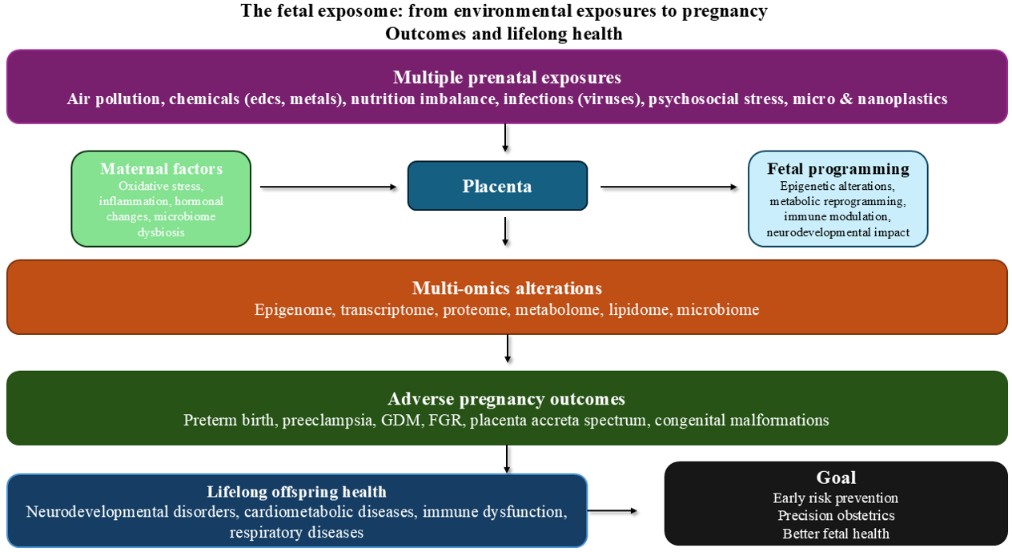
The fetal exposome is defined as all prenatal environmental, nutritional, lifestyle, psychosocial, and endogenous exposures. These exposures alter placental function and fetal programming and are increasingly recognized as important drivers of pregnancy outcomes and lifelong offspring health. Environmental factors, such as air pollution, endocrine-disrupting chemicals, heavy metals, nutritional imbalance, infections, and psychosocial stress, induce molecular changes through oxidative stress, inflammation, endocrine disruption, mitochondrial dysfunction, and epigenetic reprogramming. The use of multi-omics technologies, such as epigenomics, transcriptomics, proteomics, metabolomics, lipidomics, and microbiomics, has emerged recently and has provided comprehensive characterization of biological pathways connecting prenatal exposures to adverse outcomes. Exposure-based molecular signatures have been identified for preterm birth, preeclampsia, gestational diabetes mellitus, fetal growth restriction, and disrupted offspring neurodevelopmental and cardiometabolic health through integrative analyses. New techniques, including single-cell sequencing, spatial transcriptomics, artificial intelligence, and systems biology, are advancing understanding of mechanisms and the discovery of biomarkers. This review aims to provide a concise overview of the state of the science on the fetal exposome, its molecular mechanisms, and associations with pregnancy outcomes from a multi-omics perspective. It also discusses current challenges, including exposure assessment, data integration, and validation, and highlights future opportunities for precision obstetrics and personalized maternal-fetal care.
- Abarca-Castro EA, Reyes-Lagos JJ, Guzmán Ramos K, et al. Fetal development and the air pollution exposome: an integrative perspective of health pathways. Front Cell Neurosci. 2025;19:1688437. doi: 10.3389/fncel.2025.1688437
- Chandra M, Paray AA. Natural Physiological Changes During Pregnancy. Yale J Biol Med. 2024;97(1):85-92. doi: 10.59249/jtiv4138
- Sokou R, Lianou A, Lampridou M, et al. Neonates at Risk: Understanding the Impact of High-Risk Pregnancies on Neonatal Health. Medicina. 2025;61(6):1077. doi: 10.3390/medicina61061077
- Rosenfeld CS. Transcriptomics and Other Omics Approaches to Investigate Effects of Xenobiotics on the Placenta. Front Cell Dev Biol. 2021;9:723656. doi: 10.3389/fcell.2021.723656
- Sarigiannis D, Karakitsios S, Anesti O, et al. Advancing translational exposomics: bridging genome, exposome and personalized medicine. Hum Genomics. 2025;19(1):48. doi: 10.1186/s40246-025-00761-6
- Maitre L, Bustamante M, Hernández-Ferrer C, et al. Multi-omics signatures of the human early life exposome. Nat Commun. 2022;13(1):7024. doi: 10.1038/s41467-022-34422-2
- Bhadre AA, Ghongade HP, Patil DS, Patil NW, Shirsath SA. Integrating AI-Powered Multiomics for Personalized Prediction and Management of Pregnancy Complications In 2025. JOC. 2025;24(4s):104-116. doi: 10.64149/j.carcinog.24.4s.104-116
- Ye F, Sun J, Zhao P, et al. Trimester-specific exposure to PM2.5 constituents, precursor gases, and their impact on low birth weight: a retrospective cohort study in Beijing, China. BMC Pregnancy Childbirth. 2026;26(1):459. doi: 10.1186/s12884-026-08788-w
- Andonotopo W, Bachnas MA, Dewantiningrum J, et al. The fetal exposome and preterm birth: a systematic synthesis of environmental exposures and multi-omics evidence. J Perinatal Med. 2025;54(2):391-407. doi: 10.1515/jpm-2025-0231
- Mitra T, Gulati R, Ramachandran K, et al. Endocrine disrupting chemicals: gestational diabetes and beyond. Diabetol Metab Syndr. 2024;16(1):95. doi: 10.1186/s13098-024-01317-9
- Pizent A. Oxidative Stress-Related Metabolomic Alterations in Pregnancy: Evidence from Exposure to Air Pollution, Metals/Metalloid, and Tobacco Smoke. Antioxidants. 2025;14(12):1442. doi: 10.3390/antiox14121442
- Creisher PS, Klein SL. Pathogenesis of viral infections during pregnancy. Clin Microbiol Rev. 2024;37(2):e0007323. doi: 10.1128/cmr.00073-23
- Han VX, Patel S, Jones HF, Dale RC. Maternal immune activation and neuroinflammation in human neurodevelopmental disorders. Nat Rev Neurol. 2021;17(9):564-579. doi: 10.1038/s41582-021-00530-8
- Snehamayee N, Somya S, Kumar SC, Niranjan M, Ranjan SB, Kumar MN. Microplastics and Human Health: A Comprehensive Review on Exposure Pathways, Toxicity, and Emerging Risks. Microplastics. 2026;5(1):8. doi: 10.3390/microplastics5010008
- Gonzalez Acevedo MK, Powers M, Cucullo L. Oxidative Stress, Environmental Pollutants, Aging, and Epigenetic Regulation: Mechanistic Insights and Biomarker Advances. Antioxidants. 2026;15(4):494. doi: 10.3390/antiox15040494
- Miranda J, Maestre N, Devia M, Zapata R, Ochoa-Díaz MM, Annicchiarico W. Inflammation at the Maternal–Fetal Interface: Mechanisms Linking Maternal–Fetal Immunity to Preeclampsia and Fetal Growth Restriction. Int J Mol Sci. 2026;27(9):3954. doi: 10.3390/ijms27093954
- Barrientos G, Fahlbusch FB, Conrad ML. Microbes, molecules, and the maternal–fetal interface: rethinking the gut–placenta axis. Trends in Immunology. Published online April 2026. doi: 10.1016/j.it.2026.03.010
- Bakulski KM, Blostein F, London SJ. Linking Prenatal Environmental Exposures to Lifetime Health with Epigenome-Wide Association Studies: State-of-the-Science Review and Future Recommendations. Environ Health Perspect. 2023;131(12):126001. doi: 10.1289/ehp12956
- Motsinger-Reif AA, Reif DM, Akhtari FS, et al. Gene-environment interactions within a precision environmental health framework. Cell Genomics. 2024;4(7):100591. doi: 10.1016/j.xgen.2024.100591
- Safi-Stibler S, Gabory A. Epigenetics and the Developmental Origins of Health and Disease: Parental environment signalling to the epigenome, critical time windows and sculpting the adult phenotype. Seminars in Cell & Developmental Biology. 2020;97:172-180. doi: 10.1016/j.semcdb.2019.09.008
- Lien YC, Zhang Z, Cheng Y, et al. Human Placental Transcriptome Reveals Critical Alterations in Inflammation and Energy Metabolism with Fetal Sex Differences in Spontaneous Preterm Birth. Int J Mol Sci. 2021;22(15):7899. doi: 10.3390/ijms22157899
- Li H, Huang Q, Liu Y, Garmire LX. Single cell transcriptome research in human placenta. Reproduction. 2020;160(6):R155-R167. doi: 10.1530/rep-20-0231
- Vornic I, Caprariu R, Novacescu D, et al. Molecular Insights into Human Placentation: From Villous Morphogenesis to Pathological Pathways and Translational Biomarkers. IJMS. 2025;26(19):9483. doi: 10.3390/ijms26199483
- Rodrigues SG, Assis KA, Silva JLM, et al. Molecular Signatures of Preeclampsia: The Role of Post‐Translational Protein Modifications. Comprehensive Physiol. 2026;16(1):e70107. doi: 10.1002/cph4.70107
- Monni G, Atzori L, Corda V, et al. Metabolomics in Prenatal Medicine: A Review. Front Med. 2021;8:645118. doi: 10.3389/fmed.2021.645118
- Jovanovic K, Jovandaric MZ, Jovanovic D, et al. Altered Lipid Profile and Oxidative Stress During Pregnancy: Impact on the Fetus and Risk of Metabolic Disorders in Adulthood. Int J Mol Sci. 2026;27(9):3744. doi: 10.3390/ijms27093744
- Sajdel-Sulkowska EM. The Impact of Maternal Gut Microbiota during Pregnancy on Fetal Gut–Brain Axis Development and Life-Long Health Outcomes. Microorganisms. 2023;11(9):2199. doi: 10.3390/microorganisms11092199
- Singh S, Goel I, Rana A, et al. IGFBP3 repression driven by inflammation links air pollution to placental and developmental defects. EMBO Mol Med. 2026;18(5):1648-1678. doi: 10.1038/s44321-026-00403-x
- Raghavan R. Environmental Factors in Carcinogenesis: Exposome-Driven Insights Into Cancer Risk and Prevention. IGI Global, 2025. https://www.igi-global.com/book/ environmental-factors-carcinogenesis/383607
- Młynarska E, Grabarczyk M, Leszto K, et al. Environmental Insults to Glucose Metabolism: The Role of Pollutants in Insulin Resistance. IJMS. 2025;26(18):8979. doi: 10.3390/ijms26188979
- Shu C, Street K, Breton CV, Bastain TM, Wilson ML. A review of single-cell transcriptomics and epigenomics studies in maternal and child health. Epigenomics. 2024;16(10):775- 793. doi: 10.1080/17501911.2024.2343276
- Meli R, Monnolo A, Annunziata C, Pirozzi C, Ferrante MC. Oxidative Stress and BPA Toxicity: An Antioxidant Approach for Male and Female Reproductive Dysfunction. Antioxidants. 2020;9(5):405. doi: 10.3390/antiox9050405
- Vijendra A, Kunkle C, Jordan J, et al. Molecular connections between inflammation and social determinants of health. Front Epidemiol. 2025;5:1683955. doi: 10.3389/fepid.2025.1683955
- Sobral AF, Cunha A, Costa I, Silva-Carvalho M, Silva R, Barbosa DJ. Environmental Xenobiotics and Epigenetic Modifications: Implications for Human Health and Disease. JoX. 2025;15(4):118. doi: 10.3390/jox15040118
- Kapama A, Stefanaki C, Mastorakos G, Papagianni M. The Role of Endocrine Disruptors in Childhood Obesity: Unraveling the Obesogens. Horm Res Paediatr. 2025;99(2):194-207. doi: 10.1159/000545043
- Li S, Zhu J, Zhao Y, An P, Zhao H, Xiong Y. Metabolic disorder of nutrients—an emerging field in the pathogenesis of preeclampsia. Front Nutr. 2025;12:1560610. doi: 10.3389/fnut.2025.1560610
- Lien YC, Zhang Z, Barila G, Green-Brown A, Elovitz MA, Simmons RA. Intrauterine Inflammation Alters the Transcriptome and Metabolome in Placenta. Front Physiol. 2020;11:592689. doi: 10.3389/fphys.2020.592689
- Yousefi F, Salehi B, Ghorbani N, Yaghmayee S, Eslami M. Integrative analysis of placental metabolic reprogramming and microbiome alterations in gestational diabetes mellitus (GDM). Acta Diabetol. 2026;63(6):965-982. doi: 10.1007/s00592-025-02638-5
- Ozen M, Aghaeepour N, Marić I, Wong RJ, Stevenson DK, Jantzie LL. Omics approaches: interactions at the maternal– fetal interface and origins of child health and disease. Pediatr Res. 2022;93(2):366-375. doi: 10.1038/s41390-022-02335-x
- Gómez-Roig MD, Pascal R, Cahuana MJ, et al. Environmental Exposure during Pregnancy: Influence on Prenatal Development and Early Life: A Comprehensive Review. Fetal Diagn Ther. 2021;48(4):245-257. doi: 10.1159/000514884
- Sharma RK, Kumari U. Environmental Exposure-Induced Epigenetic Modifications and Adverse Pregnancy Outcomes: A Systematic Review. Cureus. 2026. doi: 10.7759/cureus.109320
- Prabowo W, Andonotopo W, Bachnas MA, et al. Molecular Subtypes of Preeclampsia and the Emergence of Precision Obstetric Phenotyping: A Systematic Review of Transcriptomic, Multiomic, and Clinical Integration Frameworks. J Appl Sci Clin Pract. 2026;7(1):5-17. doi: 10.4103/jascp.jascp_38_25
- Jain VG, Monangi N, Zhang G, Muglia LJ. Genetics, epigenetics, and transcriptomics of preterm birth. American J Rep Immunol. 2022;88(4):e13600. doi: 10.1111/aji.13600
- Kahn LG, Trasande L. Environmental Toxicant Exposure and Hypertensive Disorders of Pregnancy: Recent Findings. Curr Hypertens Rep. 2018;20(10):87. doi: 10.1007/s11906-018-0888-5
- Xodo S, Driul L, Tolotto V, Di Giorgio E, Xodo LE. Steroidogenic compensation and lipid deficiency with enhanced NAD+ salvage in small‐for‐gestational‐age placenta. The FEBS Journal. Published online March 10, 2026. doi: 10.1111/febs.70475
- Shokry E, Marchioro L, Uhl O, et al. Impact of maternal BMI and gestational diabetes mellitus on maternal and cord blood metabolome: results from the PREOBE cohort study. Acta Diabetol. 2019;56(4):421-430. doi: 10.1007/s00592-019-01291-z
- Nguyen HG, Nguyen KTH, Nguyen PN. Non- Pharmacological Management of Gestational Diabetes Mellitus with a High Fasting Glycemic Parameter: A Hospital- Based Study in Vietnam. J Clin Med. 2024;13(19):5895. doi: 10.3390/jcm13195895
- Lu X, Shi Z, Jiang L, Zhang S. Maternal gut microbiota in the health of mothers and offspring: from the perspective of immunology. Front Immunol. 2024;15:1362784. doi: 10.3389/fimmu.2024.1362784
- Peterson BS, Bansal R, Sawardekar S, et al. Prenatal exposure to air pollution is associated with altered brain structure, function, and metabolism in childhood. J Child Psychol Psychiatry. 2022;63(11):1316-1331. doi: 10.1111/jcpp.13578
- Kramer AC, Jansson T, Bale TL, Powell TL. Maternal-fetal cross-talk via the placenta: influence on offspring development and metabolism. Development. 2023;150(20):dev202088. doi: 10.1242/dev.202088
- Nguyen PN, Vuong ADB, Pham XTT. Neonatal outcomes in the surgical management of placenta accreta spectrum disorders: a retrospective single-center observational study from 468 Vietnamese pregnancies beyond 28 weeks of gestation. BMC Pregnancy Childbirth. 2024;24(1):228. doi: 10.1186/s12884-024-06349-7
- Trinh NB, Vuong ADB, Nguyen PN. Successful Management by Selective Embryo in the Carnitine-acylcarnitine Translocase Deficiency with SLC25A20 C.199-10T>G Variation: The First Case Report from Vietnam and Literature Review. Oman Med J. 2025;40(3):e763. doi: 10.5001/omj.2025.17
- Thi Pham XT, Nguyen PN, Hoang XS. Fraser Syndrome: A Narrative Review Based on a Case from Vietnam and the Past 20 Years of Research. Diagnostics. 2025;15(13):1606. doi: 10.3390/diagnostics15131606
- Zhang P, Carlsten C, Chaleckis R, et al. Defining the Scope of Exposome Studies and Research Needs from a Multidisciplinary Perspective. Environ Sci Technol Lett. 2021;8(10):839-852. doi: 10.1021/acs.estlett.1c00648
- Yu Y, Mai Y, Zheng Y, Shi L. Assessing and mitigating batch effects in large-scale omics studies. Genome Biol. 2024;25(1):254. doi: 10.1186/s13059-024-03401-9
- David AL, Ahmadzia H, Ashcroft R, Bucci-Rechtweg C, Spencer RN, Thornton S. Improving Development of Drug Treatments for Pregnant Women and the Fetus. Ther Innov Regul Sci. 2022;56(6):976-990. doi: 10.1007/s43441-022-00433-w
- Woods RM, Lorusso JM, Fletcher J, et al. Maternal immune activation and role of placenta in the prenatal programming of neurodevelopmental disorders. Neuronal Signal. 2023;7(2):NS20220064. doi: 10.1042/NS20220064
- Nguyen Tran TN, Nguyen HT, Cao NT, et al. Umbilical cord coiling index in predicting neonatal outcomes: a single-center cross-sectional study from Vietnam. J Matern Fetal Neonatal Med. 2025;38(1):2517763. doi: 10.1080/14767058.2025.2517763
- Truong N, Zahra A, Lintao RCV, et al. Modeling reproductive and pregnancy-associated tissues using organ-on-chip platforms: challenges, limitations, and the high throughput data frontier. Front Bioeng Biotechnol. 2025;13:1568389. doi: 10.3389/fbioe.2025.1568389
- Barone M, D’Amico F, Fabbrini M, Rampelli S, Brigidi P, Turroni S. Over-feeding the gut microbiome: A scoping review on health implications and therapeutic perspectives. World J Gastroenterol. 2021;27(41):7041-7064. doi: 10.3748/wjg.v27.i41.7041