
Effect of Darjeeling black tea aromatics on central nervous system function: An in silico study of glutamate receptor–ligand interactions

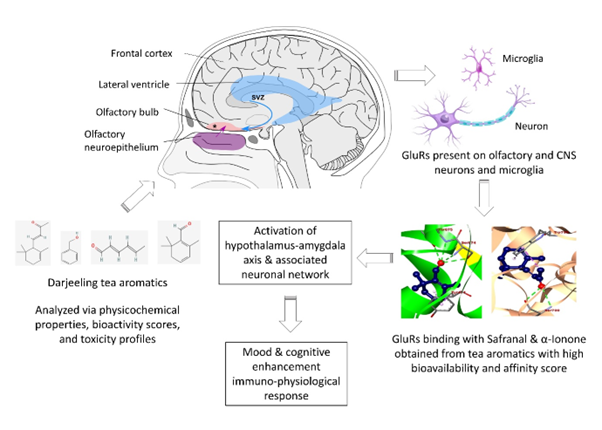
Darjeeling tea (Camellia sinensis var. sinensis) is recognized for its unique aroma and taste, associated with mood and cognitive enhancement. However, the underlying neurochemical mechanisms remain unclear. The present study investigates the potential interaction of Darjeeling tea’s volatile aroma compounds with glutamate receptors (GluRs), the predominant excitatory receptors in the central nervous system (CNS). We hypothesized that these compounds target GluRs to elicit their effects. An in silico approach was employed to analyze the physicochemical properties, bioactivity scores, and toxicity profiles of the aroma compounds. Subsequently, molecular docking simulations were performed using the retrieved 3D structures of relevant GluRs to predict the binding affinity of selected compounds exhibiting high bioactivity, drug-likeness, and bioavailability, and identify key amino acid residues within the receptor binding pockets. Our findings revealed α-ionone and safranal as prominent ligands exhibiting strong binding interactions. Among metabotropic GluRs, mGluR1 (IEWK), GluR5 (3FUZ), and GluR6 (3G3F) showed the highest affinity. Ionotropic receptor subtypes α-amino-3-hydroxy-5-methyl-4-isoxazolepropionic acid receptor (2WJW) and N-methyl-D-aspartate receptor (7EOR) also displayed significant binding scores, where greater structural dynamics were found in metabotropic GluRs on ligand binding compared to ionotropic subtypes. Given that inhalation via the nasal passage is a primary exposure route and the presence of GluR-expressing cells along this pathway, the high bioavailability of α-ionone and safranal suggests their potential to interact with neuroglial cells and subsequently influence CNS neurons and microglia/macrophages. In conclusion, the identified binding of Darjeeling tea’s aromatic ligands and GluRs offers a promising framework for elucidating the mechanisms underlying the tea’s effects on mood, psychological states, and immune-physiological responses.
- Skotnicka M, Chorostowska-Wynimko J, Jankun J, Skrzypczak-Jankun E. The black tea bioactivity: An overview. Cent Eur J Immunol. 2011;36(4):284-292.
- Fatima M, Rizvi SI. Health beneficial effects of black tea. Biomedicine. 2011;31:3-8.
- Li S, Lo CY, Pan MH, Lai CS, Ho CT. Black tea: Chemical analysis and stability. Food Funct. 2013;4(1):10-18. doi: 10.1039/c2fo30093a
- Pan MH, Lai CS, Wang H, et al. Black tea in chemo-prevention of cancer and other human diseases. Food Sci Hum Wellness. 2013;2(1):12-21. doi: 10.1016/j.fshw.2013.03.004
- Cao J, Han J, Xiao H, Qiao J, Han M. Effect of tea polyphenol compounds on anticancer drugs in terms of anti-tumor activity, toxicology and pharmacokinetics. Nutrients. 2016;8(12):762. doi: 10.3390/nu8120762
- Gao Y, Rankin GO, Tu Y, Chen C. Inhibitory effects of the four main theaflavin derivatives found in black tea on ovarian cancer cells. Anticancer Res. 2016;36(2):643-651.
- Yang K, Gao ZY, Li TQ, et al. Anti-tumor activity and the mechanism of a green tea (Camellia sinensis) polysaccharide on prostate cancer. Int J Biol Macromol. 2019;122:95-103. doi: 10.1016/j.ijbiomac.2018.10.101
- Wang Q, Yang X, Zhu C, Liu G, Sun Y, Qian L. Advances in the utilization of tea polysaccharides: Preparation, physicochemical properties and health benefits. Polymers (Basel). 2022;14(14):2775. doi: 10.3390/polym14142775
- Yoto A, Fukui N, Kaneda C, et al. Black tea aroma inhibited increase of salivary chromogranin-A after arithmetic tasks. J Physiol Anthropol. 2018;37(1):3. doi: 10.1186/s40101-018-0163-0
- Formica ML, Real DA, Picchio ML, Catlin E, Donnelly RF, Paredes AJ. On a highway to the brain: A review on nose-to-brain drug delivery using nanoparticles. Appl Mater Today. 2022;29:101631. doi: 10.1016/j.apmt.2022.101631
- Willard SS, Koochekpour S. Glutamate, glutamate receptors, and downstream signaling pathways. Int J Biol Sci. 2013;9(9):948-959. doi: 10.7150/ijbs.6426
- Pal MM. Glutamate: The master neurotransmitter and its implications in chronic stress and mood disorders. Front Hum Neurosci. 2021;15:722323. doi: 10.3389/fnhum.2021.722323
- Seo Y, Kim HS, Kang KS. Microglial involvement in the development of olfactory dysfunction. J Vet Sci. 2018;19(3):319-330. doi: 10.4142/jvs.2018.19.3.319
- Ho CT, Zheng X, Li S. Tea aroma formation. Food Sci Hum Wellness. 2015;4(1):9-27. doi: 10.1016/j.fshw.2015.04.001
- Parveen A, Qin CY, Zhou F, et al. The chemistry, sensory properties and health benefits of aroma compounds of black tea produced by Camellia sinensis and Camellia assamica. Horticulturae. 2023;9(12):1253. doi: 10.3390/horticulturae9121253
- Rezaei-Seresht H, Cheshomi H, Falanji F, Movahedi- Motlagh F, Hashemian M, Mireskandari E. Cytotoxic activity of caffeic acid and gallic acid against MCF-7 human breast cancer cells: An in silico and in vitro study. Avicenna J Phytomed. 2019;9(6):574-586.
- Daina A, Michielin O, Zoete V. SwissADME: A free web tool to evaluate pharmacokinetics, drug-likeness and medicinal chemistry friendliness of small molecules. Sci Rep. 2017;7:42717. doi: 10.1038/srep42717
- Sharma C, Nigam A, Singh R. Computational-approach understanding the structure-function prophecy of fibrinolytic protease RFEA1 from Bacillus cereus RSA1. PeerJ. 2021;9:e11570. doi: 10.7717/peerj.11570
- Trott O, Olson AJ. AutoDock Vina: Improving the speed and accuracy of docking with a new scoring function, efficient optimization and multithreading. J Comput Chem. 2010;31(2):455-461. doi: 10.1002/jcc.21334
- Tian W, Chen C, Lei X, Zhao J, Liang J. CASTp 3.0: Computed atlas of surface topography of proteins. Nucleic Acids Res. 2018;46(W1):W363-W367. doi: 10.1093/nar/gky473
- López-Blanco JR, Aliaga JI, Quintana-Ortí ES, Chacón P. iMODS: Internal coordinates normal mode analysis server. Nucleic Acids Res. 2014;42(W1):W271-W276. doi: 10.1093/nar/gku484
- Lipinski CA, Lombardo F, Dominy BW, Feeney PJ. Experimental and computational approaches to estimate solubility and permeability in drug discovery and development settings. Adv Drug Deliv Rev. 1997;23(1-3):3-25. doi: 10.1016/S0169-409X(96)00423-1
- Xu C, Cheng F, Chen L, et al. In silico prediction of chemical Ames mutagenicity. J Chem Inf Model. 2012;52(11):2840-2847. doi: 10.1021/ci300400a
- Nobre AC, Rao A, Owen GN. L-theanine, a natural constituent in tea, and its effect on mental state. Asia Pac J Clin Nutr. 2008;17 Suppl 1:167-168.
- Gibson EL, Rycroft JA. Psychological and physiological consequences of drinking tea. In: Preedy VR, editor. Handbook of Behavior, Food and Nutrition. Berlin: Springer; 2011. p. 621-636.
- Inoue-Choi M, Ramirez Y, Cornelis MC, et al. Tea consumption and all-cause and cause-specific mortality in the UK Biobank: A prospective cohort study. Ann Intern Med. 2022;175(9):1201-1211. doi: 10.7326/M22-0041
- Gohain B, Borchetia S, Bhorali P, et al. Understanding Darjeeling tea flavour on a molecular basis. Plant Mol Biol. 2012;78(6):577-597. doi: 10.1007/s11103-012-9884-7
- Huang SY. Comprehensive assessment of flexible-ligand docking algorithms: Current effectiveness and challenges. Brief Bioinform. 2018;19(5):982-994. doi: 10.1093/bib/bbw129
- Royo M, Aznar Escolano B, Madrigal MP, Jurado S. AMPA receptor function in hypothalamic synapses. Front Synaptic Neurosci. 2022;14:833449. doi: 10.3389/fnsyn.2022.833449
- Rijo-Ferreira F, Takahashi JS. Genomics of circadian rhythms in health and disease. Genome Med. 2019;11(1):82. doi: 10.1186/s13073-019-0704-0
- Florent V, Baroncini M, Jissendi-Tchofo P, et al. Hypothalamic structural and functional imbalances in anorexia nervosa. Neuroendocrinology. 2020;110(6):552-562. doi: 10.1159/000503948
- Herbert RP, Harris J, Chong KP, Chapman J, West AK, Chuah MI. Cytokines and olfactory bulb microglia in response to bacterial challenge in the compromised primary olfactory pathway. J Neuroinflammation. 2012;9:109. doi: 10.1186/1742-2094-9-109
- Czapski GA, Strosznajder JB. Glutamate and GABA in microglia-neuron cross-talk in Alzheimer’s disease. Int J Mol Sci. 2021;22(21):11677. doi: 10.3390/ijms222111677
- Domercq M, Vázquez-Villoldo N, Matute C. Neurotransmitter signaling in the pathophysiology of microglia. Front Cell Neurosci. 2013;7:49. doi: 10.3389/fncel.2013.00049
- Parellada E, Gassó P. Glutamate and microglia activation as a driver of dendritic apoptosis: A core pathophysiological mechanism to understand schizophrenia. Transl Psychiatry. 2021;11(1):271. doi: 10.1038/s41398-021-01385-9
- Kim J, Choi Y, Ahn M, et al. Microglial and astroglial reaction in the olfactory bulb of mice after Triton X-100 application. Acta Histochem. 2019;121(5):546-552. doi: 10.1016/j.acthis.2019.04.010
- Moseman EA, Blanchard AC, Nayak D, McGavern DB. T cell engagement of cross-presenting microglia protects the brain from a nasal virus infection. Sci Immunol. 2020;5(48):eabb1817. doi: 10.1126/sciimmunol.abb1817