
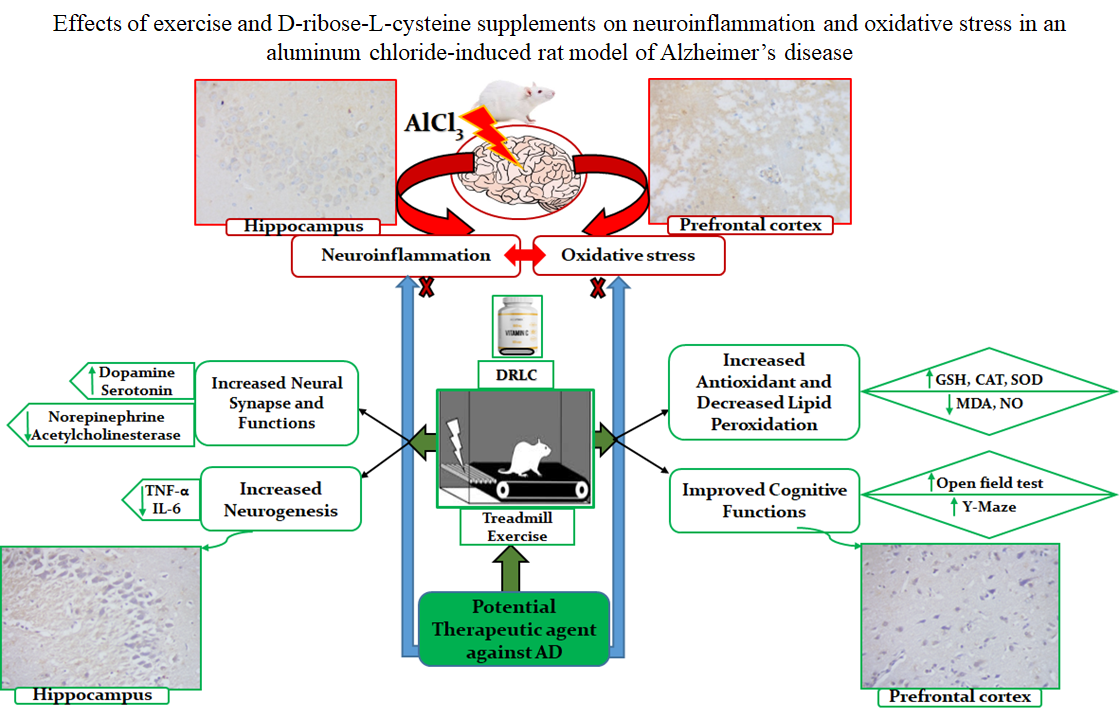
Effects of exercise and D-ribose-L-cysteine supplements on neuroinflammation and oxidative stress in an aluminum chloride-induced rat model of Alzheimer’s disease

Alzheimer’s disease (AD) pathology involves several pathways, with oxidative stress and inflammation among the major drivers. This study employs an animal model to evaluate the effects of treadmill exercise and D-ribose-L-cysteine (DRLC) on aluminum chloride (AlCl3)-induced AD. Seventy adult male Wistar rats (150–200 g) were randomized into seven groups (𝑛=10), including a control and six experimental groups: (i) AlCl3-only; (ii) AlCl3 + DRLC; (iii) AlCl3 + exercise; (iv) AlCl3 + DRLC + exercise; (v) DRLC-only; and (vi) exercise-only. A modified rodent treadmill apparatus was used for the exercise regimen, and AlCl3 and DRLC (100 mg/kg each) were prepared freshly for every administration. Y-maze and open field tests were used to evaluate the neurotoxic effects of AlCl3 on working and spatial memory. Oxidative stress markers, neurotransmitter levels, neuroinflammatory markers, and immunohistochemical analysis were also conducted to assess the impact of AlCl3 and the treatments on the hippocampus and prefrontal cortex. Results indicate that AlCl3 administration led to a decrease in neurobehavioral performance, monoamine neurotransmitter levels, and antioxidant parameters, with a corresponding increase in oxidative stress and neuroinflammatory markers. The deleterious effects of AlCl3 were also evident in the hippocampus and prefrontal cortex of the rats, contributing to AD-like pathology, as indicated by neurodegeneration. However, combined DRLC supplementation and treadmill exercise attenuated AlCl3-induced behavioral, biochemical, and histopathological alterations, restoring several outcomes toward control levels. In conclusion, the combined approach of exercise and DRLC proved to possess multiple therapeutic benefits in relieving AD symptoms due to their neuroprotective properties.
- Breijyeh Z, Karaman R. Comprehensive review on Alzheimer’s disease: Causes and treatment. Molecules. 2020;25:5789. doi: 10.3390/molecules25245789
- Cass SP. Alzheimer’s disease and exercise: A literature review. Curr Sports Med Rep. 2017;16:19-22. doi: 10.1249/JSR.0000000000000332
- Barnes JN. Exercise, cognitive function, and aging. Adv Physiol Educ. 2015;39:55-62. doi: 10.1152/advan.00101.2014
- Alzheimer’s Association. 2015 Alzheimer’s disease facts and figures. Alzheimers Dement. 2015;11:332-384. doi: 10.1016/j.jalz.2015.02.003
- Alzheimer’s Association. 2021 Alzheimer’s disease facts and figures. Alzheimers Dement. 2021;17:327-406. doi: 10.1002/alz.12328
- Vermunt L, Sikkes SA, Van Den Hout A, et al. Duration of preclinical, prodromal, and dementia stages of Alzheimer’s disease in relation to age, sex, and APOE genotype. Alzheimers Dement. 2019;15:888-898. doi: 10.1016/j.jalz.2019.04.001
- Selkoe DJ, Hardy J. The amyloid hypothesis of Alzheimer’s disease at 25 years. EMBO Mol Med. 2016;8:595-608. doi: 10.15252/emmm.201606210
- Haass C, Selkoe DJ. Soluble protein oligomers in neurodegeneration: Lessons from the Alzheimer’s amyloid beta-peptide. Nat Rev Mol Cell Biol. 2007;8:101-112. doi: 10.1038/nrm2101
- Abubakar MB, Sanusi KO, Ugusman A, et al. Alzheimer’s disease: An update and insights into pathophysiology. Front Aging Neurosci. 2022;14:742408. doi: 10.3389/fnagi.2022.742408
- Hussien HM, Abd-Elmegied A, Ghareeb DA, Hafez HS, Ahmed HE, El-moneam NA. Neuroprotective effect of berberine against environmental heavy metals-induced neurotoxicity and Alzheimer’s-like disease in rats. Food Chem Toxicol. 2018;111:432-444. doi: 10.1016/j.fct.2017.11.025
- Ogunlade B, Adelakun SA, Fidelis OP. Sulforaphane attenuates neuroinflammation, oxidative stress and cognitive impairment on aluminium-induced Alzeimer’s disease in wistar rats. J Neurosci Neuropharmaco. 2020;6(2):13-22.
- Exley C, Vickers T. Elevated brain aluminium and early onset alzheimer’s disease in an individual occupationally exposed to aluminium: A case report. J Med Case Rep. 2014;8(1):41. doi: 10.1186/1752-1947-8-41
- Chen SX, Zhang M, Ahmed M, Surapaneni KM, Veeraraghavan VP, Arulselvan P. Neuroprotective effects of ononin against the aluminium chloride-induced Alzheimer’s disease in rats. Saudi J Biol Sci. 2021;28(8):4232-4239. doi: 10.1016/j.sjbs.2021.06.031
- Cao Z, Wang F, Xiu C, Zhang J, Li Y. Hypericum perforatum extract attenuates behavioral, biochemical, and neurochemical abnormalities in Aluminium chloride-induced Alzheimer’s disease rats. Biomed Pharmacother. 2017;91:931-937. doi: 10.1016/j.biopha.2017.05.022
- Mirza A, King A, Troakes C, Exley C. Aluminium in brain tissue in familial Alzheimer’s disease. J Trace Elem Med Biol. 2017;40:30-36. doi: 10.1016/j.jtemb.2016.12.001
- Hamdan AM, Alharthi FH, Alanazi AH, et al. Neuroprotective effects of phytochemicals against aluminium chloride-induced Alzheimer’s disease through ApoE4/LRP1, Wnt3/β-catenin/GSK3β, and TLR4/NLRP3 pathways with physical and mental activities in a rat model. Pharmaceuticals. 2022;15(8):1008. doi: 10.3390/ph15081008
- Aalikhani M, Safdari Y, Jahanshahi M, Alikhani M, Khalili M. Comparison between hesperidin, coumarin, and deferoxamine iron chelation and antioxidant activity against excessive iron in the iron overloaded mice. Front. Neurosci. 2022;15:811080. doi: 10.3389/fnins.2021.811080
- Mahalakshmi B, Maurya N, Lee S, Bharath Kumar V. Possible neuroprotective mechanisms of physical exercise in neurodegeneration. Int J Mol Sci. 2020;21(16):5895. doi: 10.3390/ijms21165895
- Majid A. Neuroprotection in stroke: Past, present, and future. ISRN Neurol. 2014;2:515716. doi: 10.1155/2014/515716
- Kumar A, Singh A, Ekavali. A review on Alzheimer’s disease pathophysiology and its management: An update. Pharmacol Rep. 2015;67(2):195-203. doi: 10.1016/j.pharep.2014.09.004
- Jin Y, Sumsuzzman D, Choi J, Kang H, Lee S, Hong Y. Molecular and functional interaction of the myokine irisin with physical exercise and Alzheimer’s disease. Molecules. 2018;23(12):3229. doi: 10.3390/molecules23123229
- Pahlavani HA. Exercise therapy to prevent and treat Alzheimer’s disease. Front Aging Neurosci. 2023;15(124):38-69. doi: 10.3389/fnagi.2023.1243869
- Barnes DE, Yaffe K. The projected effect of risk factor reduction on Alzheimer’s disease prevalence. Lancet Neurol. 2011;10(9):819-828. doi: 10.1016/S1474-4422(11)70072-2
- Sutoo D, Akiyama K. Regulation of brain function by exercise. Neurobiol Dis. 2013;13(1):1-14. doi: 10.1016/S0969-9961(03)00030-5
- Schinder AF, Poo M. The neurotrophin hypothesis for synaptic plasticity. Trends Neurosci. 2020;23(12):639-645. doi: 10.1016/S0166-2236(00)01672-6
- Hosseini M, Alaei HA, Naderi A, Sharifib MR, Zahed R. Treadmill exercise reduces self-administration of morphine in male rats. Pathophysiology. 2019;16(1):3-7. doi: 10.1016/j.pathophys.2008.11.001
- Lu B, Chow A. Neurotrophins and hippocampal synaptic transmission and plasticity. J Neurosci Res. 2019;58(1):76-87.
- Lin TW, Tsai SF, Kuo YM. Physical exercise enhances neuroplasticity and delays Alzheimer’s disease. Brain Plast. 2018;4:95-110. doi: 10.3233/BPL-180073
- Ryan SM, Kelly ÁM. Exercise as a pro-cognitive, pro-neurogenic and anti-inflammatory intervention in transgenic mouse models of Alzheimer’s disease. Ageing Res Rev. 2016;27:77-92. doi: 10.1016/j.arr.2016.03.007
- Lu Y, Dong Y, Tucker D, et al. Treadmill exercise exerts neuroprotection and regulates microglial polarization and oxidative stress in a streptozotocin-induced rat model of sporadic Alzheimer’s Disease. J Alzheimer Dis. 2017;56(4):1469-1484. doi: 10.3233/JAD-160869
- Tang Y, Zhang Y, Zheng M, Chen J, Chen H, Liu N. Effects of treadmill exercise on cerebral angiogenesis and MT1-MMP expression after cerebral ischemia in rats. Brain Behav. 2018;8:e01079. doi: 10.1002/brb3.1079
- Kamat PK, Kalani A, Rai S, et al. Mechanism of oxidative stress and synapse dysfunction in the pathogenesis of Alzheimer’s disease: Understanding the therapeutics strategies. Mol Neurobiol. 2016;53(1):648-661. doi: 10.1007/s12035-014-9053-6
- Moreira PI, Santos MS, Oliveira CR, et al. Alzheimer disease and the role of free radicals in the pathogenesis of the disease. CNS Neurol Disord Drug Targets. 2008;7:3-10. doi: 10.2174/187152708783885156
- Wojsiat J, Zoltowska KM, Laskowska-Kaszub K, Wojda U. Oxidant/antioxidant imbalance in Alzheimer’s disease: Therapeutic and diagnostic prospects. Oxid Med Cell Longev. 2018;2018(1):1-16. doi: 10.1155/2018/6435861
- Mandal PK, Saharan S, Tripathi M, Murari G. Brain glutathione levels--a novel biomarker for mild cognitive impairment and Alzheimer’s disease. Biol Psychiatry. 2015;78(10):702-710. doi: 10.1016/j.biopsych.2015.04.005
- Czerniawski J, Miyashita T, Lewandowski G, Guzowski JF. Systemic lipopolysaccharide administration impairs retrieval of context-object discrimination, but not spatial, memory: Evidence for selective disruption of specific hippocampus dependent memory functions during acute neuroinflammation. Brain Behav Immun. 2015;44:159-166. doi: 10.1016/j.bbi.2014.09.014
- Adair JC, Knoefel JE, Morgan N. Controlled trial of nacetylcysteine for patients with probable Alzheimer’s disease. Neurology. 2001;57(8):1515-1517. doi: 10.1212/WNL.57.8.1515
- Ogunlade B, Fidelis OP, Afolayan OO, Agie JA. Neurotherapeutic and antioxidant response of D-ribose- L-Cysteine nutritional dietary supplements on Alzheimer-type hippocampal neurodegeneration induced by cuprizone in adult male wistar rat model. Food Chem Toxicol. 2021;147:111862. doi: 10.1016/j.fct.2020.111862
- Falana B, Adeleke O, Orenolu M, Osinubi A, Oyewopo A. Effect of D-ribose-L-cysteine on aluminium induced testicular damage in male sprague-dawley rats. JBRA Assist Reprod. 2017;21(2):94. doi: 10.5935/1518-0557.20170023
- Adelakun SA, Ogunlade B, Fidelis OP, Ajao AA. Nutritional supplementation of D-Ribose-L-Cysteine suppresses oxidative stress, spermatogenesis and steroidogenesis recovery in rats exposed to mercury chloride: Histomorphometry and biochemical evidence. Endocr Metab Sci. 2021;4:100105. doi: 10.1016/j.endmts.2021.100105
- Ojetola AA, Adedeji TG, Fasanmade AA. Changes in antioxidants status, atherogenic index and cardiovascular variables after prolonged doses of D-ribose-L-cysteine in male Wistar rats. Heliyon. 2021;7(2):e06287. doi: 10.1016/j.heliyon.2021.e06287
- Adedotun OA, Chukwunenye CC, Balogun AF, Olawale MA, Babatunde JO, Ogunlade B. Histomorphological response of D-ribose-L-cysteine to ketamine-induced testicular toxicity in adult male Wistar rats. Redox Experiment Medicine. 2023;1:20-23.
- Ogunsuyi OB, Aro PO, Umar HI, Oboh G. Administration of curcumin plus treadmill exercise modulate some neuronal enzyme activities, redox markers and BDNF mRNA expression in pilocarpine-induced epileptic seizure in rats. Neurochem J. 2023;17(3):467-476. doi: 10.1134/S1819712423030145
- Alomari MA, Khabour OF, Alzoubi KH, Alzubi MA. Forced and voluntary exercises equally improve spatial learning and memory and hippocampal BDNF levels. Behav Brain Res. 2013;247:34-39. doi: 10.1016/j.bbr.2013.03.007
- Bayod S, Del Valle J, Lalanza JF, et al. Long-term treadmill exercise induces neuroprotective molecular changes in rat brain. J Appl Physiol. 2011;111(5):1380-1390. doi: 10.1152/japplphysiol.00425.2011
- National Research Council. Guide to the Care and Use of Laboratory Animals. 8th ed. Washington, DC: The National Academies Press; 2011. p. 246.
- Bali A, Jaggi AS. Electric foot shock stress: A useful tool in neuropsychiatric studies. Rev Neurosci. 2015;26(6):655-677. doi: 10.1515/revneuro-2015-0015
- Bedford TG, Tipton CM, Wilson NC, Oppliger RA, Gisolfi CV. Maximum oxygen consumption of rats and its changes with various experimental procedures. Appl Physiol Respir Environ Exerc Physiol. 1979;47(6):1278-1283. doi: 10.1152/jappl.1979.47.6.1278
- Gould TD, Dao DT, Kovacsics CE. The open field test. In: Mood and Anxiety Related Phenotypes in Mice. Vol. 42. Totowa, NJ: Humana Press; 2009. p. 1-20. doi: 10.1007/978-1-60761-303-9_1
- Kraeuter AK, Guest PC, Sarnyai Z. The Y-maze for assessment of spatial working and reference memory in mice. Methods Mol Biol. 2019;1916:105-111. doi: 10.1007/978-1-4939-8994-2_10
- Sun M, Zigman S. An improved spectrophotometric assay for superoxide dismutase based on epinephrine autoxidation. Anal Biochem. 1978;90(1):81-89. doi: 10.1016/0003-2697(78)90010-6
- Clairborne A. Catalase activity. In: Greewald AR, editor. Handbook of Methods for Oxygen Radical Research. United States: CRC Press; 1995. p. 237-242.
- Jollow DJ, Mitchell JR, Zampaglione N, Gillette JR. Bromobenzene-induced liver necrosis. Protective role of glutathione and evidence for 3,4-bromobenzene oxide as the hepatotoxic metabolite. Pharmacology. 1974;11(3):151-169. doi: 10.1159/000136485
- Farombi E, Tahnteng J, Agboola A, Nwankwo J, Emerole G. Chemoprevention of 2-acetylaminofluorene-induced hepatotoxicity and lipid peroxidation in rats by kolaviron--a Garcinia kola seed extract. Food Chem Toxicol. 2000;38(6):535-541. doi: 10.1016/S0278-6915(00)00039-9
- Moshage H, Kok B, Huizenga JR, Jansen PL. Nitrite and nitrate determinations in plasma: A critical evaluation. Clin Chem. 1995;41(6):892-896. doi: 10.1093/clinchem/41.6.892
- Pearse AG. The role of histochemistry in increasing objectivity in histopathology. Postgrad Med J. 1975;51(600):708-710. doi: 10.1136/pgmj.51.600.708
- Fischer AH, Jacobson KA, Rose J, Zeller R. Hematoxylin and eosin staining of tissue and cell sections. CSH Protoc. 2008;2008(5):pdb.prot4986. doi: 10.1101/pdb.prot4986
- Shi SR, Key ME, Kalra KL. Antigen retrieval in formalin-fixed, paraffin-embedded tissues: An enhancement method for immunohistochemical staining based on microwave oven heating of tissue sections. J Histochem Cytochem. 1991;39(6):741-748. doi: 10.1177/39.6.1709656
- Burry RW. Immunocytochemistry: A Practical Guide for Biomedical Research. Berlin: Springer Science and Business Media; 2011.
- Hsu SM, Raine L, Fanger H. Use of avidin-biotin-peroxidase complex (ABC) in immunoperoxidase techniques: A comparison between ABC and unlabeled antibody (PAP) procedures. J Histochem Cytochem. 1981;29(4):577-580. doi: 10.1177/29.4.6166661
- Erukainure OL, Ijomone OM, Sanni O, Aschner M, Islam MS. Type 2 diabetes induced oxidative brain injury involves altered cerebellar neuronal integrity and elemental distribution, and exacerbated Nrf2 expression: Therapeutic potential of raffia palm (Raphia hookeri) wine. Metab Brain Dis. 2019;34:1385-1399. doi: 10.1007/s11011-019-00444-x
- Pagel P, Blome J, Wolf HW. High-performance liquid chromatographic separation and measurement of various biogenic compounds possibly involved in the pathomechanism of Parkinson’s disease. J Chromatogr. 2000;746(2):297-304. doi: 10.1016/S0378-4347(00)00348-0.
- Ellman GL. Tissue sulfhydryl groups. Arch Biochem Biophys. 1959;82(1):70-77. doi: 10.1016/0003-9861(59)90090-6
- Jain A, Jain R, Jain S. Quantitative determination of TNF alpha and interleukin-6. In: Springer Protocols Handbooks. United States: Springer; 2020. p. 87-89. doi: 10.1007/978-1-4939-9861-6_27
- Borsini F, Meli A. Is the forced swimming test a suitable model for revealing antidepressant activity? Psychopharmacology. 1998;94(2):147-160. doi: 10.1007/BF00176837
- Vlasak T, Dujlovic T, Barth A. Aluminum exposure and cognitive performance: A meta-analysis. Sci Total Environ. 2024;906:167453. doi: 10.1016/j.scitotenv.2023.167453
- Kandola A, Hendrikse J, Lucassen PJ, Yücel M. Aerobic exercise as a tool to improve hippocampal plasticity and function in humans: Practical implications for mental health treatment. Front Hum Neurosci. 2016;10:373. doi: 10.3389/fnhum.2016.00373
- De Sousa Fernandes MS, Ordônio TF, Santos GCJ, et al. Effects of physical exercise on neuroplasticity and brain function: A systematic review in human and animal studies. Neural Plast. 2020;2020:8856621. doi: 10.1155/2020/8856621
- Lovell MA, Ehmann WD, Butler SM, Markesbery WR. Elevated thiobarbituric acid-reactive substances and antioxidant enzyme activity in the brain in Alzheimer’s disease. Neurology. 1995;45(8):1594-1601. doi: 10.1212/WNL.45.8.1594
- Tiwari SC, Soni RM. Alzheimer’s disease pathology and oxidative stress: Possible therapeutic options. J Alzheimers Dis Park. 2014;04(05):162. doi: 10.4172/2161-0460.1000162
- Slitt AM, Dominick PK, Roberts JC, Cohen SD. Effect of ribose cysteine pretreatment on hepatic and renal acetaminophen metabolite formation and glutathione depletion. Basic Clin Pharmacol Toxicol. 2015;96(6):487-494. doi: 10.1111/j.1742-7843.2005.pto_96613.x
- Mattson MP. Energy intake and exercise as determinants of brain health and vulnerability to injury and disease. Cell Metab. 2022;16(6):706-722. doi: 10.1016/j.cmet.2012.08.012
- Zatta P, Ibn-Lkhayat-Idrissi M, Zambenedetti P, Kilyen M, Kiss T. In vivo and in vitro effects of aluminium on the activity of mouse brain acetylcholinesterase. Brain Res Bull. 2012;59(1):41-45. doi: 10.1016/S0361-9230(02)00836-5
- Amberla K, Nordberg A, Viitanen M, Winblad B. Longterm treatment with tacrine (THA) in Alzheimer’s disease-- evaluation of neuropsychological data. Acta Neurol Scand Appl. 2013;88(S149):55-57. doi: 10.1111/j.1600-0404.1993.tb04257.x
- Meeusen R, De Meirleir K. Exercise and brain neurotransmission. Sports Med. 2005;20(3):160-188. doi: 10.2165/00007256-199520030-00004
- Cheng XJ, Gu JX, Pang YP, et al. Tacrine-hydrogen sulfide donor hybrid ameliorates cognitive impairment in the aluminium chloride mouse model of Alzheimer’s disease. ACS Chem Neurosci. 2019;10(8):3500-3509. doi: 10.1021/acschemneuro.9b00120
- Ghosh S, Lertwattanarak R, Garduño JD, et al. Elevated muscle TLR4 expression and metabolic endotoxemia in human aging. J Gerontol A Biol Sci Med Sci. 2015;70(2):232-246. doi: 10.1093/gerona/glu067
- Uyar B, Palmer D, Kowald A, Murua-Escobar H, Barrantes I, Möller S. Single-cell analyses of aging, inflammation and senescence. Ageing Res Rev. 2020;64:101156. doi: 10.1016/j.arr.2020.101156
- Zagrodzki P, Joniec A, Gawlik M, et al. High fructose model of oxidative stress and metabolic disturbances in rats. Part I. Antioxidant status of rats’ tissues. Bull Vet Inst Pulawy. 2019;51(3):407-412.
- Valenzuela PL, Maffiuletti NA, Joyner MJ, Lucia A, Lepers R. Lifelong endurance exercise as a countermeasure against age-related VO2max decline: Physiological overview and insights from masters athletes. Sports Med. 2020;50(4):703-716. doi: 10.1007/s40279-019-01252-0
- Cao Z, Yang X, Zhang H, et al. Aluminum chloride induces neuroinflammation, loss of neuronal dendritic spine and cognition impairment in developing rats. Chemosphere. 2016;151:289-295. doi: 10.1016/j.chemosphere.2016.02.092
- Zhang X, He Q, Huang T, et al. Treadmill exercise decreases deposition and counteracts cognitive decline in APP/PS1 mice, Possibly via hippocampal microglia modifications. Front Aging Neurosci. 2019;11:78. doi: 10.3389/fnagi.2019.00078
- Hosseini M, Alaei H, Reisi P, Radahmadi M. The effect of treadmill running on memory before and after the NBM-lesion in rats. J Bodyw Mov Ther. 2013;17(4):423-429. doi: 10.1016/j.jbmt.2012.12.005